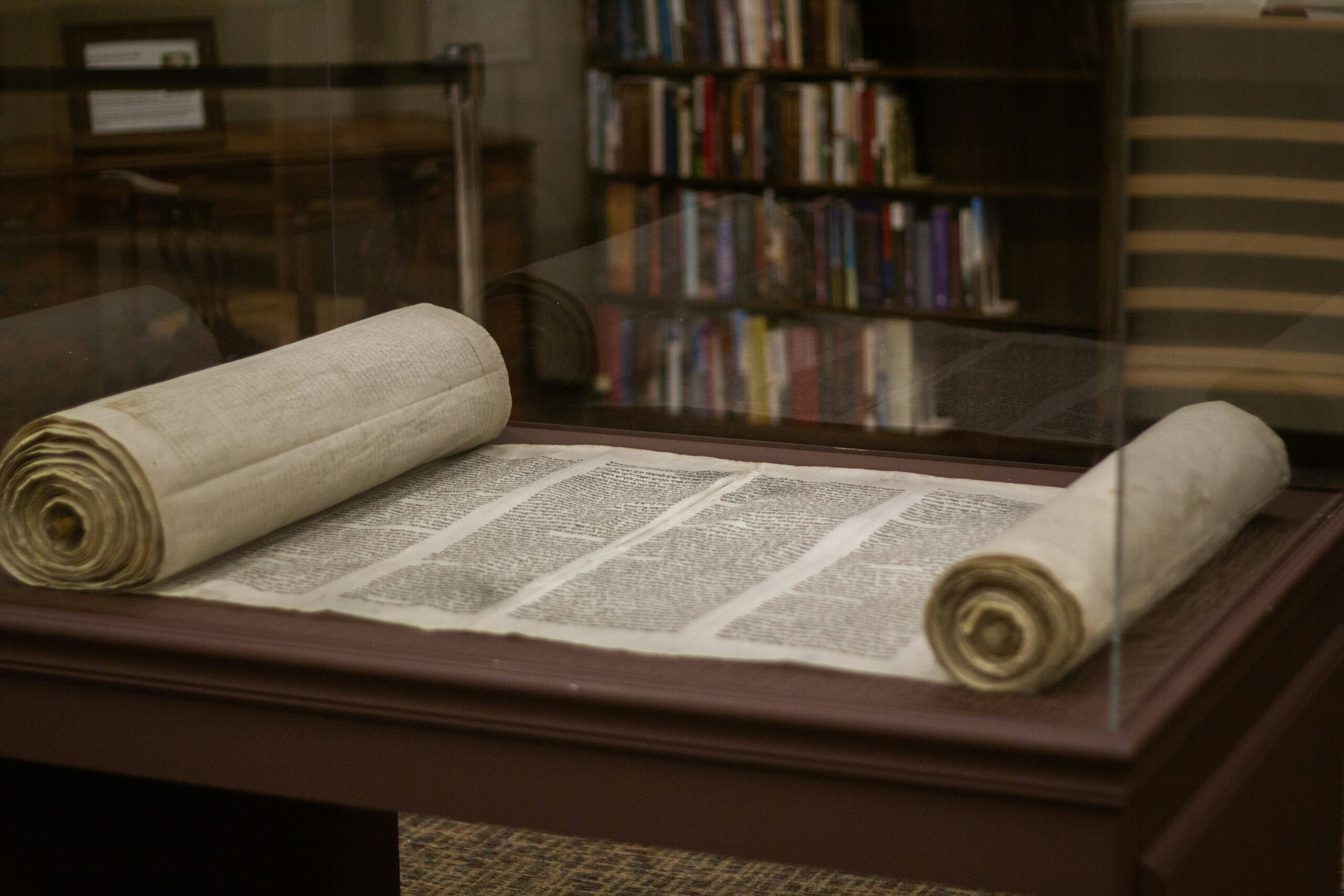
Old Testament Survey
Part 1, Original Languages
The History of the
written
Word of God
Ronald J. Frasco
I. Introduction
II. Original Languages
A. Old Testament
1. Hebrew
a. Internal witness
Old Testament witnesses to preservation of Sacred writings; written between the 15th and 5th century B.C.
Exodus 24:3-4 – the words of the Law
Moses wrote down all the words of the Lord.
Exodus 24:12 – the promise of the stone tablets
I will give you the stone tablets with the law and the commandment which I have written for their instruction.
Exodus 31:18 – the giving of the tablets of stone
When He had finished speaking with him upon Mount Sinai, He gave Moses the two tablets of the testimony, tablets of stone, written by the finger of God.
Exodus 32:15-16 – the presentation and destruction of the tablets
:15 Then Moses turned and went down from the mountain with the two tablets of the testimony in his hand, tablets which were written on both sides; they were written on one side and the other.
:16 The tablets were God’s work, and the writing was God’s writing engraved on the tablets.
Exodus 34:1–4 – The replacement of the tablets
Exodus 34:28–29 – The Ten Commandments
And he wrote on the tablets the words of the covenant, the Ten Commandments.
Deuteronomy 31:24-26 – Completion of the Law
:24 It came about, when Moses finished writing the words of this law in a book until they were complete,
:25 that Moses commanded the Levites who carried the ark of the covenant of the Lord, saying,
:26 “Take this book of the law and place it beside the ark of the covenant of the Lord your God, that it may remain there as a witness against you.
Nehemiah 8:1-8 – Ezra’s preaching of the Word
2 Kings 22:8-13 – King Josiah’s and the Lost Bible
“I have found the book of the law in the house of the Lord.” (:8)
I. Introduction
II. Original Languages
A. Old Testament
1. Hebrew
a. Internal witness
b. External witness
i. Sopherim “Scribes”
c. B.C. 500 oldest manuscripts of the Old Testament, the Caretakers of the Scriptures.
One set of scholars offers up a curious description of the scribes’ level of commitment …
“With respect to the Jewish Scriptures, however, it was not scribal accuracy alone that guaranteed their product. Rather, it was their almost superstitious reverence for the Bible. . . . there were specifications not only for the kind of skins to be used and the size of the columns, but there was even a religious ritual necessary for the scribe to perform before writing the name of God. Rules governed the kind of ink used, dictated the spacing of words, and prohibited writing anything from memory. . . . If a manuscript was found to contain even one mistake, it was discarded and destroyed.” Geisler & Nix, p.380
Many codex and manuscripts of numerous versions — 500 B.C. to A.D. 500 .
ii. Masoretes — A.D. 500-1000
Careful Jewish scribes who created and added the vowels to the Hebrew Old Testament.
Hebrew text without vowel pointings:
בראשׁית ברא אלהים את השׁמימ ןאת הארץ
Nw, dn’t knw bt y, bt wrtng lk ths wld b xtrml dffclt t rd, lt ln ndrstd. Bt wrs thn bng hrd t ndrstnd nd, smn mght vn gt th wrng mssg. W shld xprss thnks t th Lrd fr vwls … nd fr th Msrts!
Hebrew text with Masoretic vowel pointings:
בְּרֵאשִׁ֖ית בָּרָ֣א אֱלֹהִ֑ים אֵ֥ת הַשָּׁמַ֖יִם וְאֵ֥ת הָאָֽרֶץ
iii. Printed Hebrew Old Testaments
- Bologna edition — A.D. 1477 — First printed Hebrew Old Testament
- Other early printed Hebrew Old Testaments
Soncino — A.D. 1488
Naples — A.D. 1491
Brescia — A.D. 1494
- First Rabbinic Bible — A.D. 1516
- Biblia Hebraica — A.D. 1929,1937, 1967, 1977 — the Standard
I. Introduction
II. Original Languages
A. Old Testament
1. Hebrew
2. Greek
a. Septuagint — c. B.C. 250-150
The Septuagint is the Greek translation of the Hebrew Old Testament. Because the Jewish people became so scattered, and because Greek became the common language of the people, the Jews needed to have the Scriptures translated into the popular language of the people.
The word “Septuagint” means seventy. Thus, reference to the Septuagint is frequently accomplished by employing Roman numerals for 70 – LXX. Seventy refers to an ancient legend that 72 Jewish translators working independently completed their work in 72 days and found their work to be in complete agreement with one another.
It is from this Greek translation, rather than the Hebrew Old Testament, that most New Testament writers regularly quote.
b. Other Greek translations of the Hebrew Old
Testament
- Aquila’s translation, A.D. 130 – a new translation
- Theodotion’s revision, A.D. 180-190 – a revision
- Origen’s Hexapla, A.D. 240-150 – six column parallel included all
3. Latin Vulgate Translation — A.D. 406
Jerome was commissioned to translate the entire Bible into Latin at the end of the fourth century. Jerome was a fascinating individual as one historian so colorfully notes,
He is outstanding, not for his sanctity, like Anthony, nor for his firmness before the authorities, like Ambrose, nor even for his preaching, like Chrysostom, but rather for his titanic and endless struggle with the world and with himself. . . . He always strove to be more than human, and therefore had little patience for those who appeared indolent, or who dared criticize him. (Gonzales, Story of Christianity, p. 201)
He used the original Hebrew and Greek manuscripts from which to work. The entire translation process took more than twenty years! This was the first time entire Bible — Old and New Testament — was translated into another language.
This is the Bible that would hold prominence in the church for nearly one thousand years!! However, as Latin slowly died out as the common language of the people, this would ultimately produce a significant problem – the need and the ensuing desire to give the people a copy of the Bible in their own language. And that would issue in the Reformation.
- The word document: Part 1, Original Languages
- Back to HWWG