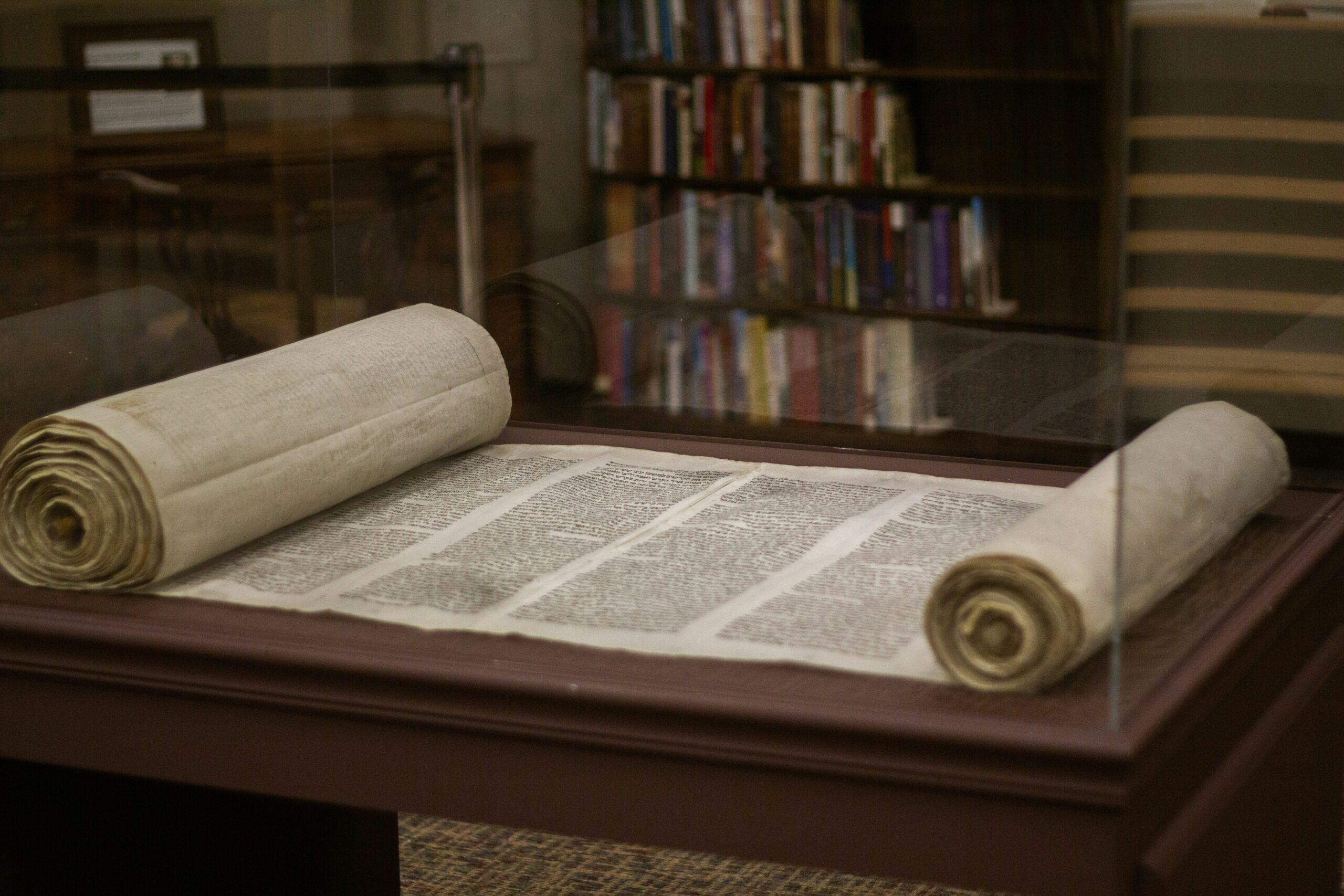
Old Testament Survey
Genesis, 1-11
OLD TESTAMENT SURVEY LESSON 1: GENESIS
Book of Origins (Gk.), in the Beginning (Heb.).
AUTHOR: Moses, see MSB for OT and NT witness.
DATE: Between 1446 and 1406 B.C. (wilderness wanderings before conquest of Canaan).[2] STRUCTURE: There are two central divisions in Genesis.
- Primeval (early) History (Gen 1–11).[3]
- Patriarchal (Based on fatherly ancestors) History (Gen 12–50).[4]
THEME: The God Who Creates.[5]
OBJECTIVE FOR STUDENTS: Be able to describe at least three teachings of Genesis that cause us as Christians to see the world differently than those who don’t believe in Genesis.
- Creation (Genesis 1–2)
- Genesis 1:1 is foundational for our worldview.6
- God’s creation takes place over seven days (note how numeral next to Hebrew word for day always signifies 24-hour period).7
- God spoke, and it took place.8
- God’s creation was created good (Gen 1:10, 12, 18, 21, 25, also note “very good” in v. 31).
- Man was create unique in God’s creation.9
- Chapter 2 is a narrowing of what took place at the end of chapter 1, not a different account.10
 Both work (Gen 2:15) and Marriage (Gen 2:24–25) are founded by God as good gifts before the fall.
6 God created space and time and is therefore independent of all things. A totally different worldview than the Hebrews’ Egyptian neighbors. This teaches there is one God Who created everything (and one God period), also known as monotheism. This establishes a Creator/Creation distinction. (ex: God is not matter – God created matter; God is not the earth – God created the earth). The text assumes and does not carry the burden to prove the existence of God (cf. Rom 1). There are many applications of this truth – from evangelism to apologetics.
7 Theological and apologetic footnote: What about day and night being created (Gen 1:5) before sun, moon, and stars (Gen 1:14–16)? This is not an inconsistency or making this out to be poetry, but a demonstration of the absolute independence and total power of God over natural laws (also consider Rev. 21:23 – God does not need the sun for light).
8 See “and there was light” (Gen 1:3), “and it was so” (Gen 1:7, 9, 11, 15, 24, 30).
9 The Triune God created man uniquely in His Own image and likeness, to multiply and rule over the earth (Gen 1:26–28). Ancient custom of rulers was to create an “image” of themselves in their lands (boulders with engravings, statues) that would represent their authority (contrast with second commandment). “Likeness” has some sort of resemblance, but it is important to not take this too far… see 5:3 for some similarities (not a 1-for-1).
This inequality in creation brings glory to God. Humanity is specially created – see repetition of the word “to create” in this section. God does not choose to speak man and woman into existence, molds him (Gen 2:7) and her (Gen 2:22) instead. Application: We bring glory to God when we exercise dominion and steward His creation. As some have said, “Earth may be your mother, but it is my Father’s footstool.” This also shows that Both men and women were created in God’s image (Gen 1:27). Two genders were established from the very beginning!
10 Note the importance of the expression “these are the generations,” also called the Toledot formula. Genesis 2:4 is KEY! The word for “account” is the same word used for “generations” found 9 other times in Genesis, and establish the structure of the book. These generations have a narrowing focus – they get more specific: Generations of the earth (Gen 2:4), Generations of Adam (Gen 5:1), Generations of Noah (6:1), Generations of Shem, Ham, and Japheth (Gen 10:1), Generations of Shem (Gen 11:10), Generations of Terah (Gen 11:27)., Generations of Ishmael (Gen 25:12), Generations of Isaac (Gen 25:19), Generations of Esau (Gen 36:1, 9), Generations of Jacob (Gen 37:2).
- The Fall (Gen 3–5):
- Satan’s temptation of Eve teaches many things.11
- Sin destroyed many things.12
- Even though humanity sinned, God was merciful.
i. God promises redemption through the seed of the woman (Gen 3:15),
which is the first instance of the Gospel in the Bible. 13
- App: Your understanding of this event changes the way you see the world.14
 Post-fall developments – humanity spirals downwards into sin.15
11 He speaks, which is weird! Something more than an animal is here. Satan is not equal to God, for this text emphasizes his creatureliness. Satan begins by causing Eve to doubt God’s Word – “Did God really say?” (Gen 3:1). Eve adds to God’s Word and presents Him as overbearing – “shall not touch it” (Gen 3:3). Satan then resorts to a full-on lie – “You surely will not die!” (Gen 3:4). Satan presents God as withholding something of value from Adam and Eve – “God knows that in the day you eat from it…” (Gen 3:5). The application of this is that Sin overpromises and underdelivers. Satan claims that Eve will become like God, having personal authority to determine what is good and evil (Gen 3:5). The fruit of the tree is appealing in Eve’s own estimation (Gen 3:6) – “saw that the tree was good for food” “it was a delight to the eyes” “desirable to make one wise.” The application we can draw from this is that we must never trust what seems best to our own reason in moment of temptation, trust God’s Word and obey.
12 Sin destroyed fellowship of humanity (Gen 3:7). Sin destroyed fellowship with God (Gen 3:8). Sin prompts Adam to shift blame from self to Eve and ultimately God (Gen 3:12). Eve does not take responsibility either (Gen 3:13). God curses the snake – slithering snakes are proof of the fall. Pain in childbirth and conflict between men and women came from the curse (Gen 3:16). Difficulty in work came from the curse (Gen 3:17–19), not work itself (Gen 2:15).
13 This nickname has come from the term protoevangelium, which is Greek for “first Gospel.” Stepping on head represented victory in battle in ancient customs. THIS IS WHERE THE SEARCH FOR THE SEED BEGINS! After this verse, the question we as readers should be asking is “Who will God use to reverse the fall – bringing back order to the creation and solving the problem of man’s sin?” Man did not die physically the day of the fall, though both Adam and Eve died spiritually. God made skins for Adam and Eve (Gen 3:21). God banished Adam and Eve from Eden, ushering in mortality, and mercifully preventing them from being in their sinful state forever (Gen 3:22– 24). Eve later, in expecting the seed, thinks her son Cain might be the promised seed (Gen 4:1), which he quickly proves wrong in his murder of Abel. Also note that Cain’s sacrifice was not worse than Abel’s because it was vegetables, but because it was not offered up in faith (Heb 11).
14 An understanding of Genesis 3 helps us understand what humanity’s greatest problem is – what the cause of evil in our lives is. Evil is not fundamentally spawned from a lack or increase of policy, circumstances, limits imposed by society or because an evil heart is an incurable sickness that all must forever suffer with – that God cannot even change. Instead, Genesis 3 teaches that humanity’s fundamental problem is sin.
15 Murder is introduced (Gen 4:7–8), yet God is merciful to Cain (Gen 4:15). Polygamy is introduced (Gen 4:19; contrast with God’s design in Gen 2). Post-fall: Humanity grows in technological development (housing, farming, music, metal work – Gen 4:20–22), but sin gets worse. Post-fall: Murder grows (Gen 4:23–25). Non- murder death is introduced (5:5).
- Noah is placed as a potential candidate for the Gen 3:15 seed (5:29).
- The Flood (Gen 6–9):
- Genesis 6 begins by describing man’s downward spiral into sin.[6]
- God’s faithful remembrance of Noah (Gen 8:1; in light of His covenant), sets the picture of God as a faithful God for future covenants.
- The effects of sin did not depart after the flood, God emphasizes that humans are still born sinners (Gen 8:21).
- The dominion mandate is re-established with Noah and his family (Gen 9:1).[7]
- Noah, like Adam and those after him, demonstrates that he is not the seed of the woman in his drunkenness (Gen 9:21).[8]
- The Nations (Gen 10–11):
- Gen 11 demonstrates another downward spiral into sin through an upward spiral of Ziggurat worship.[9]
- Line of the seed narrows through Shem (Gen 11:10; consider the word “semite”), and then later to Terah (Gen 11:27), the father of Abram.
- Next threat to the seed is Sarai’s barrenness (Gen 11:30).
POSSIBLE PAPER TOPIC: In a 2–3-page paper, explain one area of your life or worldview that is impacted by the book of Genesis. In other words, what is something that the book of Genesis teaches (anything from creation, the fall, God’s mercy, humanity’s sinfulness, etc.) that makes you see the world differently than someone who does not believe in Genesis? And why does this teaching from Genesis make you see these things differently?
QUESTIONS FOR FURTHER STUDY (Not going to be on quizzes or exams):
Why is the creation of the Sun, Moon, and Stars after day and night not evidence against a 6-day creation?
God is independent over natural laws, and does not need the sun, moon, and stars to light the earth.
What makes Genesis 3:15 foundational for our reading in Genesis?
God promises that the seed of the woman would crush the head of the serpent. Solution to the problem of sin is found in this seed.
Who are the two examples that are (potentially) mistaken as the seed of the woman?
Cain (Gen 4:1) and Noah (Gen 5:29).
Why cannot Cain or Noah be the fulfillment of the Genesis 3:15 prophecy?
Both Cain and Noah were sinners, (Cain – murderer, Noah – drunkard). Sinners cannot be the solution to sin, for they themselves are part of the problem.
Why does Moses use “these are the generations” so many times? What role does this play in the search for the Genesis 3:15 seed?
It is used with a narrowing focus, starting as broadly as the Heavens and the earth (Gen 2:4), and narrowing to the line Terah (Gen 11:27).
Bibliography Tozer, A. W. Knowledge of the Holy.
MacArthur, John. MacArthur Study Bible.
House, Paul. Old Testament Theology.
Schreiner, Thomas. The King in His Beauty.
Twiss, Paul, Old Testament I lectures.
Bidebach, Brian, Ordination Preparation lectures.
OT SURVEY, 1
[1] Tozer, Knowledge of the Holy, page 1 (italics added).
[2] Probably closer to 1406 B.C. – 1 Kings 6:1 shows that Solomon’s fourth year (966/965 B.C.) was 480 years after the Exodus, which is where the date 1446 B.C. comes from.
[3] This can be further divided into four key events: Creation (Gen 1–2), Fall (3–5), Flood (6–9), and Nations (10–11).
[4] This can be further divided into four key people: Abraham (12–24), Isaac (25–26), Jacob (27–36), Joseph (37–50).
[5] Every proposed theme in this class has either been directly taken or adapted from Paul R. House’s Old Testament Theology.
[6] God mercifully shortens the days of sinful man’s life (Gen 6:3). Nephilim are introduced (6:4). Man’s heart (thoughts, intentions, inclinations) is radically consumed by sin (Gen 6:5). Man’s sin caused God to be sorry He made man on the earth. The independent, unchanging God (Gen 1) is not like man that He should regret (1 Sam 15:11, 29). This is an statement describing God’s distaste for sin. God’s mercy is displayed in seeing Noah (Gen 6:8). Though seemingly conditional, Noah’s rescue stands out in the narrative, and as will be seen with Abraham, God’s mercy extends past any merit in the individuals. God judges the earth (Gen 6:13), but establishes covenant with Noah (Gen 6:18)
[7] Also note that the death penalty is established (Gen 9:6–7).
[8] The simple reasoning is that the One Who is to reverse the curse cannot be a sinner Himself! Ham acts wickedly, unlike his brothers Shem and Japheth, and fathers Canaan (Gen 9:22) – the very people that presently inhabit the promised land in Moses’ day. Generations motif again listed through Shem, Ham, and Japeth (Gen 10:1), demonstrating that the quest for the seed of the woman is still ongoing. Through Noah’s descendants many different future enemies of Israel are born.
[9] “Let us” language very akin to what Moses uses for God in His creation of man. These men wanted to make a name for themselves and not give glory to God (Gen 11:4). God mercifully does not wipe out humanity, though He has every right to do so in His sovereign right. Instead, He confuses the languages of the men in an act of mercy which scatters them across the earth (Gen 11:8) and simultaneously helps them fulfill their mandate to “fill the earth.” This is the opposite of what happened at Pentecost (Acts 2).
Converted to HTML with WordToHTML.net | Document Converter for Windows
- The word document: Genesis 1-11