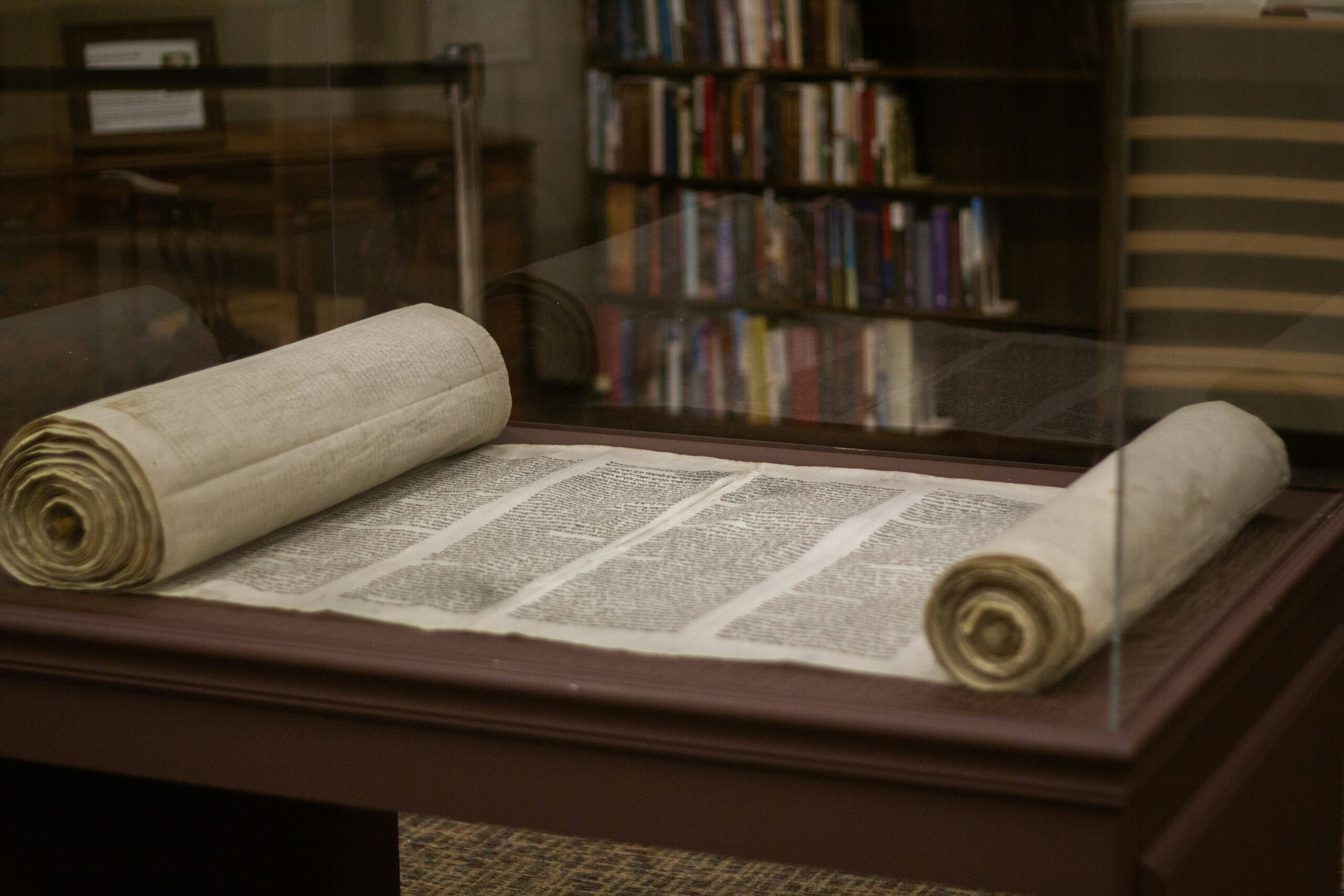
Old Testament Survey
Scottish Divines
The Venerable Dead *
Godly Scottish Divines, who, though long ago taken to glory, have profoundly impacted the generations that followed, by means of their immense practical esteem of God’s Word, with careful and thorough exegesis and powerful exposition.
Ron Frasco
* A term coined by early American Pastor, Samuel Davies, as quoted by Iain Murray in Revival and Revivalism – “I am as happy as perhaps creation can make me: I enjoy all the necessaries and most of the conveniences of life; I have a peaceful study, as a refuge from the hurries and noise of the world around me; the venerable dead are waiting in my library to entertain me …”
Scottish Divines – a primer for Danny
Some time ago, I began to notice a common thread with some of my favorite commentaries many of them were written by Scottish Presbyterians. They also all seemed to be exceptionally godly men, with an exceedingly high view of God s Word. About a year ago, I began to compile biographical notes on these men. Then, in God s providence, you called to invite us on the Reformation tour. I was thrilled (still am) that I get to come and walk where these dear brothers walked.
During these two weeks, we will hear about the spiritual giants John Knox, Patrick Henry, John Rogers, Thomas Cromwell, John Bunyan & Isaac Watts two of my heroes of the faith, and Charles Spurgeon (everyone’s favorite). But there is another list of godly men the kind of men that early American Pastor, Samuel Davies, referred to as the venerable dead. These were premier exegetes who, though less well-known, are most highly regarded by many more than just this one pastor. These are the additional men about whom I will be thinking as we trek about …
David Dickson – 1583-1663 Pastor He was, as Murray captures it, the instrument in the hand of God of numerous conversions. , Professor (he played a considerable part in establishing vital, orthodox Christianity throughout the land. ), Theologian, Non-Conformist. Commentaries: Hebrews, Paul s Epistles, Matthew, Psalms, Truth s Victory over Error: Commentary of the Westminster Confession, Therapeutica Sacra manual of spiritual counsel, etc.
Robert Haldane – 1764-1842 very remarkable evangelist! He served in the navy in the war with France and returned home to his family estate the Airthrey Castle, but soon dedicated his life and wealth to evangelistic efforts at home and in India and Africa. In time, he sold his family s estate to fund missionary work and establishment of Churches. Writings: He only wrote one commentary, an excellent commentary on Romans the result of many years of study, and Evidences and Authority of Divine Revelation.
John Brown (of Whitburn) – 1784-1858 (of special note to me personally because he died exactly 100 years before I was born) Pastor he was …
‘singularly devoted to one aim, the exposition and preaching of the Word of God he viewed commenting on the Scriptures as his highest privilege and duty he was profoundly disturbed at the all too common custom of ministers preaching a truth which was nevertheless not the truth of the text upon which they based their sermon he labored quietly and studiously at Biggar, a small town amidst the temptations of popularity, the struggles of controversy, and the responsibilities of leadership in his denomination John Brown remained a spiritual Christian.’ (BTT)
Spurgeon called him, a modern day Puritan. His biographer said of him that he not only employed his entire powers in the study of the Scriptures, but resigned his whole being to the empire of the Word of God. Iain Murray identifies him as one of the greatest Scottish exegetes of the 19th century. I’d add about 20 more centuries to that. Writings: Excellent commentary on Hebrews, Galatians, Christian Pastor s Manual.
Patrick Fairbairn – 1805-1874 Pastor Scholar, Theologian. ‘He combined his extensive experience of pastoral work with many years of well-regulated and exacting study of Scripture and the disciplines ancillary to its interpretation.’ (BTT) . Writings: Jonah, Ezekiel, Pastoral Epistles, Interpretation of Prophecy.
John Eadie – 1810-1876 Pastor, Professor. He pastored his Church in Glasgow for 28
years, where his influence was felt throughout the region. Then was called to Kelvin, which Church he pastored for 13 more years (God does, at times, relocate His servants). One historian noted of him,
… there never was a harder worker than the general divine, who yet bore no visible trace of the toil under the burden of which he sank before his time. He stood apart from the heats of controversy and was loved and trusted by men of every creed. His fellow-citizens were proud of him as one whose name was known and honored in the quiet retreats of learning …
Writings: Galatians, Ephesians, Philippians, Colossians, History of the English Bible.
Robert Murray M Cheyne – 1813-1843 He died at the young age of 30 during a typhus epidemic! Pastor, Evangelist. It is said of him that he ‘was widely regarded as one of the most saintly and able young ministers of his day.’ (BTT) He was saved by reading David Dickson’s (see his earlier mention), Sum of Saving Knowledge. He became a capable and beloved preacher and man of God. Of whom Iain Murray remarked, he had a remarkable influence in his lifetime ). Writings: Bible Reading Plan, many, many others. One of his famous quotes – “Am I redeeming the time.”
John Murray – 1898-1975 long time Professor at Princeton, then Westminster, with notables such as Machen and VanTil, following on the heels of A.A. and Charles Hodge and B.B. Warfield. BTT describes him as a careful scholar, an eloquent lecturer, a moving preacher, and the author of many outstanding articles and books. Murray s driving passions were to declare Christ s Word, advance His cause, and bless His people.
- The word document: Scottish Divines