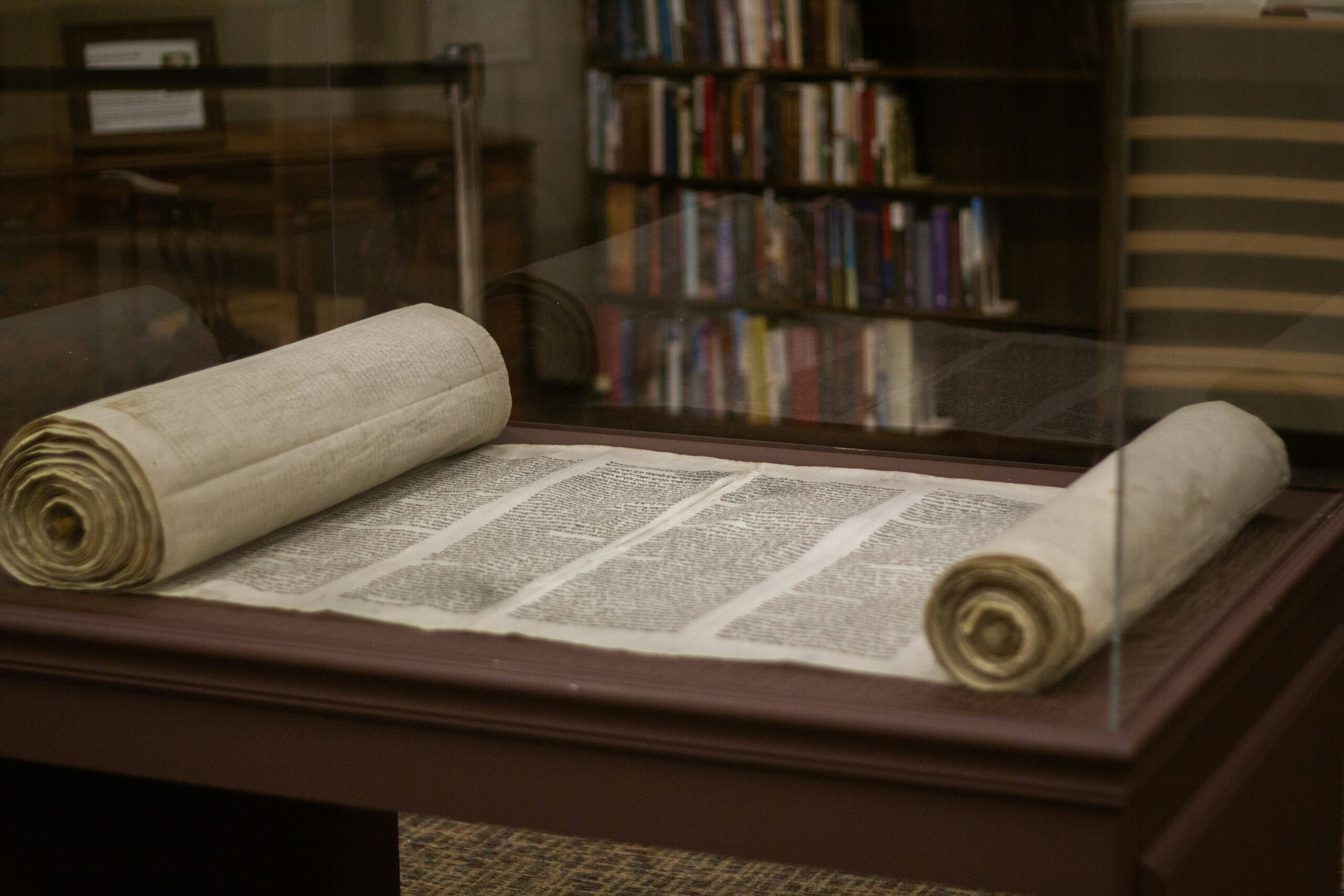
Old Testament Survey
Part 4, Greek Texts
The History of the
written
Word of God
V. The Greek Text of the New Testament
Ronald J. Frasco
I. Introduction
II. Revelation
III. Canon
IV. Original Languages
V. The Greek Text
Review …
- Canon complete in A.D. 365 – Athanasius’ list
- Still no entire New Testament in print
- Jerome commissioned to produce complete Bible, which was completed in A.D. 406. This work took nearly twenty years. Though produced from the Hebrew and Greek texts, it was translated into Latin – the language of the people of the day.
- Jerome’s Latin Vulgate would serve as the primary translation for the next thousand years!
Several factors began to change the perspective of Jerome’s Latin Vulgate. First, Latin had long since died out as the common language of the people. Only the priests and religious scholars could read and understand it. For most people, the Word of God had become an austere, greatly overshadowed, and much forgotten vehicle of truth. That left believers entirely dependent upon the clergy for spiritual instruction. But the Roman Catholic clergy had been abusing that responsibility for centuries. The Church held that her priesthood, theologians, and ultimately the Pope himself determined the meaning and the message of the Scriptures. This led to many errors, heretical teachings, and abuses. By the 14th century, corruption in the Church was rampant. The need for reform was great.
There was a second factor that began to work against Jerome’s Latin translation. In the ten centuries since Jerome’s translation, many discoveries and much scholarship had taken place in the realm of the Greek text of the New Testament. Eventually, scholars were able to produce a reconstructed Greek Text of the New Testament.
These two factors – the demise of Latin and the production of the Greek Text – brought about amazing change. It led initially to the production of Bible translations in the languages of the people – not the least of which was English. And that ultimately resulted in the Reformation of Christ’s Church.
V. The Greek Text of the New Testament
A. Greek Text Families
Why do our English translations differ so much from one another?
The study of the history of the Greek text provides a great deal of insight. In short, there are different Greek texts upon which our English translations are based. These texts, obviously, contain many variations or differences.
1. Cause
How did we come to have differing Greek texts? While God’s inspired Word was perfect, and the ‘autographs’ or the original Biblical letters and writings were free from error, once these original documents began to be copied, changes occurred. Different copyists in different areas used different rules and standards in reproducing Biblical documents. In other words, scribes were making copies of copies and with each copy changes were gradually introduced into the text. As Dr. Robert Thomas explains,
‘Variations exist in copies of the Old and New Testaments that have been preserved down to the present. The works that came from the authors of Bible books (or from their amanuenses or secretaries) are the ones that the Holy Spirit inspired, but when various scribes made copies from the original productions, changes gradually crept in. Scribes made some of these changes consciously, thinking they were correcting an earlier copying error, but they made most of them unconsciously. Whatever the cause, the fact remains that the modern translator has to decide between various readings in the text that he translates.’ Thomas, How to Choose a Bible Translation, p. 55
This is harmonized by other scholars as well,
‘Most of the New Testament books were written during the second half of the first century. Those manuscripts were written under the direction of the Holy Spirit and were inerrant. They were undoubtedly written on papyrus and have all subsequently been lost. Nevertheless, the autographs of the New Testament were providentially copied and circulated before they became illegible or lost. These copies were made as early as A.D. 95 … Although there were many early copies of the autographs, they are not all of the same quality, for as soon as a manuscript was copied misprints began to creep into the text. Some of the early copies were highly accurate and quite expensive as they were copied by professional scribes. Manuscript copies made by less capable scribes were less expensive, but they were of a generally poorer quality and wider distribution … Thus, the possibility of errors within the copies multiplied …’ Geisler and Nix, A General Introduction to the Bible, pp.445-446
What kinds of mistakes could a copiest make? If this is all you had to work with, what kinds of mistakes might you make?
There would almost certainly be both unintentional and intentional changes …
Unintentional changes
Eyesight errors – by reading and copying
Wrong division of words
Omission of letters, words and lines
Repetition of letters, words and lines
Reversal of two letters
Spelling confusions
Hearing errors – by listening to a reader
i.e. ‘pale’ and ‘pail’
Errors of memory – forgetting exact words / phrases
Errors of judgment – inclusion of marginal comments
Errors of writing – penmanship
Intentional changes
Grammar and Spelling – editing text to conform to
different rules of grammar
Harmonization – making one passage agree with another
Historical – corrections of perceived errors
Compliments / completions
Combination – combining two readings together
Doctrinal – in attempt to bring into line seemingly
contradictory thoughts
V. The Greek Text of the New Testament
A. Greek Text Families
1. Cause
2. Archaeological contributions to the Greek Text
As long as there have been attempts to copy and translate the Scriptures there have been attempts to use the best (purest) text possible. Over the past 400 years there have been many archaeological discoveries that have provided valuable information for scholars seeking to determine the purest Greek New Testament.
There have been four major periods of archaeological / manuscript discovery:
1840 — Discovery of Ancient Manuscripts
1897 — Discovery of Ancient Papyri
1930 — Additional discoveries of Ancient Papyri
1947 — Discovery of the Dead Sea Scrolls
Upon examination of the many manuscripts, scrolls, and fragments, scholars began to discern four basic ‘families’ or types of Greek text. Each family tends to maintain a distinct set of characteristics. When two writings agree with one another (when they maintain the same unique characteristics) they are said to be of the same family. Scholars eventually identified four families or text-types: Alexandrian, Western, Caesarian and Byzantine.

Thomas explains how different families arose,
‘Earliest ancient translations of the New Testament are in three languages: Syriac, Latin and Coptic. . . . The Syriac translation … follows the Western text-type … The earliest Latin translation … followed Greek manuscripts of the Western family. . . . The earliest Coptic translation came about A.D. 200 … [and] fall predominantly in line with the Alexandrian family.’ Thomas, p.58
The relationship between these Greek Text ‘families’ and our English translations is pronounced. While there are no English translations based upon the Caesarian Family, the other families are each represented by English translations. The Douai Rheims (Roman Catholic) is translated from the Western Text. Thomas evaluates the other two families and their respective translations,
‘For most English Bible users, the New Testament translation boils down to a decision between two families … the Byzantine and the Alexandrian. Many have opted for and will continue to opt for the Byzantine text-type, largely because of the widespread and long-standing influence of the King James Version. . . . Others will join the growing constituency in support of the Alexandrian supported translations [i.e. New American Standard]. When all is said and done, the stronger evidence in all probability supports this category of readings as being closer to the very words that were written by the original authors of the New Testament books.’ Thomas, pp.86-87
V. The Greek Text of the New Testament
A. Greek Text Families
B. Greek Text Editions
1. Greek Texts from the ‘Pre-Critical [1] Period’
Complutensian Polyglot – 1514
‘… this magnificent edition of the Hebrew, Aramaic, Greek and Latin texts … known as the Complutensian Polyglot.… What Greek manuscripts lie behind the text of the Complutensian New Testament has never been satisfactorily ascertained.’ Metzger, The Text of the New Testament, pp.97-98
Erasmus’ Greek Text – 1516, [see G&N, pp.449-451]
This humanistic scholar was responsible for printing the first Greek Text. The problem was, as one historian notes, that ‘Erasmus could not find a manuscript which contained the entire Greek Testament.’ (Metzger, p.99) As a result,
‘[he] relied on two rather inferior manuscripts’ and at times leaned on the Latin Vulgate translating this back into Greek! Metzger criticizes,
‘As would be expected from such a procedure, here and there in Erasmus’ self-made Greek text are readings which have never been found in any known Greek manuscript …‘ Metzger, p.100
Stephanus’ Greek Text – four editions: 1546, ’49, ’50, and ’51, [see G&N, p.451]
‘He was the first to introduce numbered verses but has been criticized that he ‘marked the verse divisions while journeying on horseback,’ and that some of the awkward divisions arose from the jogging of the horse that bumped his pen into the wrong places.’ Metzger, p.104
Stephanus’ Third edition (of four) is nearly identical to the ‘Textus Receptus.’
‘After its publication, the fourth edition of the Stephanus Greek text became dominant in England. It was used for the Geneva Bible (1557 and 1560) and the King James Version of 1611.’ G&N, p.451
Beza’s Greek Text – four editions: 1565, ’82, ’89, ’98, [see G&N, pp.451-452]
Scholarly friend of Calvin; 9 editions; heavily used by KJV translators; very similar to Stephanus’ Text.
Elzevir’s Greek Text / “Textus Receptus” – 1624, 1633, [see G&N, p.452]
Two brothers, who were printers, gave this edition the label ‘Textus Receptus’ or ‘Received Text’ by boasting in their second edition, ‘[the reader has] the text which is now received by all …’
‘[The Text] the Elzevirs had published succeeded in establishing itself as ‘the only true text’ of the New Testament and was slavishly reprinted in hundreds of subsequent editions. It lies at the basis of the King James version and of all of the principle Protestant translations in the languages of Europe prior to 1881. [Hold on to that date!] So superstitious has been the reverence accorded the Textus Receptus that in some cases attempts to criticize or emend it [to revise or make scholarly corrections] have been regarded as akin to sacrilege. Yet its textual basis is essentially a handful of late and haphazardly collected minuscule manuscripts, and in a dozen passages its reading is supported by no known Greek witness.‘ Metzger, p.106
‘Their Greek text was almost identical to that of Stephanus, which lay as the basis of the New Testament in the King James Version (1611) … because it was regarded as ‘the only true text’ … However, the textual basis was actually very late, from only a handful of manuscripts, and several passages were inserted that had no actual authority supporting them.’ G&N, p.452
V. The Greek Text of the New Testament
A. Greek Text Families
B. Greek Text Editions
1. Greek Texts from the ‘Pre-Critical* Period’
2. Greek Texts from the ‘Intermediate Period’ – a time of
organizing variant readings
The same archaeological / manuscript discoveries (mentioned earlier) began to ‘inform’ the study of the Greek text.
Mill’s Greek Text – 1707
A revision of Stephanus’ Text but with a list of the more than 30,000 variant readings which Mills discovered.
Wells’ Greek Text – 1719
‘The first to edit a complete New Testament which abandoned the ‘Textus Receptus’ in favor of readings from the more ancient manuscripts.’ Metzger, p.109
Bengel’s Greek Text – 1734
‘He was disturbed by the thirty-thousand variants of Mill’s text and began to study the transmission of the text. He gathered all the editions, manuscripts, and early translations available to him for study.’ G&N, p.453
‘After devoting himself to a lifetime of study of the Greek text, he concluded that ‘the variant readings were fewer in number than might have been expected, and that they did not shake any article of evangelical doctrine.’ Metzger, p.112
Thus, he did not correct the TR but listed the alternative readings in the margins.
‘Though Bengel was a man whose personal piety and life of good works were known to all (he had been in charge of an orphan home at Halle), and whose orthodoxy of belief was acknowledged …, he was treated as though he were an enemy of the Scriptures.’ Metzger, p.113
Wettstein’s Greek Text -1751
After forty years of labor, he printed the TR with marginal corrections. His greater contribution is the large numbers of manuscripts he discovered.
Greisbach’s Greek Text – 1775
Made great headway into the study of ancient manuscripts and published one edition of the Greek text.
Harwood’s Greek Text – 1776
Made one carefully prepared revision of the TR.
V. The Greek Text of the New Testament
A. Greek Text Families
B. Greek Text Editions
1. Greek Texts from the ‘Pre-Critical* Period’
2. Greek Texts from the ‘Intermediate Period’ – a time of
organizing variant readings
3. Greek Texts from the ‘Modern Critical Period’
Discoveries and scholarship applied to discovery of the genuine Greek Text.
Lachmann’s Greek Text – 1831
He was the first to publish a completely new Greek Text.
‘In editing the New Testament Lachmann’s aim was not to reproduce the original text, which he believed to be an impossible task, but to present on purely documentary evidence, apart from any previously printed editions, the text current in Eastern Christendom at the end of the fourth century …’ Metzger, p.125
Tischendorf’s Greek Text – 1864
When his professor urged him to study the ancient manuscripts of the New Testament, he accepted the challenge declaring, “I am confronted with a sacred task, the struggle to regain the original form of the New Testament.” (Metzger, p.126) As a result, he discovered more manuscripts and published more editions of the Greek Text than any other scholar — 8 editions.
Tregelles’ Greek Text – 1872
‘… chiefly instrumental in leading England away from the Textus Receptus during the mid-nineteenth century …’ G&N, p.455
He published one extremely carefully determined Greek Text.
‘In spite of poverty, opposition, and ill health, Tregelles overcame all difficulties and devoted a lifetime of meticulous labors upon the text of the New Testament as an act of worship, undertaken, as he declares in the preface, ‘in the full belief that it would be for the service of God, by serving His Church.’ Metzger, p.128
Alford’s Greek Text – 1869
He worked for the ‘demolition of the unworthy and pedantic reverence of the received Text, which stood in the way of all chance of discovering the genuine Word of God.’ Alford as quoted by Metzger, p.128
Westcott & Hort – 1881
After 28 years of work, two conservative, Cambridge Bible scholars, B.F. Westcott and F.J.A. Hort produced the most carefully edited Greek Text ever produced. This Text eventually led to the Revised Version of 1881, the American Standard Version of 1901, and subsequently the great majority of modern translations.
Nestle-Aland / United Bible Society’s Greek Text – 1966, ’69, ’75, ’83
The modern standard Greek Text was compiled by comparing both Tischendorf and Westcott & Hort’s Texts.
In all, there have been over 800 different editions of the Greek Text!
V. The Greek Text of the New Testament
A. Greek Text Families
B. Greek Text Editions
C. Conclusion
What do we do with the differences in our English versions?
Be humble. Be thankful. Be diligent.
The goal of our instruction is love
from a pure heart
and a good conscience
and a sincere faith. 1Ti 1:5
[1] * ‘Critical’ here, refers to the practice of comparing differing texts, as noted below.
‘… the exercise of judgment … scholarly judgment … applied to the text … in an attempt to restore the original text.’ G&N, pp.159-160
- The word document: Part 4, Greek Texts
- Back to HWWG