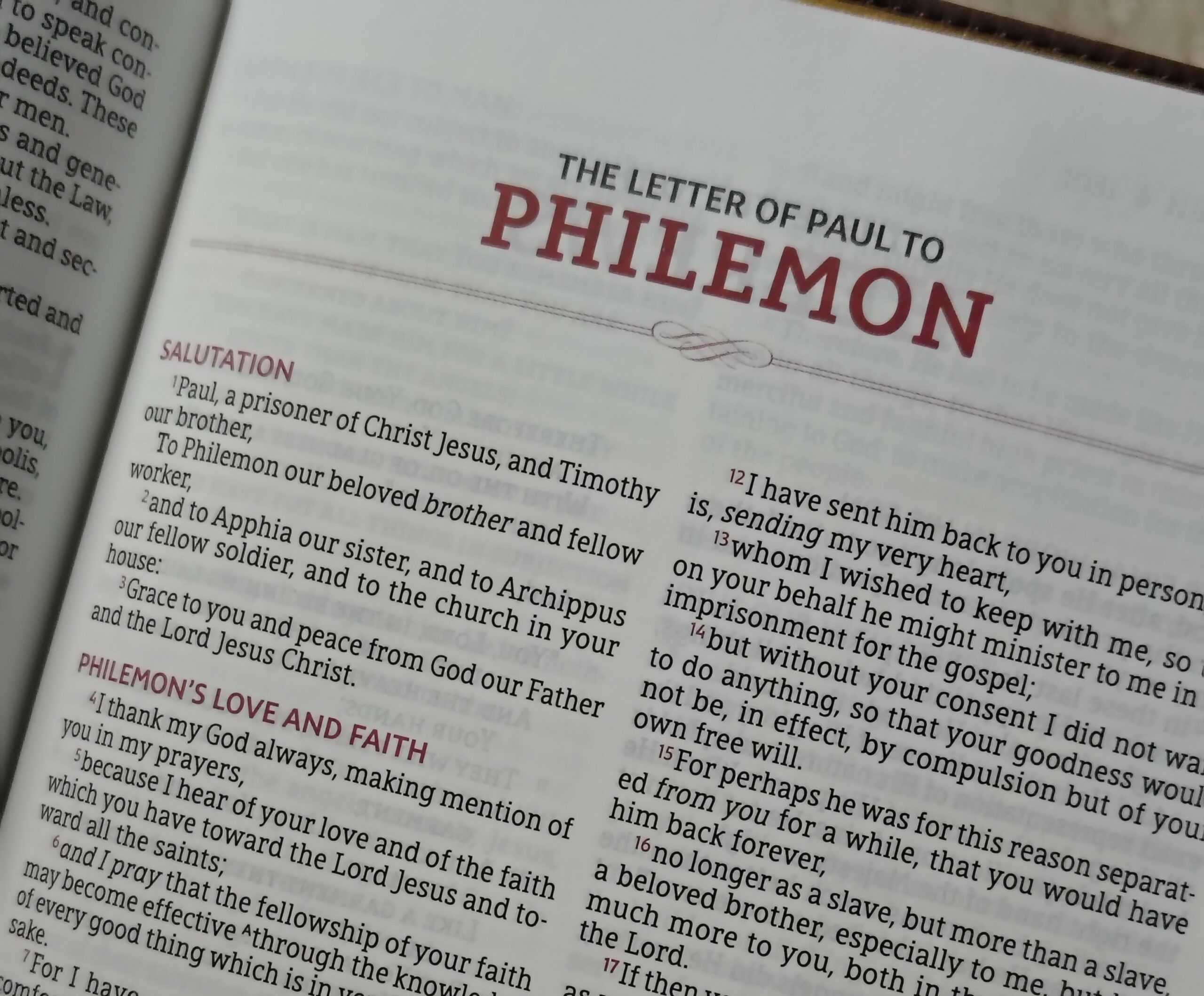
Participation, Providence and Persuasion – Philemon
This sermon examines the letter to Philemon through three primary lenses: participation in the body of Christ, God’s sovereign providence, and the skillful persuasion of Paul. The central message highlights how Paul, despite his apostolic authority, humbly appeals to Philemon to receive the runaway slave Onesimus not as a property dispute but as a spiritual reconciliation. The exposition emphasizes that true Christian fellowship involves shared spiritual accounts and mutual care, where actions like forgiveness and hospitality carry eternal weight. By illustrating God’s providence in orchestrating the salvation of both men, the sermon encourages believers to trust in divine sovereignty while doing the next faithful thing. The tone is instructional and pastoral, urging the audience to view their relationships within the church as opportunities for deep, transformative discipleship rather than mere social interaction.
Transcript
Thank you, Pastor. If God’s beloved
would open their Bibles to Philemon. It’s right before Hebrews. It’s
a pretty small book. The time is about 62 A.D. The place is a prison in Rome. We have three characters today,
Paul the Apostle, Onesimus, and Philemon. The Apostle Paul had
been incarcerated for almost four years, two years in Caesarea,
a one-year trip to Rome where he was shipwrecked, and now in
Rome itself, and he was chained to a soldier of the Imperial
Guard 24-7 on house arrest. Rome did not provide a prisoner’s
sustenance, so Paul was surrounded by many acquaintances who would
have cared for his daily physical needs, brought him his food,
his clothing, medicine, anything he would have needed had to be
provided by friends. Despite being locked up and chained
to a guard, Paul still would find opportunities to witness,
and people who somehow came in contact with him were getting
saved under his limited ministry. Onesimus was one such man. Onesimus was a slave. He had
run away from his master and fled to Rome, hoping to disappear
in the crowded metropolis and hopefully avoid the slave hunters
who made a living capturing the many runaways. In Rome, Onesimus
had heard the gospel from Paul himself and was born again. And
in their subsequent conversations, I can hear how it goes. Paul
would have learned Onesimus was a slave. Not just a slave, but
a runaway slave. Not just a runaway, but Onesimus
was from the town of Colossae. where Paul knew a few people.
And not just from Colossae, Onesimus was from a man named Philemon,
whom Paul had led to the faith many years earlier, probably
in Ephesus. Philemon was a prominent member
of the church in Colossae. He was a wealthy man. He was
wealthy enough to own slaves. He had a big enough house that
the church met at his house. He hosted that. So he would have
been a prominent businessman too. So now Paul is doing what
he can do to further the gospel from prison. Onesimus is helping
serving Paul in his endeavor at Rome, and Philemon is in Colossae,
minus one runaway slave. It’s a small world, isn’t it,
in God’s providence. And it was a bit of a sticky
situation for everybody. Philemon may have hired slave
hunters to go capture his investment. He was right to do so. Paul was
breaking Roman law by harboring a runaway. Onesimus could be caught at any
moment. To top it off, Onesimus admitted to defrauding Philemon
in some way. Typically, a runaway would steal
something valuable because he didn’t have any possessions.
And as he would flee, he would sell it to fund his flight wherever
he was going. Onesimus made it all the way
to Rome, which was 1,400 miles away. Paul, I stole the Philemon family china
and silver, pawned it in Ephesus, bought a ticket, and made it
to Rome. Whatever it was, we don’t know
for sure, but somehow Onesimus defrauded Philemon. Onesimus
is born again. He’s with Paul. What’s Paul going
to do? You see, slavery was a big thing in the Roman Empire. At
least one-third of the population were slaves, and it had almost
eclipsed free labor. It was not ethnic, so it was
different than the American slave trade. Anyone from any nationality,
from any class could become a slave. And anyone, no matter their nationality,
could be granted their freedom. Some slaves of skill held high
positions of society and they would have been dressed better
and treated better and been more well educated and well off than
a lot of the free people that were around them. Slaves were
not just for the upper class to own, even the middle class
owned slaves back then. Slaves were only restricted from
serving in political positions in the Roman Empire. A slave
could be a doctor, accountant, musician, teacher, dairyman,
contractor, engineer, welder, secretary, banker, pilot, paver,
lawyer, baker. I think I covered most people
in this room. You name it. Oftentimes, people
were born in slavery. Sometimes they had to sell themselves
into slavery if they came under a challenging hardship. Better
to be a slave than to starve to death. Better to sell yourself
into slavery than watch your family starve to death. The average
slave would cost about $50,000 in today’s currency. A super-skilled,
super-educated, super-talented slave could be in the millions,
but that was very rare. So Roman slavery was different than the
African slave trade we’re more familiar with, but I don’t want
to glorify it either. They were still property. They
were chattel. A master could do whatever he
wanted to do with his slaves. Usually it was in his best interest
to take care of his investment, but not always the case. There
are many stories of mistresses beating slave girls to death
because they were jealous. Or the one noble who got so angry
he ordered one of his slaves thrown to the lamprey eels that
he had. Like any slave trade, it was an institution held in
check by fear and punishment. If a runaway slave was caught
and returned to his master, he could be beaten, whipped, have
an F branded on his forehead for fugitive, have a collar put
around his neck that says, if found, I’m a runaway, return
to Philemon of Colossae, or have their legs broken, whatever.
Something had to be done, though, to ensure that the rest of the
slaves in the house didn’t come up with any funny ideas of their
own. So, again, we have our characters. We have Paul the Apostle in prison
after four years. Onesimus has been born again,
but he’s a runaway with Paul. And Philemon, a wealthy businessman
and member of the town of Colossae. Philemon has been robbed, and
Onesimus is a Christian, and Paul has been praying about the
situation. So what is Paul gonna do? Chained
to a guard, locked in a house, Paul sits down and writes three
letters. Actually four, but I think at this moment he wrote three.
He wrote the letter to the Ephesians, the letter to the Colossians,
and the letter to Philemon. And he handed these three letters
to two men, Tychicus and Onesimus, and he sent them to Asia Minor
to go deliver these letters. Can’t you just kind of envision
this situation? Tychicus and Onesimus walking into Colossae.
They would have gone to the most hospitable man in town, who’s
Philemon. where the church met, and they would have walked up
to his house. Can you see how nervous Onesimus would have been?
Philemon would have looked and saw Tychicus, his old friend,
and right next to him, Philemon. Or Tychicus, his old friend,
and right next to him, his runaway slave, who was stolen from him.
I bet you when their eyes locked, both their hearts dropped. Onesimus
would have sheepishly walked up to Philemon and handed him
a piece of paper. Philemon would have opened it
up, and it would have been a letter from Paul. Let’s read. Paul, a prisoner of Christ Jesus,
and Timothy, our brother. To Philemon, our beloved brother
and fellow worker, and to Appiah, our sister, and to Archippus,
our fellow soldier, and to the church in your house, grace to
you and peace from God our Father and the Lord Jesus Christ. I
thank my God always making mention of you in my prayers because
I hear of your love and the faith which you have toward the Lord
Jesus and toward all the saints. And I pray that the fellowship
of your faith may become effective through the knowledge of every
good thing which is in you for Christ’s sake. For I have come
to have much joy and comfort in your love because the hearts
of the saints have been refreshed through you, brother. Therefore,
though I have enough confidence in Christ to order you to do
what is proper, yet for love’s sake, I rather appeal to you,
since I am such a person as Paul, the aged, and now also a prisoner
of Christ Jesus. I appeal to you for my child,
Onesimus, whom I have begotten in my imprisonment, who formerly
was useless to you, but now is useful both to you and to me.
I have sent him back to you in person that is sending my very
heart whom I wish to keep with me so that on your behalf he
might minister to me in my imprisonment for the gospel. But without your
consent I did not want to do anything so that your goodness
would be in effect so that your goodness would not be in effect
by compulsion but of your own free will. For perhaps he was
for this reason separated from you for a while, that you would
have him back forever, no longer as a slave, but more than a slave,
a beloved brother, especially to me, but how much more to you,
both in the flesh and in the Lord. If then you regard me a
partner, accept him as you would me. But if he has wronged you
in any way or owes you anything, charge that to my account. I,
Paul, in writing this with my own hand, I will repay it, not
to mention to you that you owe me even your own self as well. Yes, brother, let me benefit
from you in the Lord. Refresh my heart in Christ. Having
confidence in your obedience, I write to you since I know that
you will do even more than what I say. At the same time, prepare
a lodging, for I hope that through your prayers, I will be given
to you. Epiphras, my fellow prisoner in Christ Jesus, greets you,
as do Mark, Aristarchus, Demas, Luke, my fellow workers. The
grace of the Lord Jesus Christ be with your spirit. The main theme of Philemon is
forgiveness. We’re going to do that next week.
The secondary purpose for the writing of Philemon is to teach
us about brotherly love. Brotherly love between Christians.
And if you look at the bulletin, I had three points participation.
You’re going to see words like fellow worker, fellow soldier,
fellowship in the faith, words like that. We are one and we’re
in this together. And the second one is God’s providence.
We’re gonna see how God is orchestrating all of these events to give us
this wonderful letter. And the last one is persuasion.
Take note of how Paul is discipling the heart of his friend here
unto Christ. So with that, Philemon verse
one. Paul, a prisoner of Christ Jesus
and Timothy, our brother. It’s a different introduction
than Paul usually does. In most of Paul’s letters, he
says, Paul, an apostle. Or Paul, a bondservant of Jesus
Christ. Here, he doesn’t say either of
those. He just says, I’m in prison. And that’ll be important later. The recipients. We have four
recipients of this letter. To Philemon, our beloved brother
and fellow worker. And to Appiah, our sister. And to Archippus, our fellow
soldier. and to the church in your house. Philemon, he is a
beloved brother. The Apostle John, when he writes,
uses a beautiful word, beloved, let us love one another. That
means they’re the object of God’s love. They’ve been called out.
He says, he’s our beloved brother. He’s the object of our love and
God’s love. He’s a dear brother, we might say today. Philemon
is a dear brother and fellow worker. They worked at the same
occupation. They sweated over the same task,
Paul and this guy. They knew each other. They worked
together. They sweated together in the advance of the gospel.
Second person then to Appiah, our sister. All we know is it’s
a woman and she’s a believer in Christ. And to Archippus,
our fellow soldier. While Philemon was a fellow worker,
Archippus is a fellow soldier. He was a fellow brother in arms.
he and Paul would have gone to battle together in the gospel
and in the faith. Colossians 4.17 says, say to
Archippus, take heed to the ministry which you received in the Lord
that you may fulfill it. So we could say for sure, I think
this guy had some form of leadership or pastorate or teaching or elder
ministry in the Colossian church. And the fourth recipient, and
to the church in your house. So this is a private letter to
one man the whole church gets to see it and read it and hear
it. So really, everybody in the Colossian church got two letters,
right? Because Philemon was in the Church of Colossae, and he
got the letter to Colossians, and the whole Church of Colossae
got Philemon’s private letter from Paul. And so they both would
have got all of this. And notice, to the church in
your house, we often say we’re going to church, and I understand
that, but that is poor language. We’re going to the building where
the church meets. The congregation met in Philemon’s house. There
wasn’t church buildings for two or three hundred years. The fact
that they met in his house shows that he had the means to be hospitable
to the entire congregation of the Church of Colossae. And we
have Paul’s standard greeting here. Grace to you and peace
from God our Father and the Lord Jesus Christ. The content of this letter, Paul
is going to ask Philemon to forgive Onesimus. And it’s going to affect
him financially, domestically, socially, and within the church.
And so I think because it’s a household, it’ll affect his entire household.
I think Appiah is his wife and Archippus is his son. But it
doesn’t say for sure. And because it’s gonna affect
the gospel and his testimony, the whole church is addressed
and they get to hear what’s going on. We come now to verse four. Paul goes straight to Philemon
here, the U in verse four is singular, so one recipient. I thank my God always making
mention of you in my prayers. Paul was exceedingly thankful
for Philemon, his dear brother, his fellow worker, all the time,
making mention of him by name. I thank my God always making
mention of you in my prayers. Why? Because I hear of your love
and of the faith which you have. Philemon was a famous guy. Paul
had been in prison for four years. He had led Philemon to the Lord.
He had served with Philemon. He hadn’t seen him for a while.
He’s hearing about him 1,400 miles away. How does he hear
about him? Other people are telling him about Philemon, what kind
of guy Philemon is. We’re going to get a picture
of this guy right here, his character. I hear about your love and of
the faith which you have toward the Lord Jesus and toward all
the saints. He loves Christ. He’s faithful
to Christ. He loves Christ’s people and
he’s faithful to Christ’s people. He’s vertically right with Christ. He’s vertically serving the brethren. And just in his congregation,
it says, toward all the saints. Christ’s love does not discriminate,
and he’s gonna find out that it doesn’t even discriminate
with a slave. Toward all the saints. Because Philemon’s love
and faith in Christ were genuine, they were expressed, and Paul
heard about it. And Paul gives thanks all the
time by name for this wonderful man. This is a good man. But Paul has a prayer request.
Verse six. And I pray that the fellowship
of your faith may become effective through the knowledge of every
good thing which is in you for Christ’s sake. Fellowship of
your faith. Fellowship is Koinonia. It’s
the shared life that we have together. Participation, sharing,
serving, loving, caring with one another within the community. Fellowship of your faith. It’s
within the faith community in Christ that it may become effective,
that it can accomplish its purposes powerfully through the knowledge.
This is epagnosis. This is not just hearing about
it. This is an experiential knowledge, right? This is like I could tell
you guys about jumping out of a plane and parachuting, but
if I slap a bag on your back and throw you out, you’re going
to find out. A parachute, hopefully not just a backpack, but this
is experiential knowledge. This is applied knowledge through
the knowledge of every good thing. A good thing is that which is
pleasing to God, which is in you. You already have it for
Christ’s sake. And I find this a strange prayer request. Because
if you look at the preceding verse, he already had love and
faith. toward Christ and all the saints, and it was already
being expressed. So why would he ask that this
would happen if it was already happening? He tells the Philippians
in Philippians chapter one, I pray that your love would abound more
and more in all knowledge and discernment. I get that. He doesn’t
say that here. This is like a new prayer request.
And because we’ve already read the letter, we know what he’s
going to ask him. He’s going to ask him to do a hard thing. He’s gonna ask
him for a favor, to forgive this slave. And he’s been praying
for him. Look at it backwards, for Christ’s
sake, we forgive for our own sake, or for Christ’s? For his
sake, for the sake of the gospel, which is in you. Is forgiveness
in each believer? It better be. But you ain’t forgiven. It’s already in you, because
you’re a Christian. Every good thing, is forgiving
another person who comes to you in repentance a good thing that
God would approve? Is it effective in preaching
the gospel? Will it bring sweeter fellowship of the faith within
the brethren? You bet. So, while Philemon’s been living this life,
and he’s a good, godly man, Paul’s bringing him something that’s
gonna be hard to do, and he’s been praying for him. He’s been
praying that this would happen. He’s actually been setting him
up with prayer. Verse seven. For I have come
to have much joy and comfort in your love. Because, he says
why, the hearts of the saints have been refreshed through you,
brother. Refreshed. You guys have ever seen the Westerns
where the cavalry is chasing somebody and they come into a
stable and say, we need fresh horses. These old horses are
tired and wore out and they’ve thrown a horseshoe and they get
off and they get on fresh horses. Well, what does the stable boy
do? walks them around so they don’t sweat, brushes them out,
gives them feed and water. The next day he’ll check, refix
the horseshoes, rest them for a few days, and then they’re
fresh horses again. That’s what Philemon did. I don’t
know how specifically, but that’s the kind of thing he did for
the saints. And it says in the heart, and this word in Greek
is not the heart, it’s the bowels. deep down inside the seat of
your emotions and your passions. These people were despondent,
they were tired, whatever it was, itinerant missionaries or
people in the church, they needed compassion, they needed someone
to come alongside them, they needed help, they needed something.
Philemon was the guy. He took tired people and refreshed
their souls and patched them up. And that’s what he did. And Paul says, I have, I rejoice
all the time and I have much comfort because I’m in prison
knowing that there’s people like you out there serving the saints
in this way. Because the hearts of the saints
have been refreshed through you. Now we don’t know what position
Philemon held there. Elder, deacon, teacher, probably
not an elder because he doesn’t say fellow soldier, he says fellow
worker. So that would fit the office of a deacon, but it doesn’t
say, we just don’t know. What we do know is this man had
a heart for people, he was kind, and he put his money where his
mouth is. And he served the Lord with everything he had, with
his home, and for sure with these people. And I’m sure he was a
teacher in some respect, because you can’t refresh the souls of
God’s people without having a biblical word of truth, rightly spoken,
fit for the moment, edifying the person. He was a special
guy. He was quite a guy. Now we come to the main body
of the letter, verse 8. Paul gets to it. Therefore, though I have enough
confidence in Christ to order you to do what is proper. I probably
said that more strongly than Paul would have had he been dictating
this, but I want you to hear what he’s trying to do here.
Therefore, I have enough confidence. Paul was an apostle. He was called
an apostle by Christ, equipped and sent out by Christ, and Christ
granted him the authority for the office. He was an apostle.
He could have ordered or commanded Philemon what to do here. The
right thing to do is forgive. He could have said, you’re doing
it. That’s what he says. Therefore, I have enough confidence
in Christ to order you to do what is proper yet. For love’s
sake, I rather appeal to you, since I am such a person as Paul
the aged, and now also a prisoner of Christ Jesus. So instead of
coming to you like an apostle, he says, I’m taking off my apostle
hat, I’m laying it on the table, I’m coming to you man to man,
brother to brother in Christ, and I’m gonna ask you a question,
and I make the appeal upon three things. For love’s sake, I’m
old and worn out. I’ve been in prison for four
years. And I’m just asking you to do this as a brother in Christ,
because it’s the right thing to do. For love’s sake, Paul
loved Philemon. Philemon loved him. They both
loved Christ. Christ loved them. Paul loved Onesimus. We love
because Christ first loved us. This is brotherly love. It’s
not law. This is love. For the sake of
love, for the sake of the gospel, I’m coming to you. I’m coming
to you because I’m Paul the aged. He was probably early 60s. Maybe
just turned 60. Sorry, Ron. He calls himself aged, and I
don’t think he’s really old, and Philemon had a son in the
ministry, probably close in age, so I don’t think he means like
I’m older than you. The word aged, he’s wore out.
He’s been in the ministry for 30 years. He’s had a life of hard living
and he doesn’t mean partying. This is what he did. More labors,
more imprisonments, beaten up more times than I can count,
went near death five times, beaten with rod three times, stoned
once, shipwrecked three times, journeys, rivers, robbers, wilderness,
ocean, sleeplessness, cold, hungry, thirsty. I’m tired. I’ve aged. It’s taking a toll
on me, Philemon. I’m coming to you as a tired
soldier for Christ. And now a prisoner. I’ve been
in jail four years. I’m not coming to you with any
authority. I’m coming to you as a humble man. And I’m pleading
for the sake of love. Do you see Paul’s heart here?
How he sets this up? He’s not coming heavy handed.
He’s pleading as a humble man. He takes off his apostle’s hat.
And he comes humbly as a brother in Christ. And then he tells
him what he’s going to appeal in this way. Verse 10. I appeal
to you. I don’t order you. I appeal to
you. I’m pleading with you. I beseech
you strongly, brother Philemon, for my child Onesimus. You hear
this language? Whom I have begotten in my imprisonment. He calls Timothy his child and
Titus his child, and here he calls a runaway slave his child,
his son. My child, Onesimus, whom I have
begotten, I gave birth to him, not literally, spiritually, in
my imprisonment. Onesimus got converted. So Philemon
and Onesimus have something in common now, right? The name Onesimus
means useful. It’s a common name for a slave.
Hey, useful, let’s go. move some cows. That’s what we
would say where we do. I appeal to you for my child
Onesimus, whom I have begotten in my imprisonment. He describes
this guy who formerly was useless to you, but now is useful both
to you and to me. And Paul’s doing a play on words
here. Useless is Christos. Useful is you, Christos. And
Onesimus is useful. So he’s playing on the word here.
He says, He was useful, but actually he was useless, but now he’s
useful to both of us. Useful was useless, but now useful is
useful. And so if you were a Greek and
you were reading this letter, you might smirk at what Paul
is doing here. It’s pretty cool. Who formerly
was useless to you, and he was. He defrauded him. I would go
even farther. I think Philemon told Paul, yeah,
I wasn’t a very good slave. I was lazy. I don’t know. He
was useless to you, but now is useful both to you and to me.
I have sent him back to you in person. That is sending my very
heart. It’s affectionate language. Paul loved Onesimus. I’m sending
him. He’s like a son to me. It’s like
sending my very heart to you, Philemon. Paul tells him what he wanted
to do, verse 13, whom I wished to keep with me. Paul would have
rather keep Onesimus with him. He was useful to him. He was
serving Paul. He was in prison. I don’t know
exactly what he did, but he was serving Paul in a very useful
way. Paul wanted to keep him. Paul
probably needed to keep him. But I’m sending him back, my
own heart. so that on your behalf he might
minister to me in my imprisonment for the gospel.” So Paul is saying,
as I’m sending him back to you, I wanted to keep him with me,
so that on your behalf he might minister to me in my imprisonment
for the gospel. Notice what Paul is saying here.
If I kept him, and he was your slave, and you really sent him
to serve me, his work would be credited to your account. That’s
what he’s saying. Which is kind of neat how God’s
economy works. Because if Philemon had sent his slave to go serve
Paul, Paul says that’s credited to your account, does that mean
the slave would have gotten nothing credited to his spiritual account?
God would credit both of them. God is very gracious in how he
works this out, and that’s what we’re gonna go to when we talk
about participation in the gospel. Even though Paul really wanted
to keep Onesimus with him, he needed him, he tells us why he
sent him back, verse 14, but without your consent, I did not
want to do anything so that your goodness would not be in effect
by compulsion, but of your own free will. I wanted you to do
it from the goodness of your heart. Paul did not want to do
anything without Philemon’s permission and blessing. He did not want
to make his decision for him. He could have. He could have
said, Philemon, Onesimus showed up. He’s converted. He’s born
again. Praise the Lord. He’s helping
me. I need him. I’m keeping him. Thank you. Right. And Philemon probably
would have said okay. I think it probably would have been easier
in this situation if he had done that. We’ll talk about that in
a little bit. Paul didn’t do that because Philemon wouldn’t
get a blessing in that. He would not have done it from
the goodness of his heart. Paul was concerned about Philemon
participating in this. And he says, I wanted your permission,
number one. There’s a second reason, and I’m going to give
you a preview because we’re going ahead to it in the following verses,
but we’re not there yet. There’s a second reason that
Paul did this. This book, really, the main theme
is about repentance, forgiveness, and reconciliation, and a picture
of the gospel, especially between two brothers. And Paul sees it
as absolutely necessary and puts a premium on the reconciliation
of face-to-face between two brothers. Even though Paul wanted to keep
him with him, probably needed to keep him with him, he set
aside his own desires and sent him back, because he wanted Philemon
to do it out of the goodwill of his heart. And if it’s dictated,
it’s not goodwill. and the premium he put on forgiveness. And then Paul is really pulling
at the heartstrings here of Philemon in verse 15. The way he writes
this, he introduces God’s providence. For perhaps he was for this reason
separated from you for a while, that you would have him back
forever. For perhaps, this is in the passive
voice, he was separated from you for a while, So the way this
is written in the Greek, the separation is not attributed
to Onesimus’ sin of fleeing, it’s attributed to God. This
was in God’s orchestrated plan. He was separated from you for
a while so that you could have him back as a brother forever.
And so he’s telling him, for perhaps, think about this, he
could have just said, this is in God’s providence. But he’s
saying, think about this, Philemon. Consider it for yourself. Look
at the big picture. Come out of yourself and maybe
the anger you’re feeling right now. Consider what’s happening.
Consider God’s providence in all of this. Paul would have known a thing
or two about providence, right? He says in Galatians 1, I was set
apart from my mother’s womb. And he says in 1 Corinthians
15, 8, as one abnormally born when he was born again on the
road. Before he was a persecutor of the church, killing Christians,
God saved him. And he looks back on his life
and says, wow. He understood God’s providence, or he would
not have said, I was set apart from my mother’s womb for such
task. He would have read the Old Testament scriptures, Genesis
50, about Joseph, right? His brother sold him into slavery.
They wanted to kill him. God delivered him. They sold
him to the Ishmaelites. He wasn’t theirs to sell. Ishmaelites
hauled him off to Egypt. Potiphar falsely threw him in
jail. You guys know the story. There was so much sin going on
there. And in the end, when his brothers come to him because
they’re scared and they even tell another lie, our dad said, forgive
us. If you read Genesis 50, he says, But you guys intended for evil,
God intended for good. God worked it out. Go to Acts,
Acts chapter 4. We got Peter and John, the beginning
of 3, went out, healed a guy, preached a sermon. They got arrested
because there was quite a commotion in chapter 4. They got threatened
by the Sanhedrin and then released. 4 verse 23, when they had been
released, they went to their own companions. and reported
all that the chief priests and the elders had said to them.
And when they had heard this, they lifted their voices to God with
one accord and said, O Lord, it is you who made the heaven
and the earth and the sea and all that is in them, who by the
Holy Spirit through the mouth of our father David, your servant
said, why did the Gentiles rage and the peoples devise futile
things? The kings of the earth took their stands and the rulers
were gathered together against the Lord and against his Christ. For truly in this city, they
were gathered together against your holy servant, Jesus, whom
you anointed both Herod And Pontius Pilate, along with the Gentiles
and the people of Israel, to do whatever your hand and your
purpose predestined to occur. Predetermined. Foreordained. The future is not unknown to
God because he looks through the future and sees the future.
It’s known to God because he makes the future. That’s the
foreknowledge of Christ. That’s what that word means.
And so Paul is saying, look, he’s born again. trust in the
providence of God if he’s any one of us that are born again
understands the providence of God right and so Paul’s telling
Philemon think about it perhaps perhaps this whole thing happened
so that you can have him back forever so this this Philemon
who would have seen Onesimus come to him and thought where’s
my china and my silver that you stole you don’t have it with
you Paul’s just pulling at him, telling him, think about the
bigger picture, what God is doing here, you have a brother in Christ.
Verse 16, no longer as a slave, but more than a slave, a beloved
brother, especially to me, but how much more to you, both in
the flesh and in the Lord. No longer as a slave, he’s still
a slave, he came back as a slave, but he’s gonna say, but more
than a slave. A beloved brother. So Philemon
is doubly blessed, right? He gets his slave back, triply
blessed. The slave’s not useless anymore,
he’s useful. He’s really fulfilling his name.
Plus he has a brother in Christ that he gets to spend eternity
with. He says, consider what happened, Philemon. Look at the
bigger picture here. And Paul changes this relationship
right here, especially to me, but how much more to you? So
this relationship was between Philemon and Onesimus, and Paul
butts himself right in the middle of it. He says, no, no, this
is between Philemon, Onesimus, and me. And Christ reigns over them all,
and God is the father of them all. Galatians 3.28, there is
neither Jew nor Greek, there is neither slave nor free man,
there is neither male nor female, for you are all one in Christ
Jesus. You’re all one. one body, along with Appia, Archippus,
and the whole church in Colossae, that would have received Onesimus
back into their fold as a member of the body of Christ, worshiping
with them, even though he was a slave. And so he’s opening
this up. When you are born again, you
are inserted into the body of Christ and the body of Christ.
You’re united with Christ. And if I’m united with Christ
and you’re united with Christ, we’re uniquely united to one
another. And that’s where Paul is going with this, both in the
flesh and in the Lord. Verse 17. If then you regard
me a partner. Do you, Paul? Do you regard me
a partner? Do I have koinonia with you?
Fellowship in the faith? Have we labored in the faith?
Are we working toward the same thing? Are we brothers in Christ?
If you regard me a partner, and he has two requests, accept him,
okay? Receive him back. Not just that,
as you would me. The honor that you would have
given me had I come to your house as the Apostle Paul, as your
beloved friend, as the one who led you to the Lord. Give it
to Onesimus. You can see Philemon’s jaw go
and say, what? Are you kidding me? My runaway
slave who defrauded me, accept him back like I would you?” That
is what Paul is saying. Paul says, give him the honor
that is due me. Give it to your runaway slave.
He’s a representative of myself. However, Onesimus has wronged
Philemon in a big way and Paul is not going to suggest that
we just sweep it under the rug. Verse 18, but if he has wronged
you in any way or owes you anything, charge that to my account. This
is kind of the same language as perhaps For this reason, he
ran away from you, that you would have him back forever. But if
he has wronged you, it’s a little softer than he robbed you blind,
charge it to my account. He knows the emotions that Philemon
would have had seeing his runaway slave. If he has wronged you,
it’s a euphemism, because he did, in any way or owes you anything,
charge it to my account. It takes more than love to forgive.
I know that sounds strange. The way we think about love.
It takes more than the way we think about love to forgive.
Biblical love pays a price. We’re gonna talk about that next
week when we talk about forgiveness. Biblical love pays a price. Someone
had to pay. Paul, Onesimus, or Philemon.
Philemon either ate it, Onesimus paid it back, or Paul paid it.
So that’s kind of the picture Paul is setting up here. Paul
says, I’ll pay it. Verse 19, Paul gets very business-like
and he writes an IOU. I, Paul, am writing this with
my own hand. I will repay it. Paul here is an IOU. It’s like
a promissory note. In a few words here, he takes
Onesimus’ debt and makes it his own. It’s my personal obligation
to you. Not Onesimus’ anymore. Can’t hold that against him.
Hold it against me. However, Paul has a credit card here if
you look at the parenthesis. Not to mention, If you say, yeah,
go do this, not to mention. This is the gambit where we mention
what we say we’re not going to mention. So Paul says, not to
mention that you owe me even your own self. Paul had led Philemon
to the Lord. Philemon, you’re no longer destined
for the pit of hell to suffer in eternity under God’s wrath. You are now adopted into the
body of Christ How could you ever pay that back? Paul has
quite an account with this guy, right? And this is the shortest
IOU I’ve ever seen, a promissory note. Writing it with my own
hand, I’ll repay, you owe me your own self. Canceled. I mean, in one verse, Philemon
goes from a creditor to a debtor, right? Just like that, it’s done. Again, we’re gonna talk about
this next week. So it is in the gospel right the transaction
God did with his son Verse 20 Paul is still pleading he gets
back to his request. Yes, brother Let me benefit from
you in the Lord refresh my heart in Christ You’ve refreshed all
these other people’s heart. I need my heart refreshed refresh
my heart You know how you can do it because we’re 1,400 miles
apart do this for me. I Brother, please let me benefit
from you. And I’m going over the top to
show don’t read Philemon with a cynical eye. Because you’ll
see, not to mention you owe me your very self, you’ll see a
heavy-handed Paul here who’s using manipulation to get what
he wants. That is not what Paul’s doing. Now, pause. Time out. We may see this request
and consider it in our context. We haven’t had slavery for 150,
60 years. We abhor it. We’re capitalists,
but we have enough socialism to think, you know, Philemon
was a wealthy guy. He can afford it. It’s not going to hurt him
anyway. And we might not really be sensitive to what’s going
on in this context here. So I want us to think about it
as if Philemon Onesimus would consider it. Philemon had quite
a dilemma. He did. He was a man who owned slaves.
He probably had a decent sized business that afforded him the
ability to serve all the saints the way he did so that he was
known throughout the whole empire and host the church the way he
did. He probably had a large estate. I don’t think the church
in Colossia was a small church. What do you think would happen
within the management of his household and his servants and
his business if he received back a runaway thief with honor? Let bygones be bygones. All’s
well that ends well, let’s sweep it under the rug. That’s how
these slaves would have seen it from their perspective, right?
Do you think they would have been tempted to run away? Do
you think they would have got lazy? Do you think they maybe
would have faked faith to garner some favoritism? Because, boy,
it sure works for Philemon or Onesimus. I keep getting the
names wrong, but you guys get what I’m getting at here. How
about in town, doing business with other people and trading?
You think it would have ticked off the other slave owners? Gonna
cause problems here with the way you’re doing business? His
son and wife, his wife would have managed the domestic affairs
of the house. How about his son who probably part of the estate
was serving in the church and says, you know, dad, we’re not
as productive as we were. I only have three hours to prepare
my sermon instead of 30. Cuz I gotta work more, right? I’m just trying to get us to
think about what Philemon was facing. Onesimus had quite a
dilemma too, right? What if Philemon just had one
of those bad days where he got just ticked off and wrathful?
He could beat him, put a brand on his forehead, collar on his
neck, sell him to the galley ships where the life expectancy
was short to make a point to the other slaves. I don’t think
he would do that because that’s not the character we saw, but
Onesimus had that as a possibility when he went walking back, right?
Paul had a dilemma too. Paul knew he was potentially
putting Philemon and Onesimus in a dicey situation. It would
cost Philemon. And really, in that culture,
this is kind of a crazy thing to do. But that’s what the gospel
does. It transforms relationships. And that’s why Philemon’s in
scripture for us. End pause, we’ll get back to
it. Verse 21. Having confidence in your obedience.
Paul knew this guy. having confidence in your obedience.
It wasn’t just, they were good friends. He knew him. Having confidence in your obedience,
I write to you, since I know that you will do even more than
what I say. Paul has a history with this
good man. He even expected Philemon not just to obey, but to go above
and beyond. He did, that’s what he’s saying.
And theologians have been wondering what this even more than what
I say is, because what did he ask for? receive him with honor,
put his debt to my account, and receive him back as a slave and
a Christian brother. So what’s the more than? And there’s been
two options given. One is that he would send Onesimus
back to Paul as a slave, as Philemon’s representative to serve Paul.
And the second option is that he would grant him his freedom,
manumission, and send him to Paul to serve Paul. And the text
doesn’t say. I have my own opinion after the
study, but it’s just that my opinion.
So as I got to this point in the letter, I just thought about
Philemon, the kind of guy he was and the situation he was
in. And I have had the blessing in my life to know a man like
Philemon. He was back in California. He
was a good man. Pete Verboom, many people in
this room know him. I bought the dairy from him. So we did
business together. He helped me because I was 27
and the guy had been buying cows and feed and cattle for 60 years. I mean, who wouldn’t ask for
advice? And I became good friends with
him. He babysat our kids when Sophia would go into labor. I
knew him well in the community. He served the church. Oh, he
served the church in every way he could. He was a deacon. He
was not an elder. He would take care of widows
and air conditioners and anything he could do. And I was good friends
with him. I got born again in that church.
I served on the deacon board with him. And then I became an
elder and we served in that capacity. He passed away a year ago, and
I had the privilege of doing his eulogy. And it was wonderful. I heard a pastor say once, there’s
not more lies told than at a funeral about somebody. And I didn’t
have to lie. I just told the truth about this
guy. And it was, his life preached
a sermon. Okay, and I’m not trying to elevate
him. I’m saying I knew a guy like Philemon. And if he had
a dairy, and I had a dairy, and he had an employee steal a whole
bunch of heifers, Drive to Colorado, sell them in Reno, blow all the
cash in Las Vegas, and show up in Colorado, come to this church,
and get born again. And if I sent him back to Pete,
I could write this letter to him. And I have the relationship
with him, and I know his personality. I would say, receive him back.
OK. As me. Sure. Credit to my account. Now
we’re good. I already told you I’d do it.
That’s almost how that would go with him. And so I see that
kind of a relationship with these guys. Paul says, I have confidence. I know you and you’re going to
do even more than what I say. And then we see the love of these
guys in the next verse. Paul’s last request, verse 22. At the
same time, also prepare me a lodging, for I hope that through your
prayers, I will be given to you. Paul expects to be released from
prison. He wants to go to Colossae and when he does, he wants to
stay with Philemon. And Philemon wants him to come, because he’s
praying for him to come. So when he comes, it’ll be a
gracious act of God and an answer to prayer. Some theologians that
I read see a veiled threat in here. So I’m going to come, and
I’m going to make sure that you did what’s right. And if it’s
not, then we’re going to have a talk. And I don’t see that
in here at all, at all. I have no doubt if Philemon did
have a bad day and didn’t do what was right, Paul would say,
come on, man. And he would address it. But
I don’t see a veiled threat here. I see two men love each other.
And verse 23, the close of the letter. Epiphras, my fellow prisoner
in Christ Jesus. Epiphras was the guy who planted
the church in Colossae. He was in jail with Paul in Rome.
I don’t know how that happened. Greet you. As do Mark. This is
John Mark. You guys remember the story about John Mark? Was
he useless at a certain point? Did he become useful? She’s got
something in common with Onesimus. Maybe Philemon would have saw
that name and thought, hmm. Paul even says in 2 Timothy 4,
11, I think, send me John Mark for he is useful to me. Uses
the same word. Aristarchus, he had been with
Paul a long time. Demas, sadly he abandoned him
later. Luke, the good doctor and my
fellow workers. And then he closes with the very
thing that Philemon is going to need. Right? We’re Philemon
when this is in front of us, we just get to the close of the
letter. The grace of the Lord Jesus Christ
be with your spirit. It’s almost like a summary of
what he’s been praying the whole time. So we’re going to get back into
Philemon next week, but just some short takeaways. I hope
I, Didn’t go too fast through this wonderful letter. I listed
three participation persuasion and Providence first one participation
we saw words like fellow workers fellow soldier fellowship of
the faith on your behalf. If I’m partner with you a lot
of participation language going on and finally we saw Paul identifying
with. Onesimus and Philemon and putting
himself in there because he can, because we’re all in one body.
If we are all saved, we’re all united to Christ. If I’m in Christ
and you’re in Christ, then we’re uniquely united to one another
through Christ. Same family, same father, same
savior, same spirit, same spiritual birth, same work, same cause,
same destination. We need to think that way. Paul
does. He’s trying to get Philemon to
think that way. Onesimus does because he showed up. The rest
of the church does because they are let in on a very personal
letter. Do you see how Paul is orchestrating this and lesson
he’s trying to do here? We are not isolated individuals
like Americans would like to be and we’re proud of. There
should be no separation really between our religious and public
life either. Because this was a public decision for Philemon,
but it had religious consequences. Philemon had a personal private
household business decision before him. It was his choice to make
and only his, but it affected the whole community. Therefore,
it was a church involved thing. Whether you like it or not, if
you’re in Christ, you are participating with God one way or another and
with his body. It’s not whether you are or not,
you are. Are you doing it well or poorly? If you do it not at all, That’s
poorly. And actually, in the body of
Christ, it’s like having an arm that won’t do anything. What we do matters more than
what we know. There is a heavenly economy we
don’t often think about, Philippians 4. Let’s go there. This is actually really cool.
Just use this to show you that our participation within the
body is bigger than what we think. Philippians chapter 4. I’ll pick it up in verse 10. Philippians, there’s a lot of
things in Philippians, but it’s a thank you letter. The Philippian
church has sent Paul a gift. But I rejoice in the Lord greatly,
verse 10, that now at last you have revived your concern for
me. Indeed, you were concerned before, but you lacked opportunity. So they sent him a gift with
Epaphroditus, their pastor, and Paul had received it, and so
he writes, this is the fourth prison epistle, Ephesians, Colossians,
Philemon, and also this one, and sent this back with Epaphroditus
to them. Go down to verse 15. You yourselves
also know, Philippians, that at the first preaching of the
gospel, Second missionary trip, he went through Philippi. After
I left Macedonia, that’s where Philippi was, he went to Thessalonica.
No church shared with me in the matter of giving and receiving,
but you alone. Right away after the church was found in Philippi,
they’re sending help to him. For even in Thessalonica, you
sent a gift more than once for my needs. They sent a gift twice
and they think Paul was only in Thessalonica for two weeks.
And then Paul says something interesting here, not that I
seek the gift. I’m not looking for whatever you sent. biscuits
or a pen or a sweatshirt or care package, whatever. I’m not looking
for that. And he says earlier, very famous
verse, I can do all things through him who strengthens me. He says,
I’ve learned how to want and how to enjoy what I have. That’s
the whole point of that. But look what he seeks for. Not
that I seek the gift itself, but I seek for the profit which
increases to your account. This is not prosperity gospel.
This is a spiritual account. I seek for the blessings that
increase to your spiritual account in Christ Jesus. And he goes
on, but I have received everything in full and have an abundance.
I am amply supplied, having received from Epaphroditus what you have
sent. And he tells us what it is, a fragrant aroma, an acceptable
sacrifice, well pleasing to God. God enjoyed what they sent. Paul
says, I’m thankful to have it, but you know what I’m thankful
for? The fact that you guys are serving the Lord by refreshing
my heart and sending this to me. That’s what thrills Paul.
And he’s doing the same thing with Philemon. He says, I don’t
want to compel you to do it. I want you to do it out of the
goodness of your heart so that you can participate in the sharing of
the gospel and participate in the blessings that comes when
you help out another brother. Look at verse 19. And my God
will supply all your needs according to his riches and glory in Christ
Jesus. This isn’t prosperity. It is actually spiritual blessings.
And if you think of rewards, you cast your crown before Christ
and the crown is the reward. So whatever rewards we get is
our ability to worship Him even magnify him even better in heaven
than we do here. And if we love worshiping here,
then you’ll want rewards so you can worship him greater there,
right? And spiritual blessings to do
so, the enablement to do so. And so Paul writes that on your
behalf, you might minister to me and my imprisonment in the
gospel. When we support missionaries, and I’m still on the participation
thing here, we’re in this together. When we support missionaries,
there’s more going on than what we think. When we refresh the
hearts of the saints, there’s more going on than what we think.
When we forgive someone and reconcile, there’s more going on than what
we think. When we don’t forgive or obey, there’s more harm going
on than what we think. What we do matters and how we
do it matters. Second point, providence. For
perhaps he was separated from you for a little while that you
would have him back forever. You guys know what providence
is? I’ll just read short, simple one here from the Heidelberg
Catechism. Providence is the almighty and ever present power
of God by which he upholds as with his hand, heaven and earth
and all creatures. And so rules them that all things,
in fact, come to us not by chance, but from his heavenly hand. There’s
no chance. This this story with Philemon
Onesimus, Onesimus sinned, but it wasn’t chance. God’s hand
was in it, and he used it to save him, just like he did the
Israelites through Joseph when his brothers tossed him in. God’s
in charge, and he’s working it out, and no one’s going to thwart
his plans. And he’s doing it even in a fallen
world, which just makes it even more amazing to me, if you think
about it. Onesimus was useless. He was
lazy. He stole. He ran away. He got saved. He
went back to Philemon as a sign of true repentance. And him and
Philemon have an opportunity now to publicly display the character
of God and forgiveness and reconciliation for all to see. And not just
the church, but Philemon’s business partners too, who are going to
say, what did you do? What in the world are you thinking? And
he gets to share the gospel with them, right? I can see it now.
They say, how come you took him back? Well, he paid his debt.
Okay. How much was it? My soul? How’s that for an evangelistic
opening line, right? Anyway, do you see God’s providence
in your life? I think we can, and it’s easy
to see as we look back on our life, we can see God’s providence.
It’s hard to see in the present and impossible to see in the
future. I had a good friend of mine, when I was trying to struggle
through something in life, he said, don’t try to read God’s
providence. Don’t, you’re not omniscient, you don’t know the
future, you’re too dumb. Look at the past, and John talked
about it in his prayer. You can see his hand in your
past. Trust him now, and trust him for the future. Then what
are we to do? The next good thing. That’s all Paul did, right? He’s in prison. What did he do?
Whenever he could, he shared the gospel, and his miss got
saved. He wrote letters, which we have today. What was the next
right thing to do with Onesimus? Send him back. Did he know how
it was going to turn out? Nope. It was the next right thing to
do. If he would have been pragmatic
about it, he would have thought, you know what, I’m going to keep
him because I need him. Onesimus wants to stay here.
And if I send him back, it’s going to be messy for Philemon
and his household. That would be the easier thing,
right? The harder thing was to do the biblical thing. But once
he knew what the biblical thing was to do, We get to our last
point. Just to wrap this up for us,
just trust God. Do the next biblical thing. If
you don’t know what tomorrow brings, like John said, trust
him in the past. Do the next biblical thing. God
will work out the ends. He’s invited us to participate
with him in the means, but trust him like Paul did. But the last thing I want to
point out is Paul’s persuasion, I think is amazing in this letter.
This is discipleship at its best. Paul, do you see how skillfully
he shepherded this guy’s heart to Christ? He pointed him to
Christ. He made Philemon follow Christ
in and of his own desire, right? What’s the saying? A man convinced
against his will is of the same opinion still. You made Philemon
do this, but he could sit at home and resent it and sit with
his wife and say, yeah, how could you say no to that? It’s not
what he did. He shepherded this guy’s heart.
He was cautious, humble, tactful, loving, sensitive, caring. Paul
knew what must be done. Onesimus is repentant, Philemon
must forgive, but he knows that it would be very hard for Philemon
because he’d been wronged greatly. Because it’s hard, Paul comes
to this guy and he just tells him to look outside of yourself,
look outside at the temporary financial thing, look at the
big picture, look at God’s providence, look at what Christ has done
for you. and just showed him that he shepherded his heart
to Christ, brought Philemon the sheep through the terrain to
the chief shepherd, and said, there he is, go to him. And I
think this is good for us to consider as we do this, and this isn’t
just for Pastor Ron or the deacons. If you’re a parent, you have
children. There’s a wonderful book out
there actually, it kind of robbed the name, Shepherding a Child’s
Heart by Ted Tripp. That’s kind of the whole point
of that thing. Paul didn’t use manipulation.
He didn’t use guilt. He skillfully softened him up
with prayer before he even sent the letter. Right? Softened him up with humility,
softened him up by pointing him outside of himself, softened
him up to consider salvation in the greater body of Christ,
and took care of the loss. This is very skillful. He knew
it had to be done, and he was very skillful, and now he did
it. And I’m not saying we have to be super pragmatic about this,
but we need to put some thought in how we interact with one another.
When we see a brother and sister in Christ, they’re in the mud,
get in the mud with them, put your arm around them, lift them
up, and walk together to the throne of grace. I had a friend
of mine said it this way, a good pastor carries the conscience
of the congregation before the throne of God himself. Not to
him. He points them to the throne
himself and gets out of the way. A good pastor carries the congregation’s
conscience to the throne. And when they believe it, they
own their own faith. And that’s what Paul is doing
here. He showed Philemon the way. He doesn’t drive him to
it, but leads him to it. That’s what good pastors do.
That’s what good parents do. And that’s what good brothers
and sisters in Christ do with one another. We don’t manipulate. We’re honest. We do the hard
things, but we do them in a wise way. Next week, we’re going to
jump into this epistle again. We’re going to look at the main
theme, which is forgiveness. Let’s pray. Our Father in heaven, we thank you
for Philemon. We thank you for your providential
salvation of both of these men. We considered Onesimus, but you
saved them both in different times, many years apart. You
brought Onesimus into Philemon’s household. You worked with him
running away and stealing, and you sent him back. And we have
this beautiful picture in this letter where we get to look over
Philemon’s shoulder and read these words Paul sent him. Lord, and we see this picture
of brotherly love and forgiveness. And help it not just to be a
good story. Help this to teach us, Lord,
that we are together, that we are brothers and sisters in Christ.
And as such, we are to serve one another in brotherly love
and treat one another in brotherly love and honor one another in
brotherly love, not so much temporally, but because of who we are and
what we have in eternity. Help us to see ourselves in Onesimus
and Philemon and Paul. For all of us have been in one
of these three characters throughout our lives within the body of
Christ. And I pray, Lord, that if there are any relationships
that need to be worked through like this, that brotherly love
would prevail and that sound wisdom and skillful discipleship
would help us to have peace, grace and peace to you and God
our Father and the Lord Jesus Christ. And I pray that we would
trust your good providence, trust whatever situation that we are
in, whatever we are facing, whatever hardships we have, whatever relationships
that we’d like to reconcile, we can’t, that we would be willing
and ready to have a heart full of grace and just wait and trust
in you and do the next faithful thing today or tomorrow and let
you work out the end. But that we would be faithful
in the means no matter the end, Lord. And you would be pleased
in that. And I just pray that you would grant us to be the
kind of people that speak truth one to another, and that we would
build each other up with that, with not just persuasive speech,
but discipleship that doesn’t just tell people what to do,
where to go, but that tells them why. so that they want to do
and want to go, because they love you out of gratitude and
faith. Help us in this endeavor, Lord willing, bring us together
next week, and we could jump into Philemon again. In Jesus’
name, amen.
Messages: 2