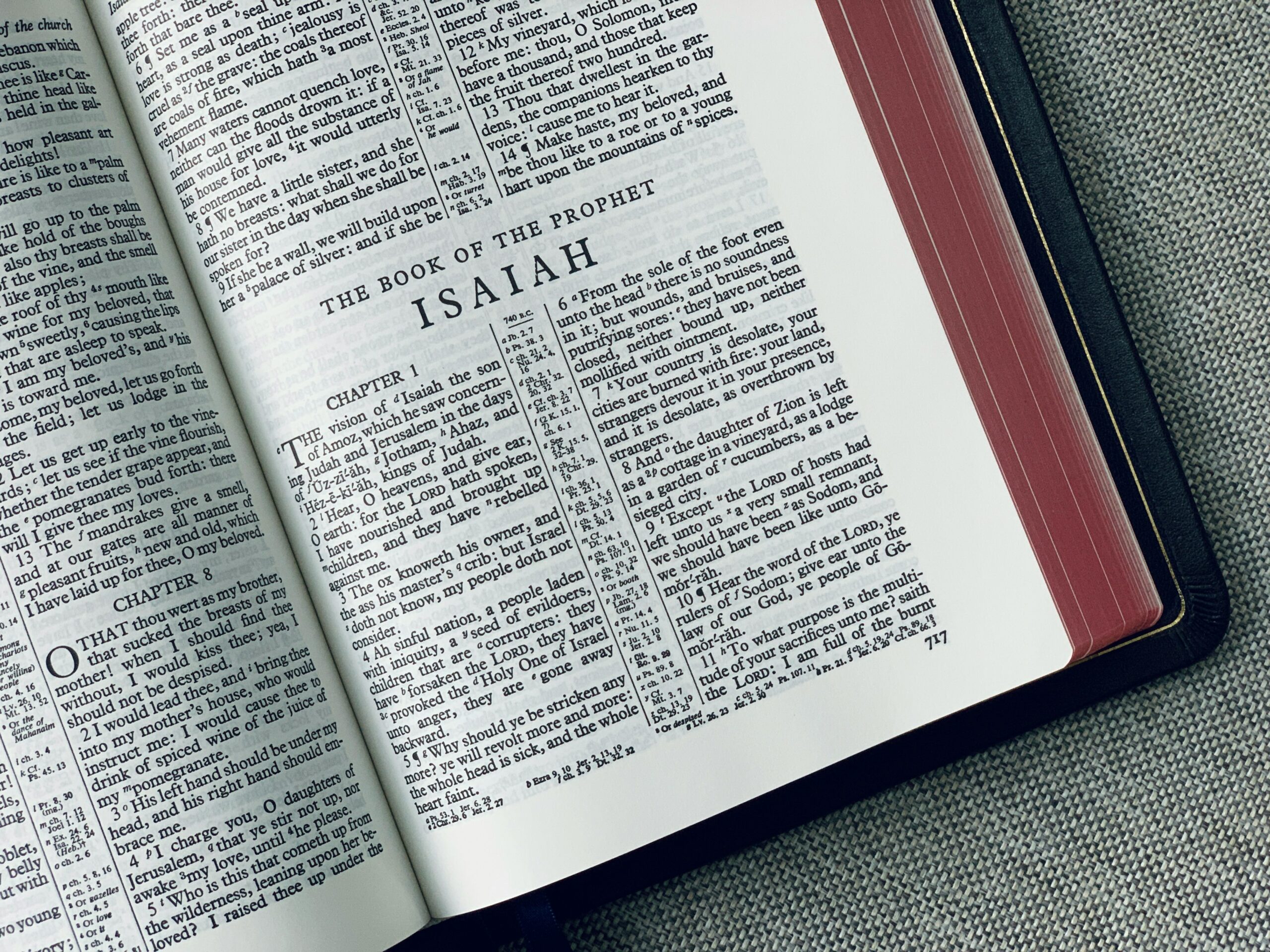
God’s Shepherd
The sermon explores Isaiah 40:11 as a profound portrait of Jesus Christ, the Messiah, depicted as the ideal shepherd. It argues that this single verse encapsulates three distinct aspects of Christ’s pastoral care: practical provision, loving protection, and gentle guidance. The preacher contrasts this tender image with the Jewish expectation of a conquering king, emphasizing that Christ’s rule is characterized by mildness and compassion rather than force. By examining the Hebrew nuances of tending, gathering, and leading, the message highlights how Christ actively seeks the lost, protects the weak, and patiently guides the vulnerable. The sermon concludes by encouraging believers to find rest and security in the knowledge that their Shepherd knows their weaknesses and leads them with deliberate, loving care.
Transcript
Isaiah answered God’s call to
be a prophet, dramatically recorded in Isaiah chapter 6, a lengthy
ministry that ranged from 740 to 680 BC, from the end of King
Uzziah’s reign to King Hezekiah’s. He ministered to the southern
kingdom of Judah for their correction and for their comfort. When you
begin to consider Isaiah the book, Isaiah has been called
the Mount Everest of Hebrew prophecy. It has been presented by many different people in many
different ways as the Bible in miniature. The first 39 chapters
are presented as the 39 Old Testament books with a focus on righteousness
and holiness and God’s justice. The last 27 chapters correspond
to the 27 New Testament books, that of glory and compassion
and favor. That’s a bit overplayed because
both of those themes can be found in both halves of the book. But Isaiah can be considered,
can be viewed as a Bible in miniature. There are a few examples of this.
The Bible contains 66 books. Isaiah contains 66 chapters. The Bible has two main divisions. Isaiah has two main divisions. The first division of the Bible,
known as the Old Testament, contains 39 books. The first division
of Isaiah, 39 books. And so on it goes. Well, the overall theme of the
book of Isaiah is salvation. The word salvation appears 26
times in Isaiah, only seven in all other prophets combined.
The outline, as I’ve already alluded, can be broken easily
in two, but then beyond that, the first main division, chapters
one through 12, the second main division, 13 through 27, then
28 through 35, and then finally 36 through 39. The second main division begins
in chapter 40. That’s where we’ll be today.
The overarching theme that is addressed in the entire latter
half of Isaiah’s prophecy is a call to repentance for the
enjoyment of the salvation of God. But the second half of Isaiah’s
prophecy is not only historically and theologically profound, it
is poetically and structurally beautiful as well. Chapters 40
through 66 are appropriately divided into three perfectly
even groupings of nine. Nine addresses, each throughout
which there is a contrast in each one. In the first, there’s
a contrast with God and idols, chapter 40 through 48. God’s suffering servant is then
contrasted, that is Jesus Christ, with his eternal glory. And then finally, the final contrast
is sinful hypocrisy contrasted with humble faith. Would God’s
people please turn to Isaiah chapter 40. I’ve taken occasion over the last
several years, I think 12 in total, to preach, especially
during the Christmas season, some of the very clear messianic
passages and chapters in Isaiah’s prophecy. In times past, we’ve
looked at sections of this book. In one occasion, we looked at
the entire chapter. Today, I want to look at one
verse. Chapter 39, Isaiah has just rebuked King Hezekiah for
boastfully showing all of his treasures to the Babylonian messengers. And Isaiah prophesied that one
day Babylon will plunder his In chapter 40, Isaiah turns the
corner and begins to present a vision of the Messiah’s incarnation,
the coming of Christ. The great theme, as one said,
of this section is Jesus Christ in his sufferings and the glory
that shall follow in his kingdom. It’s a comforting announcement.
It’s a soothing, gracious announcement of salvation. As one characterized
it, it looks further yet to greater things, much of Christ and the
gospel of his grace. While the prophet is speaking
of the redemption of the Jews, he had in his thoughts a much
more glorious deliverance, the deliverance of people from sin. Follow along with me, Isaiah chapter
40. Comfort, O comfort my people,
says your God. Speak kindly to Jerusalem and
call out to her that her warfare has ended, that her iniquity
has been removed. that she has received of the
Lord’s hand double for all her sin. The voice is calling, clear
the way for the Lord in the wilderness, make smooth in the desert a highway
for our God. Let every valley be lifted up
and every mountain and hill be made low and let the rough ground
become a plain and the rugged terrain a broad valley. Then
the glory of the Lord will be revealed, and all flesh will
see it together. The mouth of the Lord has spoken. The voice says, Call out. Then
he answered, What shall I call out? All flesh is grass, and
all its loveliness is like the flower of the field. The grass
withers, the flower fades when the breath of the Lord blows
upon it. Surely the people are grass. The grass withers, the
flower fades, but the word of our God stands forever. Get yourself
up on a high mountain, O Zion, bearer of good news. Lift up
your voice mightily, O Jerusalem, bearer of good news. Lift it
up, do not fear. Say to the cities of Judah, here
is your God. Behold, the Lord God will come
with might, with his arm ruling for him. Behold, his reward is
with him and his recompense before him. Like a shepherd, he will
tend his flock. In his arm, he will gather the
lambs and carry them in his bosom. He will gently lead the nursing
ewes. Who has measured the waters in
the hollow of his hand, and marked out the heavens by the span,
and calculated the dust of the earth by the measure, and weighed
the mountains in a balance, and the hills in a pair of scales?
Who has directed the Spirit of the Lord, or as his counselor
has informed him? With whom did he consult, and
who gave him understanding? And who has taught him the path
of justice, and taught him knowledge, and informed him of the way of
understanding? Behold, the nations are like
a drop from a bucket, and are regarded as a speck of dust on
the scales. Behold, he lifts up the islands
like fine dust. Even Lebanon is not enough to
burn, nor its beasts enough for a burnt offering. all the nations
are as nothing before him, they are regarded by him as less than
nothing and meaningless. To whom then would you liken
God? Or what likeness will you compare
with him? As for the idol, a craftsman
casts it, a goldsmith plates it with gold, and a silversmith
fashions chains of silver. He who is too impoverished for
such an offering selects a tree that does not rot. He seeks out
for himself a skillful craftsman to prepare an idol that will
not totter. Do you not know? Have you not
heard? Has it not been declared to you
from the beginning? Have you not understood from
the foundations of the earth? It is he who sits above the circles
of the earth, and its inhabitants are like grasshoppers. He stretches out the heavens
like a curtain and spreads them out like a tent to dwell in. It is he it is who reduces rulers
to nothing, who makes the judges of the earth meaningless. Scarcely
they have been planted, scarcely they have been sown, scarcely
have their stock taken root in the earth, but he merely blows
on them and they wither, and the storm carries them away like
stubble. To whom then will you liken me? That I would be his equal, says
the Holy One. Lift up your eyes on high and
see who has created these stars. the one who leads forth their
hosts by number. He calls them all by name because
of the greatness of his might and the strength of his power.
Not one of them is missing. Why do you say, O Jacob, and
assert, O Israel, my way is hidden from the Lord, and the justice
due me escapes the notice of my God? Do you not know? Have you not heard? The everlasting
God, the Lord, the creator of the ends of the earth, does not
become weary or tired. His understanding is inscrutable. He gives strength to the weary,
and to him who lacks might, he increases power. Though youths
grow weary and tired, and vigorous young men stumble badly, yet
those who wait for the Lord will gain new strength. They will
mount up with wings like eagles. They will run and not get tired.
They will walk and not become weary. I would call this one
of the hallmark chapters of all of the Bible. It opens with this threefold
pronouncement. In the first, rather an introduction,
the first 11 verses, it talks about the comfort of God that
is being given. And it’s obviously a substantial
comfort because he begins to talk about the preparation for
glory in verses three through five. And then he introduces
this almost conundrum, these seemingly incongruous elements
of the eternality of God’s word compared with human flesh, frail
as it is. The second great message is not
only the God of salvation, but the second message beginning
in verse 12 is the God of peace. He is a God of peace. He has
come to bring peace and salvation to this earth. And then he is
contrasted with idols in the third and final discussion. I wanna take you back to the
first, and now it would have us adjust our lens. I wanna look
at just a section very briefly. This opening section where God
announces a shepherd. In the opening 11 verses, they
serve as introductory remarks to this entire chapter. They
provide the context, if you will, for the following addresses.
Isaiah is declaring his directives to his servants, his prophets. And he gives them the comfort
of peace, that this is a good message they will bear. It’s
not a message of judgment. It’s a message of comfort. It’s
a message of salvation. In verses three through five,
he presents this conundrum. As I have already pointed out,
these two incongruous things, perishing flesh, and God’s eternal
word, how do those two interface? And that’s where he comes to
this first message that he has an exhortation for his prophets
to proclaim. He has a message for them. That in this conundrum, this
eternal word of God and this frail flesh, there is a mediator. And in verses
nine through 11, he introduces the shepherding ruler that is
our Lord Jesus Christ. He introduces him in verse nine,
and then he begins to tell us about this Messiah. What is he
like? The end of verse nine, he says
that this Messiah is God. This Messiah is mighty, verse
10. This Messiah is a judge. at the end of verse 10, and then
finally in verse 11. And this is where I would have
you dial down your microscope one last click. In verse 11,
he presents the Messiah as a shepherd. He’s God’s shepherd. He’s sent
by God as the shepherd, the great shepherd. As John records of Christ, he
is the good shepherd. We’ve spoken much in the previous
few weeks about shepherds, shepherding, God’s gift, his provision to
the local church. The passages that we considered,
Ephesians 4, Hebrews 13, offer instruction to the church and
to the shepherds. There’s much also throughout
the New Testament that weaves a beautiful tapestry, doesn’t
it, of instruction or pastoral instruction. Still, we may come
away desiring a more graphic picture, a visible example of
what a shepherd looks like. John chapter 10 is certainly
one of those passages, but I know of no single verse other than
the one we consider this morning. that presents such a careful,
helpful, and beautiful image of the great shepherd at work. It’s a picture of the Lord Jesus
Christ. It’s God’s shepherd. And Isaiah
presents the Messiah as the model shepherd that any other shepherd
would look to. The Messiah, the Lord Jesus Christ,
is a caring shepherd. He’s a loving shepherd. He’s
a gentle shepherd. Three times in this one little
verse, Isaiah presents the Messiah himself in the image of a shepherd. Look at it just briefly. He speaks
of a shepherd tending his flock, gathering his lambs, leading
the nursing ewes. In the Old Testament, this illustration
was used of God himself, wasn’t it? One of our dear and favorite
Psalms, Psalm 23, the Lord is my shepherd, I shall not want.
He makes me lie down in green pastures. He leads me beside
quiet waters. He restores my soul. He guides
me in the paths of righteousness for his name’s sake. Even though I walk through the
valley of the shadow of death, I fear no evil for you are with
me. Your rod and your staff, they
comfort me. You prepare a table before me
in the presence of my enemies. You’ve anointed my head with
oil. My cup overflows. Surely goodness and loving kindness
will follow me all the days of my life. And I will dwell in
the house of the Lord forever. This is the image of God as the
shepherd, the great shepherd of his people. that the image
of a flock and a shepherd is not limited there to the Psalms,
the recurring theme in Jeremiah. Jeremiah 13, 17 speaks of the
flock of the Lord. 31, 10 speaks of those. He has scattered Israel and he
will scatter Israel and gather them and keep him as a shepherd
keeps his flock. Could I have you turn, though,
From Isaiah, three books to your right to Ezekiel, chapter 34. It’s a beautiful passage. Ezekiel, chapter 34, beginning
in verse 11. Beautiful thing about turning
in your Bibles. I can always tell when most of
you are there. Ezekiel 34, 11, for thus says
the Lord God, behold, I myself will search for my sheep and
seek them out as a shepherd cares for his herd in the day in which
he is among his scattered sheep. So I will care for my sheep and
I will deliver them from all the places to which they were
scattered on a cloudy and gloomy day. I will bring them out from
the peoples and gather them from the countries and bring them
into their own land. I will feed them in the mountains
of Israel, by the streams, and in all the inhabited places of
the land. I will feed them in a good pasture,
and their grazing ground will lie on the mountain heights of
Israel. Then they will lie down on good grazing ground and feed
in rich pasture on the mountains of Israel. I will feed my flock,
and I will lead them to rest, declares the Lord God. I will
seek the lost and bring back the scattered, bind up the broken,
strengthen the sick, but the fat and the strong I will destroy,
so I will feed them with judgment. This is a picture of God as the
shepherd of his sheep. We have this recurring motif,
this image, this metaphor throughout scripture, but here in Isaiah,
it’s applied directly to the Messiah. The New Testament, as
you know, likewise characterizes the Lord Jesus Christ as a shepherd. In Matthew chapter two, The Magi’s
answer to Herod’s question, where is this individual to be born? In Bethlehem, they said, in the
land of Judah, by no means least among the leaders of Judah, for
out of you shall come forth a ruler who will shepherd my people Israel. We’ve looked in times past at
John chapter 10, only the briefest allusion this morning for the
sake of time, I am, Jesus says, the good shepherd. The good shepherd
lays down his life for the sheep. Many and numerous other passages
speak of Christ as a good shepherd, but as I said, there isn’t any
one passage. Some allude to him, some as Ezekiel,
a very lengthy description, But this one passage captures Christ
shepherding his people. It’s a beautiful image. Isaiah presents the Messiah as
the model shepherd. He’s a caring shepherd that renders
practical care to his people. He’s a loving shepherd that exhibits
genuine affection for others, and he’s a gentle shepherd that
guides and leads. with great delicateness. One
pastor said of this verse, in this verse, the mild and gentle
character of his government over his people is predicted. It would not be that of a conqueror
over his vanquished subjects. You see, that’s what the Jewish
nation expected. They wanted a conquering king,
not a suffering servant, and certainly not a shepherd. but
it would be mild and tender like that of a shepherd who carries
the lambs which are unable to walk in his own arms and gently
leads along the feeble and the delicate, the same tender care,
guardianship, and protection which a shepherd shows his flock. Let’s consider Christ. Let’s
consider Christ in his image as a shepherd. First of all,
Jesus Christ is a shepherd who is characterized by practical
care. Practical care, look at verse
11. Like a shepherd, he will tend his flock. Hebrew word there, you read?
He will lead them. He will watch over them. He will have a kindly regard
for them. He will care for them. In the
most practical terms, he will respect and observe and watch
over them. The word here means much more
than to feed. which is generally, that’s almost
what it’s reduced to in some commentaries, is just a reference
to God feeding us, Christ caring for our physical needs. It means
much more than that. What he’s talking about here
is all the care that a shepherd can render to his flock. And
I would have the saints to begin to think of all the ways that
Christ cares, does care, and has cared for you. in the most
practical terms. One faithful Puritan put it this
way, he performs his whole office as a shepherd. Everything that
Christ does is with regard to caring for the saints. He performs
his whole office as a shepherd, not only by providing food for
his flock, but by leading them into green
and good pasture, his church and its ordinances, by appointing
under shepherds to feed them with the doctrines of the gospel,
wholesome words, by protecting them from all their enemies,
the roaring and devouring lion, Satan, and the wolves in sheep’s
clothing, false teacher, by taking such notice and account of them
as none of them shall be lost, and by doing all that is expressed,
in Ezekiel 34, 16, seeking that which was lost, bringing back
that which was driven away, binding up that which was broken, strengthening
and healing the sick, as well as watching over them night and
day. The Lord Jesus Christ does all that for us and more, more
than we could ever recognize, more than ever we will acknowledge.
Jesus Christ watches over with great wisdom, knowing the beginning
from the end. He watches over with great compassion
all of his children, and it includes everything that pertains to our
life as believers. He cares for our souls. He gives
us wisdom and guidance. He pours teaching before us. He feeds us His Word. He gives
us instruction. He renders to us guidance. Matthew 11 28 speaks of Christ
in those simple but profound words. Come to me, all who are
weary and heavy laden, and I will give you rest. It is the appeal
of a loving shepherd that bids believers to come before him,
to come to him for care. Jesus Christ, as a shepherd,
gives his children everything they could ever possibly need.
When they come to him, he gives them the righteousness that only
he possesses in salvation. As those are brought to repentance
and faith, He justifies them before His Heavenly Father. He pours into them the indwelling
of His own Holy Spirit who leads us and guides us and teaches
us and comforts us and convicts us as has need. God has not left us to grope
in the dark, but Jesus Christ, the final word to humanity, is
encompassed throughout the New Testament. It explains the Old
Testament, but in its completion, God’s word is finalized through
the New Testament. Even still, having given us His
Spirit and His Word, Jesus Christ goes before His Heavenly Father
and pleads. He intercedes for us. What a
shepherd. He cares for us. There are no
prayers too small. There are no issues where we
are not encouraged to go before our Lord and ask, even to press. Ask, seek, and knock. When we know pain, only the Lord
Jesus Christ can empathize, having experienced all that we do, yet
without sin, he comforts us, pours into us his comforting
grace. On top of that, he gives us the
fellowship of the saints. like-minded believers with whom
to walk in this world. He cares for us. We’re not a
solo flock. We’re not a lone sheep on a mountainside. We’re among brothers and sisters
in Christ. And then, so abundantly is his
blessing, he gives us a godly heritage. People that we can
look up to, that have gone before us, and people that will follow
after us. By God’s grace, he gives us biblical
instruction, practical care. J.C. Ryle said of him, like a
good shepherd, Christ cares tenderly for all his believing people.
He provides for all their wants, leads them by the right way,
bears patiently with their many weaknesses and infirmities, and
does not cast them off because they are wayward, erring, or
sick. He guards and protects them from
all their enemies and those that the Father has given him. He
will be found at last to have lost none. What a shepherd. What a loving, faithful shepherd
this is. Jesus Christ is a shepherd that
is characterized by practical care. And it began with him paying
for our sin. That’s not the only thing that
this one little verse testifies of Christ. As I said, it’s a
simple verse, and in a sense, these three statements all run
together. They all say essentially the
same thing, but they’re different enough that as we step back and
look at them plainly, there are three different things said of
Christ. The Messiah is not only the model
shepherd is characterized by Jesus’ practical care, but secondly,
the Messiah is presented here as a shepherd that is characterized
by loving protection. Loving protection. Look at the
verse again. Like a shepherd, he will tend
his flock. He will gather the lambs and carry them in his bosom. The Hebrew word here, there are
two verbs, gather and carry. But the word here, this gathering,
is of a wayward sheep, of a dispersed people, of a sinful people, of
a people who have their back turned to God, who are dead in
their trespasses and sins. This is a Messiah who has a kindly
regard for his flock, a kindly regard for his people. He goes
searching for the one lost sheep. It’s a beautiful picture. The
picture of the Lord Jesus Christ, the Savior, the God of all creation,
stooping down, condescending to go look for one lost sheep,
and having found it, Which she cannot possibly follow after
too weak to walk to evil This loving Savior scoops up the sheep
in his arm and if you place your faith in Christ, you know this
sentiment and He gathers this sheep to himself and he holds
it to his chest This This is the sheep who’s wayward
and weak, and probably worn out and just plain exhausted. The
Savior comes to him and gathers him to himself. It’s not just
that he’s weak. He’s terrifically vulnerable. And many of us, we know just
enough to be dangerous, don’t we? We know who Jesus is, and
then we rush out, we buy the latest book, and we get caught
up in error so easily. Jesus Christ is a loving shepherd
that protects his sheep. He gives them what they need
most, and that is the loving protection of a Savior. John Calvin said of these words,
They describe God’s wonderful condescension. For not only is
he actuated by a general feeling of regard for his whole flock,
the 99th, but in proportion to the weakness of any one sheep,
he shows his carefulness in watching, his gentleness in handling, and
his patience in leading. Here he leaves out nothing that
belongs to the office of a good shepherd, For the shepherd ought
to observe every sheep, so as to treat it according to its
capacity. And especially they ought to
be supported if they are exceedingly weak. Jesus Christ knows this,
right? Jesus Christ knows those who
are weak. Hebrews 4.15 says, we do not
have a high priest who cannot sympathize with our weaknesses,
but one who has been tempted in all things as we are. Jesus
Christ knows weakness when he sees it. No wonder Paul admonishes the
Thessalonian believers, admonish the unruly. If there are those
that are disorderly, they should be warned and admonished. Encourage
the fainthearted. Come alongside those who are
feeble and weak and untaught, who are undisciplined. Come alongside
and encourage the fainthearted. Help the weak. Pick them up if
you have to. Sit down with them if you need
to. Pray with them. admonish the unruly, encourage
the faint-hearted, help the weak, be patient with everyone. That’s
a shepherd. These young, weak sheep, they don’t see themselves as
God sees them. They don’t know the dangers that
lie about. Jesus Christ does. and he gathers
them to himself for the protection that only a loving Savior can
provide. Jesus Christ looked out on a
city that was like a sheep without a shepherd. He had compassion
for them. And so for those wayward sheep,
he provides instruction from his word. He gives us principles
by which to live. He gives us the church in which
to come in and to take refuge from the rage that is swirling
about in the world. He gives us shepherds, earthly
shepherds, to watch over our lives. He gives us our fellow
saints with whom to walk. Shepherds, this whole motif would
have been completely foreign. to the Jews of Isaiah’s day. They had clergy, they had church
leaders, but those church leaders were aloof and detached, holier
than thou. That’s not what God calls us
to. One faithful pastor put it this
way, our Lord here shows the distinguishing mark of a good
shepherd. He will lay down his life for
the sheep to save, protect, and defend them. He will imperil
his own life, like David attacking the lion and the bear, rather
than let one of them be taken from him. Friends, Jesus Christ
has already laid down his life for you. He’s already given you
the ultimate protection. It’s the blood of Christ. You
place your faith in him, you cannot be seized from his arms. You cannot be taken from him,
not by a wolf, not by anyone, not by the devil himself. This is God’s shepherd. And Isaiah
presents here in this single verse, the Messiah, the model
shepherd, who is characterized by practical care, by loving
protection, and finally by delicate guidance. Delicate guidance. Look at the verse. Like a shepherd,
he will tend his flock. He will gather the lambs and
carry them in his bosom and gently lead the nursing youth. What he points to here in the
nursing youth would be the weakest and the most vulnerable of all.
Those sheep that are literally carrying and bearing little baby
sheep. They’ve fallen behind the flock. They can’t keep up. If the shepherd
overdrives them, they will be left behind. If the shepherd
charges up the hill, they will be taken. But not this shepherd. The shepherd loves them. He waits for them. And he gently
leads them along. This is such a rich word in scripture. It’s used to lead them to a watering
place in Psalm 23. In Psalm 31, it’s leading us
out of peril. You pull me out of the net which
they have secretly laid for me. It is used of bringing one to
a place of peace, a place of solace. Exodus 15, in your loving
kindness you have led the people whom you have redeemed. Special care that the shepherd
renders They are the objects, these sheep, these people. They are the objects of the shepherd’s
loving care. And he is going to gently lead
them and graciously guide them. He leads his sheep, he does not
drive them. Genesis 33 paints a very beautiful
picture of this very thing Says my Lord knows that the children
are frail and the flocks and herds which are nursing are a
care to me and if they are driven hard One day all the flocks will
die. That’s exactly the image here
It’s female sheep heavy with child, soon to be left behind,
if not for a loving, caring shepherd. Jesus says, take my yoke on you. Learn from me. I am gentle and
humble in heart. You will find rest for your souls.
Jesus Christ is a caring, loving Savior. Not
only does he give us instruction from his word as we’ve seen,
but he gives us counsel and divine guidance. He gives us his good
providence. He gives us conviction by means
of the Holy Spirit indwelling us, which I say all the time
is a sign of life. Conviction is not a bad thing.
Paul’s admonition to young Timothy was, I believe seasoned with
this very thought. Preach the word, he says in 2
Timothy 4.2. Preach the word. Be ready in
season and out of season. Be always ready to nourish the
sheep. Preach the word. Reprove, rebuke,
exhort. There are many different ways.
There are times where you need to appeal to someone in the strongest
terms possible. Reprove, rebuke, exhort. Exhort
with great patience and instruction. That’s a model of our Savior,
isn’t it? Isn’t he patient with you? Or is it just me? Over and over again, this beautiful
picture is painted in Scripture, 1 Corinthians 1. Consider your
calling, brethren, there were not many wise. That’s a good
thing. not many wise according to the flesh, not many mighty,
that’s a great thing, not many noble, but God has chosen the
foolish things of the world, people like you and I, to shame
the things that are wise and God has chosen the weak things
of the world to shame the things which are strong and the base
things of the world and the despised God has chosen the things that
are not so that he might nullify the things that are so that no
man may boast before God. God loves a weak sheep. God loves a feeble sheep. God
loves an ignoble sheep. God loves sheep. And in this one verse in the
most We have a model of what it is
to love sheep. Modeled by the Lord Jesus Christ
himself. Would you join me in prayer? Lord God, we humble ourselves
in your glorious presence. And we thank you That these are
not just theoretical words. This isn’t a training manual
for young pastors. This is the very Word of God.
This is the truth. This is not only prophecy, but
we know that this prophecy has already come true.
Messages: 15