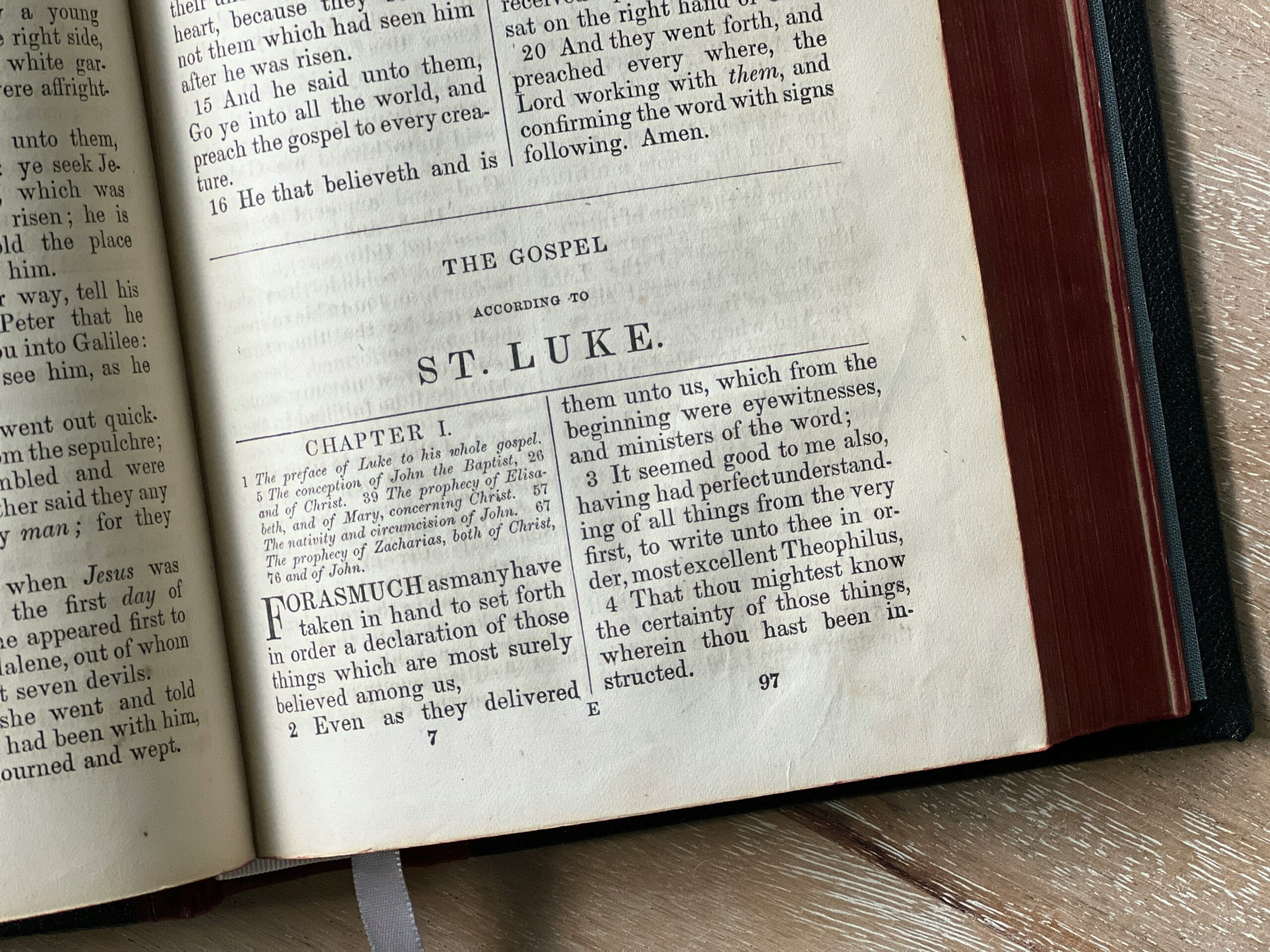
Compelled to Christ
This sermon reinterprets the Parable of the Good Samaritan not as a simple call to kindness, but as a theological argument demonstrating the impossibility of earning salvation through works. The central message argues that the law’s mindset of merit, its standard of perfection, its definition of neighbor, and its promise of life all serve to convict the sinner and drive them toward Christ. By exposing the arrogance of the lawyer who sought to justify himself, the text highlights that human effort is insufficient for eternal life. Instead, the sermon presents the law as a mirror that reveals sin, compelling believers to rely wholly on the finished work of Jesus, who perfectly kept the law and offered Himself as the sacrifice for sin.
Transcript
that I’ve preached before on
a number of occasions, but several years ago took a new run at it
and based on the context and the study, came away with just
an absolutely eye-opening perspective on this passage and one that
I preached here to the saints at Cornerstone a couple of weeks
ago. And when I preached it, I was just so encouraged at the
message and I had hoped that I would get to preach it to you
again sometime. I had no idea that it would be
this week. If you would, I want to take you to Luke chapter 10,
which you would know as the passage on the Good Samaritan, the parable
of the Good Samaritan. And really just those words,
don’t they just kind of bring a warmth of recollection of what
that parable means. The well-known phrase just elicits
all those warm feelings and images of good deeds. In fact, entire
ministries have sprung up over the centuries bearing that very
name. Good Samaritan ministries, either
soup kitchens or whatever. A tow truck that stops in the
night. If our vehicle breaks down on
the road, our prayer is for a Good Samaritan, isn’t it? Indeed,
this is one of, if not the most well-known of all of Jesus’ parables. The parable of the Good Samaritan.
But as well-known as it is, perhaps it is one of the least understood. We know of it as a heartwarming
story of a selfless act of kindness. rendered by this Samaritan. And
really, that’s about the extent of our understanding of this
passage. And there is a point to be made in that, a plea to
exercise the golden rule. I mean, it’s there, but that’s
not the point of the passage at all. Treating the other person
like he would like to be treated, that’s there, but that’s not
Jesus’ point. It’s a lesson to which we constantly
need to be admonished to look for the needs in others and respond
to those as we’re able. But if that’s all you take away
from the parable of the Good Samaritan, what do you lose? You lose plenty. Consider once
again patiently this morning and objectively as we stand back
and even take a different approach as we consider the parable of
the Good Samaritan. which for our purposes this morning, I
might even suggest a different title. This one probably won’t be memorialized down through
the ages, but the title I would suggest is the Spiritual Battle
of the Arrogant Lawyer. Try that one on. If you would,
let’s go to the parable of the Good Samaritan beginning in verse
25 of Luke’s Gospel 10. Chapter 10 of Luke’s Gospel.
And behold, a certain lawyer stood up and put him to the test
saying, Teacher, what shall I do to inherit eternal life? And
he said to him, What is written in the law? How does it read
to you? And he answered and said, You shall love the Lord your
God with all your heart, with all your soul, with all your
strength and with all your mind and your neighbor as yourself.
And he said to him, You have answered correctly. Do this and
you will live. But wishing to justify himself, he said to Jesus,
and who is my neighbor? Jesus replied and said, a certain
man was going down from Jerusalem to Jericho and he fell among
robbers and they stripped him and beat him, went off leaving
him half dead. And by chance, a certain priest
was going down on that road. And when he saw him, he passed
by on the other side. And likewise, also a Levite,
when he came to the place and saw him, passed by on the other
side. But a certain Samaritan who was
on a journey came upon him, and when he saw him, he felt compassion.
And he came to him and bandaged up his wounds, pouring oil and
wine on them. He put him on his own beast and
brought him to an inn and took care of him. And on the next
day, he took out two denarii and gave them to the innkeeper
and said, take care of him. And whatever more you spend,
whatever more you spend when I return, I will repay you. Which
of these three do you think proved to be a neighbor to the man who
fell among the robber’s hands? And he said, the one who showed
mercy toward him. And Jesus said to him, go and
do the same. Interpretations, no doubt, have
varied through the centuries on this passage. Typically, the
traveler stands as representing humanity at large. One interpretation had it that
the journey is from Jerusalem, the heavenly city, the paradise
of man’s first estate to Jericho, the evil and accursed city. And
so there is all this embellishment that gets placed upon this passage. The robbers are said to be the
powers of evil who strip this man of his robe of innocence
and purity and smite him and leave him spiritually half dead.
And so there is this tendency to read in and to spiritualize
and allegorize this great and very simple parable. Misinterpretation goes on to
say that Christ then comes and helps this man where others have
failed. The beast on which he rides is
the human nature in which the Word dwelt, and it is upon that
humanity of His that bids us rest and comfort. I mean, just
absolutely clouding the simple words of Christ. One even went so far as to say
that man is Adam stripped of his original, rather, the man
in the parable is Adam stripped of his original righteousness.
The robbers, of course, are the devil. The priest and the Levite
are the Old Testament ministry. The Good Samaritan is Jesus.
The oil, of course, you will recognize as the comfort of the
Holy Spirit. The wine is the exhortation to
work. Maybe he was full of much wine
when he interpreted the passage. The inn is the church. The two
coins are the two commands of God to love your neighbor. Love
God and love your neighbor. And of course, the innkeeper
is Paul. I mean, just absolutely ridiculous. One commentator even
chides the wounded man for traveling alone, completely missing the
fact that all four men in the parable traveled alone. I want to take a different approach.
I want to just look at the words of Christ. Let’s consider the
words of Christ in their simplest meaning. And let’s consider what
this parable means. Essentially, what Christ is laying
out is the law’s deal. The law’s bargain. The law’s
arrangement for a sinner. How can the law help the sinner? And what Christ gives is four
elements of God’s law that compel the sinner to Christ. What Christ
did here is not playful or arrogant. It is the most gracious answer
ever given to an arrogant, arrogant lawyer. Christ, in great patience, gives
this lawyer what he needed most, and that is a clear understanding
of the Gospel in an understanding of the law. Consider, if you
would, first of all, the law’s mindset. The law’s mindset. The law’s mindset is work. Look
at the lawyer again in verse 25. Behold, a certain lawyer
stood up and put him to the test. And let me just clarify before
we even get going. If you’re sitting there with
your own particular arsenal of lawyer’s jokes, save it because
it’s not that kind of a lawyer. This isn’t the ambulance chaser
kind of lawyer. This isn’t the one who litigates
in a courtroom. This lawyer is akin to a scribe,
a student, an expert in the law of God. Similar to a scribe, and both
had the same function, that of preserving and expounding the
law of God. And it says a certain lawyer
stood up and put him to the test. This man had evil in his heart.
This man was challenging none other than the Lord Jesus Himself. He didn’t have good intentions. Neither did he even have neutral
intentions. He had evil in his heart from
the very beginning. He wanted to trip Jesus up in
public. He stood up and put Him to the
test. Those words don’t necessarily
mean that they’re malicious, but as his heart is uncovered
here, you see where his heart was. The motive of this man was evidently
not right, J.C. Ryle said. He only asked the
question to tempt our Lord, to provoke Him into saying something
on which His enemies might lay hold. And his question was simple.
Teacher, what shall I do to inherit eternal life? That is the law’s
mindset. How can I earn my way to heaven?
How can I work my way into a position of forgiveness? That is the perennial
question of the human heart. One commentator’s title for this
little section of Scripture was, The Work Which Saves. Because
the man’s question rested on the idea of the merit of good
works. That was his whole mindset. That
was the pharisaical mindset. That if we can only do a certain
amount of things and we must do them in order to earn our
salvation, but it is earnable. It was a question brewing in
the hearts of many. In Luke 18, it’s recorded that
a ruler questioned Jesus saying, good teacher, what shall I do
to inherit eternal life? And Jesus goes on and gives him
essentially the same challenge. The question of the lawyer is
the question of the human heart everywhere and at all times.
You’ll find it asked and answered in all of the world’s religions.
What must I do to gain eternal life. But in this question, there
is an evident strain of a pernicious heresy that mankind will not
let go of. And that is the heresy of works. That we can actually do enough
and work enough and live a good enough life to earn us a place
in heaven. The foundation of this lawyer’s
question was the idea that eternal life was the reward of merit,
of works. And the only question was, what
were these specific works? If he could only lay his hand
on that specific list of to-dos, heaven was his. Or was it? Many have said, I didn’t coin
the phrase, but there are two religions in the world, salvation
by human effort and salvation by divine accomplishment. The
lawyer was just simply going by way of the former. Salvation
by human effort. Salvation by self, said Charles
Spurgeon, is man’s darling hope. Salvation by doings and feelings
or something or other of their own is the favorite delusion
of sinners. Even though the lawyer proposes
this question in the first person singular, what must I do? What he really means is theoretically,
how do we all collectively get to heaven? What must we do to
be saved? And so the law’s mindset is a
mindset of doing, of working. Something to gain something else
through a system of works, earning salvation. And that points us to Christ.
That points us to Christ. But secondly, so does the law’s
standard. The law’s standard points us
to Christ, secondly. Go back again if you look at
v. 26 where Jesus said to him, what
is written in the law? How does it read to you? That phrase was one that was
constantly used by the rabbis and the scribes and certainly
this lawyer would have recognized it immediately. It was how they
graciously challenged one another in the Word. We have friends
that are involved You know, these Bible trivia contests and and
this was a very common interplay between rabbis. And so, in a sense, coming from
Christ, it was a grave rebuke. to this rabbi to be put on the
spot by this so-called lawyer and then to have the tables turned
on himself. The man was just absolutely exasperated
with Christ at this very point. The lawyer deserved to get no
other answer, though, because his question wasn’t sincere in
the first place. The lawyer answers Christ. And he said, you shall love the
Lord your God with all your heart, with all your soul, with all
your strength, with all your mind and your neighbor as yourself.
He couldn’t even quote Scripture in its completeness. It was abrupt. It was impromptu. It was kind of in your face. Of course, this is what it means.
He kind of almost paraphrases and rapidly goes through this
thing in a hasty manner to throw it up in the face of Christ as
being just basic. Simple. It was the Shema, Deuteronomy
6.5, which was repeated every morning and evening by the Jews. It was the same exact response
provided by Jesus Himself on another occasion. One of them,
a lawyer, Matthew 22, asked Him a question, testing Him, Teacher,
what is the great commandment in the law? And Jesus gave this
essentially the same answer. This lawyer knew. He knew at
the core of his being that he was to love the Lord his God
with all of his heart. The amazing thing is he thought
that he had done it. He really believed that he had
done it. The whole duty of mankind is
summed up in these words. The work of loving God into all
of him, into all ways. It was summed up in these words.
And we are to prize God. We are to highly esteem Him.
Those things haven’t changed, but this lawyer actually believed
that he had done it in great completeness. And when he said, and your neighbor
as yourself, he really believed that he had done that, too. I
mean, conceptualize this for a minute. The lawyer actually
thought, look, this is a checklist. I’ve got these things done. I’ve
loved God perfectly and I’ve loved my neighbor perfectly.
What other things do you have for me to do? Now, the rabbi’s standard for
what was a neighbor was pretty low. They wouldn’t put an Israelite
to death for killing a Gentile because He wasn’t even his neighbor. They didn’t even consider a Gentile
to be his neighbor. If they saw a Gentile in danger
or in danger of death, they didn’t think that they had any obligation
to render any kind of assistance to them. According to the law, though,
The requirements for inheriting eternal life are perfect love
towards God and perfect love towards one’s neighbor. The law
is an exacting, precise and incredibly high standard. Wholehearted love for God, said
one, means coming in some measure to see other people as God sees
them and all people as the objects of God’s love. Therefore, anyone
who truly loves God with all his being must and will love
others. No wonder Christ’s response is
almost equally curt. But I’ve told you before that
I think it’s the most gracious thing in the world he could say.
What he wants the lawyer to realize is what he’s actually saying.
And He said to him, look at verse 28. You’ve answered correctly. You have answered correctly.
Do this and you will live. If you go out and continue to
love the Lord your God with all your heart, soul, mind and strength
perfectly, and love your neighbor as yourself perfectly, you will
live. That’s the law’s standard. It’s
perfection. And if you can do that perfectly,
you have earned eternal life. Jesus wards off this question
and he makes this lawyer, the law expert, repeat his own answer. And then he basically teaches
him how far off he was of this great standard. When Jesus closes
with these words, do this and you will live. There were the
words of a prophet who knew what was in us, who knew what was
in the man. Jesus knew this man’s heart because
He knows all of our hearts and it wouldn’t have mattered who
asked Him the question. Not a one of us has ever loved
God perfectly for even a day, much less a life. One pastor said, There’s no doubt
about it. His words are plain. Do this
and you will live. But do what? Love? A safe kind
of teaching salvation through works? No. If by doing this,
but only by doing this, a man is to be saved by doing, then
it makes only clear as the Son that not only by doing or that
only by doing will any be saved. Jesus wasn’t falling into this.
He’s basically laying out the very position that to love God
perfectly and to love your neighbor perfectly is absolutely impossible. And he wanted the lawyer to grasp
that. He wanted the lawyer to acknowledge that. He wanted the
lawyer to submit himself to that very reasonable conclusion that
the law is absolutely an impossible standard. Spurgeon said it this
way, if men do not understand the law, they will not feel that
they are sinners. And if they are not consciously
sinners, they will never value the sin offering. What Jesus
wanted from this man was to have him fall on his knees and to
say, oh, put the law away. If that’s what you’re holding
up to me as the standard of how I get into heaven, I am lost
and undone. And that’s exactly what Jesus
wanted. It’s what he wants all the time. Spurgeon goes on and
says, there is no healing a man until the law has wounded him.
There is no making him alive until the law has slain him. The law never came to save men. It came on purpose to make the
evidence complete that salvation by works is impossible. And thus, to drive the elect
of God to rely wholly on the finished salvation of the gospel. When Jesus said, do this and
live, He had no earthly idea. He had no intention of the man
actually thinking that he could do this. Jesus knew he couldn’t.
He wanted to call him to repentance. So not only does the law’s mindset,
a mindset of human effort drive us to Christ, the law’s standard
urges us to Christ. It’s an impossible standard.
And it depends on a perfect life. If it depends on a perfect life,
we’re dead. We’re as good as dead. Thirdly,
I said there were four aspects of God’s law that urge us Christward,
not only the law’s mindset and the law’s neighbor, pardon me,
the law’s standard, but thirdly, the law’s neighbor. And listen to how this goes.
but wishing to justify himself. You know, those are the arguments
we all win, isn’t it? The ones in our mind where, you
know, you’re kind of justifying it. And that’s what he’s doing.
He’s trying to justify himself. He’s trying to let himself off
the hook. Which means that he’s already
seemingly under some degree of conviction. He’s almost there. He knows that the law presents
an impossible standard. Wishing to justify himself, he
said to Jesus, and who is my neighbor? And I think he said
this with all the disdain he could muster. Don’t throw this
passage up at me. Everybody knows that I couldn’t
go out and love every person that I ever come across perfectly. Come now. This is what the Pharisees were
constantly about, wasn’t it? They felt like they had to reinterpret
everything that God ever said in order to justify their positions.
This question implied a conscience that was almost halfway awakened. He was almost there. He realized
the utter difficulty of the law. One said that it’s characteristic
that no doubt it seems to have crossed his mind as to his love
of God. There he felt that he was safe,
but there were some misgivings as to the second commandment.
He really still believed that he loved God perfectly, but the
one that was tripping him up was this love your neighbor deal. The lawyer knew that he didn’t
possess eternal life. The lawyer knew that he didn’t
love all men perfectly, and if that remained God’s standards,
then he was a dead man. What he should have done is confessed
his utter inability to love God and to love his neighbor, but
he didn’t. He maintains his position. He
stands his ground. And now he wants Jesus to answer
him to soften, if you will, the standard. Who is my neighbor? That little turn reflects the
real character of the Lord, doesn’t it? He was a self-righteous man
and he flattered himself, as one said, with the notion that
he could actually deserve eternal life based on his own doings.
That little statement makes clear that he was a self-righteous
man. Consider the context. It’s an answer to the new question
that’s built on the original question, which presents to us
the standard of what a neighbor is. As one pastor said it, the
real aim of the parable of the Good Samaritan is to show the
scribe that the answer to his question is a theological one. It is written by nature on every
heart and that to know nothing is needed but the will to understand
it. But Jesus does not at all mean
thereby in his charitable disposition that this one act of kindness,
this man can earn salvation. In other words, he’s not saying
go out and do some kind act. And Jesus replied to him. And in his reply, this is where
so many have gone astray of the very meaning of this parable.
The reply is the parable, but the reply, this parable is parked
in the context of what has already taken place. And that is these
aspects of God’s law that urge us towards Christ. The law’s
mindset was to work, the law standard was Perfection, the
law’s neighbor, was everyone, as the parable goes on to say.
The law’s neighbor. Thirdly, look at verse 30. Jesus replied and said a certain
man was going down from Jerusalem to Jericho. He fell among robbers
and they stripped him and beat him and went off, leaving him
half dead. That road to Jericho was a truly notoriously dangerous
place. It came to be known as the red
or the bloody way because of the amount of crime that took
place. It wasn’t just a crime of robbery, though, if you look
at the passage, it was a crime of utter humiliation, stripped,
even that of attempted murder. They fully intended this man
to die. Whoever did this to him. Look
at verse 31, and by chance. A certain priest was going down
on that road and when he saw him, he passed by on the other
side. I mean, imagine the hope that
welled up in this wounded man if he was even able to open his
eyes and notice the potential for help. Imagine the utter despair
as this priest goes completely around him. It’s a fascinating
word here. Para. which is also that word
in the parables, to cast alongside something. Paraelphon would mean
to come down next to someone. Paraclete is that word, that
blended word that is spoken of as the Holy Spirit that comes
alongside of us, even to dwell within us. But here the word
is antiparaelphon. This guy went completely around. He couldn’t have gone any further
unless he fell off the cliff trying to get away from this
man. Jesus goes out of his way to
show how neglectful this man was, he went completely out of
his way to avoid this poor man. Verse 32 says, a Levite also,
when he came to the place and saw him, he passed by on the
other side. There are some possible excuses
that have been ventured for these guys. The priest and the Levite,
if they had touched this man, they would have been ceremonially
unclean. Maybe that’s an excuse. But they
were coming down from Jerusalem, not up to Jerusalem. Their religious
business was over. Perhaps they were too busy. But
for a Jew, the most religious and holy task was to bind up
the wounds of the suffering, wasn’t it? Perhaps they thought
it was not my business. Too dangerous. Maybe the robbers
will get me. It’s no use. The man’s probably
going to die anyway. Whatever. It’s not the point
of the parable to get all bound up in their excuses. That’s the
point of the parable. Look at verse 33. But a certain
Samaritan who was on a journey came upon him. The Samaritans,
you know, were the half breeds hated by the Jews. They called
them the worshippers of the pigeon. A man of this race was accused
of misleading the Jews by false signals, defiling the temple
with human bones. Their testimony wouldn’t even
have been allowed in a court of law. No Jew was to even eat
with such a one. They were absolutely considered
the dogs of the world. And here comes a Samaritan. I
mean, by this time, the lawyer is just got to be beside himself.
And when he saw him, when this Samaritan saw this poor, wounded
man, he felt compassion. Something happened to him internally.
It was gut wrenching, literally, when he saw this man. But he
didn’t stop there. It wasn’t just feeling. For some,
it’s enough just to feel their pain, but not for this man. And
he came to him, verse 34, bandaged up his wounds, pouring oil and
wine on them. I mean, what if the man had just
gone to the next town and called 9-1-1? Is that enough? What if
he had called the Red Cross or the city council and said, you
know, you’ve got a problem on that road? His efforts were personal and
selfless and thorough. I remember during our time in
California, the L.A. riots occurred and the image
of the flashpoint and the poor truck driver there in the intersection
and almost from out of nowhere, that tall black man coming to
this poor man’s aid and leading him away from this angry mob. That’s the image that you get
is one that you know what? Look, I’m going to do everything
in my power to help this man. Christ’s words here show that
the lawyer’s question had been asked from the completely wrong
point of view. The question wasn’t who is my
neighbor, but who am I a neighbor to? Who am I neighborly to? But his love didn’t stop there.
He put him on his own beast, brought him to an inn, took care
of him, gave the innkeeper money. Didn’t stop with medical treatment.
It went on to financial assistance. It was sacrificial and personal
enough for several weeks. And Jesus closes this great parable,
which is not a parable about going and doing a good thing
in order to earn anything. Which of these three, verse 36,
do you think proved to be a neighbor to the man who fell among the
robber’s hands? And he said, the one who showed mercy toward
him. I mean, what else could he say? Obviously, this is the
man who was a neighbor. But by this little word game,
the lawyer avoids the absolute shock to his own hatred for the
Samaritans. He wouldn’t even utter his name.
The Samaritan in your story, Jesus. It’s more impossible still People,
the law’s standard drives us to Christ. It’s an impossible
standard. It’s one that’s only emphasized
and underscored by this little illustration that Jesus told
for that very point. If we are to be saved by the
law, we must perfectly and practically love every soul of man that ever
crosses our path on the face of the earth. That’s exactly
what he was saying. And there’s a fourth. aspect of God’s law
that urges us Christward, not only the law’s mindset and standard,
not only the law’s neighbor, but the law’s promise. When Jesus
said, go and do the same. I mean, he puts this on this
man. He puts this standard on this
lawyer when he’d already told him the exacting nature of God’s
law and how impossible it is. Just to recite, the verse tells
us it’s absolutely undoable from a human standpoint. And when
Jesus tells this parable, He tells him how exacting the law
standard is, and now He says, yeah, go do it. You think you’ve
loved God perfectly? You think you’ve loved your neighbor
perfectly? Go ahead. Go do it and you will live as
the law says. It was an echo of Jesus’ words
from verse 28. It’s like this unfortunate lawyer
who never recognized, at least in recorded Scripture, his inability
to keep God’s law perfectly, that perfect standard. Maybe
if you’re in time, able to recognize the impossible standard of the
law, even to the point of despair, you realize that God’s law is
perfect and you are not and you will never be. If you lament
of your sin, if you acknowledge your abject inability to keep
and to remedy your own situation, there is hope. And the hope is
Christ. And that is the point of the
whole parable. It compels us to Christ. The
law points us from the very opening of this passage to Christ. Christ
kept the law perfectly. He offered a spotless life as
the sacrifice for sinners. Proving oneself to be a good
neighbor, doing this even for perfection, in addition to loving
God with a love that is perfect, would indeed result in everlasting
life. But Jesus doesn’t entertain for a minute that that’s even
possible. The solution for the problem
is provided by God himself. Jesus Christ came with his sacrifice
for those that were bound under the law. And that refers to every
person ever born. Paul said it, eighth chapter
of Romans, there is now therefore no condemnation for those who
are in Christ Jesus, for the law of the spirit of life in
Christ Jesus has set you free from the law of sin and death.
For what the law could not do, weak as it was through the flesh,
God did, sending His own Son in the likeness of sinful flesh
as an offering for sin. He condemned sin in the flesh.
The law won’t save you. The law cannot save you. One pastor said it this way,
the irrevocable word of God still remains valid that he who observes
the law perfectly will live He who always loves God and his
fellow man will inherit eternal life. But alas, no man has ever
been able to observe the law perfectly, nor can anyone do
so. And because no imperfect observance
of the law, however excellent it may be, can be accepted. And
because this judgment of God that the soul that sins, even
on a single occasion, shall die. is just as irrevocable. We know
that no man can ever inherit eternal life on the grounds of
his own merit. But God be praised that Christ
Jesus, as man, lived a life of complete love toward God and
men and as the entirely innocent one endured death for us on the
cross. You see, it’s when a man sees
himself to be utterly lost and ruined, and completely covered
over with the defilement of sin, that’s when he’s ready. That’s when he’s ready for Christ,
because Christ then remains his only hope. Let’s pray. Lord God, we came again to this
passage so often misconstrued as a simple little story about
doing good, baking cookies for a neighbor, changing attire,
doing some kindness. But Lord, what we see of it is
a gracious, clear call to Christ that the law in every aspect
calls us graciously and mercifully and drives us to Christ. It compels
us to Christ. Father, if there are any in our
midst this morning who still cling to some hope that somehow
they can be a good person and do enough good, that perhaps
God might grade on a curve. Perhaps God’s law isn’t that
exacting. to perhaps some good thing or
things that they’ve done might earn them a place. Lord, if there
are any that are clinging to that delusion, help them to learn
what the lawyer did not. That the law must be lived perfectly,
and since it cannot, there must be another way, and the other
way is Christ, it’s Christ alone. Grant us the grace, Father, of
open eyes It’s in Jesus’ name that we pray, Amen.
Messages: 103