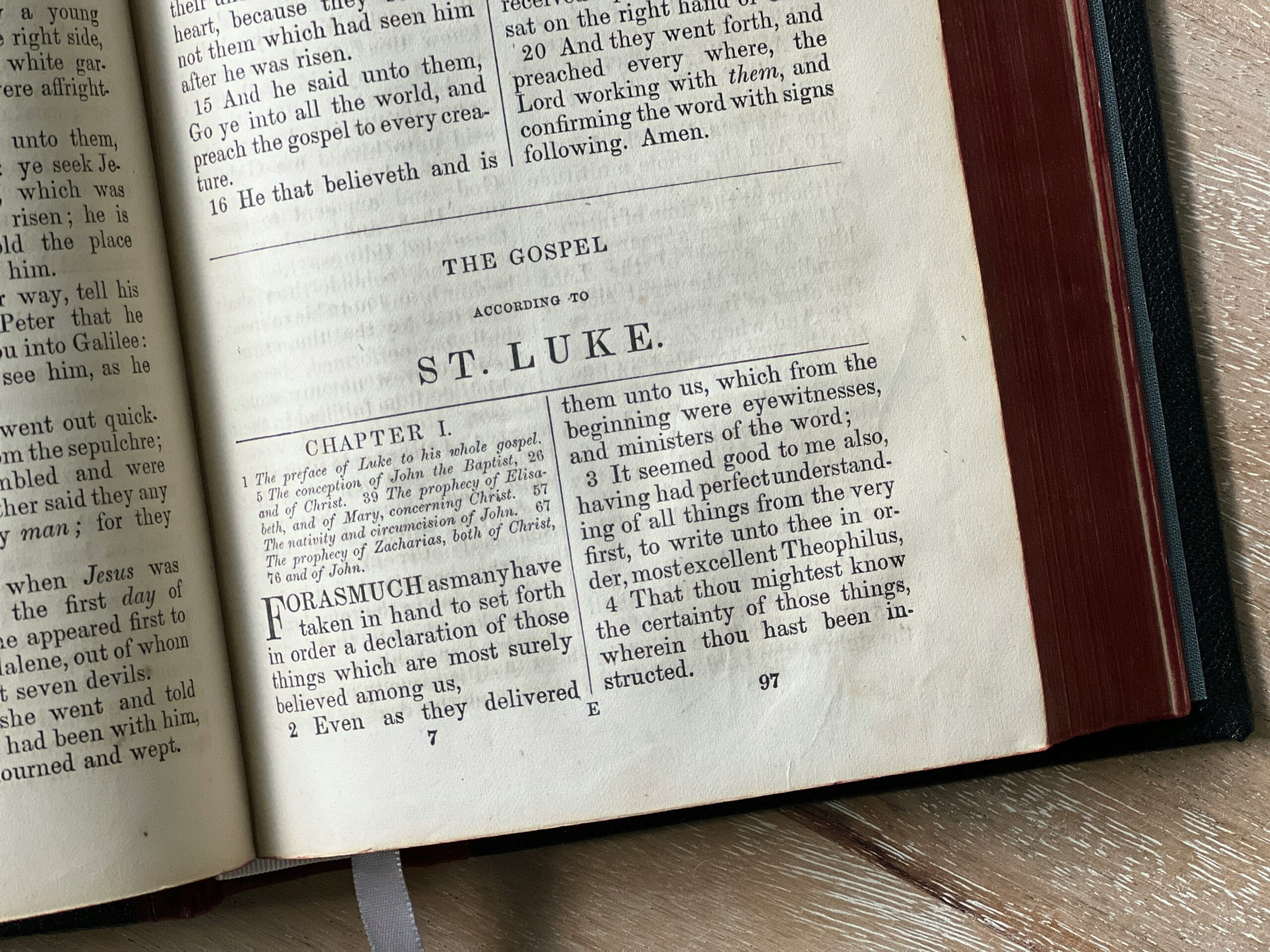
Signs of the Times, Part 3
This sermon examines the Olivet Discourse in Luke 21, distinguishing between the historical destruction of the temple in A.D. 70 and the future, global events preceding Christ’s return. The central message emphasizes that current global conflicts, natural disasters, and false messiahs are not the immediate end but rather ‘birth pains’ or false signs that characterize the end of the age. By analyzing the disciples’ questions and Jesus’ warnings, the text argues for a complex, dynamic second coming that includes the rapture, tribulation, and millennial reign, rather than a single point-in-time event. The tone is instructional and pastoral, urging believers to approach eschatology with humility and discernment, avoiding both indifference and dogmatic speculation. Ultimately, the sermon calls for a confident yet humble reliance on Scripture, recognizing that while the world faces increasing turmoil, the return of Christ remains the certain hope for believers.
Transcript
So it is there if you need it,
if you prefer that with a little bit of place for notes. But we
find ourselves once again in Luke, the Gospel of Luke Chapter
21, where we have just begun to taste
and sample and begin to study and meditate on the whole subject
of eschatology. Subject that many are fearful
of taking up and in a sense. I probably Have been at times
in that in that group there is a tendency to either be preoccupied
with it or indifferent to it, and I think that a healthy balance
is appropriate and One pastor said of the subject that there
are many, many Christians who simply will not discuss it. There
are many preachers who don’t think that the details are important,
even though they are laid out in immense detail in Scripture,
as we’ll see in a moment. As we considered last week, approximately
20 percent of the Bible, one fifth of Scripture is prophecy,
future predictive prophecy. The great portion of that prophecy
is focused on the return of Christ, and so to turn an indifferent
eye to those subjects or to cower from them in fear. Or to misappropriate
them and to do things with them that scripture does not intend,
all of those are inappropriate approaches to the scriptures. As I shared with you last week,
it has been a humbling study and to come to such a difficult
subject and to come with so many people with such strong opinions
on both sides, as I have said for me personally, if there is
one thing that that I’m praying for through the midst of this
and one thing that I’m sensing as I approach it is not not the
sense that I’ve arrived, but humility. Humility in approaching
it. Remembering who I am and that
I am not the inventor of the scriptures, but also just a prayer,
a desire that as I and we move forward, that there would be
just a general humility for us all. The passage, of course,
as we’ve talked about, is the Olivet Discourse. The prophetic
unveiling of the future for not only Jesus’ disciples, but for
Jerusalem, the nation of Israel, for God’s people, for all things
as they begin to be uncovered here in the Olivet Discourse.
This is the last major discourse of Christ, the longest of any
of Christ’s answers in all of Scripture. And I want to go again
to chapter 21. Let’s just meditate on those
first few verses. I want to look at verse 5 through
11 again this morning. Where Luke records, And while
some were talking about the temple, that it was adorned with beautiful
stones and votive gifts, he said, As for these things which you
are looking at, the days will come in which there will not
be one stone upon another which will not be torn down. They questioned
him, saying, Teacher, when, therefore, will these things happen? And
what will be the sign when these things are about to take place?
He said, See to it that you are not misled. For many will come
in my name saying, I am he and the time is near. Do not go after
them. When you hear of wars and disturbances,
do not be terrified, for these things must take place first.
But the end does not follow immediately. Then he continued by saying to
the nation will rise against nation and kingdom against kingdom.
And there will be great earthquakes and in various places, plagues
and famines. And there will be terrors and
great signs from heaven. A difficult portion of Scripture,
no doubt. Jesus sitting there, perhaps
even across The ravine from the great temple, the beauty of the
temple there before them, tells his disciples that this temple
is going to be utterly destroyed. And we saw and we’ve spent no
little time looking at the fact that Jesus words received a literal
fulfillment in AD 70. As one described it, this literal,
terrible fulfillment in A.D. 70, the temple actually destroyed
by fire. We saw that that was contrary
to the order of the emperor. And yet just the enthusiasm in
the moment just overflowed. And ultimately, the soldiers
took matters into their own hands, not to mention fire and burned
the temple to the ground. God, as we saw, allowed it to
be destroyed. God ordained it. God prophesied
here of it, the temple, the city and everything. Everything that
is, except, as I suggested several weeks ago, the people. He allowed
the destruction of the place of worship, the temple itself,
even the very Holy of Holies, where God’s presence did once
continually abide. And yet he permitted as he permitted
rather the destruction of the entire city. He preserved a portion
of the children of Israel. And that’s what led me to propose
to you that the nation of Israel is alive today and that in 80
70, while the temple was raised to the ground, Jerusalem was
reduced to rubble. God’s people, the Jews are alive
and God has a plan for them. As I begun to lay out for you,
we began to look at this, these great sections of Scripture.
And I suggested to you that there are plenty of these prophecies
that still await future fulfillment. As one said, Christ’s warnings
about false messiahs, wars, rumors of wars, famines, pestilences,
earthquakes may have seemed to foretell what took place on a
limited scale in A.D. 70. But many clues throughout
this context suggest that the precise and final fulfillment
of these prophecies awaits a yet future cataclysm. That would
be worldwide rather than local and apocalyptic rather than merely
historic. We went on to point out last
week and spent a lot of time doing, and I’m not going to repeat
that this morning, that there are unfulfilled prophecies concurrent
with these prophecies regarding the future end that Jesus is
talking about. I will pick just one example
of many, Zechariah chapter one. Well, the angel of the Lord said,
O Lord of hosts, how long will you have no compassion on Jerusalem
and the cities of Judah? with which you have been indignant
these 70 years.” The angel retorts in verse 14, proclaims saying,
Thus says the Lord of hosts, I am exceedingly jealous for
Jerusalem and Zion. Thus says the Lord of hosts in
verse 16, I will return to Jerusalem with compassion. My house will
be built in it, declares the Lord. Later on in that same book, Zechariah
chapter 2, sing for joy and be glad, O daughter of Zion, for
behold, I am coming and I will dwell in your midst. There are
certain prophecies of Scripture. Zechariah chapter 14, 9-11. It goes on to say that the Lord
will be king over all the earth. And there are prophecies that
point to the fact that these are concurrent with the prophecies
before us. Nevertheless, Jesus’ disciples,
back to Jesus’ disciples, are focused not on the future of
Christ’s reign, but they are focused on this whole question
about the temple. Stunned and shocked, as we’ve
seen. Shocked that the suggestion that the beautiful temple that
they look at, the magnificent structure, is going to be leveled
to the ground. And because nothing makes sense,
the most logical thing that comes out of them is a series of questions. They’re overwhelmed by the news
that they’ve heard. And one question follows rapid
fire after another. As I’ve suggested in past weeks,
and if you integrate both all three rather of the synoptic
gospels together, you come up with not one or two questions,
not even three, but four questions, four distinct questions about
this section. Both Luke and Mark record the
first, when will these things happen? Both Mark and Luke record
the second, what will be the sign when these things are to
be to take place? We not only want to know when,
but we want to know the harbingers of these things. When are the
things going to come about and what will be the signs of their
coming about? But Matthew records two additional
questions, and I’ve suggested that they’re very telling, very
important, because I think that’s the tack. that Jesus takes in
answering and beginning to answer this great section. Matthew records
two additional questions, the first of which is what will be
the sign of your coming? Not just the temple. And that
clearly is tied into the destruction of the temple, but he didn’t
talk anything about the sign of his coming, and yet that’s
their focus. And then they ask a fourth question
and a final question, and this really is where Jesus seizes
upon it, what will be the sign of the end of the age? What will
be the sign of the end of the age, how are we going to know
when everything begins to fall apart and what the disciples
assumed, as we’ve seen, is that they incorrectly. Assume that
the end is going to immediately follow the destruction of the
temple. They didn’t foresee this long
interval between events. And so of these four questions,
Jesus ignores for a moment the first. About the temple, when
the temple would be destroyed, what would be the signs? As we’ve
said, looking back now, we know exactly when that was, 70 A.D.,
total destruction, precisely as Jesus had told them. The destruction
of the temple, though, wasn’t the main feature in Christ’s
mind. It wasn’t the most important
thing that he was to talk about. Even though Jesus had just told
them about the destruction of the temple, the temple and its
place in history was a distant second in Jesus mind. The first
and the most important is what Matthew records, the end of the
age, the second coming. While they ask for signs, Jesus
doesn’t immediately provide them with signs. In fact, as we began
to look at last week, if anything, Jesus tells them first what the
false signs are. What are going to be the false
indicators of the end of the age? So the question that Jesus is
answering, and it’s very important. It is absolutely crucial To understand
what Jesus is speaking to. The question that Jesus is answering
is not about the temple and its destruction in 70 A.D., he’s
talking about the signs of the end of the age and they are two
very distinct events. Verse 9 through 11 of Luke’s
Gospel say it very clearly. When you hear of wars and disturbances,
do not be terrified for those things must take place first.
But the end does not follow immediately. Continued by saying to the nation
will rise against nation and kingdom against kingdom. We’ll
get into the bulk of that this morning. Again, what Jesus is
pointing to is global, not local. It is not just a local event,
isolated, if you will, in Jerusalem only. But what Jesus points to
is going to be worldwide, global. That’s a popular new word, isn’t
it? That’s in vogue today. talk about global warming, talk
about global greening, global economies, global politics. Well, Jesus is concerned about
what’s global too. As we begin to consider it, as
I suggested several weeks ago, I see the second coming as a
dynamic Not just a point in time, but a dynamic, complex event
that begins with the rapture of the church out of the world.
We spent some time on this last week. The rapture, if you will,
for just a moment, marks the beginning, if you will, of the
return of Christ, the beginning of the second coming. Not just
a point in time event, the second coming, it is a complex, dynamic
event. Those things are alluded to quite
clearly in First Thessalonians 413, First Corinthians 1551. First Thessalonians says it this
way. The Lord himself will descend
from heaven with a shout, with the voice of the archangel, with
the trumpet of God. The dead in Christ will rise
first. Then we who are alive and remain will be caught up
together with them in the clouds to meet the Lord in the air.
First Corinthians says it if possible, even more excitedly. I tell you a mystery. We will
not all asleep, but we will be changed in a moment, in a twinkling
of the eye. At the last trumpet, the trumpet
will sound and the dead in Christ will be raised imperishable and
we will be changed. As I’ve said last week, and I’ll
wrap up our review with this. Sometimes people struggle with
the idea of a second coming, of the second coming being a
dynamic, complex event. Well, we speak of many times
as the second coming. We want a point in time, trumpet
in the clouds. Jesus comes back. The world is
over as we know it. But it’s an event that is not
limited to a moment in time, not as I see it. And it’s unfortunate,
in my opinion, that people look at it as a point in time event,
because we don’t use the same mentality when we refer to Jesus
first coming. Remember when I said to you that
we don’t limit Jesus first coming to the birth, we don’t limit
Jesus initial coming to the manger. To the star, to the story of
Christmas and all those things, we don’t limit it to that. Jesus’
first coming was a dynamic event. It included the manger. It included
the birth, the shepherds. It included that youthful life.
It included his ministry. It included his baptism. It included
all of those things up to and including not just his arrest
and crucifixion and burial, but it included even his ascension
to heaven. It was a dynamic event. And likewise, The second coming
will be a complex, dynamic event. It will include not only the
ingathering of the saints out of the earth, but a terrible
seven year tribulation, as well as a thousand year millennial
reign with elect Israel. And ultimately, the creation
of a new heaven and a new earth. That’s why I suggested to you
last week that what unfolds here in the Olivet discourse is future.
It hasn’t happened. We cannot look back on 70 A.D. and put a stamp there and say
case closed. Jesus’ most intimate followers
here could not conceive of this concept of intervals. They saw
all the mountains together as one, and yet the mountains aren’t
stacked up together like that, are they? As we look out on the
horizon, we see a range of mountains and they all look as if they
were cut out By just so many colors of paper and laid upon
one another. And yet, in reality, hundreds
of miles separate those peaks. There will be an interval between
the crucifixion and the destruction of the temple, an interval between
the destruction of the temple and the second coming of Christ,
an interval between the rapture of the church out of the world
and Christ’s establishment of his kingdom in the earth. As one said, the main difficulties
of our Lord’s prophecy vanish when we bear in mind that prophecy
is like a landscape in which time and space are subordinated
to eternal relations in which events look like hills seen range
behind range, which the distant spectator to the distant spectator
appear as one. The fall of Jerusalem still some
40 years away. is part of the beginning of the
end. But they cannot seem to discern an interval between that
moment and the destruction of the temple, and neither could
they understand an interval between the next range that is the second
coming of Christ. As one pastor said it, Jesus
followers had no idea of this great interval of several millennia
They thought the judgment and the signs of judgment and the
coming of Christ in glory and the end of the age and the establishment
of the messianic age was all going to happen at the same time.
Certainly in Jesus lifetime, because he was the Messiah. Because
his followers were so unclear and uncertain about the future.
They were in a vulnerable spot. They might have been duped into
falling for almost anything. And so Jesus, in order to help
them, issues a series of warnings. Warnings about false signs, and
these false signs point not to A.D. 70, but to the return of
Christ. As I’ve said, a dynamic, complex
event that begins with the rapture of the church. What are the signs
for which we should be watching? False science. First of all,
he says false messiahs. False messiahs look back again
at the text and in verse eight, Jesus says, and he said, See
to it that you are not misled. For many will come in my name
saying, I am he and the time is near. Jesus begins with the warning,
see to it that you are not misled. The word here translated misled
is Plano. It’s an interesting image. We
get the word planets from that, as it were, stars wandering across
the sky. And certainly now, because of
science, we know that that isn’t entirely true. They don’t wander.
They’ve got orbits and paths on which they travel. But to
the first century Greek, this was a an interesting image because
the stars seemed to them to meander through the sky. Jesus says,
don’t meander, don’t wander off, don’t misread these things. J.C. Ryle issued a very lengthy
warning about this very passage. Many of us in the Institute have
come to really love and appreciate J.C. Ryle and his direct style.
He said it this way. He said the necessity of this
caution has been continually proved. But in the history of
the church on no subject, perhaps have divines, a word that I don’t
particularly care for, have divines. He’s talking about pastors, theologians
on no subject, perhaps have divines made so many mistakes as in the
interpretation of unfulfilled prophecy. The mistakes that theologians
made about the fulfillment of prophecy in every age of the
church have been many and great. In our own day, we see some putting
a literal fulfillment on figurative prophecy and on others putting
a figurative meaning on literal prophecy. Some can see nothing
but the church in passages where Israel are mentioned. Others
can see nothing but Israel in every prophecy of the Bible.
On no subject have they shown so completely the weakness of
man’s intellect. Dogmatism, positiveness, controversial
bitterness, obstinacy in maintaining untenable positions. Rash assertions
and speculations have too often brought discredit on the whole
subject of the prophetical scriptures. And cause the enemies of Christianity
to blaspheme. Let us beware on the one side
of that lazy indifference. which turns away from all prophetical
literature on account of its difficulties. Let us beware on
the other side of that dogmatical and arrogant spirit which makes
men forget that they are students and talk confidently as if they
were the prophets themselves. Certainly one of the many passages
that I’ve read over the past several months and years that
really provokes me to pursue earnestly humility in the midst
of this study. See to it that you are not misled.
Jesus said it much more succinctly. Don’t be led astray. Don’t go
down a path that is untenable to use Ryle’s words. The word is used three times
in the book of First John. It’s a warning of deception about
by ourselves and others. 1 John 1.8, 2.26, 3.7. Don’t
be tricked, he says. Don’t be fooled. Don’t be tricked
about when Jesus is coming. You will know. You won’t have
to speculate. You won’t have to hold a news
conference to discuss it. You won’t have to tune in to
Fox News to verify it. When Jesus comes back, you will
know. Because the whole world will
know. Glanced down, if you would, at
verse twenty five of Luke’s gospel, there will be signs in sun and
moon and stars and on the earth dismay among the nations in perplexity
at the roaring of the sea and the waves, men fainting from
fear and the expectations about the things which are coming upon
the world for the powers of the heavens will be shaken. I don’t
recall that on Fox News. I don’t recall that being reported.
I don’t see that going on now, but it will. Bad things have
happened before. More will come. Nothing even
close to that has occurred yet in our lifetime. These are not
the things, not the signs. They are not those harbingers
of Christ’s return. They are not the things preceding
the destruction of Jerusalem. And they are not the things that
precede the return of Christ. Jesus says many will come. And
when they come, don’t be misled. Look at that passage again, many
will come in my name. And not just in my name, but
Matthew goes on to say that there will be many that say, I am the
Christ. I’m not working for Jesus, I
am Jesus. That’s what they’re saying. In
my name is a much milder way of saying it. It just means a
claim to be either on behalf of an emissary of. But Matthew makes it even more
clear that there are going to be those that even come and say
that they are Christ himself. They will claim to be the Messiah,
said one Jesus own title. Some of these people will come
close to claiming deity, a sure reference to the last days. But
there is little evidence that any of the turbulent men so active
preceding the fall of Jerusalem ever claimed to be the Messiah.
You can’t use this to point to 80, 70, the fact that there were
a plethora of men claiming to be the Messiah because there
weren’t that many. There were a few men, some that claimed
to be a type of Messiah. But none that use those words,
none that use the name of Jesus, none that said, I am the Christ. One clarified it quite clearly
when he said, we know of no false messiahs between the ascension
and the fall of Jerusalem. We’ve seen, therefore, at the
outset to have a sign which refers rather to Christ’s return than
to the destruction of Jerusalem. There will be these false Christs.
There will be those that point to themselves and say, look at
me, follow me. As one said, there were plenty
of false Christ even before Jesus time. There have been multitudes
of them throughout church history. Our own generation have produced
numerous notorious false messiahs and other religious deceivers.
And you think of a day and age in which we live, David Koresh
and Jim Jones and all the rest of them. Not just strong religious
followers, but those who claim to occupy the place of Christ.
place of the Messiah. We cannot be misled, we can’t
allow ourselves to be misled about those who profess to be
the Christ, as if you could just kind of blend into the culture
and suddenly emerge in time. Scriptures make it very clear
that it will be an absolutely overwhelming event for the world
when Christ returns. You’re not going to miss it. So that even the subject here,
when Jesus says, don’t be misled, it is a rebuke. Can’t possibly
be misled. One pastor. Said this of the
those seasons, he said, before dealing with the end times of
the future, Jesus reminded his disciples that their first duty
was to be alert to the dangers that would confront them. And
he points out two types of danger, not only deceived by pretenders
and catastrophic occurrences, but also persecutions ultimately,
as we’ll close in the next couple of weeks. As I said, there have been dozens
who claimed to be Christ. And what Jesus says, there’s
going to be plenty of these, plenty of these, that is a sign,
but it’s a false sign. There’s another false sign, not
only false messiahs, but. As both Mark and Luke go on to
point out, and I will title it that way, false labor, false
labor. I’ll get to it in a minute. There is a movie coming out,
I’ve seen it in the last seen signs of it in the last couple
of days. It’s called 2012. Maybe you’ve
seen the commercials, maybe you’ve seen the ads for it, whatever,
forecasting the end of the world, right? And it’s based on some
silly idea from a Mayan calendar pointing to the end of the time.
And there have been many such movies and books written, and
I was quite amused as I just I mean, I just casually started
to create a list in my mind, and they just came flooding forward. And I realized, I don’t think
I’ve seen any of these movies, maybe one or two. Outbreak, right? A movie about
a monkey virus that wipes us all out. And then we went on a rampage
about keeping monkeys far from the people at the zoo, heaven
forbid. And then there were the tornado and hurricane movies
and earthquake movies. Maybe that was the first. I’m
dating myself now. And then movies about volcanoes
right in the middle of Los Angeles that somehow cataclysmically
will overcome and take the whole world. Floods and tidal waves. Lions and tigers and bears. Nuclear
war the source of many such movies I can remember when I was in
high school. That was the big thing all nuclear war You know we’re
gonna all perish from nuclear war and there were many after
you know the day after kind of movies Global warming now is
the big thing global warming that melts the polar ice cap
floods the whole world and And if that doesn’t get us, there’s
movies about asteroids and meteors, a movie called Deep Impact. I
didn’t see it. You guessed it. Asteroids on
a collision course to wipe out and obliterate Earth. The reality
is that no disaster, manmade or accidental, no virus, no earthquake,
no worldwide weather disturbance is going to ruin Earth. God will. And God will do it in his time
and he will do it quite effectively. God is the one who will destroy
the earth, but he will do it on his time. And this is a long
way off. Look back again. In Luke chapter
21, Luke 21, 9, when you hear of wars and disturbances, do
not be afraid. These things must take place.
But the end does not follow immediately. The end is not yet. I’ll say it again. This is not
pointing to AD 70, which was a localized event. It is pointing
to the harbingers of Christ’s return. Beginning with the rapture
of the church, God calling out of the world all those believers
in the Lord Jesus. As one pastor said, the report
of wars and rumors of war was actually in progress and widespread
expectations of wars. They must not be viewed as signaling
the immediate end. There’s always been those things.
Wars and threats of wars will characterize the end of the age.
National convulsions arise as the inevitable consequence of
human depravity. What a good way to put it. And
that’s what always amuses me when people hold hands and sing
about peace. Then they fight with each other on the way home
from the protest march. They are the natural results.
of human depravity, the natural results of human nature that
is separated from God and ruled by self-interest. If there is anything that you
can expect to see on the pages of the newspaper and the news
headlines of the news shows, it’s about war, isn’t it? Verse 10 says he continued by
saying to them, nation will rise against nation and kingdom against
kingdom. You’re going to hear about wars
and disturbances. It’s going to be commonplace.
As one said, if there is any subject that dominates world
history, it’s the subject of war. The whole of human history
is the history of war. Nothing is more characteristic
of humanity than war. Civil war, border war, tribal
war, family war, revolutions, rebellions, military actions,
terrorism, genocide, world wars. That’s the news, right? There
will be always these conflicts, these normal conflicts. Luke
goes on to describe them, as I said, in verse 10. Nation will
rise against nation, kingdom against kingdom. Don’t be surprised. It’s commonplace. I began to look up some data.
The Korean War. Killed three million people,
3,500,000. The Vietnam War, five million people. The Napoleon
Wars of 1815 killed 6,500,000. The Russian Civil War, 1921. Not exactly on our newspapers,
were they? Of course, I didn’t have that
paper then. The Russian Civil War killed nine million people. World War I, a little bit now
more in focus with our own understanding of history since America was
involved, 25 million people. The Mongolian conquest of 1472,
there’s another one that maybe isn’t on your radar, but the
Mongolian conquest killed 60 million people. In World War
Two, the War of Wars, 70 million people died in World War Two. And so when Jesus says. You’re
going to you’re going to hear about these things, they’re going
to be commonplace, you’ll hear of wars and disturbances, you’re
going to hear about border skirmishes, you’re going to hear about all
these things, terrorism. You hear about nations rising
up against nation and kingdom against kingdom. It’s a false sign. It’s a sign
of the end. But it is not the end. It’s not
a harbinger of Jesus immediate return. In the midst of all these
commotions. That sees us. It sees our attention. They call us off of the path
of tranquility and peace that we normally live on. We can’t allow those things to
take our focus off of Christ, off of living for Christ. But
look back again at the passage. It gets worse. Not only are there
wars, but earthquakes. Earthquakes, too. That’s what
he says. Earthquakes. All three of the
gospel writers say it. They all three just say it differently.
Matthew says earthquakes. Mark says earthquakes in various
places. Luke says great earthquakes. Very big, mega earthquakes. So there were earthquakes and
volcanoes and the like before 70 A.D., they weren’t necessarily
signs of the end. Is it a sign of the end to hear
of earthquakes? Not immediately. As one pastor
said, to be sure the events here had significance, they’re stepping
stones leading to the final goal. I like the way of putting that.
When you hear about wars, is that the sign of the end? No,
but it’s a stepping stone. What about earthquakes? Yeah, stepping
stones by means of them, the end of the age is both foreshadowed
and brought closer and God’s eternal plan is being carried
forward. Toward the end of the present dispensation, the indicated
disturbances will occur together more numerous, more extensive,
more fearful than ever before in connection with a great tribulation.
just going to begin to shatter the whole earth, earthquakes
and. Tornadoes and wars and disturbances. Earthquakes are new. Death tolls of hundreds of thousands
of people. Are all over the page, if you
research it. There was one in Iran that killed
200,000. Another one in Syria, 230. One
in 1976 in China that killed 242,000 people. These are great
earthquakes. Shanghai province in 1556 killed
almost a million people. There have been great earthquakes
throughout the history of our world. But 1556. And now we find ourselves
in 2009. Was that a harbinger, an immediate
harbinger of the end of time? No, but it is part of the birth
pains. Luke only adds another calamity. He adds the calamity and this
is meant to encourage really. Wars, earthquakes, plagues. It’s meant to encourage. There
will be great earthquakes and in various places, plagues and
famines. Well, we certainly are acutely
aware of that difficulty in life, aren’t we? Because now, as if
this could forestall a major God-ordained epidemic that would
wipe out the earth, all we’ve got to do is wash our hands,
right? All we’ve got to do is use that
clear stuff that makes our hands sting and stink And we can avoid
this plague. Swine flu, H1N1, bird flu, typhoid,
malaria, smallpox, bubonic plague. The list is endless when you
begin to talk about plagues that are going to affect the earth.
Typhoid fever, as I said, smallpox, the Asiatic Russian flu, cholera. I read about one, the plague
of Justinian in 541 A.D. This one killed about a quarter
of the population around the Mediterranean. At its point,
it was killing 10,000 a day. That’s a plague. Better wash
your hands if that one comes back. AIDS has killed 25 million,
estimated. Malaria, one declared that it
was most likely the greatest killer of humans in history.
2.7 million people a year, still. Black Death of the Dark Ages,
13 and 1400s. The Black Death is the name commonly
given to the epidemic of outbreaks, said one of bubonic plague that
killed nearly a third of the population of Europe, 34 million
people. Whoa. And then the great flu
of 1918 and 1919, 50 to 100 million people, they lost track. They
started burying whole villages. Wash your hands, right? Not only earthquakes and wars
and plagues. But all three of the gospel writers
also mentioned famines, and we certainly hear that, too, all
the time. Luke says there’ll be plagues and famines. One estimate
stated that there have been at least 2000 famines in recorded
history, famines in Jerusalem and Rome and India and Spain
and Ireland and Scotland and right now in Africa. That doesn’t
surprise us. Only Luke adds one other little
detail, and I want you to look again at the passage. Only Luke
includes this last bit of detail. Calamities coming upon the earth
before Christ returns. Jesus said there will be terrors
and great signs from heaven. What are they? I don’t know. Could it be light shows, could
it be comets, could it be asteroids? Sure, certainly it’ll be scary.
We know that because it says it. That’s the word. Fearful. Phobaton. Things that make us
afraid, I don’t know what they are. But if you’re afraid, then
prophecy is fulfilled, right? Something happens coming from
the sky. Well, then there it is. Now, look at the passage
again, because Luke ends it right there. Great science from heaven,
but both Mark and Luke add one other little thing. Both Mark
and Luke say all these things. Sew it all up in a bag. All these
things are merely the beginning of birth pains. Let me tell you
about birth pains. They are the pains related to birth. In medical
terminology, they’re referred to as Braxton Hicks, right? And
they’re really not that bad. They’re not that painful. And now, of course, by the giggles,
I can tell. You know that I have not experienced
them. The point is that everything
is relative. That’s the point that the gospel writers are making.
Are they painful? Absolutely. Are they as painful
as childbirth itself? Not even close. Not even close. By women’s account, they’re no
big deal. They aren’t the real thing. Once you’ve experienced
childbirth, Braxton Hicks fades in the distance, doesn’t it? Jesus says that all of these
things, wars, disturbances, famines, earthquakes, all of it are just
birth pangs. The spiritual equivalent of Braxton
Hicks. It’s a sign of the coming birth,
but it is merely a harbinger. We of all people ought to be
the most confident in the face of this. We of all people ought
to be the most courageous Knowing Christ, knowing His Word, knowing
God’s plan for the earth, it ought to be exciting and thrilling.
As I said last week, heart palpitating, joyful excitement ought to be
ours as we look forward and we begin to see some of these things. They’re false signs. We know
it’s not instantaneous, but we’ve seen these things for thousands
of years. And we know that they’ll come again. And we’re not going
to run after everyone that claims to be Christ. As I told you last week, any
Christian has to be absolutely thrilled. Absolutely humbled
at the news of God’s word and any non-Christian, anyone who
doesn’t know for sure that they are in Christ has to be absolutely
shaken to the core. To know that these things are
going to come upon us and worse things are going to happen. And
then eventually Christ is going to come back and take his church
out of the world. If you don’t know the Lord Jesus
Christ, you are in deep trouble. You are in terrible trouble.
The only hope for humanity is the Lord Jesus Christ. The only
one who has paid your sin is the Lord Jesus Christ. The only
way off of this globe with any assurance. With any peace is
through the Lord Jesus Christ. I’m overdue, let’s pray. Our Father and our God, we thank
you For the great hope that is ours in the midst of great uncertainty
where so many people have been misled. Lord, we thank you and praise
you that with you we have a sure confidence we have salvation. Lord, if there are any young
or old who do not know for a certain that they are safe. Lord, we
pray that you would prompt in them A curiosity that spills
out in hot pursuit. Of forgiveness for their sin.
Forgiveness that was secured already on the cross by the Lord
Jesus Christ. Father, we thank you. We praise
you as we meditate upon these things with all humility. It’s
in Jesus name that we pray. Amen. It’s just a matter of time.
Messages: 103