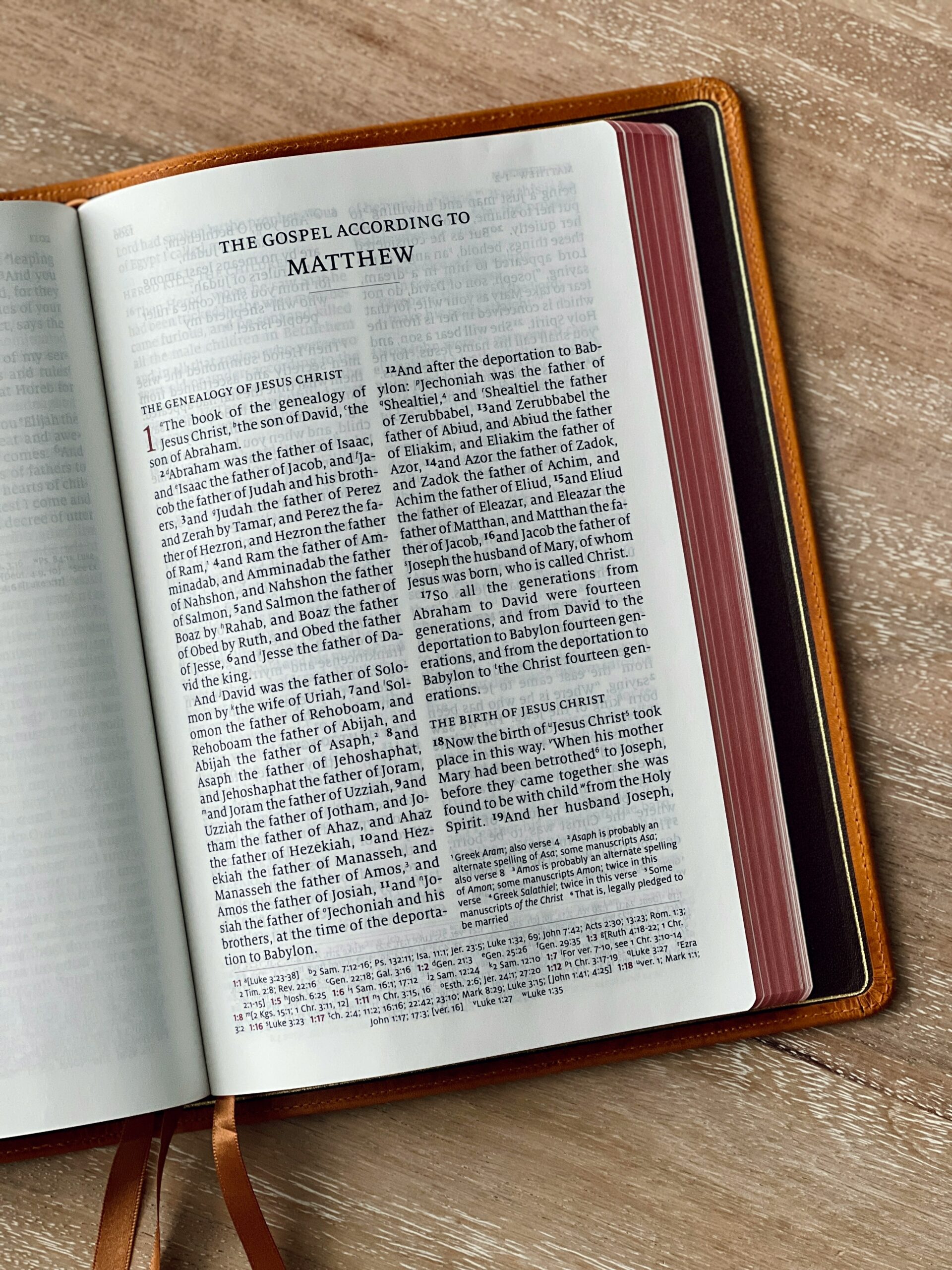
By Prophets Seen of Old
The sermon examines the account of Joseph and Mary in Matthew 1, emphasizing the theological necessity of the virgin birth for the doctrine of the Incarnation. It traces the prophecy of Emmanuel in Isaiah 7, delivered to King Ahaz, to demonstrate that God’s promise of a Messiah born of a virgin was a sovereign act to preserve David’s line and fulfill redemption. The text highlights Joseph’s righteous response to the angel’s revelation, illustrating his faith in God’s plan despite the social and personal difficulties he faced. The central message asserts that Jesus is truly God and man, bridging the chasm between a holy God and sinful humanity. This union, described as God with us, provides ultimate hope and salvation for believers.
Transcript
on these matters, and we are
trying to take them in sequential order. That’s the overall plan,
and we are essentially prepared to discover
how God interacted with Mary’s betrothed, her husband-to-be,
Joseph. Some people have reduced this
section of Scripture as just kind of a myth, a stab at an
explanation, a fantastic and fanciful invention from the Christian
community that tries to justify or give credence to this idea
of the virgin birth. Some say that it was borrowed
or that the Christians stole this idea from some pagan traditions. Well, it is fantastic, but it
is fantastic in every sense of that word. It is. It is almost
Hard for Christians to believe this story, but because we know
that there is a miracle working God behind it, we receive it
as truth as as God has communicated it to us. We find her. I said
Luke, didn’t I? Find the other gospel, Matthew,
from which we have been in Matthew chapter one. And that’s where
we’ll pick up the account of Joseph and how the Lord dealt
with him. Now, mind you, remember, Joseph
likely doesn’t know at all yet what has transpired. He there’s
no indication that Mary ran home to him and and said, Joseph,
guess what? I met up with an angel today
and he said that I’m going to have a baby and it’s going to
be a miracle. There’s no indication of that at all. And so Joseph,
has to discover this all in real time and it provides no little
difficulty for him as you will see Matthew chapter one and we
pick up in verse eighteen. Now the birth of Jesus Christ
was as follows when his mother Mary had been betrothed to Joseph
before they came together she was found to be with child by
the Holy Spirit and Joseph her husband being a righteous man
and not wanting to disgrace her desire to put her away secretly. But when he had considered this,
behold, an angel of the Lord appeared to him in a dream saying,
Joseph, son of David, do not be afraid to take Mary as your
wife for that which has been conceived in her is of the Holy
Spirit. And she will bear a son. and
you shall call his name Jesus. For it is he who will save his
people from their sins. Now, all this took place that
what was spoken by the Lord through the prophet might be fulfilled,
saying, behold, the Virgin shall be with child and shall bear
a son and they shall call his name Emmanuel, which translated
means God with us. Joseph arose from his sleep and
did, as the angel of the Lord commanded him, and took her as
his wife and kept her a virgin until she gave birth to a son. And he called his name Jesus. What do I want to do? Rather
untraditional, I’d probably get graded down if this were a seminary,
a seminary sermon. Because they always say to give
them the outline up front. Tell them where you’re going
to take them and then take them there and repeat the outline four times.
I’m not going to give you the outline. Not for a while. Not until almost the very end.
I want to take you back and I just want to view this text and we’re
going to make pretty rapid pace through it. Go back to verse
18 if you would. Now the birth of Jesus Christ
was as follows. Never before. Never again. had such an amazing miracle occurred,
and perhaps this was even why Mary had a difficult time even
sharing it with her husband-to-be. I mean, that’s tough news to
embrace. That’s a difficult report. It’s
almost too unbelievable, even for a faith-filled young lady. Mary did accept it. But passing
it on proved to be equally difficult, and perhaps that’s why Joseph
didn’t know that never before had anything like this happened.
It says that. This occurred in the time when
she was betrothed to Joseph, and this again is a hint that
more than a hint that Joseph was not the real father in The
human sense of Jesus, it repeats the fact it was set forth, even
when we looked at the genealogies. Remember, in verse 16 of Matthew,
chapter one to Jacob was born Joseph, the husband of Mary,
not the father of Jesus. If there was ever a place to
refer to Joseph as Jesus father, this was the place. And it clearly
points out Mary as being Jesus mother. But Joseph definitely
is not identified as the father. Rather, the Holy Spirit in a
special way caused this conception. And we looked at that in the
passage in Luke. We consider the angels explanation of that
to Mary. But it goes on in verse 19 to
say that Joseph, her husband, being a righteous man, as he
began to gather in all this data. He began to see the effects of
pregnancy in his young bride-to-be, and it was trouble. As it would
be to any young man who had not been with his wife. Look at verse
19. Actually, jump back to verse
18, since I didn’t finish that. When his mother Mary had been
betrothed to Joseph before they came together. And I take that
to mean in an intimate sense. Let’s just be plain about it.
She was found, nevertheless, to be with child by the Holy
Spirit. Joseph, her husband, being a
righteous man and not wanting to disgrace her desire to put
her away secretly. Let me just take a few moments
to talk about the whole marriage process in the Jewish culture. We have it somewhat simplified
in our day and age There is the engagement process, and some
of those are quite lengthy and others are relatively short,
but there is the engagement and then the lead up to the marriage
itself. And then there’s the marriage in the Jewish culture. According to Jewish custom, there
was this essentially this engagement process. We would probably almost
refer to it as going steady. And then there was the betrothal.
So there was this process of, if you will, courtship. making
a comeback in our own day, and they would get to know one another,
and they would be drawn to one another, sometimes even paired
up by loving parents, which is still on the table in our own
household, by the way. And then there would be the tropical
period. The tropical period was a much
more serious step than just mere engagement. Engagements in our
day, they can be broken off right up to the point of marriage,
right? Right up to the point of the I do’s. Somebody can just
decide or not show up or, you know, break the thing off. Not
the betrothal. To enter into betrothal was a
one-year process. It was It was a situation where
a young man and a young woman were already considered to be
husband and wife. This is a very serious step. In any breach of this, those
parties could be condemned to stoning. That’s how seriously
they took marriage, and that’s how seriously the law prescribed
on not only marriage but divorce. And only after that one year
period of betrothal, then they entered into the act of what
we would call matrimony or marriage. And then things really were firmed
up. And so we can understand Joseph’s
concern, can’t we? Mary is betrothed. She is the
bride to be. And she also happens to be pregnant. And it’s very clear that Joseph
and Mary have not been intimate. And so Joseph himself, let’s
be frank about it, he is justifiably suspicious. Mary can say whatever
she will, but what’s obvious to Joseph is something has transpired
that in his mind should not should not have taken place. Joseph
has no knowledge of anything. Miraculous, and it says that
he’s a righteous man. It doesn’t mean he’s a perfect
man. It doesn’t mean that he doesn’t need a savior. It doesn’t
mean that he has achieved some kind of godliness that is over
and above all other men. It just means that he was a principled
man. He had integrity. And his righteousness,
his integrity, the penchant for doing what was right and good
and proper prompts him to put her away. But there are only
a few options open to young Joseph. Joseph could issue a lawsuit,
essentially go before the courts, publicly disgracing and shaming
Mary and justly getting him out of this betrothal, this marriage. He could hand her a bill of divorce,
which was a little more private, and it would dismiss her quietly. It would just kind of send her
away. And there would no doubt be questions in the public, there
would no doubt be questions among the family and friends, but at
least there wouldn’t be these public legal proceedings that
would disgrace his beloved Mary. See, that was the problem. Joseph
still loved Mary. And he didn’t want to hurt her
even still, even though his own heart was aching. And so he decided
to end their relationship quietly. But God is sovereign. God has
a purpose in all of this, and he would not let Joseph go through
with this divorce. Look at verse 20. But when he
had considered this, behold, an angel of the Lord appeared
to him in a dream saying, Joseph, son of David, do not be afraid
to take Mary as your wife for that which has been conceived
in her is of the Holy Spirit. Note this. He considered it.
He wasn’t rash. This is instructive to a lot
of us. A lot of us just kind of fly off every which way. This
man pondered the situation, he pondered what he could do. He
didn’t do anything rash or thoughtless, nothing impetuous. The angel steps in. No sooner
had Joseph begun to ponder what his steps might be, the angel
comes before him and he greets him as the son of David, reminding
him of his own lineage. connecting to the throne of David.
The angel provides the same comfort that he had given to Mary. Do
not be afraid. Can you imagine the relief that came over Joseph
just at that one sentence? Do not be afraid to take Mary
as your wife. This is OK with God. The first thought. Was likely
the fact that he loved Mary. That he could now have Mary legitimately
before God. That he could maintain his righteousness
and his integrity. That he could maintain her dignity.
That this was, in a sense, of God. Then he thought of himself. That he didn’t have to be without
her. He didn’t have to send her away. And then he stumbled back
over the angel’s words. And he had to have been floored. Because suddenly all of history
comes into view, all of humanity comes into view. The God is sending forth the
Messiah. And he’s doing so by way of Mary. Not only did his day turn around.
His marriage, his betrothal, his life turned around. Can we
even begin to conceive that Joseph, we said this of Mary, That Mary,
the one who would be asked to bear and bear forth the Messiah,
can we imagine that for a moment she wouldn’t be let in on the
grace of God for salvation? We can’t. Neither can we imagine
that Joseph, husband of Mary, introduced in such a dramatic
fashion to the Savior. Can we even begin to imagine
that Joseph didn’t come to faith? We don’t have that. We don’t
know that. But Joseph is certainly face
to face with the truth of history. This awesome miracle of the virgin
birth and a fulfillment of the prophecy of David’s lineage.
Look at the remainder of the message is just astounding. Verse
21, and she will bear a son, you will call his name Jesus,
for he will save his people from their sins. Now, there’s no doubt.
that in Joseph’s Jewish mind, he probably did take that to
mean that this is the long promised Messiah for the Jewish nation.
But he was that he was at least that. And even by virtue of his
name, his name is going to be a testimony to all that he was
the Savior Jesus, the the word meant, as we’ve already studied,
Joshua, The Greek word for Joshua, God is help or savior. And why
was this name so important, because this name, Jesus, essentially
proclaims Christ’s mission every time it’s uttered, I’m here to
save. I’m here to save and Joseph has
the task of giving him the stowing upon in that name, that was his
job as his dad. The angel explains it quite simply.
You should call his name Jesus. Why? For it is he who will save
his people from their sins. This was no political messiah.
This was no earthly ruler. This was no conqueror. This was
Jesus, the promised messiah. J.C. Ryle, one of my favorite
commentators on The Gospel said this, Jesus means Savior. This is his special office. He
saves his people from the guilt of sin by washing them in his
atoning blood. He saves them from the dominion
of sin by putting their hearts, putting in their hearts the sanctifying
spirit. He saves them from the presence
of sin when he takes them out of this world to rest with him
in heaven. Well, Joseph has to be just astounded. that his wife is going to bear
the Messiah, the promised Messiah, that had come to essentially
treat humanity’s great enemy, that of sin. And then Matthew
has this little explanation. We do have a follow-up at the
very end in verses 24-25 that talk about how Joseph dealt with
all this, but it ends rather abruptly. It ends even as the
angel is speaking And Matthew adds this comment in verse 22.
Now, all this took place that what was spoken by the Lord through
the prophet might be fulfilled, saying, Behold, the Virgin shall
be with child shall bear a son. They should call his name Emmanuel,
which translated means God with us. And that’s how a lot of people
read that passage. This is the heart of the entire section. We can’t possibly read it like
that. Essentially, what Matthew does
is say, look, I want you to pause and listen to what the angel
just said and hear that that is fulfilled prophecy. Prophecy
that was given hundreds of years earlier, pointing to this obtuse
promise to a wayward king. The Virgin shall be with child
and she shall bear a son. They shall call his name Emmanuel. For the context, just in your
mind’s eye, think of Isaiah 6. Remember Isaiah going before
God’s throne in his mind, brought there by way of a vision, and
he receives a commissioning. Remember, there he is in reverence
and awe before the almighty God himself. And he’s commissioned
out on this spot to go serve this God and immediately As God
sends him out, he’s given an assignment to go to the king
of Judah, a king named Ahaz. And he’s to go and to bring a
particular message to King Ahaz. For that message, please turn
to Isaiah chapter 7. And if we’ve had to go through
Matthew 1 quickly, we’ve got to go through Isaiah 7 even more
quickly. In Isaiah chapter 7, this is
the message that Isaiah was commissioned to bring before King Ahaz. We
pick it up in verse 1. Now, it came about in the days
of Ahaz, the son of Jotham, the son of Uzziah, king of Judah,
that Rezin, the king of Aram, and Pekah, the son of Remaliah,
king of Israel, went up to Jerusalem to wage war against it, but could
not conquer it. Now, if all that seems a little
strange to you, it should. The king of Israel going up against
the king of Judah in association with a heathen kingdom? Shocking. Let me identify a few of these
people for you. Following, remember, the death
of King Solomon, the kingdom divided. Most of us know about
that, at least to some degree. Ten tribes lined up under a king
named Jeroboam, and two lined up with Ramoboam. Jeroboam was
an evil king and every king in Israel after him was evil. Every
single one of them. Rehoboam was known as Judah.
It was the short version and they had some good kings and
they had some bad kings. Ahaz? Not so good. Here’s the report on King Ahaz.
In 2 Chronicles chapter 28, it says that Ahaz was 20 years old.
That could have been part of the problem. Ahaz was 20 years
old when he became king, and he reigned 16 years in Jerusalem. And he did not do right in the
sight of the Lord as David, his father, had done. David wasn’t
his father, but stood in the lineage of David, his great,
great, great grandfather. But he walked in all the ways
of the kings of Israel. He also made molten images for
the Baals. Moreover, he burned incense in
the valley of Ben-Hinnom and burned his sons in the fire,
if not his own sons, the young men of his community. Just shocking,
shocking idolatry. He sacrificed and burnt incense
in the high places on the hills and under every green tree, he
did it brazenly, he sinned. So the overall assessment of
this king of Judah was that he did not do right. It was not
good. And that’s incredibly a sad turn
for Judah, by and large, their kings were much better than those
of Israel. Israel never did have one single
king that was good, not one. Judah enjoyed many. Ahaz had this strong heritage. King
Uzziah, if you studied the kings, was a good king. He tried to
do what was right, Jotham. They were among Judah’s good
kings, good men, they ruled well, they did the right things in
the eyes of the Lord, they measured up before God. Ahaz, on the other
hand, stooped to the worst kind of idolatry, idolatry so heinous
that it moved him to sacrifice even his own sons in the fires
of a false god. It was just absolutely sickening. So that’s Ahaz. Raising with
the king of neighboring Syria, not a Syria, but Syria and Pekka
was the undeserving king of Israel. Here’s how he got his gig. Second
Kings 1525, Pekka, the son of Ramaliah, his officer conspired
and struck him in Samaria in the castle of the king’s house
with Agrabah and Ariah. With him were 50 men of the Giladites
and he killed him and became king in his place. What a noble
guy. basically took the throne and became king in his place. So, you have these three figures
at the start of Isaiah’s prophecy. Ahaz, Rezan, and Pekah. Now,
regarding Ahaz, because of his sinful habits and his rule, God
had decided to punish him. He’s going to strike him. He’s
trying to humble him, and as so often God does, God had chosen
the very heathen nations around him to bring him to repentance.
In a sense, it was an act of mercy on God’s part to send this
attack. And so far, these these men were
trying to woo Ahaz and get him to be complicitous in attacking
yet a fourth nation. When Ahaz wouldn’t have it, they
attacked him. And now God is using these nations
to chase in a house. When you refused. Their appeals,
they tried a more severe approach. They just simply attacked him.
And tried to bring him to repentance that way. Well, the very idea
here is that they are literally in camps at the doors of Judah. They’re preparing to attack him
once again, and he really believes that this time it’s for good.
And so he’s nervous, nervous for himself, but also nervous,
and he had to be mindful that through Judah would come this
Messiah. And as one characterized, the
threat of these two conspirators was to destroy David’s dynasty
and to establish a king of their own choice. certainly Pekka already
had that reputation, but if they did that, what would become of
this glorious promise of God? Remember, this is all part of
God’s plan. God has sent Isaiah for this very purpose to deliver
this message. Look at verse two. When it was
reported to the house of David, that is to Judah, to Ahab, When
it was reported to the House of David saying the Arameans
have camped in Ephraim, they’re right on our doorstep. You can
just hear the panic. His heart and the hearts of the
people shook as the trees of the forest shake with the wind.
And we have this beautiful image in Colorado of aspen trees, right?
And we love to watch the quaking of the leaves. That’s the image
that he gives. They were shaken to the core
because this isn’t a camping trip. They are in camp there
for a purpose. They’re there to destroy Judah.
And they shook. They had stood up to their enemies
once and twice, but now these enemies are fortifying, now they’re
gathering, they’re formulating new strategies. And Ahaz has
to wonder how long can he even hold out? But instead of looking
outside of themselves, instead of looking to their God, Ahaz
looks only to his own resources. Now, having already commissioned
Isaiah, Isaiah now begins to speak his message to Ahaz. Look at verse three. Then the
Lord said to Isaiah, Go out now to meet Ahaz. You and your son,
Shir At the end of the conduit of the upper pool on the highway
to the Fuller’s Field. This is amazing. God knows exactly
what this guy is exactly. And he’s out there likely because
he’s overseeing this military operation, possibly even stopping
up the water supply to his enemies, because he’s all about his own
resources and nothing about God’s. He says, say to him, take care. and be calm, have no fear. Well,
that was a has his biggest problem. He feared men more than he feared
God. Take care, be calm, have no fear,
do not be faint hearted because these two stubs of smoldering
firebrands, what a beautiful picture. These guys are nothing,
nothing more than a burnt match. And he exhorts him to be calm,
Literally, don’t let your heart go soft. Restrain yourself, man
up. And Isaiah sternly warns Ahaz
to be calm, don’t fear, don’t be tempted to act in your own
strength, trust God. And then he gives him this message
of hope, it’s rather obtuse to our ears, but look at verse five.
Because Aaron, with Ephraim and the sons of Remaliah, has planned
evil against you, saying, Let us go up against Judah and terrorize
it, make for ourselves a breach in its walls and set up the son
of Tabeal as king in the midst of it, says the Lord your God,
it shall not stand or come to pass. You know what Isaiah says,
Look, God already knows their whole plan. He knows exactly
what they’re going to do. He knows how they’re going to
get in the city or try. He knows exactly who they want
to set up as king, puppet king. That’s the big idea. The son
of Tabeal. He was a literal unknown guy
who’s just going to be a puppet king. And Isaiah says, this is
not going to stand. God’s not going to allow this.
What are you worried for? Why are you shaking in your boots? Remember, they’re nothing more
than tools in God’s hand for accomplishing his purpose. Not
their own. They can’t do anything. They
can’t do one single thing other than what God allows. Isaiah
continues his appeal, and it gets a little bit more up to
store here. Look at verse eight for the head
of Aram is Damascus. The head of Damascus is raising
now within another sixty five years. Ephraim will be shattered
so that is no longer a people. The head of Ephraim is Samaria.
The head of Samaria is the son of Ramaliah. If you will not
believe, surely you will not last. What he says is this in
all those You know, you’d almost have to have a map before you
to understand who’s who and where they are. But he says the boundaries
aren’t going to change. The borders of the nations are
not going to change. The capital cities are not going
to change. Nothing is going to become of this. Ultimately, he basically says that these two
feeble nations are nothing to be feared before me. Look at
verse 10. Then the Lord spoke again to
Ahaz, saying, Ask a sign for yourself in the Lord your God.
Says you want proof? Ask God. Name it. Pick anything
you want and ask God to prove himself to you. And Isaiah says,
We’re going to do that. Ask for a sign for yourself from
the Lord your God. Make it as deep as Sheol or as
high as heaven. And he basically says, look,
what I’m telling you is true. You have nothing to fear with
these nations. God is sovereign over the nations. Pick whatever sign you want.
And now Ahaz. Ahaz gets sanctimonious. He’s far too religious for such
a thing. He’s far It’s beyond him to even
begin to think of tempting the Lord God for asking him of a
sign. Look at verse 12. But Ahab said,
I will not ask, nor will I test the Lord, as if he wasn’t testing
the Lord already. I love the way one characterizes
this scene. What a pious sound this has. And yet this self-hardened reached
its culminating point in these well-sounding words, he hid himself
hypocritically under the mask of the piety of the law to avoid
being disturbed in his Assyrian alignment. Basically, he won’t
ask for a sign, even though the emissary of God himself has told
him to do so. He won’t ask for a sign because
that takes faith. Even though he’s already distrustful
of God, it was just phony, just it was a sham. And Isaiah calls
it calls it exactly like it is, look at verse 13, then he said,
listen now, oh, House of David, I picture him grabbing, you know,
a has his chin. Listen to me, Buster. Listen
now, oh, House of David, is it too slight a thing for you to
try the patience of men? Pekka and this son of Ramalaya
and is it too? Are you really in your right
mind? You test the patience of men
that now you will try the patience of my God as well. A has it stood up to mere men,
but now he’s standing face to face with God and with his servant.
Through his lack of repentance, Through his lack of faith, this
hypocritical suggestion that he was too noble to ask God to
prove himself. Well. He’s stubborn in the core
of his being, look at verse 14. Isaiah says, look, God’s going
to give you a sign. You didn’t ask for it. Therefore,
the Lord himself will give you a sign. Behold, the Virgin shall
be with child and will bear a son. She will call his name Immanuel.
He will eat curds and honey at the time he knows enough to refuse
evil and choose good for before the boy will know how to enough
to refuse evil and choose good. The land whose two kings you
dread will be forsaken. The bottom line of this prophecy,
this unsolicited sign was that God was essentially rebuking
Ahaz for his lack of faith, and he was absolutely affirming that
God’s promises will not fail. It isn’t up to Ahaz to preserve
the line of David. It’s up to God. And if Judah
was going to be wiped out, no way could a Messiah emerge from
that nation to assume David’s throne. And so God must have
a plan. And Isaiah’s prophecy points
forward to that eventual outworking of God’s plan. No way that these two rogue kings
are going to upset and for God’s plan of redemption. No way. Ahaz
should have long since been on board. Ahaz should have aligned
himself with God, not with heathen nations. Ahaz knew the scriptures. Second Samuel, when your days
are complete, you lie down with your fathers. I will raise up
your descendant after you, David, who will come forth from you,
and I will establish his kingdom. He shall build a house for my
name, and I will establish the throne of his kingdom forever.
Psalm 89, Psalm 132, but the prophecy here offers new details
about the one who is to assume David’s throne. Isaiah here just
briefly foretells these three quick, obtuse sentences. The
Messiah who is to come. The one who is going to sit on
David’s perpetual throne. He’s going to be God incarnate
by way of a unique birth. He would be born of a virgin. So what did these mean? What
did these words rather mean to Ahaz? What was the immediate
benefit to Ahaz? Nothing. Absolutely nothing. The prophecy, just like Isaiah’s
visit, was a call to faith. It was a call to repentance,
and it fell on deaf ears. Proof that God even offered to
Ahaz wouldn’t be granted for centuries, and God did him no
disservice in that. We do know what Ahaz did with
this prophecy. The words fell on a stony heart
and did exactly what he wanted to do all along. There was no
repentance. There was no awe at the sovereignty
of God. There was no intent of pondering
the deep meaning of the words of this prophecy. No calling
for divine assistance in his predicament. He stood up to them
and it just records that he was essentially wiped out. Verse 24 of Chapter 28, Second
Chronicles, when Ahaz gathered together the utensils of the
house of God, he cut the utensils of the house of God in pieces.
He closed the doors of the house of the Lord. He made altars for
himself in every corner of Jerusalem. Now he’s going to get really
religious. And it says in every city of Judah, he made the high
places to burn incense to other gods and provoke the Lord, the
God of his fathers, to anger. And then it doesn’t even record
how. just records the fact that he was gone. The rest of his acts in his ways
from the first to the last. Behold, they are written in the
book of the kings of Judah and Israel. He has slept with his
father. He died and they buried him in
the city. They didn’t even grant him a
king’s funeral. Now, I give you the outline. There are several additional
questions that remain. We know what I have a has given this.
Prophecy. First, what is Matthew do with
it? What did Matthew do with this prophecy under the Holy
Spirit’s influence? And secondly, what do we do with
it? Back to Matthew chapter one, if you would. Look at verse twenty three. Behold, the Virgin shall be with
child, shall bear a son, and they shall call his name Immanuel.
Matthew applies. Isaiah chapter 7. To this particular
scene by the Holy Spirit’s influence, this is the fulfillment of that
promise. This promise was given by Isaiah
700 years earlier. This is now the first of Forty
prophecies that will be directly quoted by Matthew, written primarily
to Jews. But note, Matthew here adds this
incredible point that this prophecy was spoken by the Lord through
the prophet. This was God’s doing. This was
God’s unfolding plan of redemption. First of all, a virgin shall
be with shall bear be with child and bear a son Some people say
that the virgin birth is unimportant, but it’s not so. It’s vital.
It’s crucial. It’s miraculous. And if you’ve
studied the passages, the passage in Isaiah, it kind of leaves
it vague as to Mary’s status. The word can be used just generally
for a maiden. But here in Matthew’s Gospel,
it becomes absolutely clear what Isaiah meant, what the prophecy
was referring to, referring to a virgin birth. See, it’s important
because if Mary wasn’t born of a virgin, as the scripture says,
that our view of scripture is faulty. Our view of the world,
the miracle working God is faulty. Our view of Jesus, that he is
both God and man is faulty. Our view of God is faulty because
it has to change our worldview. I love the way James Boyce said
it. The essence of the incarnation
is that by it, God became man in order to achieve salvation
and establish the rule of God in history and over history.
The means by which this was accomplished was the virgin birth. The conception of Christ without
benefit of human father has always staggered the unbelieving mind
both within and without the church, and has been denied reducing
Jesus to the level of mere man with a not so well defined spiritual
sensibility. But the incarnation is much more
than this. It is the invasion of God in
history through one who is both uniquely God and man. God did
it was a miracle. She will call his name Emmanuel
Here, Isaiah isn’t suggesting a literal name for the child,
that his name will literally be Emmanuel as opposed to Jesus,
but that it refers to everything about him. It points to the totality
of his being. That everything is going to be
fulfilled in him, that Jesus Christ was nothing less than
God who had come. It’s interesting to note that
Isaiah doesn’t explain the meaning like Matthew does. Isaiah just
says that it is Immanuel. Matthew, though, takes that extra
step to explain to us, and we’ll look at that in a moment. In
the Hebrew, it’s a compound, this word is, which sounds similarly
when it’s produced, whether it’s in Hebrew or in English, Immanuel. It’s a word for God. L blended
with a word that in its roots speaks of proximity. You could
almost describe this as the with us God. Three words that impart ultimate
hope to sinners. Because in Matthew’s gospel,
Matthew is writing primarily to Jews, but he’s writing to
Gentiles as well. largely in a Greek speaking world
who wouldn’t grasp the significance of Emmanuel. And so Matthew takes
the extra step to explain to them. They are three words of
ultimate hope for sinners. They shall call his name Emmanuel,
which translated means God with us. First of all, he was God. He was going to be miraculously
born. But Jesus Christ came as the
incarnation of the deity. God came down and took on human
flesh. It was absolutely miraculous,
but it was well purposed as well. One of my favorite writers said
nothing could be plainer than the scriptures do teach that
Christ is truly God, that he is truly man and that he is one
person. They assert of him whatever may
be said of God and everything that can be said of sinless man,
they assume it as certain fact that Christ is God and man in
one person. Christ. Was that. Christ took on this additional
form without in any way exchanging or changing His divine nature. But the second word, the second
word is potentially troubling. God with. Because that word with
Communicates association that communicates partnership and
communicates accompaniment, togetherness, even fellowship, perhaps. But
it just could have justly been God with judgment that would
have been that would have been fair. God with anger. That would have been just. To
come. To sinners. It could have never
been God with Satan, God with ill intent, God with some other
unredeeming quality. But it’s the three words together
that’s absolutely astounding. God with us. And those three words together
communicate something absolutely miraculous. Something imparting
ultimate hope for sinners has taken place because God has done
something. Because God with sinners. God with sinners, that is not
what we would expect to hear. He has solved and overcome the
great chasm that exists between himself as a holy God and sinners
so that he is now said to be with us. The problem remedy,
the sin of the world was too great alone, we couldn’t have
done anything to bridge that chasm, we couldn’t have lived
good enough lives. And if all of us had paid the
price for one human. On a similar cross, it wouldn’t
have paid for one sinner. Like the way one said that the
debt was so great that while man alone owed it, God alone
could pay it so that the same person must be both God and man. It was absolutely crucial. Still, another said the wise
God sought to be the best way for our redemption, that Christ
should be incarnate, it was not fit for any to satisfy God’s
justice, but man. None could do it, but God, therefore
Christ being both God and man, is the fittest to undertake this
work of redemption. And Matthew simply records, and
it’s so beautiful in its simplicity. Matthew just, he records that
Joseph simply took the angel at his words. Joseph arose from
his sleep and did as the angel of the Lord commanded him and
took her as his wife. and kept her a virgin until she
gave birth to a son, and he called his name Jesus. Those three little
words for us that impart absolute hope, we sing about them all
the time as we draw near to Christmas. Veiled in flesh, the Godhead
see, hail the incarnate deity, pleased as man with men to dwell. Jesus, our Emmanuel. God, with us. What hope? Let’s pray. O merciful God, as we have begun
to string together and course through these rich passages,
we have been reminded again and again of your plan of redemption
and its culmination through your provision of the Lord Jesus Christ. O God, We know that we never
could have paid for our own sin. The very mention of Your name,
God, strikes fear into the hearts of sinners. And even the addition of that
word, with, does us no good. But when Your Word says that
Jesus is our Emmanuel, God with us, we know that You have accomplished
a mighty thing. You have accomplished our redemption
by sending Jesus Christ to pay for the debt of sinners on the
cross. Sinners like us. Lord, we can truly say God indeed
with us. Lord God, we pray. That if there
is even a single individual here who does not know that to be
a truth. May you open their eyes even
today. Grant them the privilege of knowing that Christ died for
sinners. That these are not just Christmas
stories. This is the truth. This is God’s plan of redemption
unfolded before our eyes. We thank you and we praise you
in Jesus name. Amen.
Messages: 8