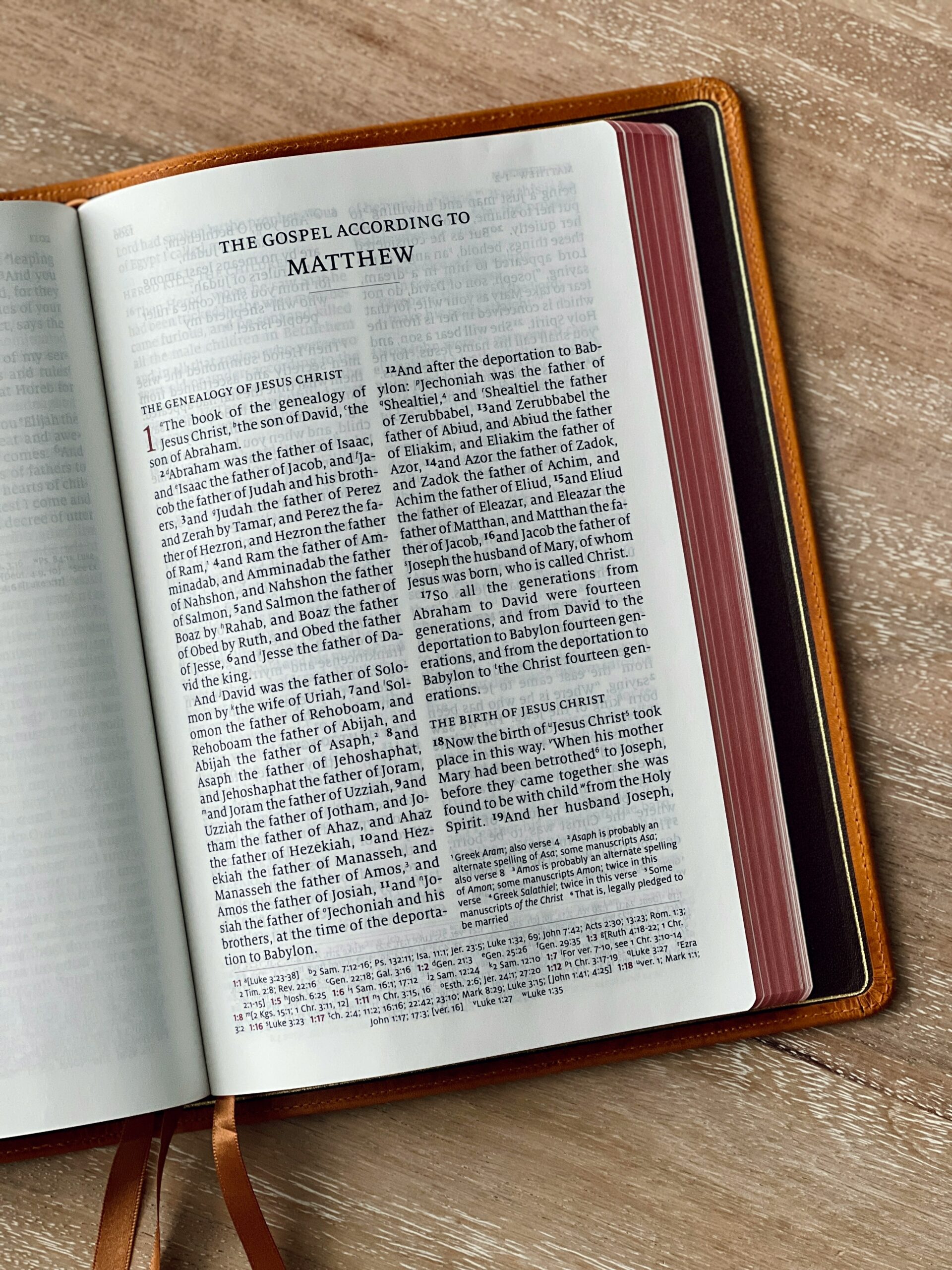
The Pedigree of The Savior
This sermon examines the genealogy of Jesus Christ in Matthew 1, categorizing the ancestors into three distinct groups: the famous, the infamous, and the unfamous. The preacher highlights how this lineage includes both heroes of faith and notorious sinners, illustrating that no human pedigree is perfect. This composition serves to demonstrate that Jesus fully embraced humanity, identifying with all aspects of human experience, from greatness to failure and obscurity. The central message is that God’s grace is sufficient for all, as He chose to save the famous, the infamous, and the unknown alike. Ultimately, the sermon affirms that Christ’s incarnation and sinless life provide the ultimate hope and redemption for every person, regardless of their background or standing.
Transcript
I considered jumping right into
the Gospel of John, which, unless the Lord really steers me, that
is the direction that we’ll be taking after the first of the
year. But in the meantime, I’ve been
looking for a 12-week series to consider as I continue to
lay the foundation in the study of the Gospel of John. When I looked at where we’ve
been in the past, we have really enjoyed a rich study in the book
of Isaiah, in those prophetic passages about the Messiah. We
have looked at some of these passages before, but we’ve never
looked at them in a consecutive flow. So I’ve entitled the overarching
series, The Early Earthly Life. of the Lord Jesus Christ. Certainly,
the Lord Jesus Christ existed long before he came to earth. We have no account of that life
beforehand, but we do have a rich detail of history leading up
to his ministry. So, I wanted to begin there.
A fad has kind of developed over the years, I’ve dabbled in it
a little bit, in this age of computers and databases and just
the information age in which we find ourselves, is this fascination
and sometimes even fixation or obsession with family treats. We find ourselves concerned about
our roots, our family genealogies, and our family lineage. And part
of that is born out of curiosity that we want to know what our
heritage is, who were our predecessors, from what continents did they
come, what was their legacy, what did they leave behind, what
did they stand for, what did they do, what did they accomplish,
What is our pedigree? What is our family tree? What
is our genealogy? Those are questions that are
really very popular and, in a very large measure, fairly easy to
research in our day. We want to know, who are the
big names in our family tree? Were there wealthy people? That’s
one of the reasons we go looking, right? Were there famous people? Were there Christian people?
I know in the family tree that we’ve researched, I have several
pastors in my family tree. The denomination leads a little
bit to be desired, but we have others that fought in the Civil
War. We have others that just seem to be almost obscure. We know almost nothing about
them. And some really sad stories, too. We read of one where they
had just left Italy in a sailing vessel, and not long after they
got going, the vessel foundered on rocks and it began to break
up. And I think nine of these ten
kids were killed, but one had remained was, of course, in our
family tree. And so just some fascinating
things. But it began to dawn on me as I looked at this passage
years ago that this is essentially the family tree, the pedigree
of our Savior. And it presents to us, as the
Gospels do, a sinless, perfect Savior who is God incarnate. We know that God took on human
flesh, but that human flesh has a family tree. God did come to
earth to be born, a miraculous birth, born of a virgin, and
yet born into a family tree by way of Joseph’s lineage, and
by Mary’s lineage as well, as you’ll hear in a moment. Born
to pay our redemption. And we all acknowledge that Christ
was both fully God and fully man, except for his sinfulness. But that part of being fully
man a lot of times can be set aside quite easily. Including
his ancestry, including his family tree, his genealogy. And so I wanted to look this
morning at the pedigree of a Savior. family tree, the genealogy of
the Savior. After that, we turn to Matthew
chapter 1, beginning with verse 1. The book of the genealogy
of Jesus Christ, the son of David, the son of Abraham. To Abraham
was born Isaac, and to Isaac, Jacob. And to Jacob, Judah and
his brothers. And to Judah were born Perez
and Zerah by Tamar. And to Peres was born Hesron,
and to Hesron, Ram. And to Ram was born Aminadab,
and to Aminadab, Nashon, and to Nashon, Salmon. And to Salmon
was born Boaz, by Rahab. And to Boaz was born Obed, by
Ruth. And to Obed, Jesse. And to Jesse
was born David, by Cain. And to David was born Solomon,
by her who had been the wife of Uriah. And to Solomon was
born Rehoboam. And to Rehoboam, Abijah. And
to Abijah, Asa. And to Asa was born Jehoshaphat. And to Jehoshaphat, Joram. And to Joram, Uzziah. And to
Uzziah was born Jotham. And to Jotham, Ahaz. And to Ahaz,
Hezekiah. And to Hezekiah was born Mamasi,
and to Mamasi was born Amon, and to Amon was born Josiah,
and to Josiah were born Jeconiah and his brothers at the time
of the deportation into Babylon. After the deportation into Babylon,
to Jechoniah was born Shealtiel, and to Shealtiel, Zerubbabel,
and to Zerubbabel was born Abiud, and to Abiud, Eliakim, and to
Eliakim, Azor, and to Azor was born Zadok, and to Zadok, Achim,
and to Achim, Eliud, and to Eliud was born Eleazar, and to Eleazar,
Mathan, and to Mathan was born Jacob, and to Jacob was born
Joseph, the husband of Mary, By whom was born Jesus, who is
called Christ. Therefore all the generations
from Abraham to David are fourteen generations. And from David to
the deportation to Babylon, fourteen generations. And from the deportation
to Babylon to the time of Christ, fourteen generations. Isn’t that fascinating? Okay,
maybe not yet. But I hope that by the end of
the hour we will be able to rejoice in the fascinating, amazing history,
the genealogy of the Lord Jesus Christ. The Jewish people have
placed a great emphasis on the importance of bloodline and it
was especially important for the Messiah because he had to
come from the house, the household of David. He had to come from
that Davidic bloodline. And so the purpose that Matthew
gives here right up front in this genealogy is to show that
Jesus is the rightful heir to the throne of David, to all of
those divine promises that were given with regards to that throne. Let me say this, before we even
get going this morning, that it isn’t my intent at all to
dissect and thoroughly examine this particular genealogy. And it’s especially not my intent
to compare and contrast this, if you’re familiar with it, with
the genealogy that Luke records in Luke chapter 3. There is a
difference in the order. Luke, as it were, inverts the
order. There are gaps in the genealogies. There’s information that Matthew
provides that Luke doesn’t. There are supposed inconsistencies,
but as we studied it through Luke, we were able to close all
of those gaps. We did all of that when we studied
the genealogy in the Gospel of Luke. That was back in 2003.
If you wish, you can access that particular study for some of
the more detailed questions and considerations. We’re going to
take a much more broad perspective this morning. But in brief, here
are some of the conclusions from that study in Luke’s Gospel.
Matthew places his genealogy up front, at the very beginning
of his Gospel account, in accordance with Jewish etiquette. Matthew,
as you might recall, was writing specifically to Jews, and that
makes the genealogy a very natural place to start. Matthew provides
this genealogy in descending order through the centuries,
beginning with Abraham, ending with the Messiah, whereas Luke
provides the genealogy in ascending order beginning instead with
Jesus, and tracing it all the way back to the garden to Adam,
who was the son of God. Gaps. There are plenty of them. Gaps and additions to the two
lists are really not a problem, as we found in our study of Luke’s
Gospel. Male offspring a lot of times
were often referred to as sons of so-and-so, even though they
weren’t direct lineage. In other words, someone’s great-great-grandson
could be referred to him as his son, by his generation. Beyond that, it was not uncommon,
rather, that if an individual was so obscure, they were just
completely unknown, and therefore they lived such a brief life,
they can easily be left out of even a formal legal lineage. And the fact that Luke includes
individuals that Matthew leaves out does no damage at all to
the integrity of Scripture, as we’ve found. Since Joseph was
the perceived father of Jesus, thus Matthew’s angle, he’s got
to present Joseph as the perceived father. Matthew provides Joseph’s
lineage, whereas Luke provides Mary’s lineage. Doing so would
be very odd to the Jewish mind. And so Matthew is very sensitive
to provide the father’s genealogy here. But when Luke writes to
a much broader readership, Luke is writing essentially to the
world, to Gentiles as well as Jews, and he provides that inverted
lineage based on Mary’s bloodline. As one characterizes it, Matthew
gives the royal succession, Luke gives the family lineage. Interesting. I like the way one commentator
put it, when he said, whether or not the details in the two
genealogies are in all cases correct, there may be no doubt
that the main facts which they illustrate are historical. Namely,
that Joseph was of Davidic origin, and therefore descended from
the father of the Jewish race and from the father of mankind,
that Jesus was the son of David seemed to have been generally
admitted. And we do not read that his Messiahship
was ever questioned on the ground that he was not descended from
David. That’s the point. Matthew puts
this out front. He says, look, Jesus Christ is
the Son of David. Jesus Christ is in the Davidic
line. Jesus Christ is the Messiah. Now there are many ways to outline
this passage and some people use a lot of creativity. One
commentator said that there are three sections that correspond
with what he called the three crises of God’s kingdom. The
call of Abraham, the kingship of David, in the captivity of
God’s people, and that’s essentially how everybody lays this out,
even though scripture lays it out quite plainly. Scripture
itself in verse 17 says that you can break this up very nicely
into three groups of 14, and the 14 points to particular episodes
in the life of God’s people. There was Abraham to David, David
to exile, and the exile to the point of the Savior. I like the
way Watson put it. The rise of David’s house, the
decline of David’s house, and the eclipse of basically superseding
David’s throne. All right, so with that background
in mind, let’s look at each of these 42 people. For our purposes, I think what
you can do, you can look at this, and each of these 42 people fit
very neatly into one of three categories. One of three categories,
and each of these categories has a common thread. First of
all, there are in this list the famous, the famous. They are
those individuals who, by God’s enabling grace, are known for
great acts of faith. Not perfect people. In fact,
if you mention their names today, many people might not know who
they are. So even their fame is relative,
their goodness is certainly relative. And each of them are known for
disgraceful acts of faithlessness. It’s noteworthy that we find
many of these famous people in the hall of faith in Hebrews
chapter 11, Abraham, Isaac, Jacob, David, even Rahab. And there’s
a continuum here. When I speak of those who were
famous, there is a broad spectrum of faithfulness and some kind
of degree of accomplishment. Some did greater deeds than others. All of them exhibited some degree
of human weakness. None of them, as I said, were
perfect. And what we’ll do, I’ll sweep through, and we’ll look
at some of the famous people in this genealogy. And then we’ll
come back, and we’ll pick up Ruth, too. First of all, look
at Ruth 2, Abraham. He was famous. He still is. Unchurched people in this day
and age would probably have some idea that Abraham was a significant
figure in the life of God’s economy. Abraham was he with whom God
had covenanted to give him the land, the seed, and the blessing. In Abraham, his fame was known. He demonstrated great faith.
Remember one particular episode was that magnanimous act of faith. of giving Lot first choice of
the land. Back in Genesis 13, Abraham just
pleaded for peace. Let there be no strife between
them. What an amazing approach. And
he basically says, you know what, look, here’s my faith. I’m going
to trust God to provide. God had promised him And I’m
going to trust God to provide me. He says, you pick first.
If you go to the left, I’ll go to the right. If you go to the
right, I’ll go to the left. You pick one. Abraham’s faith was seen also
in this humanly impossible situation of the promise of a son at his
age. The scripture reports he believed
God. He believed the Lord and God
reckoned it, counted it to him as righteousness. That’s where
Paul’s entire argument on the righteousness by faith, that’s
where it comes from. That’s the example that Paul
uses. And so when we come to the book of Hebrews, It says
that by faith Abraham, when he was called, obeyed by going out
to the place which he was to receive for an inheritance, and
he went out not knowing where he was going out of faith. It
says that he lived as an alien in the land of promise. And yet, with this famous patriarch
of God, there were also sinful acts of faithlessness. You think
of the lie that he concocted to Pharaoh, born out of a lack
of faith. He records in Genesis chapter
20 verse 11, Abraham said, because I thought surely there is no
fear of God in this place and they will kill me because of
my wife. And so he comes up with this crazy story. Later on, when Abimelech found out about
that, it was a very serious thing. Abimelech certainly wasn’t a
believer in God, but he knew that he was in deep trouble because
of that, facelessly. There was a sinful, you know
it well, a sinful action with his wife’s maid, Hagar. And the
consequences that really stem all the way down to our day.
Abraham’s wife, Sarah, took Hagar, the Egyptian, her maid, and gave
her to her husband, Abraham’s wife, and went in and gave Hagar,
and she conceived. So here, even in perhaps arguably
the greatest patriarch In Christ’s bloodline, there was not only
pain, there was infamy. Isaac. Look at verse 2. Isaac
was known, certainly as a good man. One of the most romantic
stories in all of Scripture is the way that he took his wife,
Rebekah, It’s recorded in Genesis chapter 24. Isaac went out to meditate in
the field towards evening. He lifted up his eyes and looked,
and behold, the camels were coming, and there comes his wife. You’ve
never even met her. It’s an amazing, beautiful story. And it says in verse 67, Isaac
brought her into his mother Sarah’s tent. He took Rebekah, and she
became his wife, and he loved her. We have this idea today
that looks come first, right? Gotta be good looking. For him, this is the wife that
God provided, and as soon as he took her, he loved her. But there were some difficult
things in his life too, weren’t there? In a lie that he borrowed
from his father, he claimed that his wife was his sister. And
in Genesis chapter 26, when the men of the place asked about
his wife, he said, she’s my sister. For he was afraid to say when
a wife, thinking the men of this place might kill me on account
of Rebecca, for she is beautiful. Isaac wasn’t perfect. Look at
Jacob. Jacob was a famous man, a strange,
mixture, said one, of piety with cunning. I don’t know how you
blend those two, but he did. In his life, one of the great
turning points of his life was this vision that God had given
him, where he spent the entire night in prayer, agony, even
remorse at the deeds of his early life. But he found faith in God, he
trusted God. And in him would Christ’s bloodline
be traced. We saw when he wrestled with
the angel of faith, wrestled with him until daybreak, and
he said, I will not let you go until you bless me. Because of
that, he was essentially renamed. Renamed not only Jacob, but Israel. But there were some difficulties
in his life as well, weren’t there? There was the trickery. Trickery of Esau for his birthright. And then trickery of his own
father to secure that birthright by way of blessing. Jacob wasn’t
a perfect man. But he’s famous. Look at the end of verse
2, walking into verse 3, Judah. Now, Judah is a hard one to put
on this list. But he is in the family tree
of Christ’s bloodline, and difficult I say because the immoral act,
and you can look it up, the immoral act with his daughter-in-law
Tamar, it’s a stretch to put Judah into this list of the other
heroes of the faith. Certainly there were some good
things that Judah did, but that’s that stumble there
was colossal. Judah certainly is a famous man,
but he’s not the most virtuous one on this list. Skip down to
verse 5 if you would. We come across the first female,
which would never be included in an official Jewish family
tree. And so you already have in this
pedigree, this family tree, this genealogy, a very unique presentation. You already have something that
has God’s design on it and not mere menace. And he adds in a
person called Rahab. You know her as Rahab the harlot. And we’ll leave it at that. She
was a Gentile. And if there was a union with
someone, it’s mentioned only here. in scripture. Joshua says
that, Joshua records that in chapter 2, Joshua sent the son
of Nun, Joshua the son of Nun, sent two men as spies secretly
saying, go, give them the land, especially Jericho, so they Lynn
came into the house of the harlot, whose name was Rhea, and lodged
there. We know the stories that unfold.
She provided them not only protection, but even covers for them. One
of my seminary professors said one time, a fascinating study,
he said he wished that somebody would go back into, particularly
the Old Testament, and look at all of the areas where deceit
was used, and seemingly, Acknowledged by God. Allowed. Not endorsed. Later on in Joshua chapter 6,
Rahab and Harlot, all of her house were promised to be able
to live. They came, as you recall, towards
the city, saving only them. And so in Hebrews, Rahab, of
all people, makes it into the Hall of Faith. Hebrews 11.31,
by faith Rahab the harlot did not perish along with those who
were disobedient after she had welcomed the spies in peace. James, writing in James 2.25 says this,
that in the same way was not Rahab the harlot also justified
by her works. Remember there, James is settling
out. If you have faith, let me see it in your deeds. Well, we
have in Rahab a famous individual, a Gentile, a troubled, sinful
woman, but a woman whose deeds measure up. Famous. And then there also is in verse
5 Boaz, a wealthy man from Bethlehem, the
husband of Naomi, And when Naomi and Ruth returned to the country
of Boaz, Ruth received permission, remember, to go glean in the
fields of Boaz, and he treated her with such kindness. He gave
her great privileges that were usually afforded to only a few
people. Then there’s Ruth. As we’re considering
that story there in verse 5, this Moabite woman, And by Moab,
I’m not talking about the one in Utah. This was a Gentile heathen
nation. But this faithful woman, this
faithful woman to her mother-in-law Naomi said this, where you will
go, I will go. Your people shall be my people.
Your God will be my God. God. Woke her in to Jesus’ family
tribute. Look at verse 6. A man after God’s own heart. Probably the most important name
in the entire list. This is the list that any Jewish
scholar would have looked for in the list of a supposed messiah. And there he is. This is the
man after God’s own heart, 1 Samuel 13, 14. Scripture reports so many different
incidents, so many battles that David was part of and miraculously
won. His fight with Goliath, his noble
refusal to strike King Saul, 1 Samuel 24. righteous occasion where he listens
and heeds Abigail’s advice and spares foolish Nabal and then,
in God’s providence, marries his widow. We know so much of David’s good,
but we also know, as soon as you mention David’s name, you
think of him that he’s a lot like us, isn’t he? By God’s grace, he was a good
man, able to do good things, but he had feet of clay. He was
a sinful man like you and I. 2 Samuel 11 records that horrific
scene of his murder of Uriah, his sin with Bathsheba. 2 Samuel
5.13 talks about how he took multiple wives. David took more
concubines than wives from Jerusalem after he came from Hebron. I
mean, he just multiplied his troubles. And then, down at verse
7, perhaps the most disappointing individual on this portion of
the list. Really tough to put him in here,
but he is famous. Solomon. probably come up with
a title for him, A Life of Wasted Wisdom. The wisest man who ever
lived and yet made some of the most foolish and faithless blunders. And we know Jesus was to be of
the tribe of Judah. We know that. He’s down the line
of Judah, the son of Jacob, and here we have a number of famous
kings from the time of the divided kingdoms who were kings over
Judah. And so the family tree traces
through those kings. And if you know that episode,
what a fascinating study this is. Asa. King Asa. Look at verse 8. King Asa did
write. You know, if scripture is going
to write about you for the remainder of your days, and for perpetuity,
as long as there are people and Bibles, this isn’t a bad way
to be remembered, compared to all the other things. Asa did
right. If that’s all the people said
about you, get in and get out, right? Because the more they
say about you, it’s probably not going to get much better
than this. Asa removed idols, got rid of the prostitutes, But
his reform, if you remember, didn’t even spare his own mother. He removed her from being queen
because of her idolatry. And it says the heart of Asa,
1 Kings 15, the heart of Asa was wholly devoted to the Lord
all his days. But he wasn’t perfect. It goes
on to say that the reform in the land was incomplete. Jehoshaphat,
very similar. Verse 8, he sought God and was
a good king. He walked in all the ways of
the days of his father. Did not turn aside from it, doing
right, for his reforms were incomplete. Uzziah. Perhaps there is hope
in Uzziah, verse 9. He did right. He did right in
the sight of the Lord according to all that his father, Amaziah,
had done. that his reforms were incomplete.
He didn’t do all that the Lord asked him to do. Job found them.
Job found the same thing. He did right. He did what was
right according to his father Uzziah. And you begin to get
this picture of the father’s influence in the lives of their
sons, both for good and for evil. That his reforms were incomplete. Look at verse 10. It has a title.
A name some of us know. Perhaps Hezekiah will get an
A. That he’s truly a famous man,
a good man, through and through. Close. Verse 18, he did write, according
to all that his father David had done in room to high places,
he trusted the Lord, the God of Israel, so that after him
there was none like him in all the kings of Judah. That’s not
necessarily a great statement. It just talks about the moral
and spiritual decline that is coming. There was a crack. He wasn’t perfect. In chapter
20 verse 12 says that he made a boastful display of his treasures to God’s enemies. And they came and they plundered
them. What about Josiah, verse 11?
Josiah did right. He walked in all the ways that
his father did. Nor did he turn aside to the right and the left.
But it was too late to save Judah. Judah would fall. Zerubbabel,
verse 13. Look at Zerubbabel. Zerubbabel was the head of the
tribe of Judah at the time of the return from Babylon’s captivity. Now we’re jumping forward centuries.
And if you will, he was the general contractor of the temple. But we don’t know enough about
Zerubbabel to really commend him any more than what we know
of here. He was a faithful man, a good
man, a famous man. And then if you jump all the
way down to verse 16, you have Joseph and Mary. Joseph, who
was righteous, according to Matthew 1.19. Mary, favored one. Luke 128. Now again, by famous, I’m not
suggesting that any of these people were thoroughly good.
We just saw a picture, a snapshot if you will. Nor were any of
them perfect or inherently righteous. Every single one of them sinned. Every single one of them needed
a savior. But the general characterization
of their life by God, my dear, was that they were good. If you’re
looking for a genealogy, and this is the best you can get,
this is the best you can ever hope for, from mere mortals,
you go and do your research, and you come across these individuals
in your family tree, you are ecstatic. By God’s grace, doing
amazing things. Scripture, In the history of
the church, in the history of humanity, it’s full of these
people spiritually famous. How deserving that perfect sinless
Savior would have been to have such a noble pedigree with people
like this in it. He should have been the best
of the best. You would certainly expect to
find these people in Christ’s lineage, but there were others.
There are others, and group two is quite different. Group two,
in addition to the famous people in Christ’s lineage, there were
the infamous people. Those who were without God and
without hope, and were characterized by lies of sinfulness. And it’s
very interesting to note, as you work through this list, Infamous
individuals, nearly all of whom were kings of Judah. All of them
were characterized as having done evil in God’s eyes. The fascinating truth is that
the average reign of the good kings of Judah, those who were
characterized by doing right, was 36.33 years. The average reign of bad kings?
Those who are characterized as doing evil, was only 8 years. Sin and sinful living has consequences. Sin is judged by God even in
life. But here they are in the midst
of the Savior’s genealogy. Let’s briefly look at these. Look at Raibalt, verse 7. Raibalt
was a harsh, arrogant, insolent king. He consulted only with
the young men. He wanted to surround himself
with yes men. What a danger. What a danger. And he said this. My father made
your yoke heavy, but I will add to your yoke. My father disciplined
you with whips, but I will discipline you with scorpions. And worse
than a church split, he split the kingdom. Look at verse 7 again. There
was a Bible. Abijah reigned for three years.
You talk about God being eager to get rid of somebody. Three
years as a king. He sought to bring the ten tribes
of Israel back into allegiance. He imitated his father’s sins. He had 14 wives by whom he had
22 sons and 16 daughters. And it says of him that he walked
in all the sins of his father. Because his heart was not wholly
devoted to the Lord. Look at verse 8, Joram did evil,
enough of him. Ahaz did evil, enough of him. In fact, Ahaz, take a peek first. Stay there in verse 9. Ahaz was
said of him, what deeds did he do? What legacy did he leave? Chapter 16 says, he did not do
right what was in the sight of the Lord his God, but he walked
in the way of the kings of Israel, that is, sinfully. Every single
one of the kings of Israel was sinful. Not one of them was ever
cited as being good, doing right. He walked in the sins of the
kings of Israel and even made his sons pass through the fire,
gross idolatry. He sacrificed his children. or verse 10, Manasseh did evil. Amen, verse 10, did evil. Tamar, we already know of her
deal. Jeconiah. It’s said of Jeconiah in 2 Chronicles
36, that he was eight or 18, depending on the translation. Eight years old when he became
king, he reigned three months and 10 days, and he did evil
on the side of the Lord. Now at eight years old, you gotta
really work at it. to offend the Lord so significantly. And I’ll tell you what, when
you’re buying one of those online things, you know, where you’re
tracing your family genealogy, and this is what you come up
with, your family tree, I’m telling you, you want to change your
name. Right? That life is full of these infamous
people. And the big question for us is
why would these people be in the family tree of the Savior? But there’s a third group. Not
only the famous and the infamous, but the people I would call the
unfamous. Just obscure, unknown, nobodies, really. Those that
the world might call nobodies, little-known individuals, about
whom scripture has very, very little to say. Most of these
people belong only to the quote-unquote silent years, the intertestamental
period, after the Old Testament is complete, before the New Testament
initiates. They’re just names. Listen to this. Verse 3, Hezron. Mentioned only in genealogy,
it’s not exactly a claim to fame. Ram. Mentioned only in genealogies. Amitadab. Mentioned only in genealogies. Neshon. Here’s one. The prince of the tribe of Judah,
the first numbering of Israel. That’s about all we know of Neshon. He did have some kind of responsibility. We don’t even know the degree
or exactly what it was. Salmon. Verse 5. Mentioned only
in genealogies. Obed. Dittos. Jesse seemed to
have been characterized as just a quiet, hardworking, respectable
man with eight sons. Outside of that, we don’t know
anything about him. Sheal Teal, honorable mention, a bygood,
only here in all the scripture. Verse 13, Eliakim, mentioned
only here in possibly one other genealogy. Azor, mentioned only
here, verse 14. Verse 14, Zadok, only here. Achan, only here. Elihu, only
here. See, we’re making headway now.
Eleazar, mentioned only here in all of scripture. Matan, mentioned
only here in all of scripture, verse 15. Jacob, mentioned here. Now, if you’re researching, And
you’re paying big money. You’re investing your money in
their family tree, trying to discover who’s there. And you
come across these people, and you want your money back. Who’s
this? But you know what? Life is full of the unfamous.
In a large measure, it’s you and I. And you think, why should
these people be in the genealogy of the Lord Jesus Christ, the
Messiah? We need some names. We need some
glyphs. We need some notoriety. But even the famous people who
saw his infamous law, why include them? Why include anybody? Some had to be included, because
Jesus had to proceed from some of these names mentioned, Abraham,
Isaac, Judah, David. The infamous people are certainly
people that you wouldn’t want upstream in your family tree
and these unknowns, why them? May I submit that first of all, this is the
best that God could have done given the material with which
he had to work. Humanity. In fact, given human nature,
any human history could have only fared worse if you looked
at your family tree. In a sense, this is the pruning
of the crop. Unlike men, God didn’t have to set out to build
a pedigree in which he could boast. The problem, as we’ve
seen all along, was the quality of the material with which he
had to work, the sinful humanity. The glory of Christ was his deity. As one characterized this list,
the parade of names that might be supposed to be unfit insertion
into the pedigree of the Messiah is intended to teach that he
who came to call not righteous, but sinners, and who so commended
the faith of those who are not of Israel, was himself descended
from blatant sinners and from a stranger, a heathen, a Gentile. Because Jesus came to take on
human flesh. Jesus came to embrace humanity,
empathize with humanity, show his love for humanity, and save
humanity. Paul’s words take on a more profound
significance. In light of this passage, he
emptied himself, taking the form of a bouncer. And being made
in the likeness of men, he humbled himself by becoming obedient
to the point of death, even dying on the cross. And all of that,
yet without sin. Jonathan Edwards said this of
the Savior, Jesus Christ has true excellency, and so great
an excellency that when you come to truly see Him, you look no
further. Your faith rests there. There
is a transcendent glory and ineffable sweetness in Christ. You see
that you have been pursuing shadows, but now you have found the substance. You realize you have been seeking
happiness in the screen, but now you have found the ocean.
The excellency of Christ is an object adequate to the natural
cravings of the soul and is sufficient to fill its capacity. Christ
has an infinite excellency, such as the mind desires, in which
it finds no bounds, and the more the mind contemplates Him, the
more excellent does He appear. See the common thread? That even
those spiritually famous, they were sinners in need of God’s
saving grace. None are truly spiritually famous
without God’s grace. And yet there are none so infamous
that they are beyond God’s saving grace. Those infinite sinners,
the very ones that Jesus came to call to repentance, no one
is beyond God’s reach. And you know what? The most encouraging
thing to me is there are no unimportant people to God. There are no nobodies
in God’s eyes. To us, that latter list just
means that they weren’t to God. It was for all of these kinds of
people that Jesus Christ came to save the famous, the infamous,
and the unfamous. No wonder the hymns of Christmas
often echo that great theme. Joy to the world, the Lord is
come. Let earth receive her King. Let
every heart prepare him room. A couple more psalms before we
go. For merciful God, as we glance
at this passage, perhaps we look, read it, dozens of times, each
time somewhat with bewilderment, but today we’re absolutely astounded. We’re astounded that there wasn’t
a better pedigree for our Savior. Better men, better women. The Lord, this was of your design.
This was your plan of redemption. There was no better material
with which to work. So you took humanity, in its
fame, in its infamy, and even in its obscurity. You wove together
a family tree that brought us the Savior. We’ve come to be
most thankful. Father, prepare our hearts. for
this season. Let us not become distracted.
Let us take hold of the early start in focusing our minds on
the Lord Jesus Christ. Let that not wait. We thank you and praise you in
Jesus’ name. 355 is our closing hymn. This morning,
we are God’s people. So if you take your hymnals, and go
to 355, let’s stand and sing with God.
Messages: 8