Sweet Dreams
This sermon explores how King David found restful sleep amidst the severe threat of his son Absalom’s rebellion by focusing on the character of God. The central message emphasizes that true peace comes not from the absence of trouble, but from a deliberate shift in focus toward God as a shield, a source of glory, and a sustainer. The text highlights the importance of verbal prayer and the confidence that God hears and answers, allowing believers to rest securely even when surrounded by enemies. By examining the historical context of 2 Samuel 15 alongside Psalm 3, the sermon illustrates that salvation and protection belong solely to the Lord, freeing believers from the anxiety of worldly concerns. The tone is pastoral and comforting, encouraging listeners to trust in God’s sovereignty and grace for both their spiritual security and daily well-being.
Transcript
Sleeplessness or that inability to fall asleep or stay asleep has got to be one of the most common frustrations of life. Whether it’s from caffeine or worry, all of us have faced it. It’s one thing to be awake while others are sleeping if you’re working on a project or preparing for some big adventure. or dealing with some crisis, God gives grace. It’s quite another thing to be weary and exhausted, lying your head on your pillow and finding yourself completely unable to sleep or to stay asleep. Right in line with that are the occasions when you’re able to fall asleep, But worries and concerns, thoughts, or a wide variety of sicknesses wakes you up and keeps you up. In those dark evenings, it seems as if you’re the only person in your time zone that isn’t sleeping. As I mentioned, sickness is just one of the causes of insomnia. But far more often, sleeplessness is caused not by a troubled tummy, but a troubled mind. There’s an infinite supply of things that makes us lose sleep.
Concern for our family, concern for friends, their health, their safety, their security. Concern about our own health, aches and pains, sickness, disease. Concern about something that we did during the day or said or something that we did not do or say that we ought to have. Concern about finances, our 401k, our retirement, our salary. Concern about world events and politics. Concern about sin. Concern about our job, our career, our co-workers. That list of things that cause sleep-depriving worry is endless.
And not even King David was exempt from this nearly universal experience. David had plenty of things that burdened his mind and his soul. There were his own wayward contentious and ornery people. There were his kingdom’s neighboring nations, always looking to harass and assail God’s nation. There were his own weaknesses and failings, which were many. And there was also his own family. They too produced problems that led to anxious thoughts on the king’s part.
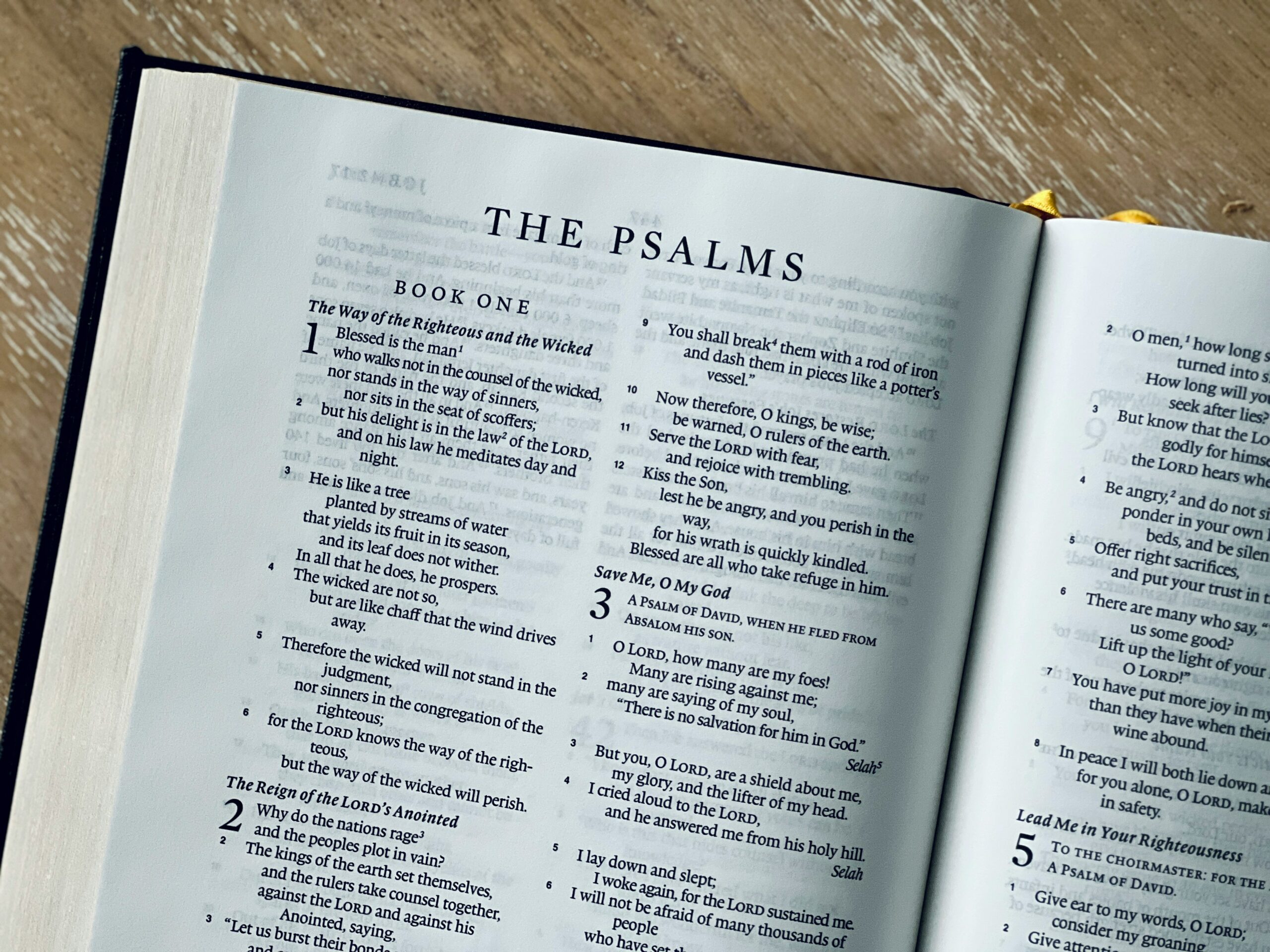
We’re given a clear statement on the context of Psalm 3, our psalm this morning, and it comes from the superscription, the title, if you will. 116 of our psalms have these superscriptions, 73 of David’s. Sometimes these titles, they function like no more than a title, just telling us what the psalm is about. Sometimes they give us a great deal of background, as here in Psalm 3. They often provide the name of the author, the historical context of the psalm, as well as sometimes musical direction for the use of the psalm in worship. Well, the superscription of Psalm 3 tells us a great deal.
It brings us right into one of the most dramatic episodes of King David’s life. It just says, a Psalm of David, when he fled Absalom his son. Even if we’d never read that account, the latter portion of that line should alarm us. fled from his son. That alone tells us that David had big problems in his family. Whenever someone tells me that they’re from a dysfunctional family, I say, show me a gathering of sinners that isn’t dysfunctional. David’s family was no different. One of the worst episodes that David faced involved his own son, Absalom.
To begin with this morning, instead of turning to Psalm 3, would you please turn to 2 Samuel 15? If you’re in Psalm 3, put a bulletin there and we’ll be back there in a moment. We’ll make our way to Psalm 3, but we need to start in 2 Samuel to get the context. We all likely know or have heard the story that led up to this dreadful season in David’s life.
David’s older son, Amnon, violated his half-sister, Tamar. I’ll leave it at that. Her full brother, Absalom, was enraged at this. And even though he did not take immediate action, the pot simmered. His hatred for Amnon festered for several years as he sought an opportunity to avenge his sister. In time, he made arrangements to kill Amnon. That led to an obvious breach between Absalom and his father, David. The relationship became so toxic that Absalom had to flee, effectively banished from the kingdom. After a three-year absence, David recalled Absalom from afar, but even though Absalom returned, David held him at arm’s length, refusing to fully reconcile with him. By the way, this sermon is almost 35 years old in the making. During seminary, I was a college pastor in a fairly large church. And at one point, I was invited to preach in what we called Big Church, the main service.
And this was the very section that I had in mind. I wanted to use it as a reminder to forgive those who have offended us, not to be like David, calling Absalom back, but at the same time, keeping him at arm’s length. And my title was The Banished One, thinking of Absalom. I ended up changing my passage. I preached something else, but I had already submitted my title. So you can understand my shock when I arrived at church that morning and saw our very large marquee that just read, Ron Frasco, The Banished One.
Let’s pick up our account once again. His father’s indifference toward him enraged Absalom, and he began to build a sizable coalition that included many disgruntled associates of his father, David. We pick up the account 2 Samuel chapter 15. We pick up that account in verse 1. 2 Samuel chapter 15. Now it came about after this that Absalom provided for himself a chariot and horses and 50 men as runners before him.
Absalom used to rise early and stand beside the way to the gate And when any man had a suit to come to the king for judgment, Absalom would call him and say, from what city are you? And he would say, your servant is from one of the tribes of Israel. Then Absalom would say to him, see, your claims are good and right, but no man listens to you on the part of the king. Moreover, Absalom would say, Oh, that one would appoint me judge in the land.
Then every man who has any suit or cause would come to me and I would give him justice. And when a man came near to prostrate himself before him, he would put out his hand and take hold of him and kiss him. In this manner, Absalom dealt with all Israel. who came to the king for judgment. So Absalom stole away the hearts of the men of Israel. And so in his bitterness, Absalom was just currying favor with any who would listen to him.
He was not only factious, divisive, he was seditious. But it worked. And he went and sent feelers out throughout all of Israel, gathering followers to his cause. Verse 12, if you jump down there, concludes that the conspiracy was strong, for the people increased continually with Absalom. In the ensuing chapter, chapter 16, Verse 16 of chapter 16, it just says that Absalom and all the people, the men of Israel, entered Jerusalem. Absalom had quite a coalition. The rebellion likely didn’t include every single citizen, but it was way more than a groundswell of opposition.
Well, when David heard of this, development, he made a decision to flee Jerusalem. There was a lot more to this sad chapter of David’s life. Verse 30 presents a dismal snapshot. Would you glance there? David went up the ascent of the Mount of Olives and wept as he went, and his head was covered, and he walked barefoot. Hardly the image of a king He crossed over the same stream, the Kidron, under the same or very similar circumstances as Jesus would do centuries later. And it’s against this backdrop that David writes Psalm 3. And so would you now turn back to Psalm 3 as we read. Psalm 3, the Psalm of David. when he fled from his son, Absalom.
O Lord, how many, how my, pardon me, O Lord, how my adversaries have increased. Many are rising up against me. Many are saying of my soul, there is no deliverance for him in God. You, O Lord, are a shield about me, my glory, and the one who lifts my head. I was crying to the Lord with my voice, and He answered me from His holy mountain. I lay down and slept. I awoke, for the Lord sustains me. I will not be afraid of ten thousands of people who have set themselves against me round about. Arise, O Lord, save me, O my God, for you have smitten all my enemies on the cheek. You have shattered the teeth of the wicked. Salvation belongs to the Lord. Your blessing be upon your people.
Well, that was a lot of lead up to a very short psalm. We might immediately wonder why David doesn’t directly mention Absalom in this psalm. That could be explained by two points. Number one, David’s abiding love and affection for Absalom. He didn’t want to bring his name into this.
And secondly, that David wanted this psalm to be more generally received and applied by others. In other words, it wasn’t just about this grievous incident, but this incident served as a general reminder to people about God and His nature. David isn’t just focusing on the facts of this one incident. Instead, he captures the sentiments and the lessons learned from such an event. As we’ve seen, David had more than his shares of troubles and concerns in the chapter from which we just read. Verse 13 says that the hearts of the men of Israel are with Absalom.
It wasn’t just the rebellion of his own son, but his people with him. A man named Shimei came out of his house cursing David, throwing stones at him, the king. A man named Ahithophel, one of David’s confidants and counselors, deserted David and joined forces with Absalom. He even offered to kill the king. And so how do we get to this comfortable place? that David describes in Psalm 3. Is sleep, does it do some kind of magic?
No, there’s a process here that David lays out and he details it for us in this Psalm. I would suggest to you that there are three portions of the Psalm that correspond to the mind’s course in a day of trouble. There’s one remaining feature that we should observe before we look more closely at this psalm. You likely noticed that mysterious little word sila. It’s a word that appears more than 70 times in the psalms, always following a portion of text. Here it’s appended three times. The word basically means to lift up.
No one really knows exactly what that means, but the fact that it’s appended at the end of certain paragraphs suggests that it had musical implications. It was likely some kind of a pause, an interlude in which either the singing voices or the musical instruments or both were emphasized. Or perhaps one was emphasized while the other fell silent. It could be as simply as calling for louder singing, louder playing. Kind of like what we say, what we mean when we say strike up the band. If nothing else, we can treat it as a demand that we pay close attention to the words that Selah follows.
As for the structure of the psalm, It very clearly breaks up into three sections. In verses one through three, David is talking to God. In verses four through six, David is mulling his testimony of God’s care. And in verses seven and eight, David utters his conclusion, a plea and a praise to God. Begin in verse one. the mind’s course in a day of trouble that ultimately leads to sweet dreams. First we see the deliberating, we see David, we find David rather, deliberating the giver of sleep.
He’s thinking about God, even in the course of his troubles. King David here slips into his jammies. And like most people do, he begins to recount his day. It’s unavoidable that he should not consider the difficult parts. And that indeed is the starting point. Oh Lord, how many are my adversaries? Many are rising up against me.
What began as a severe dispute between him and his son, soon grew to a small army of 50, attending Absalom’s chariot. That alone would have been a very bold move on Absalom’s part, and David just seems to have allowed it. But that, as we saw, was only the beginning. Seeds of Absalom’s rebellion had now germinated and were flourishing. The men of David’s inner circle have acted treacherously The traitor Ahithophel sought Absalom’s permission to take an army of 12,000 men to eliminate, assassinate the king. Seemingly, the entire city had sided with Absalom.
It must have seemed as if the whole world had turned against David. And that hateful man, Shimei, who chased the king with stones and harsh epithets, is likely the one to whom David refers in verse two. Many are saying of my soul, there is no deliverance for him in God. Seeing that the political winds had shifted against David, Shimei took opportunity to mock him, saying in 2 Samuel 16, get out, get out, you man of bloodshed and worthless fellow. The Lord has given the kingdom into the hand of your son Absalom. The taunt of his enemy was not merely that David was not saved, but that he was beyond saving. There is no deliverance for you. You’re unsavable, and that is just about the worst thing that a person can say about someone And it hit David very hard. We do this, don’t we? For sure, we’re going to face problems in this life, but we often allow our mind to expand these problems completely out of proportion. Things were bad. Things were objectively bad. Things looked grim for David, but there was yet one that was still on his side, and David could not forget him.
Look at verse three. But you, O Lord. David, he almost doesn’t need to say anything else. The whole world is against me, but you, O Lord. Just the fact that there is an about face there, an adversative, says it all, but. David does continue, however, but you, O Lord, are a shield about me, my glory, and the one who lifts my head. He takes ultimate solace in three things that are true of his God. First, that he is a shield about him. The warrior’s shield protected the front portion of his body. This is a different kind of shield God made a similar promise to Abraham, Genesis 15. Do not fear, Abraham. I am a shield to you.
God made a similar promise to Israel, Deuteronomy 33, 29. Blessed are you, Israel, who is like you, a people saved by the Lord, who is the shield of your help and the sword of your majesty. And David couldn’t forget that the Lord had made this promise to him. He says it again in Psalm 18.
The Lord is my rock, my fortress, my deliverer, my God, my rock in whom I take refuge, my shield, and the horn of my salvation. But this is a different kind of shield because David says it is about him. That is around him. God’s protection surrounded David in front, behind, above, and below. It was like an impenetrable bubble. And I can only liken it to the proverbial force field of science fiction. Even as David’s enemies were drawing the circle tighter and tighter around him, David is there resigning securely behind God as his shield.
But God, he says, is also his glory. David knew that God had promised a perpetual throne. He knew that to destroy that would be to essentially destroy God and his plan of redemption. God would yet be glorified, even though the situation appeared to be dire. His shame, we saw, was pictured well, fleeing his enemies, even his own son, barefoot with his head covered and hung low. David had no glory of his own to boast about. His glory was God himself. He utters this again in full in Psalm 62.
He only is my rock and my salvation, my stronghold. I shall not be shaken. On God, my salvation and glory rest. The rock of my strength, my refuge is in God. Trust in Him in all times, O people. Pour out your heart before Him. God is a refuge for us. There’s a third feature in his God.
He is, David says, the one who lifts my head. The Lord is the one that makes the downtrodden to look up. The Lord is the one that takes their chin, as it were, and lifts them. The Lord is the one that had put David in his place. The Lord is the one that sustained him. The Lord is the one that brought him through a myriad of trials and difficulties.
And so God not only comforts, but grants strength and protection and victory. God is the one that lifts my head. And as David inventories his day, at the end of his day, it is this recollection that readies him for a night’s rest. That would do it. That should do it.
We cannot be naive about the troubles that we face in this life. Our trials are real, and sometimes they’re very substantial. But neither can we be naive about God and His ability. If we focus on our troubles, lack of sleep is only the beginning of our difficulties. We have read And we are called to think on God and His help available to us.
That will ready us for sleep. And so as David deliberates about the giver of sleep, he begins mending the thoughts for restful sleep in verses four through six. The second force in the day’s trouble David, even in the midst of fleeing his enemies, he focuses his thoughts on God. He is the giver of restful sleep. And in verse four, it captures him testifying to the goodness of God. And even as he articulates his testimony, he is comforted and encouraged. He begins with a testimony of answered prayer in verse four.
I was crying to the Lord with my voice. He answered me from his holy mountain. Form of the verb here indicates that it’s not just that he called upon the Lord on this occasion, but that every time he called upon the Lord, the Lord answered. He had a communion with God. He knew where to turn in his trials. He cried out to the Lord as he always did. And he did so, he adds, with his voice. And the clear implication here is that this was an audible prayer. He spoke his need before God out loud.
Let me tell you, there’s nothing wrong with silent prayer. At times, those are very appropriate. And God does hear these. Nothing wrong with praying silently to yourself, But our own experience will tell us that silent prayers, they have a tendency to drift and even dissipate, don’t they? One writer said of these silent heart prayers, he calls them, they degenerate into dreamy musing.
Okay, it’s just me. That’s the common experience of the believer. When we pray only with our heart and not with our lips, our prayers tend to vaporize. Our experience also tells us that when we clearly and verbally express our prayers to God, we don’t tend to meander through the skies. We don’t tend to lose our place. We don’t tend to pray in generalities.
And for David, The hounded king, no muted muttering would do on this occasion. He found his quiet place and raised a noise with his voice to heaven. He cried to the Lord. Well, and his prayers were heard, he testifies further, because the Lord answered him from his holy mountain. That’s almost a euphemism for God’s heavenly throne, his sanctuary.
We don’t demand an audible reply from the Lord, and that isn’t necessarily what David was referring to here. God heard his prayers and graciously provided an answer. And in David’s case, he and his throne were spared. Even though the tragedy of his son Absalom’s death in battle, David is ultimately restored to his throne, and answer to prayer.
Think of this. If we cry out to God with our voice, and God hears and answers our prayer, then what in all the world, both seen and unseen, do we have to fear? God watches us from heaven and sovereignly oversees our lives, moment by moment, every intricate detail. And it’s here that David adds a second layer to his testimony. We have it in verse five.
The central theme of this entire psalm, I lay down and slept. I lay down and slept. A fascinating little detail here. The I in the sentence is in the emphatic position. It is as if the king says, I don’t know about everyone else. I hear soldiers tromping around the hillside, but as for me, I’m going to bed. In the midst of being furiously pursued, to be killed if caught, David retires for an evening of peaceful rest.
Just amazing. Who does that? David did. And David did so because of the confidence that he had in his God. The picture painted is so vivid that we can almost picture the king doing his nightly routine. brushing his teeth, washing his face, saying his prayers, settling into bed for a good night’s rest. There are roving bands of soldiers all around the mountainside, but David’s tenacious faith and his undiminished confidence in God enable him to crawl into bed. I love the way one commentator characterized this. He said of David the king that God’s hand was his pillow. Isn’t that beautiful?
And he slept. So simply, he slept. No tossing and turning, no insomnia brought about by worry. He slept. It’s almost a hint of, there’s almost a hint of surprise in David saying that. I lay down and slept as if he was only hopeful that when he went to bed, he would have a good night’s sleep. God blessed his sleep.
His rest was part of God’s answer to him, a peace that allowed him to fall comfortably asleep. And then following a night’s rest, he awakens, I awoke, he says, with a reminder that the Lord is the one who sustains him. After a day’s stressful events where most people would think that sleep would be elusive, the psalmist arises from a good night’s sleep. This is the reason that the psalm has been titled A Morning Prayer of Trust in God.
David doesn’t speak of any night frights, no nightmares, no drawn out wakeful periods of worry. He experienced the full purpose of the night and his bed, he slept. And then he awoke. What a sweet and simple answer to prayer is a truly restful night of sleep.
One of the most frequently cited encouragements from the Psalms has got to be Psalm 30 verse five. Weeping may last for the night, but a shout of joy comes in the morning. What child of God hasn’t experienced that truth? That even in the face of wearisome trials and difficulties, thoughts that harass us, God gives rest.
And in the morning, the sun does rise. God’s grace prevails. Sleep allows both our minds and our bodies to rest and rejuvenate and rested in answer to our prayers and to the humble acknowledgement that God is our protector, he is our glory, and that he is our restorer of confidence.
He is the lifter of our heads. We awaken to a spring in our step and to a song in our hearts. Now it’s true. David does awaken to the same problems that he had the day before. But the same confidence that put him to bed and enabled him to sleep. He says, I awoke for the Lord sustains me. He captures it. God calmed his heart that he might sleep. And David says in Psalm 37, the Lord sustains the righteous. It was God who was protecting him. It was God who was enabling him.
And God gently rustles the king awake, eager and ready for more of the sustaining grace of God. And with that, the well-rested king declares, I will not be afraid of 10,000s of people who have set themselves against me roundabout. That verse not only pictures a great army, but it has him completely surrounded. And yet he’s at peace.
It’s his testimony of confidence in God. Virgin here quotes an unnamed pastor who puts it this way. This quietude of a man’s heart by faith in God is a higher sort of work than the natural resolution of manly courage, for it is the gracious operation of God’s Holy Spirit upholding a man above nature. Therefore, the Lord must have all the glory of it. Beautiful words.
God gave David the peaceful confidence. And the reference to so great an army as 10,000 is hardly an exaggerated boast. Since Absalom’s army was growing exponentially by the day, whether there were many or few, David knew that his days were in God’s hands. And on this end of his slumber, We can almost picture David relaxing outside of his cave with a cup of coffee. What would that kind of confidence do to his pursuers?
Looking at the mind’s course in a day’s trouble, not only the deliberation of the giver of restful sleep and the mending of our thoughts for restful sleep, but third and finally, renewing the assurance from restful sleep. Verses seven and eight. With the assurance of answered prayer and a confident night of protected sleep, our psalmist now boldly appeals to his God.
Arise, O Lord, save me, O my God. The metaphorical appeal for God to arise was first uttered by Moses in an appeal that God rise up. Rise up, O Lord, and let your enemies be scattered, Numbers 10, 35. It is again an anthropomorphism. They’re common in the Psalms.
It’s a human way of thinking of God. It’s an appeal for God to intervene. God has no reason to sit. There’s no need to call God out of his easy chair. The rising here is figurative. And the specific request that David makes is for the very thing that Shimei and others said was impossible for him. His salvation. Not his eternal salvation here, but the preservation through this uprising. They said that for him, there was no deliverance. This is exactly that for which David prays. Save me. He prays. And for David, the prayer is as good as answered.
He continues on by saying that God has smitten all his enemies on the cheek, a cold, rebuking slap in the face. You have shattered the teeth of the wicked. He likens his earthly foes to wild beasts who are suddenly neutralized by the loss of their teeth. They can no longer bite or chew. Now, it would take some time for this vindication to play out fully.
Absalom’s rebellion eventually fails. Absalom himself is eventually killed, slain by Joab, a captain of David’s army, which David did not sanction. Ahithophel, remember him, who asked Absalom for an army of 12,000 men so that he could kill the king, He ultimately hangs himself. David is ultimately restored as Israel’s king.
Oh, yes. And Shimei, the one who barked at the king and threw rocks at him, he repented and was mercifully spared by King David. What a turnaround. God did save him. And so with that, David expresses one final glorious truth in verse eight, salvation belongs to the Lord. Your blessing be upon your people, he prays. Men cannot provide salvation, nor can they thwart God’s efforts to provide it. Jonah learned this very basic and sobering lesson as well. Salvation is from the Lord. That is the secret to David’s sleep. He knew already that God is the God of salvation. He knew already that God had granted that favor to him. In Romans 9, the apostle Paul says it very succinctly. Just listen. It does not depend on the man who wills or the man who runs. but on God who shows mercy. It doesn’t matter about your human effort. It doesn’t matter about your desire. God is the one who shows mercy and must.
If a person is to be saved, well, that’s a brief summary of what Paul says much more fully in Romans 8. Looking back into eternity past, he recounts the various elements of God’s work of salvation. Listen to this. That those whom he foreknew he predestined, and these whom he predestined he called, and these whom he called he justified, and these whom he justified he glorified. That is the full report of salvation. That pretty much encompasses God’s work of salvation from beginning to end. David speaks of it in much simpler terms. Salvation belongs to the Lord. And that was the secret. That’s the secret to peaceful confidence that God had already provided for his greatest need. The rest of his needs were no longer even a concern.
In his work of redemption, God has already done the greater and the more difficult thing, sending his son as the atonement for our sin. bringing us to life through regeneration and repentance and faith. If God has done that greater work, he will oversee the lesser things of our life. Even if we’re pursued by a great and hateful army, he will oversee the things of our life, no matter how serious they seem to us. Would you humble yourself in his glorious presence?
Our gracious God, we thank you and praise you for this reminder of David, even in the face of a frightful difficulty. Lord, we thank you for this reminder for us as believers that we need to cultivate and place our faith in you. We need to remind ourselves that you are indeed a shield that encompasses us all around.
We have no glory of our own, but we have your glory and you will be glorified through us by grace. You are the one that makes us to look up, not in pride, but in faith. Lord God, we thank you that you are the one that sustains us. You are the one that saved us. You are the one that sees us through.
Lord, our fear and concern this morning is only for those who do not know the Lord Jesus. You’ve done the greater thing already in sending your son to pay for the sin of the world. Ours is just to receive it. to gratefully reach out and place our faith in the Lord Jesus Christ for salvation. Lord, we pray for those who do not have this confidence. They should be sleepless. They should toss and turn worrying about what tomorrow brings if they even have a tomorrow.
Lord, we thank you. that for us, whether or not tomorrow comes is irrelevant, we know that we are with you and that you are with us. Father, we thank you for your grace in our lives. And Lord, we thank you and praise you for the day that you’ve given us. We ask your blessing on our week. Help us to rest in the truth of this verse. In Jesus’ name that we pray.
Messages: 22