God-honoring Cretans
In this first of a short series, Ron explains the historical background to the letter to Titus and an provides an overview of the entire letter.
Transcript
If you would, take your Bibles
and turn to the book of Titus, Paul’s epistle to Titus. Several years ago, December always hits. You’re
studying other passages, and then there are all kinds of additional
activities. And then we also have our annual
meeting, typically in January or February. It’s a busy time.
And so several years ago, in the midst of busyness, I needed
something from the well to preach, and I dipped into Ephesians.
Some of you might remember that. We spent six or seven weeks in
Paul’s epistle to the Ephesians. And so I began to look at another
option, given the busyness of this year, and not only the annual
meeting and Christmas, but then a wedding on top of that. And
I noted that It’s been a while since I preached Titus, 21 years
as a matter of fact, and we have dipped in and out of various
passages in Titus along the way, but I figured that for the next
three or four weeks, we could return to this, kind of refresh
our memory of the richness of this epistle. and then we will
return, Lord willing, to Paul’s epistle to the Corinthians. The
pastoral epistles, 1 Timothy, Titus, and 2 Timothy, and that
is the order that I believe they were written, they provide us
with a wealth of instruction about life and conduct in the
church. It was fascinating that so much
of the prayer just now was about that very subject. These three
epistles are effectively pastor-to-pastor letters. And so they are for
the elders of the church, the leaders, and maybe even primarily
so. But they are not just for the
elders. These are what one historian
designated a treasury of practical precepts for the Christian church. In the pastoral letters, Paul
is writing to two faithful fellow workers in the gospel, Timothy
and Titus. Timothy is his appointed delegate
to Ephesus. Titus is his representative to
Crete. And while it is difficult to
pin down precise years that Paul’s letters to these helpers were
written, They are bathed in a tone that distinctly suggests that
this is the twilight of Paul’s life and ministry. There is in
these letters solemnity, directness, and even urgency. They were all
written in relatively the same time period. In 1 Timothy and
Titus, there is a sense that the end is drawing near. But in 2 Timothy, his martyrdom
is imminent. Paul knows it. Paul again finds
himself in 2 Timothy imprisoned in Rome. And tradition, that
is the prevailing report from church history, says that Paul
suffered martyrdom under Roman Emperor Nero. We have a relatively
narrow historical window during which this could have taken place. Paul was likely released from
his first imprisonment in about AD 62. We’ll talk more about
that in a minute. He revived his missionary travels
for several years and then ultimately was rearrested and ultimately
executed sometime between AD 66 and 68. We know that because
Nero’s reign ended in AD 68. But even in the waning years, of Paul’s earthly life, he filled
up his calling. And I love the theme of the songs
today, going and proclaiming Christ to the world. Paul was
all about that. He filled up his calling by seizing
hold of the opportunity to preach the gospel to several previously
unreached areas. One of those areas was the island
of Crete. Paul had indeed visited this
island on a previous occasion, but only very briefly. That visit,
you might remember, is recorded in Acts chapter 27. But that
can’t be what Paul is referring to when he writes to Titus, because
on that occasion, Paul was under arrest and being transported
to Rome to go before Caesar. He would not have had the time
or the opportunity for any kind of ministry in Crete on this
occasion. And yet in his letter to Titus,
whom he left in charge of the ministry there on Crete, he clearly
speaks of having conducted ministry there. So when might that have
occurred? The answer is, during his sixth
and final missionary journey. Sixth journey, you wonder. You say, I thought there were
only three. I haven’t lost my mind. And I
admit that I do refer to an additional three missionary journeys with
a bit of a tongue in cheek playfulness. So let me explain for just a
minute. How did I come up with three more additional missionary
journeys? Most historians, as you know,
speak of three missionary journeys. If you were to look in the back
of your Bible, there’s a map with three different colored
arrows tracing Paul’s steps. But it’s really a matter of perspective
when you think of a missionary journey. Because if a missionary
journey is defined loosely as a mobile gospel opportunity,
then there are clearly more than three such endeavors. Allowing Paul’s three traditional
journeys to stand, those that are recorded in Acts chapter
13 through 18, we can see other ministry endeavors that can reasonably
be called missionary journeys. For instance, in Acts chapters
21 through 26, Paul travels, remember that’s one of the key
elements of a missionary journey, Paul travels to Jerusalem. He
is arrested and enters into multiple examinations before various authorities. You say, but there’s still a
missing element. This isn’t a missions trip. Oh,
yes, it is. Because during each examination,
Paul takes full advantage of the opportunity that he has to
preach the gospel, whether he’s standing before religious or
political authorities. And so I’ve called this Paul’s
fourth missionary journey, his examination ministry, if you
will, since he’s seizing on these occasions to preach the gospel. Then in chapters 27 and 28, Paul
is again traveling. I mentioned this a moment ago.
He’s being taken as a prisoner to Rome, but the entire time that he is
being transported by ship. And as soon as he hits soil in
Rome, he begins preaching the gospel. The entire time that
he’s there in Rome, he’s moving about freely. He’s engaged in
preaching and teaching. And so I’ve called this Paul’s
fifth missionary journey. I would call it his excursion
ministry. But it’s Paul’s sixth and final
missionary journey that I want to focus on this morning. And
you say, you just mentioned Acts chapter 27 and 28, where are
you going to get this material? Well, I believe that it can be
shown that Paul is briefly released from his first Roman imprisonment
and uses that time for ministry. It’s a missionary journey. And
this is evident from the fact that there are statements made
in Paul’s pastoral epistles that cannot be reasonably positioned
into the narrative recorded in Acts. Now this is, as you know,
very tenuous territory to engage in conjecture and drawing conclusions
from data that’s given. So I don’t want to get dogmatic
in all of this, but there are years of activities that are,
for the most part, unrecorded in scripture. They’re not recorded
in the book of Acts, and they’re referred to only vaguely in Paul’s
epistles. Many godly scholars have admitted
to entering into this particular study with great trepidation.
Me too. One such scholar articulated
it well when he said, the light concentrated on that portion
of Paul’s life, which is related in the latter chapters of Acts,
makes darker, by contrast, the obscurity which rests upon the
remainder of his course. What he says there, in very technical
language, is that when you read the book of Acts, it seems like
it’s following Paul’s every move. No detail is left out. And then
all of a sudden, at the end of Acts 28, we’re given a statement
and we know that there’s a potential that Paul was released. We’re
just not told. He finishes this way, the progress
of the historian who attempts to trace the footsteps of the
apostles, well, that would be us. The progress of the historian
who attempts to trace the footsteps of the apostles beyond the limits
of the scriptural narrative must at best be hesitating and uncertain. And we are. But the obscurity
of these years is ordained by God. Because if you think about
it, God very well could have appointed Luke to write volume
three, right? Anything after Acts 28. But he didn’t. And yet we do
have some intriguing. Even if faint glimpses of Paul’s
life and ministry. As murky as they may be. The
first thing I want you to consider, if you would turn to Acts chapter
28. I know you have a finger in Titus. Put the bullets in
there. The first thing that I want you
to notice in Titus is that Paul’s imprisonment in Acts is very
different from the imprisonment that he outlines in 2 Timothy. But I want you to see his Acts
imprisonment first. And if you would, scroll down
to verse 30. Acts chapter 28. beginning in verse 30 where it
says, and he stayed two full years in his own rented quarters
and was welcoming all who came to him, preaching the kingdom
of God and teaching concerning the Lord Jesus Christ with all
openness unhindered. Well, now you know why it was
easy for me to call this a missionary journey. Paul is really having
a time of ministry that was just beautifully designed by God.
He dropped him into Rome and set him free. They thought he
was a prisoner. God thought otherwise. So at
the end of Acts, Luke’s narrative has Paul under house arrest,
very loosely, With a relative freedom to conduct ministry,
this first ministry, imprisonment rather, pictures him as enjoying
kind treatment even from the Romans. Unthinkable. He’s got
his own house. People are coming and going.
He’s accompanied by his fellow workers in the gospel. And he’s
even expecting to be released. You remember when he wrote Philippians? Philippians is one of the prison
epistles, right? But if you read the epistle to
the Philippians, you come away with a hopefulness on the apostle’s
part that he is going to be released. A confidence even. Philippians
1.25 says, I know that I will remain with you. In 224 of that same book, he
says, I trust in the Lord that I myself also will be coming
shortly. Paul believed that he was going
to be released. And so the summary at the end
of Acts 28, as I said, does not, will not square with the statements
made in his final letter to Timothy, 2 Timothy. It seems to be an
entirely different situation. whatever finger you have in Acts,
if you would turn to 2 Timothy. We’ll get back to Titus. 2 Timothy. I just want you to listen to some of the statements
that are made in 2 Timothy and see if they square with Acts
28. 30 and 31. He stayed two full years in his
own rented quarters and was welcoming all who came to him, preaching
the kingdom of God and teaching concerning the Lord Jesus Christ
with all openness unhindered. If you would look at verse 16,
because it seems to be an entirely different situation now. Here,
Paul is suffering the effects of imprisonment and he mentions
chains. Now he’s living the life of a
prisoner. because he’s chained probably
to a prison guard. And if you flip over to chapter
two, verse nine, he’s suffering hardship. This is great difficulty
for Paul because now he probably can’t travel about. He’s probably
not in his own home anymore. He probably doesn’t have the
benefit of having friends come and go. He’s alone in addition
to that. He’s been abandoned, he says
in chapter four, by even his closest companions. Except for
Luke. Only Luke is with me, he says
in 411. And now Paul clearly seems to
have embraced his martyrdom. He sees it as eventual, it’s
just a matter of time before he is executed by the Roman government. He notes, chapter 4, verse 6
through 8, he notes that he will eventually be poured out as a
drink offering. He is going to sacrifice his
life for Christ, for the cause of the gospel. He sees that the
time of his departure had come, he’s fought the good fight, he’s
finished the course, he’s kept the faith, but he knows he’s
done. All of these observations point
to an entirely different imprisonment than what we see in Acts 28.
It’s a second subsequent imprisonment which was punctuated by a brief
season of freedom. That’s the only reasonable explanation. But there’s more. In Paul’s pastoral
epistles, he also mentions visits to a number of cities that cannot
be reconciled with the narrative provided in the book of Acts.
You can’t fit them in. Including a ministry on the island
of Crete, as I’ve already mentioned, and a visit to Nicopolis. Chapter
3, verse 12 of Titus. There are also visits to Ephesus,
Macedonia, Miletus, none of which seem to fit into the Acts narrative. And so it seems most plausible
that after his first imprisonment, Paul was acquitted of his charges
and released, enabling him to engage in several more years
of additional ministry. Only after this period, He’s
rearrested, imprisoned, and ultimately martyred. Now, this whole thing was not
just something that I cooked up in my head. In fact, the idea
of a release after Paul’s first imprisonment was the common opinion
of the church fathers, those who were even contemporaries
with the apostles. Clement believed that Paul was
eventually released and preached the gospel in Spain. That was
one of Paul’s long desired ministries. Eusebius, another early church
father, likewise believed that Paul was released after his defense
before Caesar, though he was eventually martyred after a second
imprisonment in Rome. Chrysostom. Another early church
father says it very simply. Paul, after his residence in
Rome, departed to Spain. Jerome eventually will echo these. Those are four very big hitters
in the church fathers. Once freed, Paul embarked on
a route that is known only to God. And he took an excursion
that took him through Ephesus and Macedonia and Crete and Miletus
and Nicopolis and then ultimately back to Rome. We don’t know the
exact course, but it’s reasonable upon his departure from Rome,
he skirted around the southern tip and headed straight to Crete. for ministry with Titus. From there, it would be a short
boat ride over to Miletus and then up through Ephesus and over
the top and back into Macedonia and ultimately back to Rome.
It was a short season of ministry. In 1 Timothy 1, 3, in his initial
letter to Timothy, just listen, In his initial letter to Timothy,
he reminds Timothy of a previous conversation. I urged you upon
my departure for Macedonia to remain on at Ephesus. It seems that Paul and Timothy
are there in Ephesus and he says, Timothy, stay put. I am going
on to Macedonia. Regarding Crete. In Titus 1.5. In the opening of the epistle
to Titus, Paul mentions that he had left Titus in Crete. He could not have left him there
unless he had ministered there himself with Titus. Miletus is an interesting one
because Paul tells Timothy had recently journeyed through both
Corinth and Miletus. You might remember, because we
studied this not long ago, the last time Paul was in Miletus
is that occasion recorded in Acts chapter 20, where he believes
this may be his farewell to the Ephesian elders. And this cannot
be the same visit that he mentions in 2 Timothy 4.20. And then he’s
seen in Nicopolis, a place he’d never been recorded visiting
in the Book of Acts. But he tells Titus in 312, make
every effort to come to me at Nicopolis. These things don’t
fit in the Book of Acts. And then ultimately he’s imprisoned
again in Rome because he speaks in 2 Timothy chapter 1 of Onesiphorus
having shown kindness to him in his chains. And so, even though
it’s a position from deduction, it’s more than a reasonable conclusion
that Paul was released from his initial imprisonment. He made
good use of the time God had afforded him by traveling and
ministering for several years before he was rearrested. One
specific ministry project in which he engaged was with Titus
on the island of Crete, southwest of Greece. Crete is no tiny island. It’s roughly two and a half times
larger than the island of Manhattan. It’s about the same size as the
entire state of Florida. There on Crete, Titus and Paul
preached the gospel and by God’s grace established a number of
churches. Paul leaves Titus behind on the
island of opportunity and placing him in a unique position of spiritual
authority. Paul must have given Titus very
specific instructions because he only seems to reiterate them
in his opening instructions in his letter to Titus. For this
reason, Titus, I left you in Crete that you might set in order
what remains and appoint elders in every city as I directed you.
As for Titus. We know that Paul was not only
acquainted with this brother, but he had an especially fond
affection for this godly convert. Paul’s own words about Titus
provide us a picture of an exceptional man. Paul calls him a brother,
2 Corinthians 2.13. His partner and fellow worker
in 8.23. Following his conversion, Titus
became a trustworthy assistant to Paul. No matter the task that
was assigned to him, whether as an emissary, a messenger,
a gatherer of financial gifts, a missionary, an under-shepherd,
Titus would see his assignment through to completion. As one
very notable historian said of Titus, in his ministry to Crete,
Titus was selected for a particularly difficult and delicate mission,
and since the outcome appears to have been a happy one, it
is clear that Titus was a man of unusual tact, who possessed
high qualities of leadership. His allotted task in Crete demanded
much wisdom and strength of character. Even though Titus is never mentioned
in the book of Acts. He’s mentioned more than a dozen
times in Paul’s writings. Titus is identified expressly
as the recipient of this letter. And Paul affectionately refers
to Titus in his opening words as his true child after a common
faith, leading most people to the conclusion that This was
likely a reference to Paul’s role in Titus’ conversion, even
though such is never recorded in scripture. Titus was a Gentile,
a Greek, and that produced a particular controversy. You might remember
it. It’s recorded in Galatians 2.3. Again, there’s no specific
mention of Titus in Acts. but there is near certain allusion
to him. I’ll show you in a moment. In
Paul’s letter to Galatians, Paul names Titus specifically as one
of his few companions in a visit to Jerusalem. Keep that little
fact in mind. Listen to Galatians 2.1. Then,
after an interval of 14 years, I went up again to Jerusalem
with Barnabas, taking Titus also.” But I want you to notice the
purpose of the trip. The purpose of the trip is identified
in verse 2. And because of a revelation,
I went up and I submitted to them the gospel which I preach
among the Gentiles. This is almost certainly the
same visit as the Jerusalem Council recorded in Acts 15. And if so,
Titus, a Gentile, would have been present for such a meeting.
Paul brings him along as a showpiece of what God had done and was
doing through Gentile believers. Listen to Acts 15, just a few
verses, Acts 15. Some men came down from Judea
and began teaching the brethren, unless you are circumcised according
to the custom of Moses, you cannot be saved. And when Paul and Barnabas
had great dissension and debate with them, the brethren determined
that Paul and Barnabas and certain others. should go up to Jerusalem
to the apostles and elders concerning this issue. He brought Titus
as a showpiece. As I mentioned above, not only
did Titus become a Christian, but he also became a co-laborer
with Paul in the preaching of the gospel. In Paul’s second
epistle to the Corinthians, He speaks of Titus as his brother,
by one whom he was especially comforted, who was assigned a
very important work, 2 Corinthians 8.6, the collection of funds
being gathered for the poor of Jerusalem so that Paul finally
refers to him in 8.23 as my partner and fellow worker. Paul had the
highest regard for Titus. After leaving the island of Crete,
While still between these imprisonments, Paul pauses in Macedonia, familiar
territory. Not long after leaving the island
of opportunity, Paul writes back to Titus and reiterates his orders,
the instructions that he had already given to Titus. The letter to Titus reads very
much, as I said, a pastor to pastor communique. It’s matter
of fact, it’s quick and to the point. Paul knew well the challenging
task to which he had assigned this young pastor. Crete was
known as the island of a hundred cities, and its people were notoriously
dishonest and uncouth. Paul’s concern for such is evident
in his approach to this very personal letter, as he not only
provides admonitions and instructions and directions to Titus, but
he also supplies encouragements and cautions about ministry pitfalls. And it fits well with the overarching
theme of this epistle. I would give the theme of the
book of Titus this, developing an excellent church culture. Developing an excellent church
culture. Well, that’s a need for every
day, isn’t it? Paul desires that Titus, as well
as the churches that he shepherds, would be established and strengthened
and God-pleasing. But while Titus As I said, is
effectively a pastor to pastor letter addressing such topics
as establishing and perpetuating church leadership, dealing with
false teachers. There is also ample material
in this letter that addresses all believers, our church life, Christian civics. And two of the most profound
articulations of God’s saving grace recorded in all of Scripture,
chapter 2, 11 through 14, chapter 3, 5 through 7. But if you were
to back away, you would know these passages, significant passages
of Scripture. the qualifications for an elder
in 1.5-9, false teachers 1.10-16, saints responsibilities 2.1-10,
church and civil authorities 3.1-7. And so, in the diminishing
weeks of Paul’s life, he pauses in Macedonia. Writes his beloved son in the
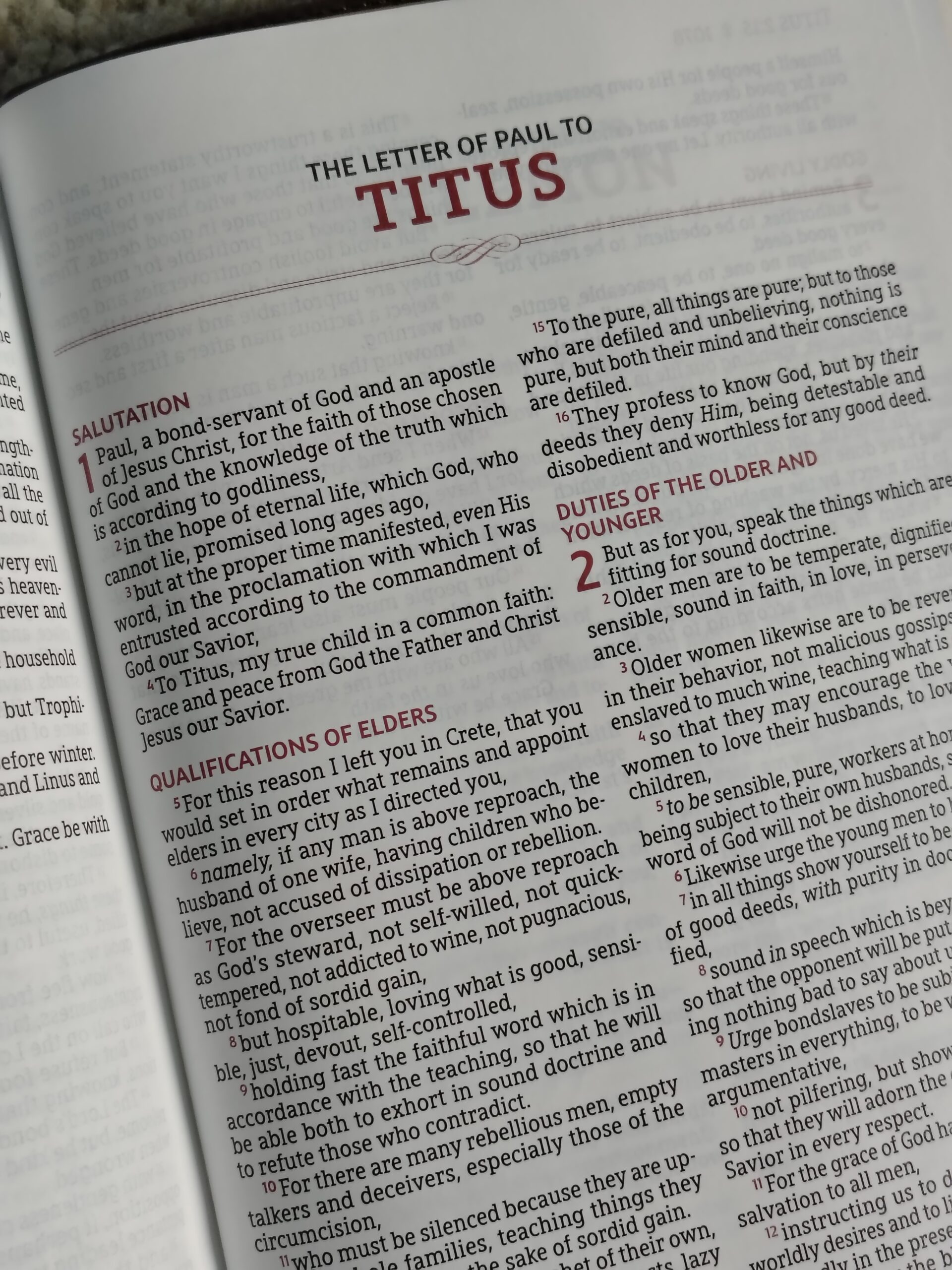
faith Titus This short letter Would you turn again to Titus? Paul a bondservant of God and
an apostle of Jesus Christ, for the faith of those chosen of
God and the knowledge of the truth, which is according to
godliness, in the hope of eternal life, which God, who cannot lie,
promised long ages ago, but at the proper time manifested even
His word in the proclamation with which I was entrusted according
to the commandment of God our Savior. to Titus, my true child
in a common faith, grace and peace from God the Father and
Christ Jesus our Savior.” Now, what Paul does in these opening
words is essentially set forth the foundation of God-honoring
ministry. And he does so with three quick
points, rapid fire. First of all, foundational ministry
has to secure the faith. It’s exactly what the theme of
our song was today. preaching Christ, sharing Christ. Paul says that he was a bondservant
for that very purpose, an apostle for the faith of those chosen
of God. We don’t know who those are,
so we preach to everyone and let God sort it out. Not only
securing faith, but imparting knowledge. Paul went about preaching
and teaching. The preaching of the gospel was
to call out of the world those that were called to salvation.
But the teaching, imparting the knowledge of the truth, that
was for those who were saved. Not only securing faith and imparting
knowledge, but encouraging hope. Anybody who’s ever engaged in
biblical counseling knows this principle. The first, the main
thing that you want to do in counseling is impart hope. You
know what? God will get you through this.
You know what? We’re here to help. You know
what? This is an easy fix. You provide
hope. That’s exactly what Paul does.
He’s an apostle, a bondservant, to provide faith and knowledge
and hope in the hope of eternal life, which God, who cannot lie,
promised long ages ago. We live in a hopeless world.
They’re absolutely hopeless. We have an open door to share
hope with them. And so Paul sets forth a foundation,
but he’s not done. And he’s just beginning to open before
us. The idea of a God honoring ministry
there on the island of Crete. And so he says that Titus, if
you’re going to cultivate a God honoring ministry, There on the
island of Crete, you’ve got to cultivate God honoring leadership. Look, if you would, at verse
five. For this reason, I left you in Crete that you might set
in order what remains and appoint elders in every city as I directed
you. Namely, if any man be above reproach,
the husband of one wife, having children who believe, not accused
of dissipation or rebellion, for the overseer must be above
reproach as God’s steward, not self-willed, not quick-tempered,
not addicted to wine, not pugnacious, not fond of sordid gain, but
hospitable, loving what is good, sensible, just, devout, self-controlled. holding fast the faithful word,
which is in accordance with the teaching that he may be able
to both exhort in sound doctrine and refute those who contradict.”
He basically says, look, Titus, if you’re going to have a God-honoring
leadership, then you’ve got to find men who are unindictable. That’s what he says in verse
six, essentially. That’s the overarching standard. You’ve
got to find men who are above reproach, unindictable. And then
he gives, in verse 7, moral disqualifiers. They set a man aside from the
capability of leading the church as an elder if they are morally
disqualified, self-willed, quick-tempered, addicted to wine, pugnacious. Those who practice sleight of
hand in the exercise of their finances, fond of sordid gain. Not only moral disqualifiers,
but verse 8 gives character prerequisites. These are absolutely necessary. If the other things disqualify,
these are the prerequisites. Hospitable. They practice hospitality. They take care of those in need,
loving what is good. They’re sensible, just, devout,
self-controlled. These are a must for a man who
would lead in the church. Not only disqualifiers and prerequisites,
but they must be doctrinally sound. They must be those who
not only know the word, but hold to the word and are able to defend
with the word. The whole reason is given in
the verses that follow in chapter one. What is the reason for elders? What is the reason for church
leaders? Why do shepherds need to be so watchful? Because just
as Paul told the elders in Acts 20, wolves are among you. Look
at verse 10. There are many. And in our 22
year history, that’s exactly right. We have seen many. In
fact, we have seen many this year. There are many rebellious
men, empty talkers and deceivers, especially those of the circumcision,
the Jews, who must be silenced because they are upsetting whole
families, teaching things they should not teach for the sake
of sordid gain. They’re in it for the money. Paul gives the proof of their
character in verse 12. One of themselves, a prophet
of their own, said, Cretans are always liars, evil beasts, lazy
gluttons. This testimony is true for this
cause. Reprove them severely that they may be sound in the
faith, not paying attention to Jewish myths and commandments
of men who turn away from the truth. He says you’ll spot them
by their character. And even one of their own people
said that this is what we are like. And what he basically says
there is that this soil on Crete, it’s fertile territory for false
teaching to take root. You’ve got to beware, Titus.
You’ve got to be watchful. You’ve got to prepare godly men
who watch over the flock because the wolves are there. And then
he gives this amazing, enduring principle of shepherding. He
gives it in verse 15 and 16. Look at this. To the pure, all
things are pure. But to those who are defiled
and unbelieving, nothing is pure. But both their mind and their
conscience are defiled. They profess to know God, but
by their deeds they deny Him, being detestable and disobedient
and worthless for any good deed. You can watch their lives and
know that they’re false. Well, Paul tells Titus that if
you’re going to have God-honoring churches on the island of Crete,
you’ve got to start with God-honoring leadership. But that can never
be enough. You can have the best leadership
in the world, and if the saints go south, you’re in trouble. And so he addresses God honoring
church members in chapter two. Look at chapter two if you would.
But as for you, speak the things which are fitting for sound doctrine.
Older men are to be temperate, dignified, sensible, sound in
faith and love and perseverance. Older women likewise are to be
reverent in their behavior, not malicious gossips, nor enslaved
to much wine, teaching what is good. that they may encourage
the young women to love their husbands, to love their children,
to be sensible, pure, workers at home, kind, being subject
to their own husbands, that the word of God may not be dishonored. Likewise, urge the young men
to be sensible in all things. Show yourself to be an example
of good deeds with purity and doctrine, dignified, sound in
speech, which is beyond reproach, in order that the opponent may
be put to shame, having nothing bad to say about us. Urge bond slaves to be subject
to their own masters in everything to be well-pleasing, not argumentative,
not pilfering. but showing all good faith that
they may adorn the doctrine of God our Savior in every respect.”
He says, look, Titus, it’s not enough to have God-honoring leadership. You’ve got to have God-honoring
church members, and that’s going to take time. You’re going to
have to shepherd them. And look at who he starts with. He starts with the shepherds.
He basically tells Titus to get it together. Speak the things which are fitting
for sound doctrine and nothing else. And then he turns to his
list, right? And I’ve told you before, you
decide which category you’re in. Older men, older women, younger
women, young men. But he starts with older men.
They’re the foundation. They’re the ones that are going
to set the tone for the entire church. And then he deals with
older women because they’re they’re so influential over the young
women of the church and they should be. And then he deals with younger men
and he puts Titus in that mix, if you noticed. And he puts Titus
in that mix because those are the men, those are the ones that
he’s got to train up for the future of the church. And he
says more to the young men than he says to any of the other categories.
And then as if he missed anybody, he fits in slaves who had a place
in God’s economy and will always have a place in God’s economy.
They’re not also rams, they’re not nobodies. And then he gives the reason
for it all. All of these exhortations to
all of these different groups rest on the gospel mandate. Look at verse 11 through 14.
For the grace of God has appeared, bringing salvation to all men,
instructing us to deny ungodliness and worldly desires and to live
sensibly, righteously and godly in the present age, looking for
the blessed hope and the appearing of the glory of our great God
and Savior, Christ Jesus, who gave himself for us that he might
redeem us from every lawless deed. and purify for himself
a people for his own possession, zealous for good deeds.” Paul says it’s all about the
gospel. You need to have your leaders
at a God-honoring place. The church members need to be
God-honoring because it’s the gospel. The grace of God has
appeared, bringing salvation to all men. This is crucial news,
Titus. No wonder he closes this chapter
by reminding the shepherd. These things speak and exhort
and reprove with all authority. Let no one disregard you. Titus was there with apostolic
authority, but he was there by God’s authority. And so not only
God honoring leadership and God honoring church members, but
a God honoring witness is what he addresses in chapter three.
Would you look there? Remind them to be subject to
rulers, to authorities, to be obedient, to be ready for every
good deed, to malign no one, to be uncontentious, gentle,
showing every consideration for all men. For we also once were
foolish ourselves, disobedient, deceived, enslaved to various
lusts and pleasures, spending our life in malice and envy and
hateful, hating one another. But when the kindness of God,
our Savior, and His love for mankind appeared, He saved us,
not on the basis of deeds, which we have done in righteousness,
But according to his mercy, by the washing of regeneration and
renewing by the Holy Spirit, whom he poured out upon us richly
through Jesus Christ, our Savior. That being justified by his grace,
we might be made heirs according to the hope of eternal life.
Paul says you’ve got to have a good witness in this wicked
island of Crete. And he first of all reminds them
of their civic duty there in verses one and two that they
live before a watching world. And godless, rebellious, uncouth
liars were plentiful on the island. Christians had to be different. And then he reminds them so gently.
He tells Titus to remind them, remind the saints that we were
just like them. And if it weren’t for the grace
of God, you are dead in your trespasses and sins. We also
once were foolish ourselves. disobedient, deceived, enslaved
to various lusts and pleasures, spending our life in malice and
envy, hateful, hating one another. That was us. And it would be
us if it weren’t for God and his grace. No wonder he reminds them of
their salvation in verses four through seven, that God had mercifully
saved them. And it was all tied to the timing
of God, that God, our Savior, and his love for mankind was
revealed. It appeared. It wasn’t because
of our deeds. It was because of God’s work
of grace and mercy in our lives. And then, Paul, in a final section,
verses 8 through 11, he uses what is in our day a dirty word, discriminate. Just to use that word in some
circles today would get us in real trouble. To practice discrimination. But Paul says, This is a trustworthy
statement and concerning these things I want you to speak confidently
so that those who have believed in God may be careful to engage
in good deeds. These things are good and profitable
for men. But shun foolish controversies
and genealogies and strife and disputes about the law for they
are unprofitable and worth less. Reject a factious man after a
first and second warning, knowing that such a man is perverted
and is sinning, being self-condemned. We need to discriminate, he says. We need to discriminate in our
words. We need to speak confidently
about the right things. And Paul tells Titus these things. The gospel is good and profitable
for all men. We need to discriminate in our
words. We need to discriminate in our
conversation. He says in verse nine, shun foolish
controversies and genealogies and strifes and disputes about
the law. It always amazes me how eager some people are to
rush into an argument. I still love that simple phrase
by Elizabeth Elliot. Never miss an opportunity to
keep your mouth shut, right? Do you know the first passage
I ever preached? Proverbs 10, 19. With many words,
transgression is unavoidable, but he who restrains his lips
is wise. We need to discriminate in our
conversation, and we need to discriminate with troublemakers.
We have this tendency of wanting to put out a sign, all are welcome,
come on in, even you. Paul says in verses 10 and 11,
reject a factious man. If he’s there to divide the flock,
what good is he? Why is he here? Reject a factious
man after a first and second warning, knowing that such a
man is perverted and is sinning, being self-condemned. It’s not
you that kick him out of the church, it’s God himself by his
standards. And then in the final words that
Paul ever wrote to Titus, his concluding greetings, when I
send Artemis or Tychicus to you, make every effort to come to
me at Nicopolis. Only time that that city is mentioned. For I have decided to spend the
winter there. Diligently help Zenos the lawyer and Apollos
on their way so that nothing is lacking for them. and let
our people also learn to engage in good deeds and to meet pressing
needs that they may not be unfruitful. All who are with me greet you.
Greet those who love us in the faith. Grace be with you all. Would you join me in prayer?
O merciful King, We desire so deeply to be God honoring, to
have a God honoring church, a God honoring church leadership. We
desire to be God honoring people and have a God honoring witness.
Lord God, we pray for your grace as we examine this epistle to
Titus. It was for Titus. It was for
the people on the island of Crete. You so designed that these would
become God honoring Cretans. And Lord, that’s what we are.
That’s what we desire. We need your grace. And so as
we examine this epistle, Lord, would you examine our own hearts
and shine the light of your grace in every cavern and corner and
show us where we fall short, that we might cry out for grace
and might repent of our behavior and our attitudes and our deeds. Lord God, we pray that you would
make us to be God honoring. It’s in Jesus’ name that we pray.
Amen.
Messages: 7