The Creeper in the Classroom
How to see and know the nature of those who would trouble the church.
Transcript
Well, if you were with us last
Lord’s Day, you know that we ducked out of 1st Corinthians
and into the book of Titus. If you would turn to Titus this
morning. And even as you find chapter
one, just let me have a moment until I catch up to you there
in Titus one. We all know and love are one
of our Lord’s favorite methods of teaching that of parables.
And one of the most significant of all the parables has to be
the parable of the soils. It is a parable that is both
sobering and cherished by believers. As you know, in that parable,
plentiful seed is cast indiscriminately over the landscape and the scattered
seeds land on a variety of different surfaces. a travel-hardened footpath,
a rock-filled bed that contained very little soil, an area of
good soil that was also beset with weed seeds, and then finally
on a bed of good, rich soil, the perfect environment for the
good seed of the gospel to germinate and to grow. And as you know,
Jesus proceeds to explain this parable. The plentiful seed is
cast indiscriminately over the landscape. It represents the
gospel, the good news about salvation by Jesus Christ. Well, the various
landing spots for that seed are pictured as variants of the human
heart. There is the indifferent heart,
pictured as the hardened footpath. There is the impulsive heart,
pictured by the rocky soil. There is the insincere heart,
pictured by the weed-filled soil. And finally, there is the interested
heart, pictured as the fertile, rich soil. And I say that this
parable is cherished, not only because it is the Lord’s teaching,
but also because it tells every Christian’s story. The story
of how the gospel came to them and ultimately changed their
lives forever. But it is also a sobering parable. Because just like the other landing
spots for the seed, not everyone to whom the gospel comes receives
that good news. And there is an absolutely terrifying
element that is often overlooked. Related to the image of the footpath.
When Christ initially speaks of the seed that lands on the
footpath, He says that birds came and ate up the seed. And that sounds innocent enough
to our ears, birds have to eat too. But in his explanation,
Christ says this, when anyone hears the word of the kingdom
and does not understand it, the evil one, Luke clarifies, the
devil, comes and snatches away what has been sown in his heart.
And that is a terrifying statement. But Jesus warned his first followers
of this very truth, even before he shared this parable. From
the earliest moments of the founding of the church, Christ began to
warn his followers of a pernicious evil that would come. No sooner
would the church be established that the devil would begin to
try to thwart God’s efforts in saving souls. In Matthew’s gospel,
Christ’s warning must have come as a complete shock to his doe
eyed followers. They were still rejoicing in
the Savior’s wholesome and happy teaching when suddenly, Matthew
7, 15, Christ sounds this warning. Beware of the false prophets
who come to you in sheep’s clothing, but inwardly are ravenous wolves. This is not the report that innocent
sheep want to hear. News of the most feared beast
lurking about. But that’s reality. And it’s information that Christ
followers must hear that the devil and his henchmen are doing
everything in their power to steal away the seed of the gospel. Jesus would later in his ministry
build upon that image, the image of ravenous wolves in John chapter
10. There he would warn his followers
by saying that the devil comes only to steal and kill and destroy. And near the end of his earthly
ministry, as recorded in Matthew 24, he again reminds his followers,
as he did at the outset. See to it that no one misleads
you, for many will come in my name saying, I am the Christ
and will mislead many. And again, verse 24, false Christs
and false prophets will arise so as to mislead, if possible,
even the elect. Well, and this sad narrative
would play out again and again in the early church. The church
in Jerusalem experienced it, Acts 15.1. Some men came down
from Judea and began teaching the brethren, unless you are
circumcised according to the custom of Moses, you cannot be
saved. Errant teaching also came to
the early church in the city of Corinth. In Paul’s second
letter to Corinth, just listen to two verses of chapter 11.
He described these events with great sadness. I betrothed you
to one husband so that to Christ I might present you as a pure
virgin. But I am afraid that as the serpent
deceived Eve by its craftiness, your minds will be led astray
from the simplicity and purity of devotion to Christ. It was
prevalent in Corinth. And he goes on to identify those
with a different message as false apostles, deceitful workers,
disguising themselves as apostles of Christ. Well, the church in
Galatia experienced it too, didn’t they? With a broken heart at
the waywardness of his people, Paul vented in his opening chapter
to the Galatians. I am amazed that you are so quickly
deserting him who called you by the grace of Christ for a
different gospel. Which is really not another.
Only there are some who are disturbing you and want to distort the gospel
of Christ. Paul says that it was a gospel
contrary to what we had preached, a gospel contrary to what you
had received. And Paul likewise pre-warned
the Ephesian church that ravenous wolves, the same that Jesus warned
about in Matthew chapter seven, he warned about in Acts chapter
20. I know that after my departure, savage wolves will come in among
you, not sparing the flock. And from among your own selves,
men will arise speaking perverse things. But note their purpose,
to draw away the disciples after them. No wonder then, when Paul
left his dear young friend, Timothy, there in Ephesus, that he did
so with cautionary instructions, to instruct certain men not to
teach strange doctrines. And not only does he give this
initial warning, but such becomes a major and recurring theme in
first Timothy. First Timothy one, 10 chapter
four, verses one and two, chapter six, verses three through five,
which concludes as follows. If anyone advocates a different
doctrine and does not agree with sound words, those of our Lord
Jesus Christ. and with the doctrine conforming
to godliness, he is conceited and understands nothing but has
a morbid interest in controversial questions, disputes about words,
out of which arise envy, strife, abusive language, evil suspicions,
constant friction between men of depraved mind, deprived of
the truth, who suppose that godliness is a means of great gain. Well,
In his second letter to Timothy, his alarms are even more acute, warning Timothy to avoid such
men who hold to a form of godliness, having denied its power. False
teachers, false ravenous wolves were so prevalent. They were
prevalent also in Rome. Paul warned his people there
in Rome to keep an eye on those who cause dissensions and hindrances
contrary to the teaching which you have learned. And you know
what? False teachers were even present
in the sweet little church in Colossae, where Paul appealed,
see to it that no one takes you captive. through philosophy and
empty deception, according to the tradition of men, according
to the elementary principles of the world, rather than according
to Christ. False prophets, false teachers
were everywhere, it seems. And so it shouldn’t come as any
surprise that wolves, false teachers would
also come to the island ministry of Crete. where Paul had left
his fellow worker, Titus, to carry on the work of ministry
there. It’s no coincidence that Paul, having laid out the qualifications
for elders in verses five through nine, immediately speaks of one
of the elders’ most urgent tasks in verses 10 and 11, that of
protecting the flock from false teachers. Would you glance at
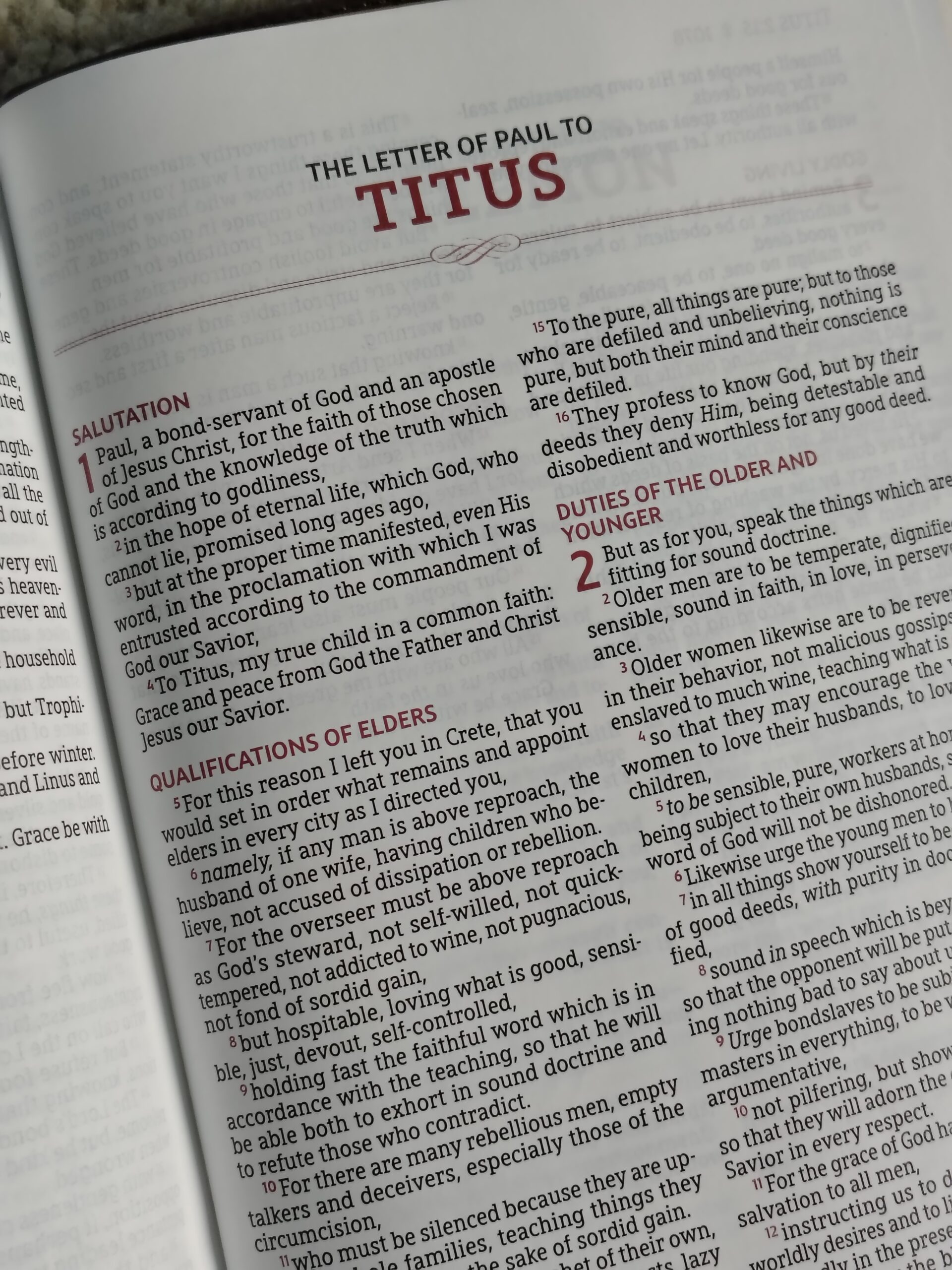
those few verses? For there are many rebellious
men, empty talkers and deceivers, especially those of the circumcision,
who must be silenced because they are upsetting whole families,
teaching things they should not teach for the sake of sordid
gain. I’ve titled this message, The
Creeper in the Classroom, because I want us to see and know the
nature of those who would trouble the church. We need to consider
this morning the disturbing characteristics of false teachers. First of all,
if you would glance at verse 11, note the motive of false
teachers at the very end of verse 11. They must be silent because
they’re upsetting whole families, teaching things they should not
teach for the sake of sordid gain. That’s their motive. And as we begin the unsettling
process of looking at these so-called teachers, I would like us first
to consider their motives, really dwell on it and understand it.
What motivates these men to do whatever it is they do to teach
what they teach? Verse 11 says, they do it for
the sake of sordid gain. In short, they’re in it for the
money. It begins with the fact that as Paul told Timothy, they
are lovers of self and lovers of money. In 2 Corinthians, Paul
said that such men are peddling the word of God. Peter warned
his people that such false teachers, in their greed, will exploit
you with false words. Because they’re in it for financial
gain alone, for what Paul calls here in verse 11, sordid gain. I love Tyndale, who first translated
this as filthy lucre. Words that still ring true today.
Dirty money. The word sorted is elsewhere
translated as disgraceful or improper. You see, the entire
goal of such men is to enrich themselves by declaring a message,
as Paul says elsewhere, another gospel that soothes rather than
convicts. They sell out to the highest
bidder. This is the sin of Balaam, who
softened his message in hope of a payout by a heathen king,
King Balak. Well, this is one of the reasons
for the character quality there in that list in verses five through
nine, that an elder must be just. He must be objective. and fair
and impartial, not a man whose soul and whose message can be
bought. In order to tickle the ears of
the ones who hear them, they accommodate their message for
a price. Now, I will tell you. It is not
good practice to go about judging other men’s motives. Not easy
to know what their motives are. And so this is a very tough characteristic
to observe and prove. A man would almost have to admit
being in it for the money. But it is detectable. If a person
is watched long enough to see what exactly it is that motivates
a person in his service. And in my nearly 30 years of
ministry, I have observed this sad feature at least once in
a man. And I’ll tell you, my own heart
has been tested in this matter again and again. I received a hint one time from
a man who ought to have known better that we should not pastor
someone about their particular sin because after all, they are
big givers. And I challenged him. First of
all, how do you know that they’re big givers? And second of all,
what difference does it make? Do we not care about their soul? An elder has to be just, has
to be objective to such temptations. I shared with somebody this past
week, a story that I’d almost forgotten. In my first ministry,
someone just slid an envelope underneath our front door with
cash in it. And it just said on the outside
of the envelope, for the church. I couldn’t dial the deacon’s
phone quickly enough to hand off that envelope. You get one
dose of integrity. There’s a second feature that
we see in false teachers as Paul lays it out, these disturbing
characteristics, not only the motive of false teachers, but
look again at verse 11. Look at the scheme of false teachers. What do they do? How is it that
they do what they do? They must be silenced because
they’re upsetting whole families, teaching things they should not
teach. That piece of news couldn’t have
been surprising to Peter and to Paul, who knew their Old Testament
very well. There, the prophet Micah declared,
thus says the Lord concerning the prophets who lead my people
astray when they have something to bite with their teeth. Food. Treats. When they have something
to bite with their teeth, they cry, peace. But against him who puts nothing
in their mouths, they declare holy war. As long as you keep
them happy, as long as you keep giving to them, they will tell
you exactly what you want to hear. A pleasant message. Micah says that as long as you
pay them, they’ll sing you a pleasant song. These parasites would quickly
move along to another host. or further adjust their message
as soon as the money train slowed. It is of no concern to such men
whether or not their teaching is true or accurate. Since their aim is money, they
will say whatever is necessary to maintain that cash flow. Puritan commentator, Thomas Taylor,
who I would suggest is the gold standard for commentaries on
the pastoral epistles. He says that when Paul here says
that these are those teaching things they should not teach,
he begins to describe what it is they’re teaching. And he says,
either impious doctrines, which detract from the glory of God
and extenuate the merit of Christ, or else loose and licentious
doctrine, rather than giving support to corrupt manners rather
than reproving them. Well, let’s look at the two of
them. As he says, impious doctrine
is that which robs God of his glory. Ideas such as that God
is not really sovereign, that he’s not really in control, or
that Christ is not God. or other errant ideas about the
Holy Spirit, as if the Holy Spirit conducts so many conversations
with all of believers ongoing throughout their life. Paul even
warned Timothy in 2 Timothy 2.18 that there were men who, having
gone astray from the truth, say that the resurrection has already
taken place. These types of impious doctrine
are plentiful throughout church history and even down to our
very day. And these false doctrines are
found in every corner of theology. False ideas about God himself,
false ideas about salvation, that someone can actually earn
their salvation, false ideas about humans, that they’re basically
good, False ideas about the church, that it can be treated as a club
or even an optional activity and not the body of Christ that
it is. False ideas about sacred things
abound even in our day. But Taylor had yet a second category
of these unseemly lessons taught in church which he calls, secondly,
loose and licentious doctrine, that rather than giving support,
they rather give support to corrupt manners than reprove them. These are those doctrinal areas
that lower the moral code, that make light of sin or downplay
it or remove the guilt and the vileness associated with it altogether. Such repulsive and offensive
teaching is also found throughout church history, but especially
in our own. The church, and by that the greater
church, is currently playing fast and loose with sexual standards,
downplaying entirely the sin of homosexuality. In many denominations
now, not only is one’s sexual preference a matter of acceptance,
it is to be celebrated as a matter of pride, even in the leadership
of the church. And we must never forget the
prevailing idea to which the church currently seems numb or
dull which the church is certainly neglectful in our day, that an
innocent child can be destroyed at will, even after birth. That’s heinous. Well, as Paul
urged Titus in verse 9 of this very chapter, we must hold fast
the faithful word which is in accordance with the teaching
so that we will be able to exhort in sound doctrine and refute
those who contradict. And you should know that here
too throughout my ministry I have met men, usually men, with all
kinds of outlandish and ridiculous ideas. From the quirky An idea that any aged person
in the church is an elder of the church. That’s just strange. To the opposite extreme, to the
ungodly idea that the New Testament church should only study Paul’s
epistles. Or how about this for strange?
that we as the New Testament Church should never plan when
we meet or select who is to bring the message or select ahead of
times what hymns we’re going to sing. We just wait for a movement
of the Spirit. We have had some doozies. Well, There’s a third disturbing
characteristic of false teachers. Not only do we see the motive
and the scheme of these false teachers, but we see the devastation
that they bring. We see this in verse 11 as well.
As we climb back up that verse, they must be silenced because
they are upsetting whole families. If the motive of the spiritual
wolves activity is money and their method is errant teaching,
their effect, as it must be, is devastating. They’re upsetting whole families.
And this doesn’t suggest that families were necessarily their
target. It may well have been so. But
individuals can easily take in false teaching and then take
it home to a family where it will not be universally received.
Jesus himself said that spiritually speaking, he came to bring a
sword. That there would be a sharp line
of division between truth and error. And that this would no
doubt affect even families. It would pit family member against
family member. And we have seen this happen.
A family member brings home error, and as discussion and eventually
disagreement ensues, division takes root, and the whole family
is upset. The word translated here, upsetting,
is no mild expression. It is that same word used to
refer to Christ overturning The tables of the money changers
in the cleansing of the temple. Perhaps even more graphic, the
word was used of the churning of the sea that stirs up the
muck on the bottom of the ocean and turns the water muddy and
unsightly. Destroys families. Brings chaos
where there was peace. Rarely does an individual imbibe
some teaching where they are not eagerly inclined to promote
it. As I’ve told you, Timothy was
facing the same challenge in Ephesus. Paul told him, avoid
worldly and empty chatter, for it will lead to further ungodliness. Their talk will spread like gangrene. Among them are Hymenaeus and
Philetus, men who have gone astray from the truth, saying that the
resurrection has already taken place and they upset the faith
of some. If it’s error, it breeds dissent. Since not everyone is going to
welcome it. The entire family then is upset
by it and therein lies the teacher’s destruction. Tearing apart entire
families. Because such teaching is so inherently
destructive, it must be caught and stopped at all cost. And we have had this family upset
as well. You try not to ever let it get
to this point. But people come in. They seem
to be well-meaning. They present themselves well.
They begin to wind themselves around people’s heart. And then
some strange feature begins to emerge, something about their
life, something about their teaching. It happens. It has happened. And the damage is real. There’s a fourth feature of the
creeper in the classroom, these disturbing characteristics of
false teachers. Not only their motive and their
scheme, their devastation, but number four, the ilk of false
teachers. And by that, I mean their nature,
their character. What are they like? Paul tells
us that in verse 10. Glance there, if you would. He
says, for there are many. Rebellious men, empty talkers
and deceivers, especially those of the circumcision. So if these individuals and their
teaching is so destructive, what are they like? We need to know.
We need to watch. Not surprising, the very first
characteristic to which Paul points is that they are rebellious. They are their own authority.
They answer to no one, not really. They are not submitted to anyone
because they want to influence everyone. They’re subjected to
none, especially not ecclesiastical authority, elders, pastors, shepherds. And as such, they are insubordinate
also to the word of God, which demands such order and obedience. They are going to do what they
are going to do, and no one, not even God himself, can tell
them any different. We have known these men who have
troubled our church, and not just in our 22-year history,
we have known them in our recent past. Listen to one pastor’s description
of such men. These were men who kept alongside
the work of the church and exhibited some affinities with it, but
never really identified themselves with its life and fellowship.
This position enabled them to ply their insidious arts with
greater effect. Sometimes these individuals come
in the form of a headstrong young man who has not yet learned the
value and necessity of authority. Such people are trouble enough,
but it gets much worse. When you get an individual who
has an agenda, who has his own set of goals and intentions designed
for the church and for its people, They’re not merely insensitive
to the constituted order of the church. They are in complete
disregard of spiritual authority. They are a law unto themselves,
stubborn, rebellious, insubordinate men. And my sad report here is that
we have experienced men like this by the dozens. I would even
go on to say that a humble, yielded, orderly man is the exception
rather than the rule. Most men are headstrong and anything
but submissive. How do we spot them? Paul says,
not only are they rebellious, they’re empty talkers. It’s a
simple point that Paul makes here, empty talkers. But in what
sense? In what sense is their talk empty? It’s empty, first of all, in
the sense that most often they talk much ado about nothing.
Instead of focusing on the pure teaching of God’s word, they
dwell on those things which they find in the white spaces. They
are those of whom it is often said they major on the minors.
But in this case, not only are they doctrines that are less
important, but these are doctrines that are errant, incorrect, false. They teach and promote things
that are troublesome and false. They are empty because they produce
nothing beneficial in the here. And this is exactly what the
Jewish nation thought of the heathen idols of foreign nations. They were empty, unprofitable,
vain, useless. These are those that one historian
described as relentless, uneasy spirits, relentless talkers who
must say something and who have broken the peace of many a home
and shattered the prosperity of many a church. The multitude
of teachers who have nothing true to say is the curse of the
kingdom of God. No wonder Jude very appropriately
describes these men as clouds without water. Paul provides many descriptions
of these men and their talk, and 1 Timothy 1, he calls their
talk fruitless discussion. At the end of this very epistle,
Titus chapter 3 verse 9, he says that their foolish controversies
render them unprofitable and worthless. Look, people talk. Teachers talk. That’s what they
do. But the test is, do they have
something to say? And unfortunately, it has been
my recurring experience that there are a lot, and I mean a
lot. A lot of men who really should
heed the counsel of James 3.1 and keep their mouth closed. They really have nothing profitable
to say. It’s just blah, blah, blah, blah,
blah. They’re not only rebellious,
empty talkers. Paul says, lastly, they’re deceivers. Paul says that such men are not
only characterized as rebellious empty talkers, they also happen
to fall into the dreadful category of deceiver. They’re the devil’s
servants. They’ve been led astray, they’ve
fallen for some false doctrine, they come to embrace that error,
but that’s not enough. They want to promote such error. They’re not only deceived, in
time they become deceivers. Such doctrine is a ticking time
bomb. In the church, if left unaddressed,
such error is what one pastor described as a seductive and
perilous fascination over the minds of its victims, deceiving
them and leading them astray. Paul seems to have saved his
strongest words for his final epistle, because in 2 Timothy
3.13, he warns that evil men and imposters will proceed from
bad to worse, deceiving and being deceived. And Paul echoes that
sentiment here to Titus. Not only are the rebellious empty
talkers, they’re deceivers. Like poison or like a deadly
virus, their teaching is dispensed and consumed and it quickly taints
the hearer and leads either to doubt or confusion or outright
capitulation into the errant teaching. It’s like a baited hook, swallowed
whole, and the hearer is deceived. You see, these people were seen
and received as those who could have led their hearers to truth.
And instead, they directed them into error. And so there’s a final characteristic
of these false teachers. It really comes in the way of
a strategy for churches in dealing with them. What do you do? How
do you handle them? In this particular point, the
strategy for false teachers we find in verse 10 and 11, because
it’s a split sentence. There are many who must be silenced. So troublesome are these rebellious
men that are loose in the church, promoting their error, all the
while taking from God’s people. What can be done? What must be
done? What approach should be employed
in dealing with such people? Sometimes, as Paul told Timothy,
such men just merely need to be instructed. They can be taught
and shown the error of their teaching and they can be rehabilitated
for service to Christ and to his church. But most often. Most often, stronger measures
have to be taken. And Paul’s advice here is simple,
silence them. And it is imperative that they
must be silenced. Tyndale translated this very
simply, referring to those whose mouths must be stopped. The word for this in the Greek
is very fascinating. It’s often used of the bit and
bridle that is inserted into a horse’s mouth. Psalm 32 presents
this image capably. Psalm 32 9, do not be as the
horse or as the mule, which have no understanding, whose trappings
include bit and bridle to hold them in check. Otherwise they
will not come near to you. But I would suggest there’s an
even more explicit image. It’s that of a muzzle. These
men must be muzzled. Paul’s point is that false teachers
must be reduced to complete silence. They cannot be given a platform
to teach in the church. They cannot be allowed to huddle
in corners with the saints. They ought not be given the latitude
to influence the members of the church. One of the surest ways of silencing
such men is to prevent them from even getting started in the first
place. Such men must be vetted, examined,
even scrutinized before ever being allowed to function as
a teacher in the church. A teacher in Christ’s church
should have a proven track record of peaceableness and submission. False teaching itself, I would
suggest to you, is relatively easy to spot. If you’ve got a
good doctrinal standard, you hold it up against some form
of teaching and it usually jumps right off the page. But it has been my personal experience
with such men that long before Long before some error was detected,
before some trouble was spotted in their doctrine, their insubordination
betrayed them. In time, all men are seen for
what they are, whether it’s in their lives or it’s in their
teaching. But when they’re seen in their
true light, they must be dealt with, they must be silenced.
If possible, they must not be allowed to teach until it is
determined that they are trustworthy. But if they’re found to be teaching
error, they they must not simply be refuted. But stopped. At all costs. They must be challenged,
confronted, rebuked, and if need if needed, the full measure of
discipline applied. so that the tender flock of Christ
and the precious institution of the church not be harmed. And that’s why, whether by their evil motives
or their rebellious attitudes or their errant doctrine, we
must observe and stop these men before they ever get started
in the church. When Paul says that they must be silenced, it
almost sounds as if everyone gets to try teaching to see if
they measure up. That’s not what Paul means. Even Paul, and especially Paul,
would say that a man must first show himself faithful. He must
prove himself. He must be found to be in sound
doctrine with pure motives and a peaceable, yielded spirit.
Otherwise, he should never teach anything. Not in the church. And such has been the prevailing
report of our church. We watch. We observe. We test. We examine. And if there are questionable
areas of a man’s life, we restrict as needed. We do not indiscriminately
push men into teaching roles because this is the very body
of Christ. Paul loved his church. He had given one of his choice
servants to shepherd this church on the island of Crete. And he
saw that if left unchecked, that work would be destroyed just
as soon as it was established. The birds, that is the devil
himself, would soon come and snatch it away. Paul says we
have to watch. We can’t have a creeper in the
classroom. Would you humble yourself before
him? Our merciful King, we thank you. We thank you for your word that
is so sound and so instructive that we can look to your word
anytime and know that we are taking in the pure word of God. Lord, we pray that you would
guide and protect our pulpit, our podium, our discipleship,
We pray that you would make us sensitive and watchful of error. We pray, Father, that you would
protect our church and that you would grant us the grace to shepherd
this church as unto Christ. We pray that you would make us
watchful of error and men who would promote it. And we thank
you for the grace that you’ve granted us over the course of
our time. Lord God, we thank you for the
truth of God’s word. And we pray that you would keep
us focused upon that alone. Lord, we thank you for our savior,
our Lord Jesus Christ. And we know that in a even in
a church of this size, there may be yet. That individual or individuals
who have not placed their faith in Christ. Lord, such are on
such fragile, tenuous ground. Lord, we pray that. If there
are any who have heard. They know what false teaching
is. Because few people will tell them that they need. Christ alone
as savior. That they cannot get into heaven
on their own merits. Lord, we humble ourselves before
you and pray that you would do your work in the hearts and lives. Of those who hear this prayer.
Bring them to repentance for their sin. And to faith alone
in Christ for salvation. We lay this before you and we
plead in Jesus name. Amen.
Messages: 7