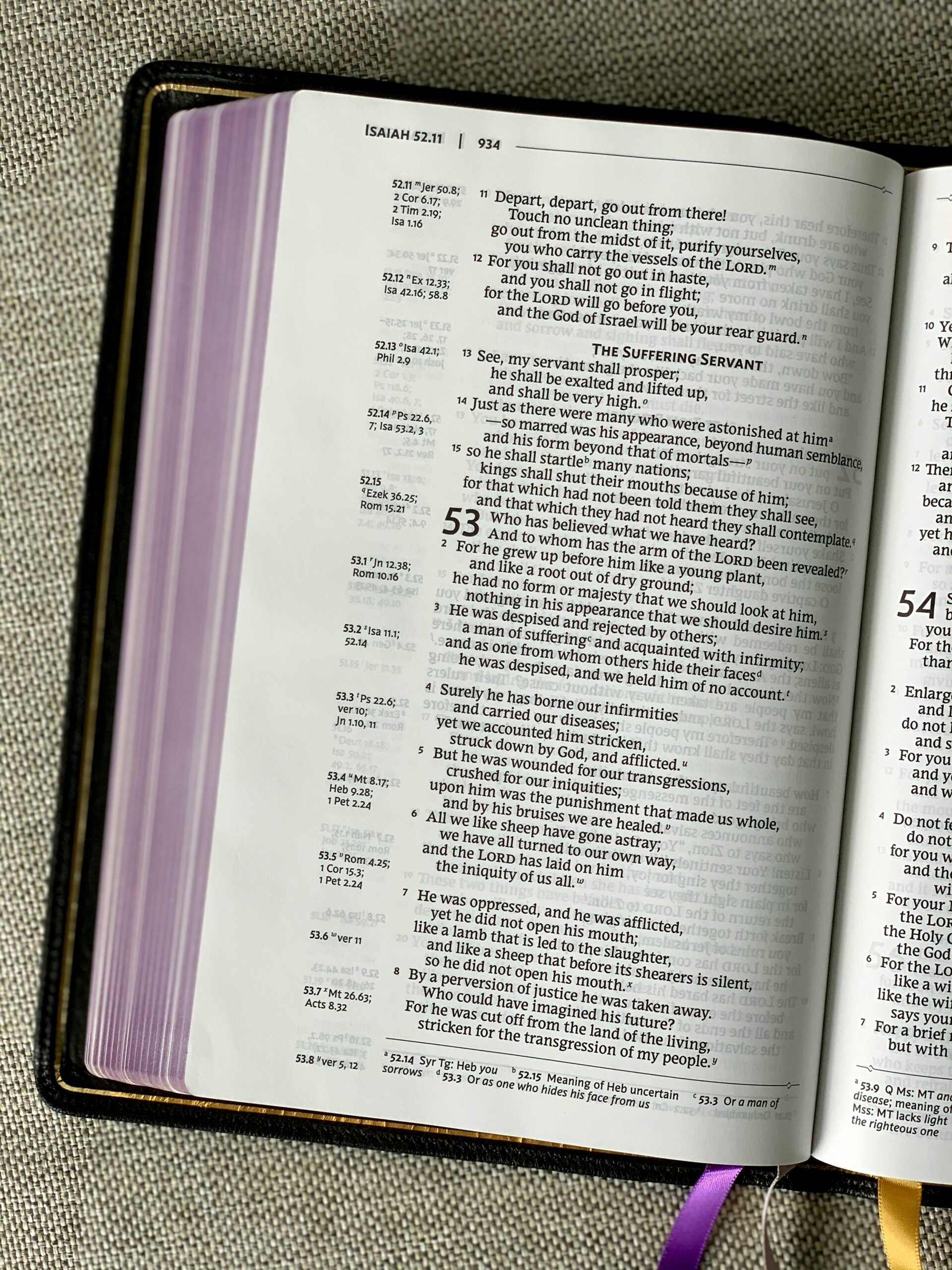
Response to the Suffering Servant – Pt. 2
This sermon explores the theological response to the Suffering Servant in Isaiah 53, focusing on the assurance of reconciliation found in Isaiah 54. The message outlines four specific assurances God provides to believers: abundant mercy, unshakeable peace, rich blessing, and absolute security. By drawing on the covenant with Noah and the immovability of mountains, the text emphasizes that God’s promise to forgive and protect is irrevocable and grounded in the finished work of Christ. The tone is comforting and instructional, urging believers to trust in God’s sovereign control over all circumstances, including suffering and opposition, because their standing before God is secure. Ultimately, the sermon calls for confidence in the eternal nature of God’s love and the permanence of the believer’s salvation.
Transcript
between John and the readers
and the prayers, I have ten full extra minutes. And I’ll use it. If God’s people would take their
Bibles and turn back to Isaiah 53-54, I say it that way because
what we began to observe last week is that Isaiah 53 doesn’t
stand on its own. There was a response, there is
a response, there’s a response that God expected. Isaiah 53
was communicated so that God’s people would respond. As I introduced last week, what
you have in the book of Isaiah, 66 chapters, it’s a relative
mirror of the Bible itself. The first 39 chapters representing
the Old Testament, much of which is gloom and doom. It’s the law. It’s God’s judgment. It’s God’s rebuke of Israel on
numerous occasions. And then in chapter 40, the tone
changes and comfort, comfort my people. Well, We find ourselves
in Isaiah 53, which for New Testament Christians is a very familiar
passage. It’s one that we cherish, one
that we often recite and look to at the Lord’s table, that
of the suffering servant. And for our purposes today, I
just want to point you back to a couple of verses, verses 6
and 7. just by way of reminder about the tone, the content of
Isaiah 53. Where Isaiah records, all of
us like sheep have gone astray. Each of us has turned to his
own way, but the Lord has caused the iniquity of us all to fall
on him. He was oppressed, and he was
afflicted, yet he did not open his mouth. like a lamb that is
led to slaughter, and like a sheep that is silent before its shearers,
so He did not open His mouth. Such is the report of the suffering
servant, our Lord Jesus Christ. We know that that points to His
suffering, His God-ordained suffering on our behalf. That He came for
a purpose, and He came to sacrifice himself, to be our propitiation
on the cross, to be a full of payment and a full atonement
for our sin. And for those of us, all of us
who have gone astray, what great news Isaiah 53 is. But there’s
a response. In chapters 54 and 55 and even
56, are part of that response to
the suffering servant. We began last week in considering
chapter 54 in just the first six verses. If you would, and
we’ll just do by way of review and a jump start into the latter
half of that chapter, Isaiah 54 verse 1. The first response
that we saw to the suffering servant was that it produces
joy in redemption. And shouldn’t it? We just sang
joy to the earth. There should be joy. There should
be rejoicing at the prospect that our sins are forgiven. That’s
where this response opens. It’s an exhortation of praise
to God’s provision. Look at verse 1. Shout for joy,
O barren one, you who have borne no child. Break forth into joyful
shouting and cry aloud, you who have not travailed. For the sons
of the desolate one will be more numerous than the sons of the
married woman, says the Lord. We took some time to point out
that this is not just an illustration to those in the congregation
who are female, to those who perhaps have never born children. He’s using an illustration and
he’s pointing to people who at that point were spiritually childless. They were spiritually bankrupt. And he says rejoice because your
fortune is about to change. The second portion of that opening
is an exhortation to readiness, preparedness for the immensity
of God’s blessing. And we pointed out that this
isn’t referring to the Jewish nation because there was never
an eruption of flourishing with regards to the Messiah. Initially,
it is the Gentile conversion. the explosion into the Gentile
world with the gospel of which we are a part. We know, we talked
about this last week, that that all is designed to make the Jewish
nation jealous and to draw in a portion of them in time. Look
at verse 2. Enlarge the place of your tent
stretch out the curtains of your dwellings, spare not, lengthen
your cords and strengthen your pegs, for you will spread abroad
to the right and to the left, and your descendants will possess
the nations and will resettle the desolate cities.” He uses
a different illustration here, one of camping, one of a tent,
and he says, make it bigger. You’re going to need a bigger
tent. to accommodate the growth. The third portion of that opening
is an exhortation to confidence in God’s promise. Look at verse
4. Fear not, for you will not be
put to shame, and do not feel humiliated, for you will not
be disgraced. But you will forget the shame
of your youth, and the reproach of your widowhood you will remember
no more. For your husband is your maker,
whose name is the Lord of hosts, and your Redeemer is the Holy
One of Israel, who is called the God of all the earth. For
the Lord has called you, like a wife forsaken and grieved in
spirit, even like a wife of one’s youth when she is rejected, says
your God. God urges them. to take confidence
in God, take him at his word, take him at his word that things
are going to change. And for the Gentile world, they
certainly did, didn’t they? Well, there’s not only the response
that includes joy in our redemption, that’s the first response, but
the second part of Isaiah 54, gives us a response to the suffering
servant that really provides assurance in that reconciliation. He’s just told them fear not,
but he’s going to drive that point home four different ways. Look at verse 7. For a brief
moment I forsook you, but with great compassion I will gather
you. In an outburst of anger I hid
my face from you for a moment. with everlasting loving kindness
I will have compassion on you says the Lord your Redeemer for
this is like the days of Noah to me when I swore that the waters
of Noah would not flood the earth again so I have sworn that I
will not be angry with you nor will I rebuke you. For the mountains
may be removed and the hills may shake, but my lovingkindness
will not be removed from you, and my covenant of peace will
not be shaken, says the Lord, who has compassion on you. Oh,
afflicted one, storm-tossed and not comforted, behold, I will
set your stones in antimony, and your foundations I will lay
in sapphires. Moreover, I will make your battlements
of rubies, and your gates of crystal, and your entire wall
of precious stones. All your sons will be taught
of the Lord, and the well-being of your sons will be great. and righteousness you will be
established. You will be far from oppression,
for you will not fear, and from terror, for it will not come
near you. If anyone fiercely assails you,
it will not be from me. Whoever assails you will fall
because of you. Behold, I myself have created
the smith who blows the fire of coals and brings out a weapon
for its work. and I have created the destroyer
to ruin. No weapon that is formed against
you will prosper and every tongue that accuses you in judgment
you will condemn. This is the heritage of the servants
of the Lord and their vindication is from me. The entire rest of
Isaiah 54 is all about providing those new converts Those that
are responding to the suffering servant in faith, God wants to
provide them assurance in the reconciliation. This is not a
treaty like most of the treaties that men make. This is not a
treaty that is ever going to be broken. Look at verses seven
and eight. The first mark of this assurance
in reconciliation is an assurance in mercy. an assurance in mercy. For a brief moment I forsook
you, but with great compassion I will gather you.” Beginning here in verse 7 and
coursing all the way down to verse 17, the prophet yields
the floor, as it were, to God Himself. This is God talking.
God is doing the speaking and he’s identified as such three
different times. Look at it. At the end of verse
8, says the Lord your Redeemer. At the end of verse 10, says
the Lord who has compassion on you. At the end of verse 17,
declares the Lord. Three times the Lord identifies
himself as the speaker, giving this comfort, giving assurance
in reconciliation. He is addressing the fledgling
church, those responding to the Lord Jesus Christ. And his purpose
is a fourfold assurance of reconciliation, that God has enacted a peace
treaty that will not be severed, ever. Those who place their faith
in the Lord Jesus Christ should be absolutely confident of their
standing in God. The first of the assurances,
as I pointed out, the first of four is that of God’s abundant
mercy. They absolutely will enjoy the
fullness of God’s mercy, not just a temporary act of kindness,
but eternal mercy. Mercy that lasts through the
ages, not only in this life, but into eternity. This is in
contrast to that which led up to their being reconciled to
God through Christ. It was a dramatic change. There
was that period of dark blackness. There was that season of fearfulness. There was that lengthy duration
of hopelessness, caught up seemingly inescapably in sin. There was that season. It was
a seemingly endless period of guilt and shame and godlessness. That is life outside of Christ,
isn’t it? They felt, as we all feel before
we are saved, that if there is a God, He has tuned us out. He has forsaken us. He has turned
His back on us, abandoning us, giving us over to our sin and
sinfulness. That’s what it seems like. Matthew
Henry writing on this section said that when God continues
his people long in trouble, when he seems to abandon them, they
themselves interpreted as such, God owns here that he had done
this for he keeps account of his afflictions of his people
and though he never turned his face against them as he does
against the wicked, he remembers how often He had turned his back
upon them. This arose indeed from displeasure. It was in wrath that he forsook
them and hid his face from them. Yet it was but a little wrath. Did you hear what Henry says?
He says that really and truly before Christ, we are experiencing
a measure of God’s wrath, not in its fullness, because to experience
God’s wrath in his fullness is to be cast into eternal hell.
But to experience a taste, a little bit, a brief moment of God’s
wrath is in itself a mercy. It is God sending that wrath
for the purpose of drawing us to him so that we hate the condition
that we brought on ourselves. We hate what we’ve become. We
begin to hate sin and sinfulness. Some of you know that I love
and appreciate some of the older confessions. One of my favorite
chapters in the Old Baptist Confession
is chapter 5 on the providence of God. Listen to what chapter
5, paragraph 5 reads. The most wise, righteous, and
gracious God often times leads his own children. If that statement
doesn’t arrest you, it should. We’ve all felt it. We’ve all
been in those doldrums of prayer. We’ve all been in those seasons
of temporary, what we used to call backsliding, where we’re
wondering whether we’re really a Christian or not. Listen to
it again. The most wise, righteous, and
gracious God oftentimes leaves his own children. But I can’t
leave you there. That is a tough sentence to digest, isn’t it?
Listen to the rest of it. The most wise, righteous, and
gracious God oftentimes leaves for a season his own children
to manifold temptations and to the corruptions of their own
hearts. You know what he does from time to time for a season?
God allows us to do what we want to do. That’s what we want. That’s what we’ve wanted all
along. And we’ve built up an excuse. We’ve built up a reason.
We have reasoned our way into a sinful spot. And God just says,
okay, that’s a mercy of God. Watch how it works. The most
wise, righteous, and gracious God oftentimes leaves for a season
His own children to manifold temptations and the corruptions
of their own hearts. Why? To chastise them for their
former sins. To make us hate that sin all
the more. Or to reveal to them the hidden
strength of corruption and the deceitfulness of their hearts
that they may be humbled. A dear saint came to me some
time ago. and expressed to me just a situation that had happened, my reply was, why are you surprised?
Why does that surprise you, that the depth of depravity would
rear its ugly head in your life? Are you so good and so godly
that you are beyond sinning? God wants us to know. God wants
us to know the hidden strength of corruption. God wants to remind
us of the deceitfulness of our own hearts, what we can justify
in our own minds, that they may be humble. God has a purpose
in just letting us do our thing. And it goes on. The most wise,
righteous, and gracious God oftentimes leaves His own children to raise
them up to a more close and constant dependent for their support upon
Himself. He wants us to trust Him. He
wants us to draw on His grace. And many times, isn’t it true,
saints of God, that what happens when we fall into sin, we realize
we weren’t praying. We realize we weren’t in fellowship.
We realize we weren’t drinking in from God’s Word. to raise us up to a more close
and constant dependence for their support upon himself, to make
them more watchful against all future occasions of sin. Can’t
you see much more clearly now those temptations when they’re
coming? Oh, I know this trick of the devil, right? And for any other just and holy
ends, this is God’s purpose. When God allows us to do our
own thing, to fall into some sin. It isn’t His doing. He didn’t
put the temptation there, says James. The question often comes
up, why has God completely abandoned us? Or does He even exist? We have
no relationship with Him. He’s a thought, an idea, a concept
perhaps, but nothing more. He’s left us to ourselves and
on our own. We soon become the only thing
that’s real to us. It’s us. And that’s all there
is. And so the people of God often feel forsaken by God. That’s what we love about the
Psalms is they speak so truthfully. They speak so honestly about
God and His dealings, but God, when He allows people to go their
own way and to get bruised and to get battered, it’s a taste
of His wrath with purpose. One Puritan said it this way,
when God hides his face from his people, withdraws his gracious
presence, and does not grant the discoveries of his love,
or they are under the frowns of his providence, and have not
the smiles of his face and the light of his countenance as formerly,
then they think they are forsaken by him. Though all this is for
a moment. You know the scriptures. The
Scriptures speak of this very thing. Romans 8, I consider the
sufferings of this present time are not worthy to be compared
to the glory that is to be revealed to us. For the anxious longing
of the creation waits eagerly for the revealing of the sons
of God, for the creation was subjected to futility. You say, well, that wasn’t very
nice. Yes, it was. The creation was subjected to futility, not
willingly, but because of Him who subjected it in hope that
the creation itself also will be set free from its slavery
to corruption into the freedom of the glory of the children
of God. He wants us to know how deceitful sin is. He wants us
to know how awful it is. He wants us to hate sin. And so He gives us a taste, a
taste of His wrath meant to draw us to himself. Paul spoke of
the same thing when he spoke to the heathens. The God who
made the world and all the things in it, Acts 17, since he is Lord
of heaven and earth, does not dwell in temples made of hands,
nor is he served by human hands as though he needed anything.
Since he gives to himself, to all people, life and breath and
all things. Here’s where it comes. And He
made from one man every nation of mankind to live on the face
of the earth, having determined their appointed times and the
boundaries of their habitation, why? That they would seek God. That’s why we’re in this pinch.
That’s why we’re in these doldrums. That’s why life is frustrating. That we would seek God. And then, just as quickly, overwhelming
mercy burst through, doesn’t it? We see our sin for what it
is. We know now that we are thoroughgoing
sinners. No one has to convince us of
that fact. We cry out in wretched shame,
don’t we? God responds because He’s the
one drawing us. He’s been the one drawing us
all along. He gave us a taste of His wrath for purpose. He’s
always behind any conversion. He is drawing us to Himself through
the finished work of His Son, Jesus Christ. And finally, we
see Christ for who He is. Finally, a loving and merciful
Savior who has already paid our ransom at the cross. What a joy. What a sacrifice. What mercy. And that shame and guilt and
hopelessness, it’s gone. We don’t even know where it went.
God took it. It’s as if it never even existed. It was in the face of eternity
as if it didn’t exist. It was a brief moment. It’s a
brief moment. Paul said the same thing. Momentary
life affliction. One faithful pastor said, The
afflictions of the Church are always momentary. The afflictions
of God’s people are always momentary. When we raise our eyes to eternal
happiness, we can endure anything in the here and now, in view
of eternity. All the dealings with of God
with his people, however dark and dismal they may be, whatever
appearances there are of them, of wrath and displeasure, they
are agreeable and do not contradict his everlasting love. God has
a purpose in those things. God has a purpose in allowing
us to taste of his wrath. But when we place our faith In
the suffering servant, the Lord Jesus Christ, we are absolutely
assured of God’s mercy. It’s done. It’s finished. It’s
behind him. For a brief moment, God says,
I forsook you. But with great compassion, I
will gather you. God gathers us to himself. There’s
a second assurance. Not only the assurance of mercy,
but an assurance of peace. Look at verse 9. For this is
like the days of Noah to me, when I swore that the waters
of Noah would not flood the earth again. So I have sworn that I
will not be angry with you, nor will I rebuke you. For the mountains
may be removed, and the hills may shake, but my loving kindness
will not be removed from you. My covenant of peace will not
be shaken, says the Lord, who has compassion on you. Well,
this mercy, this assurance of mercy, which is the first blessing
of the assurance of reconciliation, this assurance of mercy has its
effects. And perhaps chief among them
is peace. Peace with God. This is the fruit
of reconciliation with God. God has enacted a peace treaty. And in order to underscore the
infallibility, the unchangeableness of his promise, that he, God
himself, cites his divine arrangement with Noah. This wasn’t a deal
that Noah negotiated. Promise me, God, that you’re
never going to flood the earth. No. It’s a covenant. This was
God’s commitment. This is God’s divine arrangement. And just as he promised to Noah
that he would never, ever flood the earth again. And he ratified
that covenant with a sign, didn’t he? A rainbow. Even so, he affirms
that his promise to those who place their faith in the Lord
Jesus Christ are absolutely sure, safe, secure. They are bound
to enjoy the full results of this peace treaty signed by the
very blood of Jesus Christ. As one said, this peace includes
all the blessings of grace, which that covenant is stored with.
And the covenant is the spring and source of all peace, spiritual
and eternal. Moreover, as this refers to gospel
times, the new covenant is here meant. It’s the new covenant
of faith in the Lord Jesus Christ and the peace with God that comes
from that. just as God promised Noah and
kept that promise, didn’t he? God has never flooded the entire
earth since, so he will keep the promise made to believers.
They will never again have to answer for, atone for, account
for their sin anymore. Never. Jesus Christ himself has
paid the debt in full. It is covered. 1 Peter 3.18. In Christ, Christ also died for
sins once for all. The just for the unjust so that
he might bring us to God. There is no other sacrifice even
conceivable that must be rendered to secure our salvation. It’s
already provided. And just as sure as God did not
flood the entire earth again, God’s gracious attitude is just
like that which he showed to Noah. It’s an attitude of gracious
confirmation. It’s an undying promise to uphold
his mercy to us. It’s an absolute promise of continued
peace, perpetual peace. You will never again, if you
are in Christ, you will never again be at war with God. That’s how we’re described. Before
we come to Christ, we are said to be at enmity with Him. No
longer. Never again. Never again will
you take up arms against God. Not if you’re in Christ. Not
if you’ve placed your faith in the suffering Savior. Just as God sent the great flood
once and appointed Noah with the mission of the ark once,
so Christ, having satisfied the demands with his payment of our
sin of the cross, God will not go back on that promise. Now, as if that illustration
weren’t enough, Noah, the promise of the rainbow, that’s a pretty
solid promise. Is if that illustration weren’t
enough, God offers another. This is stupendous for us. Look
at verse 10. The mountains may be removed
and the hills may shake. My loving kindness will not be
removed from you. My covenant of peace will not be shaken.
Perhaps you’re saying, look, I wasn’t there at the flood.
I haven’t been around that long. So that illustration doesn’t
quite do it for me. Okay. So you’re in Colorado and
all I would say is look to the West. Look at the mountains. Imagine yourself looking to the
west, to the mountains, the great rocky mountains. There they are.
They seemingly have always been there since creation, immovable,
steadfast, fixed. But God says here, it would be
easier to brush aside the rocky mountains than to have him brush
aside his commitment of perpetual peace. takes the most, in our world,
the most fixed things on earth, mountains. And he said it would
be easier to brush those aside. I mean, can we imagine waking
up one day, we can’t even, in fact, we can’t even conceive
of the circumstances that would remove the mountains, some kind
of force that would have to align itself to either wash away or
wipe away the mountains just in this state. We can’t even
conceive. No earthquake, no flood, no comet, no great man-made construction
project complete with every dump truck known to man hauling dirt
away perpetually. It would take millions of years. One pastor said it is more firm
than the strongest parts of the visible creation. Sooner they
remove than God’s covenant with his people be broken. Mountains
have sometimes been shaken by earthquakes and removed, but
the promises of God were never broken by the shock of any event. What is this verse suggesting?
That God’s peace treaty will not fail. It will not fail. The Puritans are so good in Isaiah. Here’s one. The love of God to
his people is an everlasting love. It always continues. It never did nor never will depart,
notwithstanding their fallen Adam, their depraved state by
nature, their actual sins and transgressions, their many revoltings
and backslidings. Though the Lord may hide His
face from them and afflict them, still He loves them. Whatever
departs from them, His kindness shall not. Though riches may
flee away from them, friends stand aloof off from them, health
may be taken away, life itself, yet the love of God is always
the same. Are there doubts? Can we doubt
this peace treaty that God has enacted in the very blood of
our Lord Jesus? You see, when we place our faith
In Jesus Christ, the suffering servant, we have God’s assurance
of continued peace. But there’s a third. There’s
a third assurance provided in this passage in the course of
which God himself is giving us an assurance of reconciliation. There is an assurance of reconciliation. There is an assurance of mercy.
There is an assurance of peace. And thirdly, there is an assurance
of blessing. Look at verses 11 through 12.
Pardon me, 11 through 13. Oh, afflicted one, storm-tossed
and not comforted, behold, I will set your stones in antimony,
and your foundations I will lay in sapphires. Moreover, I will
make your battlements of rubies, and your gates of crystal, and
your entire wall of precious stones. All your sons will be
taught of the Lord, and the well-being of your sons will be great. But God assures those who are
afflicted, storm-tossed, not comforted, blessing. And He does it in a most creative
way. God now, in His description of His people, the first thing
He does is point up their formerly sad condition. It was truly sad,
afflicted, storm-tossed, comfortless. It’s a picture of a truly sad
state, isn’t it? Afflicted makes reference to
some kind of physical condition, a disease. Storm Toss brings
into view mariners who are floundering about on the ocean. As one described
it, like a ship driven from her anchors by storm, hurried into
the ocean, ready to be swallowed up by the waves. And all the
while, No human comfort is provided whatsoever. We know that, right? Misery knows its own company,
right? You remember in your lost condition,
as a sinner, there was none to give you comfort, not like God
does. There were some that, you know what they would usually
do, is encourage you in your sin. Oh, it’s not that bad. Of
course, God is describing a person who has not had their sins covered
by the Savior. And so the actual literal condition
for anyone outside of Christ is actually much worse than what’s
described here, isn’t it? This is just a taste of what
life is really like. The affliction isn’t physical
at all, is it? It’s a spiritual disease that
they’ve contracted. It’s the curse of sin from the
fall of Adam and Eve. It is a wretched condition. It
is a deadly disease, incurable, outside of faith in Christ, dead
in our trespasses and sins, says Paul, and the disorder described
here, being tossed at sea, is a softened description of that
sorry estate. It is utter chaos, life outside
of Christ, isn’t it? It is a constant disturbance.
It is utter hopelessness. And to top it all off, there
is none to comfort us. No human compassion, no human
tears, no befriending will relieve us. Not of this condition. We are in utter despair. And
most of the time, we don’t even grasp the severity. We don’t
even know how bad it is, this wretched condition. But God says, I’m going to bless
you. I’m going to turn things around.
For those who place their faith in Christ, he says, behold, I
will set your stones in antimony. That word literally means a paradox
or a contradiction. Exactly the opposite of what
you are and the way you’re feeling now, I’m going to turn it around. By way of an illustration, God
tells them that he’s going to reverse their condition, and
he employs the image of a construction project. And he says that it
will soon be just exactly the opposite of what it’s been. It
has been, as the opening of verse 11 has told us, a virtual wreck,
right? God shows up on the construction
scene with this building completely destroyed. The house is in a
wretched condition. All that’s about to change. God
overtakes the restoration project, and it’ll be thoroughly remodeled.
No detail will be left untouched. There will be literally no stone
unturned. Look at the end of verse 11. Your foundations I will lay in
sapphires. I will make your battlements
of rubies, your gates of crystal. God, God is the one who has graciously
overtaken. this construction project. God
is the one building his church. God is the one changing lives
and turning them around. Paul used the same illustration
in 1 Corinthians. According to the grace of God,
which was given to me like a wise master builder, I laid a foundation
and another is building on it. But each man must be careful
how he builds, for no man can lay a foundation other than the
one which is laid, which is Jesus Christ. Now if any man builds
on the foundation with gold, silver, precious stones, wood,
hay, straw, each man’s work will become evident. God’s construction
project, however, uses only the finest jewel.” He uses an illustration. And he points up that as he has
taken on this construction project, as bad as it is now, it’s going
to be that much better when God finishes the project. And the
blessing isn’t over. Look at verse 13. All your sons
will be taught of the Lord and the well-being of your sons will
be great. There’s going to be a great spiritual
offspring for the church. God now here rounds out his description
of the new and blessed condition of the church. And in the end,
it’s not about a building at all, is it? We thought it was
a construction project, but it was an illustration of blessing,
that God is going to overwhelm us with blessings. We see it’s not about a building
at all. It’s about a heritage. It’s about a heritage of people,
sons, he says, Our heritage of Christians will be perpetual
until the day of the Lord. Conversions will continue. The
grace of instruction will continue. The nurturing and admonition
of the Lord will continue. Building people up in sound doctrine
will continue, but that sound doctrine will reside in people. Both the natural offspring of
believers and new children of the Lord that have never met
him yet. One pastor said, the children
of the church who are born in her, nursed up at her side, who
are the children of God by adoption, by which is manifested by regeneration,
these the Lord will take care of, that they are taught, even
all of them from the least to the greatest. At the end of the
day, It isn’t me in the pulpit teaching you. At the end of the
day, it isn’t whoever’s behind the podium or the pulpit. At
the end of the day, it’s the Spirit of God teaching you. It’s
God Himself instructing your heart. When we place our faith
in Christ, the suffering servant, we are assured of God’s rich
and continued blessings. But there’s a fourth. There’s
a fourth assurance in this passage. Not only if we place our faith
in the suffering servant, are we assured of mercy, we’re assured
of peace, we’re assured of God’s blessing, we are assured of security. Security. Look at verse 14. In righteousness, you will be
established. You will be far from oppression,
for you will not fear. And from terror, for it will
not come near you. If anyone fiercely assails you,
it will not be from me. Whoever assails you will fall
because of you. Behold, I myself have created
the smith who blows the fire of coals and brings out a weapon
for its work. And I have created the destroyer
to ruin. No weapon that is formed against
you will prosper, and every tongue that accuses you in judgment
you will condemn. This is the heritage of the servants
of the Lord, and their vindication is from me, declares the Lord. Look at verses 14 and 15. The final assurance of four that
God here provides is the assurance of the believer’s absolute security
in Christ. God’s never going to change his
mind. God’s never going to say, well,
he didn’t turn out to be that great of a Christian anyway.
I’m going to revoke this deal. When someone places their faith
in Jesus Christ, their salvation is absolutely secure. They will
never lose that salvation. They will never have their sin
dredged up so that they have to stand unforgiven before God. They can assuredly set their
sights on a certain eternity with God. And note, He tells
us first that it’s in righteousness you will be established. Why,
this is the very thing we need most, isn’t it? As sinners, Righteousness,
or the lack thereof, is precisely what stands between us and a
holy God. We would not have been justified,
we would not have been welcomed to walk into a holy God’s presence. But in Christ, God has provided
us righteousness, all of our sin went on to Christ and all
of his righteousness comes on to us. And for the first time
ever, we are justified in standing before a holy God. We belong
there. God has provided Christ’s righteousness,
and by faith we are bestowed the full measure of that righteousness. That’s Romans one. In the gospel,
the righteousness of God is revealed. When we place our faith in Jesus
Christ, that is the gospel. We are imputed with the righteousness
of Christ. As one said, in the righteousness
of Christ whence flows the peace before spoken of and which is
the stability of the church of Christ and the security of its
members from condemnation The doctrine of justification by
Christ’s righteousness is, as Luther calls it, the article
of the church by which, if it is held fast or neglected, it
stands or falls. Did you hear what Luther said?
That’s the most important truth in all of scripture. Justification
by faith. Look at verse 14. you’ll be far
from oppression, for you will not fear from terror, it will
not come near you. When God says you will be established,
He indicates an absolute security in Christ. established, firmly
built, absolutely secure, immovable, unending. Nothing will shake
the foundation that God has laid. Nothing will destroy the relationship
that God has established. Not all the forces of mankind,
nor even the devil himself. Here’s how one described it. The confederate force of hell
and earth will be renewing their assaults as long as there is
a devil in hell and a persecutor out of it. God’s people must
expect frequent alarms, but God will not disown them. He will not give them over to
the commission or to countenance as they gather together as hand
joins hand. So when he says, not only established
and secure, but because of that, we are completely fearless. That
doesn’t mean we walk about provoking and poking fun and picking a
fight with the devil himself. But we have nothing to fear.
As Christians, we have nothing to fear. We don’t even need to
talk to him. We don’t need to do dialogue with the devil at
all. Not only are we secure, we’re
fearless. You don’t have to be afraid.
You don’t have to be afraid of things out there, things in here.
We don’t have to be afraid. Our confidence, our security
is in Jesus Christ. Glance, if you would, at verse
16. Behold, I myself have created the smith who blows the fire
of coals. I bring brings out weapons for its work. I’ve created
the destroyer to ruin.” One commentator said, it is melancholy
to think. As if men did not die fast enough
of themselves, how ingenious and industrious they are to make
instruments of death and to find out ways and means to kill one
another. Isn’t that a sad truth? The smith
blows the coals on the fire to make his iron malleable, softens
it at first that it may be hardened into steel so that he may bring
forth an instrument proper for the work of those who seek to
destroy.” That is a melancholy thought. But God here declares
his absolute sovereign rule over all things, not just generally,
over events and trends, weather and earthquakes and the pulsating
whims of nature. God is in control of all of that
too. But everything is subject to His sovereignty. Down to the
very minutia, not only to the individual, down to the very
weapon that some individual is wielding in his hand, down to
the twice-removed, distant and aloof manufacturer of said weapon. God is in charge of him. And
he can work into that weapon some flaw that jams the trigger. God is in control of all of it,
every last element. Everything is comfortably well
in hand, God’s hand. No one can make the slightest
move without God’s sovereign approval. We were talking the
other day that those in law enforcement, those in military will often
sit at the back of the room with their, you know, facing the doorway
so they see everything that comes in. Not me. I sit with my back to the door.
Send me to heaven. Right? God’s in control. One commented that the Lord observes
to the comfort of his people, surrounded by enemies with instruments
of war in their hands, that he made this myth. That made these, not only as
man, but as a craftsman, gave him all the skill in making these
weapons and therefore he can take away the skill or hinder
him from making any or destroy and defeat and render useless
those that are made. God is in control of every little
thing. We know this to be true of kings,
right? Proverbs 21, the king’s heart is like channels of water
in the hand of the Lord. He turns it wherever he wishes. God is absolutely sovereign. And as a result of the exercise
of God’s sovereign control, look at verse 17. No weapon that is
formed against you will prosper. Every tongue that accuses you
in judgment you will condemn. This is the heritage of the servants
of the Lord, and their vindication is from me, declares the Lord. Everything formed against us
will come to naught. says God. And every time that
accuses you in judgment, you will condemn. Not only will ever
believer be acquitted of any charges. This is the ultimate reversal
here, a counter suit of the most extreme proportions. The accused
becomes the accuser and not merely the accuser, but the one who
issues the indictment. Every tongue that accuses you
in judgment, you will condemn just by virtue of your life in
Christ. Peter said it this way. Be innocent and things of which
are slander. Don’t fall into that trap. Live
an innocent God honoring life. Take the charges right out of
their mouth. This is the heritage of the Lord and their vindication
is from me. that you have here essentially
is a reiteration of a verse that’s already been alluded to this
morning. Romans 8, what should we say
to these things? If God is for us, who is against us? He who did not spare his own
son but delivered him up for us all, how will he not also
freely give us all things? Who will bring a charge against
God’s elect? God is the one who justifies,
who’s the one who condemns? Christ Jesus is he who died,
yes, rather who was raised, who is at the right hand of God,
who also intercedes for us. Who will separate us from the
love of Christ? Will tribulation, or distress,
or persecution, or famine, or nakedness, or peril, or sword,
Just as it is written, for your sake we are being put to death
all day long. We were considered as sheep to be slaughtered. But
in all things, we overwhelmingly conquer through him who loved
us. Brian convinced that neither
death, nor life, nor angels, nor principalities, nor things
present, nor things to come, nor powers, nor height, nor depth,
nor any other created thing will be able to separate us. from
the love of God which is in Christ Jesus. When we place our faith
in the Lord Jesus Christ, God’s suffering servant, we have God’s
absolute assurance of security. We have an assurance of mercy.
We have an assurance of peace. We have an assurance of blessing.
And we have an assurance of security. God assures us that our reconciliation
to him is absolutely irrevocable. Would you humble yourselves before
him? Our merciful King, we do find ourselves, those of
us who have placed our faith in Jesus Christ, we know that
we were responding to the suffering servant, we were responding to
your own drawing. You had laid us low. You had
made us to hate our own sin. Sin that we once loved and relished. Lord, you have drawn us to yourself.
And now we see that for those in Christ, not only is there joy in our
redemption, but there is an absolute and unshakable assurance. in
our reconciliation to you. Lord God, we thank you and we
praise you. It’s a work that you have done
in our heart. And Lord, if there is anyone here who does not know
the Lord Jesus Christ, who has not responded and embraced and
welcomed in and placed their faith in the suffering servant. What a glorious promise is this
one. an absolute assurance of reconciliation, mercy, peace,
blessing, security. Lord, do your work as you have
done in our lives. Do your work in those who do
not know our Lord Jesus. It’s in his name that we pray.
Amen.
Messages: 6