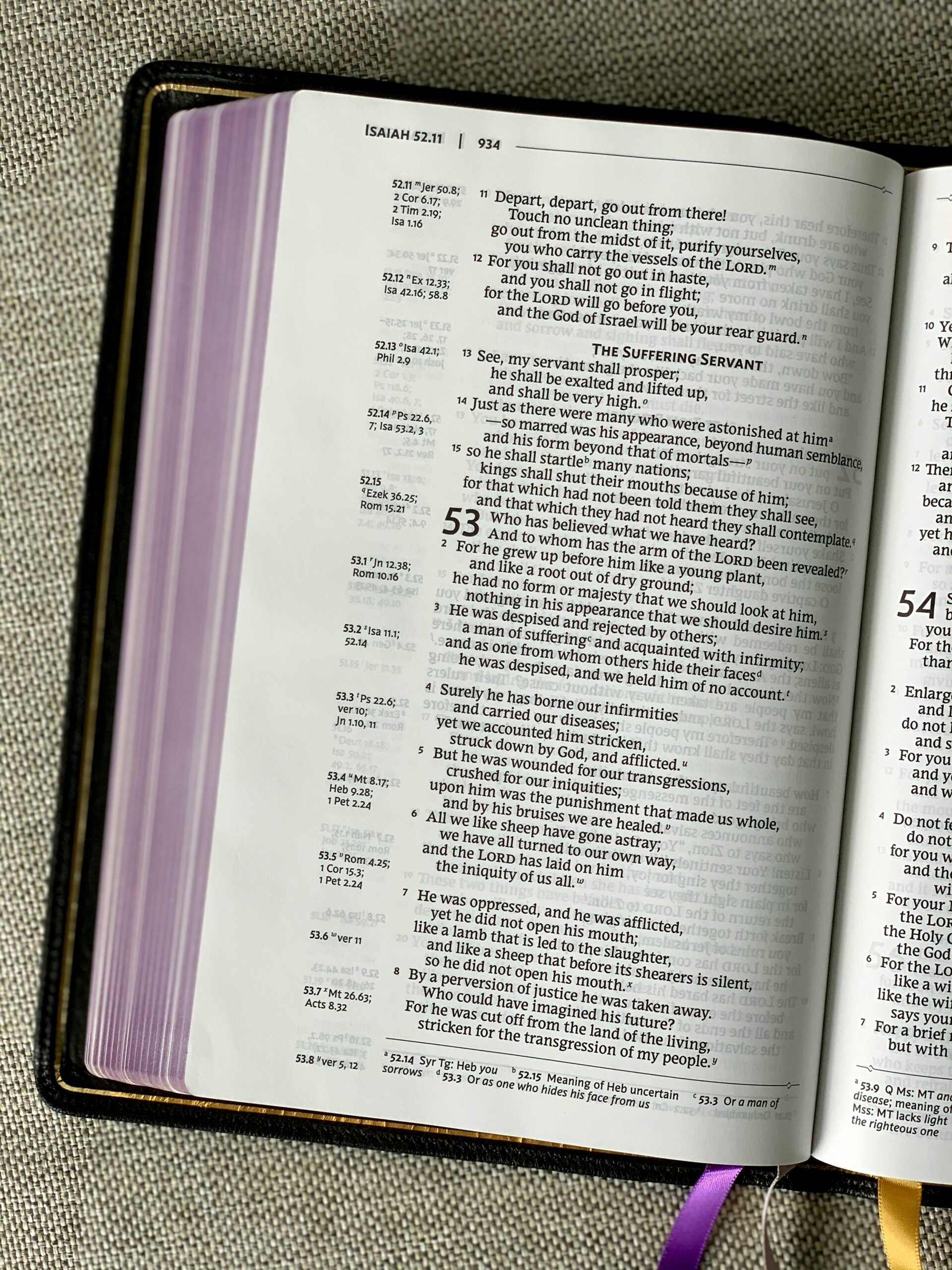
Response to the Suffering Servant
This sermon explores Isaiah 54 as the joyful response to the suffering servant described in the preceding chapter, identifying the text as a prophecy concerning the Christian Church rather than solely the nation of Israel. The central message calls believers to exuberant praise for God’s provision of redemption, which transforms the church from a barren, forsaken state into a flourishing community of faith. The preacher emphasizes the imperative for preparedness to accommodate the immense, global growth of the gospel, urging the church to ‘enlarge the tent’ and spare no effort in spreading the message. Furthermore, the text offers an exhortation to confidence in God’s promises, assuring believers of their security through Christ as their Maker, Redeemer, and Lord of hosts. The tone is pastoral and encouraging, inviting the congregation to rest in the assurance that God’s covenant of peace remains unshaken despite the world’s rejection.
Transcript
if God’s people would take their
Bibles and turn to that great Old Testament book of Isaiah,
Isaiah and specifically turn to chapter 53. It’s kind of unfair that Isaiah
has been called the Apostle Paul of the Old Testament and you
can see some similarities. Both were godly men, both called
in an amazing way, both served God passionately in their calling. But perhaps it would be more
fair to say that Paul was the Isaiah of the New Testament,
since Isaiah was first. Isaiah, you know, answered God’s
call to be a prophet recorded in that dramatic scene in Isaiah
6. Isaiah had a lengthy ministry
that ranged from 740 to 680 BC, 60 years, from the end of King
Uzziah’s reign all the way to King Hezekiah’s reign. He ministered
to the southern kingdom of Judah for their correction, largely,
and their encouragement during that time of Israel’s history,
they were under a severe threat by neighboring countries and
their armies. And Isaiah was called upon, really,
in large measure, to warn Judah about the temptation, very tempting
idea, of making pacts with those nations so as to not be attacked.
Instead, what they should have done is cultivate faith in God
to protect them. Isaiah has been called the messianic
prophet since he was so absolutely enraptured with the idea that
Israel was to be a light to the other nations, particularly through
the Messiah himself. One day, Isaiah was thoroughly
convinced the Messiah would be ushered into human history bringing
full redemption and blessing and liberation and joy. That day, Isaiah looked forward
to and prophesied of it frequently. Isaiah, in the New Testament
rather, Isaiah’s prophecy is quoted from more than any other
Old Testament prophet. Tradition holds that because
Isaiah stood firmly against evil King Manasseh, He suffered a
martyr’s death being sawn in two. Many believe that that is
what is in reference in Hebrews 1137. They were stoned. They
were sawn in two. They were tempted. They were
put to death by the sword. They went out, went about in
sheepskins, goatskins. They believe that that points
to Isaiah’s death. Isaiah, as the book, has been
called elsewhere the Mount Everest of Hebrew prophecy. I’ve pointed
this out in seasons past that it has also been characterized
as the Bible in miniature. The first 39 books of Isaiah
kind of mirror the first 39 books of the New Testament, the 66
chapters in all. points to the fact that the last
27 books of Isaiah, or chapters of Isaiah, point to the New Testament
in its glory and compassion in God’s favor and provision for
salvation. Well, those chapters break out
fairly nicely. It’s fairly easy, with the volume
not accepted, it’s fairly easy to map out Isaiah and to create
an outline. The outline of the book of Isaiah,
by agreement of nearly every scholar, is that there is that
division between the first 39 and the latter 27 books. The latter half of the book,
chapters 40 through 66, we find three sections, each with nine
addresses. And so that, too, is relatively
easy to map out. First division of the second
section would be chapters 40 through 48. The second division
would be chapters 49 through 57. And the final division of
that second half would be chapters 58 through 66. If you don’t already
know what we’re doing here, I’m drawing you in and dialing you
down closer and closer into the book of Isaiah. I told you that
that’s where we want to turn. I told you that the book is divided
in two. The second half is divided into
three. Let’s take a closer look at those
three sections. Chapters 40 through 48 essentially
announce a deliverance from Cyrus’s captivity. A godless man. God predicts and prophesies these
future events in In chapters 49 through 57, we have a lengthy
section on the description of one who is identified as a suffering
servant. And then in the closing chapters,
58 through 66, we have God’s announcement of the final abolition
of all national distinctions and a future glory for God’s
people. Well, as I indicated, That middle
section, and that’s where we’re going to part, that middle section
is about an individual identified as the suffering servant. And
in that middle section, there are a series of songs. And they’re
songs about the Messiah. They’re songs about this suffering
servant. In chapter 42, verses one through
nine, you see the first song. It has been called a poem that
was descriptive of the servant’s gentle manner and worldwide mission,
a dimly burning wick he will not extinguish. Isaiah 49 more
powerfully describes the servant’s mission and its success. Isaiah chapter 50, the third
song of four, is the servant, they call it a soliloquy concerning
his perfection in his suffering. But it’s the fourth song that
I want to bring us into now, and now we’re into the text. The fourth song starts in Isaiah
chapter 52 and ends in chapter 53 verse 12. It’s a passage we’re
very familiar with. This is the passage that talks
about the servant, the suffering servant’s vicarious sacrifice
and his ultimate exaltation. Would you just peek at Isaiah
53, you’re familiar with it. Who has believed our message,
and to whom has the arm of the Lord been revealed? For he grew
up before him like a tender shoot, and like a root out of parched
ground. He has no stately form or majesty
that we should look upon him, nor appearance that we should
be attracted to him. He was despised and forsaken
of men, a man of sorrows and acquainted with grief, and like
one from whom men hide their face. He was despised, and we
did not esteem Him. Surely our griefs He Himself
bore, and our sorrows He carried, yet we ourselves esteemed Him
stricken, smitten of God, and afflicted. But He was pierced
through for our transgressions. He was crushed for our iniquities. The chastening for our well-being
fell upon Him, and by His scourging we are healed. All of us, like
sheep, have gone astray. Each of us has turned to his
own way. But the Lord has caused the iniquity
of us all to fall on him. He was oppressed. He was afflicted. Yet he did not open his mouth,
like a lamb that is led to slaughter, and like a sheep that is silent
before its shearers. So he did not open his mouth.
by oppression and judgment, he was taken away. And as for his
generation, who considered that he was cut off of the land of
the living for the transgression of my people, to whom the stroke
was due? His grave was assigned with wicked
men, yet he was with a rich man in his death, because he had
done no violence, nor was there any deceit in his mouth. But
the Lord was pleased to crush him, putting him to grief, If
he would render himself as a guilt offering, he will see his offspring. He will prolong his days, and
the good pleasure of the Lord will prosper in his hand. As
a result of the anguish of his soul, he will see and be satisfied. By his knowledge, the righteous
one, my servant, will justify the many, as he will bear their
iniquities. Therefore, I will allot him a
portion with the great and he will divide the booty with the
strong because he poured out himself to death and was numbered
with the transgressors. Yet he himself bore the sin of
many and interceded for the transgressors. That has to be one of the most important passages
in all of scripture because it details the suffering of Christ,
our Lord, what he did on our behalf, how he suffered for us
and why he suffered for us. He suffered to impart his righteousness
to us as he bore our sin in his body on the cross. It is a remarkable
passage, and several years ago we spent, I think, some four
or five or six weeks looking at every verse and line in that
prophecy. We don’t think twice about applying
Isaiah 53 to Christ. We see Christ almost in every
line of that, don’t we? And well, we should. But we typically
don’t think at all about the importance of the chapters that
follow. I would challenge you, perhaps
not by a show of hands, but I would say very few people in the room
even are familiar in the least with the chapters that follow
Isaiah 53. But these chapters are part of
God’s inspired word as well. And given their proximity to
one of the most important chapters in all of scripture, we should
heed the call to pay attention to them as well. We should stir
our curiosity about the aftermath, the reception, the response to
Isaiah 53. That’s what you have in the chapters
that follow. If you would, look with me at
Isaiah chapter 54. Shout for joy, O barren one,
you have born no child. Break forth into joyful shouting
and cry aloud. you who have not travail. For
the sons of the desolate one will be more numerous than the
sons of the married woman, says the Lord. Enlarge the place of
your tent. Stretch out the curtains of your
dwellings. Spare not. Lengthen your cords
and strengthen your pegs. For you will spread abroad to
the right and to the left and your descendants will possess
nations and will resettle the desolate cities. Fear not, for
you will not be put to shame, and you will not feel humiliated,
for you will not be disgraced, you will not forget the shame
of your youth, and the reproach of your widowhood you will remember
no more. For your husband is your maker,
whose name is the Lord of hosts, and your Redeemer is the Holy
One of Israel, who is called the God of all the earth, for
the Lord has called you. like a wife forsaken and grieved
in spirit, like a wife of one’s youth when she is rejected, says
your God. For a brief moment, I forsook
you, but with great compassion, I will gather you in an outburst
of anger. I hid my face from you in a moment,
but with everlasting loving kindness, I will have compassion on you,
says the Lord, your Redeemer. For this is like the days of
Noah to me when I swore that the waters of Noah would not
flood the earth again. So I have sworn that I will not
be angry with you, nor will I rebuke you. For the mountains may be
removed and the hills may shake, but my loving kindness will not
be removed from you. And my covenant of peace will
not be shaken, says the Lord who has compassion on you. Oh,
afflicted one, storm-tossed and not comforted, behold, I will
set your stones in antimony, and your foundations I will lay
in sapphires. Moreover, I will make your battlements
of rubies, and your gates of crystal, and your entire wall
of precious stones. And your sons will be taught
of the Lord, and the well-being of your sons will be great. In
righteousness, you will be established. You will be far from oppression,
for you will not fear, and from terror, for it will not come
near you. If anyone fiercely assails you, he will not be from
me. Whoever assails you will fall
because of you. Behold, I myself have created
the smith who blows the fire of coals and brings out a weapon
for its work. I and I have created the destroyer
to ruin no weapon that is formed against you will prosper and
every tongue that accuses you in judgment you will condemn
this is the heritage of the servants of the Lord and their vindication
is from me well there’s obviously a lot there in that chapter for
us and we will make it just through a portion of that chapter Isaiah
chapter 54. Essentially what you have, as
I’ve suggested in the chapters that follow, you have the response
to the suffering servant of Isaiah 53. And it’s a response that
produces, first of all, joy in redemption. It calls our hearts
to rejoice in the knowledge of the fact of our redemption. Look,
first of all, at this exhortation to praise for God’s provision. Verse one just says, shout for
joy, O barren one, you who have borne no child. Break forth into
joyful shouting and cry aloud for you who have not prevailed. For the sons of the desolate
one will be more numerous than the sons of the married woman,
says the Lord. Now, if you’re like me, I’d say
most men would look at that passage and say, this isn’t for me. Brothers,
this is for us. The question immediately arises
as we transition from Isaiah 53 to Isaiah 54, to whom or about
whom are these words spoken? Some people think they’re spoken
individually, to individual people, and because of that, these are
spoken to the women, especially those who have not, by God’s
providence, born children. Others think that these words
are to be interpreted of the nation of Israel, who eventually
responds favorably to the suffering servant of Isaiah 53, the Lord
Jesus Christ, together with the ultimate inclusion of the Gentile
church. Jews first, Gentiles second. Here’s how one described it.
These words seem to be addressed to Jerusalem, the true metropolis
of the renewed nation, the ancient seat of the church of the Old
Testament. She is compared to Abraham’s
wife for her long continued barrenness and subsequent bearing of one
through whom Abraham became the father of many nations. Well, the problem with that is
that Israel largely rejected Christ. Remember John chapter
1, Jesus came to his own and his own did not receive him.
While there was a remnant that believed initially and throughout
the centuries, even at the foundational level, the apostles, early converts,
it was the Gentile response that was really to account for the
church’s rapid growth. Another one suggested that the
preeminence of the Hebrew church as the mother church of Christendom
is the leading idea. Well the problem with that very
similarly is that the descriptions of growth and expansion here
in Isaiah point much more to a much more enduring growth than
any initial interest and response by the Jewish nation. Another one said it this way,
it may be easily granted that this has a primary reference
to the welfare and prosperity of the Jewish Church. Yet it
cannot be denied that it has a further and principal reference
to the Gospel Church. I don’t see that either the passage
before us or the facts of history bear that out. The conclusion
that the description provided here in Isaiah 54 and 55 is a
primary reference to the welfare and prosperity of the Jewish
church. I don’t see it. So there’s a third option. To
whom are these words written? About whom are they written?
I believe they’re written corporately to the church. To the Christian
church. with the blessings being enjoyed
by individual believers, including all of those Jews who in time
come to Christ. It’s written to the church. One
pastor said it this way, as the former chapter Isaiah 53 is a
prophecy of the humiliation and exaltation of Christ of his sufferings
and death and the glory that should follow. This is a prophecy
of that part of his glory that relates to the flourishing estate
of his church. It’s the response to Christ.
Another reformer said it this way. After having spoken of the
death of Christ, he passes on with good reason to the church.
Christian Church, those who responded to the suffering servant, the
Lord Jesus Christ. one described it as the magnificent
and glorious promise, pardon me, he said it this way, the
magnificent and glorious promises here do so vastly exceed the
Jewish nation’s consideration at that time which was full of
uncertainties and distractions and troubles as all the histories
of those times tell us and far from that glory and lasting tranquility
which is here assured to her. Do you see what it says? neither
history nor even the testimony of the rest of scripture bears
it out. It must necessarily be referred
to the times of the gospel in which all that is here said was
or will be remarkably fulfilled. As the foregoing of the chapter
directly and literally speaks of Christ so does this literally
speak of the Church of Christ or the kingdom of the Messiah. What’s the point? The point is
this. In other words, the description
has a primary reference to the Christian Church, to the response
by testimony to the suffering that Christ put himself through
on our behalf. It’s believers in the Lord Jesus
Christ, including those Jewish people who in time come to faith,
whether immediately or in time. So the prophet says, shout for
joy, O barren one, you who have borne no child. Break forth into
joyful shouting and cry aloud, you who have not prevailed. For
the sons of the desolate one will be more numerous than the
sons of the married woman. And all the men sat unconvinced
that this is speaking to them. But it is. I want to ask you
to pause for a moment to grasp the nature and the significance
of what I consider to be an illustration that Isaiah employs here. Under
the direct influence of the Holy Spirit, he takes the most vulnerable
person in any society, a woman. And not just any woman, but a
barren woman, whom he further presents as being single, all
alone, completely vulnerable, and what is more, brokenhearted. And he takes that as an image
and sets it before us. And he says, that was the state
of humanity. Men, we can grasp this. We can
draw near to this illustration. We don’t have to be short sighted
and say that because he’s using an illustration about a woman,
a barren woman, a broken hearted woman, that it doesn’t apply
to us. This does apply. And it applies
beautifully so. The prophet calls for rejoicing
even in the face of this dreadful condition, and he communicates
the hope of change in fortune. He calls the woman to rejoice. But mind you, this is an illustration. This is a metaphor. The prophet
is speaking to the church. So men, we’re going to have to
work hard to grasp the significance of this prophecy. The women will
have a much easier time understanding the point that the prophet is
making. It’s written as much to the men as to the women. It pictures humanity. languishing,
broken hearted, alone, without child, barren, forsaken, seemingly
without any blessing or hope or assistance from God or man. It’s a dreadful condition. But suddenly there blows this
wisp of hope and there’s a distinct change. Matthew Henry, the great commentator,
captured it well when he said multitudes were converted from
idols to the living God. Those were the church’s Children
that were born partakers of a new and divine nature. By the word,
there were more good people found in the Gentile church when that
was set up that had long been a far off and without God in
the world than were ever found in the Jewish Church. Did you
hear what he said? He said exactly what Isaiah 54
1 tells us that at one point it was hardly even in existence,
the most vulnerable in all of society. And yet all of a sudden
it’s flourishing. growing, leaps and bounds. And
so with all of the thousands, yes, millions of people converted
to faith in Christ alone for salvation, what more natural
response than that of exuberant praise? That’s what he calls
them to. exuberant praise, expressing
gratitude to Almighty God for his abundant and efficacious
grace at work in their hearts, awakening sinners by regeneration
to new life in Christ. What a glorious thing. Another pastor said it this way.
This is a matter spoken of as great rejoicing to the church,
which is called upon to break forth into singing upon this
account. The increase of the church is
the joy of all its friends, even in heaven. Among the angels of
God, there is an uncommon joy for every sinner that repents. So if that’s true, that all of
heaven rejoices at the faith and the repentance of one sinner,
can you imagine a mighty explosion of faith throughout the centuries? Now, the prophet here is essentially drawing on
Jewish understanding of their own history. And he’s very likely
pointing to Sarah in view as the backdrop of this illustration.
They knew her situation well, that she was advanced in age,
unable to bear, barren, and yet God promised through that that
he was going to raise up a mighty seed for Abraham through her.
Sarah was one who knew all of the heartaches that are expressed
in this verse. Barrenness, without child, advanced in age, suddenly
blessed. This is a working metaphor of
the church. Without God, without hope in
the world, without even really being brought into existence
yet, strangers to the promises, now finding themselves blessed
beyond measure, brought near by God’s grace, redeemed, justified
by faith in their Savior, the Lord Jesus Christ. Shout for
joy. Shout for joy, O barren one.
You have borne no child. Break forth into joyful shouting,
and cry aloud, you who have not travailed. The sons of the desolate
one will be more numerous than the sons of the married woman. You say, well, that is just that’s
a fascinating interpretation. Pastor, I’m not sure we can get
there. I’m only through verse one. Let me show you just how
we can get there. If you would keep your finger
in Isaiah and turn over to the book of Galatians. One day I hope to preach the
book of Galatians. I’ll get a good jumpstart today. You know the situation of Galatia. where believers who had received
and placed their faith in the Lord Jesus Christ were now slipping
back into works, adopting and bringing forward many of the
Old Testament practices and laws and piling them on their Christianity,
hoping to kind of add to their faith and faithfulness. Well,
Paul Paul rebukes it. Remember, he asks him, point
blank, who has bewitched you? Who tricked you with this so-called
doctrine? And in chapter three, he begins
to advance an argument that we just must pay attention to this
morning. He’s talking about the gospel of grace. It’s the gospel
of God’s grace. And in those first few verses,
he talks about the reception of the Holy Spirit. But I want
you to skip down to verse six. Here he begins to use the argument
of Abraham. Abraham didn’t earn his salvation
by works. Abraham received his salvation
by faith. Look at verse 6. Even so, Abraham
believed God, and it was reckoned to him as righteousness. Therefore,
be sure that it is those who are of faith who are sons of
Abraham. This is essentially what Isaiah
54 says. There’s two different kinds of
offspring, two different kinds of children. And there are those
that are born by blood, a blood lineage, and there are those
that are born into Abraham’s family by faith. And Paul, here in that third
major section of Galatians 3, lays out the argument of justification
by faith. Jump down to verse 11. Now that
no one is justified by the law before God is evident, for the
righteous man shall live by faith. If that sounds familiar, it should. Because those are essentially
Paul’s words to the Romans. Don’t turn, you won’t have time.
Just jot down if you want. Romans 4.13, 4.16, and 9.7. In Romans 4 13, it says the promise
to Abraham or to his descendants that he would be heir of the
world was not through the law. It wasn’t by keeping the law
perfectly. It wasn’t by living according
to the law, but through the righteousness of faith. It was faith in Christ
alone that bestowed that righteousness upon them. Verse four of chapter
4 verse 16 says this, for this reason it is by faith in order
that it may be in accordance with grace so that the promise
will be guaranteed to all the descendants not only to those
who are of the law but also to those who are of the faith of
Abraham who is the father of all. There’s two ways to be Abraham’s
offspring. Paul goes on in his argument
in Galatia In the fourth major section, he talks about the nature
of the law. In the fifth major section, in
chapter four, verse one, all the way through verse eight,
he talks about the nature of errors. What are they like? What do they get? Paul challenges
their thinking. Look at verse nine of chapter
four. But now you have come to know
God rather be known by God. How is it that you turn back
again to the weak and worthless elemental things to which you
desire to be enslaved all over again? He challenges the Galatians
in yielding up their freedom in faith and instead going back
into handcuffs of bondage to the law. And now if you would
skip all the way down to verse 21. I told you there’s a purpose
to this. Paul comes up with this masterful
presentation of the history of the Jewish religion and he lands
essentially quoting Isaiah 54 verse 1. Tell me you who want
to be under the law, do you not listen to the law? For it is
written that Abraham had two sons, one by the bond woman and
one by the free woman. But the son by the bond woman
was born according to the flesh and the son by the free woman
according to the prompt through the promise. This is, and this
is Paul here admitting it. This is allegorically speaking. That’s exactly what we have in
Isaiah 54 verse one. Is it an allegory, an illustration,
a metaphor? This is allegorically speaking
for these women are two covenants. One proceeding from Mount Sinai,
bearing children who are to be slaves to the law. She is Hagar. Now this Hagar is Mount Sinai
in Arabia and corresponds to the present Jerusalem for she
is in slavery with her children. The Jews believed that they could
live according to the law and win their salvation, earn their
salvation. Paul says no way. But the Jerusalem
above in heaven is free. She is our mother, for it is
written, rejoice, O barren woman who does not bear. Break forth
and shout, you who are not in labor. For more numerous are
the children of the desolate than the one who has a husband. So then, brethren, look at verse
31. So then, brethren, we are not
children of the bondwoman. We are children of the free. We are those who come to faith
or come to Christ in faith. We are those who come to salvation,
righteousness by faith and not by words. It’s exactly what Isaiah
54 verse 1 is pointing to. That there is going to be a great
explosion of birth that is just unending of believers in the
Lord Jesus Christ And so we have not only in verse one a call
to praise for God’s provision, but in the verses that following
the follow, we have an exhortation to preparedness for the immensity
of God’s blessing. He says, Wait till you see how
big this explosion, this population exposure, explosion of those
who are justified by faith as opposed to words. Look at verse two, we’re back
in Isaiah. These words do point to us. These words are for us. And Paul points out that this
is an exhortation for us to be prepared for the immensity of
God’s blessing. Look at verse two. Enlarge the
place of your tent. Stretch out the curtains of your
dwellings. Spare not. Lengthen your cords. Strengthen
your pegs. For you will spread abroad to the right and to the
left. Your descendants will possess nations and will resettle the
desolate cities. Enlarge the place of your tent.”
You know what he does? He switches metaphors now. And
he says, get ready. We’re all going camping. Even
me. This idea of a tent was so familiar
to the nation of Israel, so familiar to the people of the day, that’s
how they went about it. It wasn’t a camping trip for enjoyment’s
sake, it was part of the necessary equipment that you had if you
traveled. Isaiah 33, Jeremiah 10, but he says, enlarge the
place of your tent, and that’s the place where the tent is set
up. Isaiah switches metaphors now
from the barren woman. Now he’s talking about a tent
that houses a great number of people. And he’s doing it to
illustrate the richness of the blessings of God upon the burgeoning
church. It’s going to explode, he says.
He erupts. This explosion is going to erupt
with a response to the gospel of Jesus Christ. And he says,
enlarge your tent. We need a bigger tent. You’re
going to need more room, Isaiah says. The illustration is simple. The first, the one that the formerly
barren, practically outcast woman is now blessed beyond measure
with children. And the second illustration,
the one about the tent, that the explosion of people is going
to be so plentiful of the spiritual offspring that it is named as
an urgent task to enlarge the space, to get ready for the covering
over God’s people. one pastor described it thus
it was in the first preaching of the gospel it was the business
of the apostles to disciple all the nations and to stretch forth
the curtains of the church’s habitation to preach the gospel
where Christ had not been yet named to leaven with the gospel
those towns and countries that had hitherto been strangers to
it and you know You know how it went. It was an absolute explosion
of the gospel. It started in Jerusalem, then
into Samaria, and then into parts unknown, Judea, then across the
globe it went. And it hasn’t stopped yet, right? So Isaiah says, spare not, spare
no pains, spare no difficulty, don’t hold back. Get into the
mix. Roll up your sleeves. Get busy
with the cause of the gospel. Whatever the challenges are to
accommodating the increase in numbers, do it. Spare no effort. Whatever it takes. Any cost to
spread the gospel should be irrelevant. should be embraced. Spare not
lengthen the cord, straighten the pegs. He stays with the illustration,
doesn’t he? Over and over again, he says,
This is what we’re gonna do. We’re gonna enlarge this covering.
We’re gonna prepare for this rapid and immense growth of the
church. The courts that held up the walls,
the pegs that fastened down those courts to stake the tent. prepare to abundantly witness
the massive growth of the church, is what Isaiah says. And having
generally forecasted the rapid growth of this fledgling church,
Isaiah now makes it explicit as he provides the reasoning
for the tent expansion efforts. Look at verse three. For you
will spread abroad to the right and to the left. The phrase to
the right and the left is a Hebraism. It’s a common saying among the
Hebrews. It just referred to infinite distance. If you’re
facing east, look as far as you can to the north and to the south,
and it’s going to spread. In other words, it meant a vast,
broad, unchecked expansion. Isaiah says that the church will
know, it will experience this kind of growth. A multitude of
believers, a multitude of new children, if you will, One commentator, the gospel spread
itself into all parts of the world that there were Eastern
and Western churches. The church’s seed inherited the
Gentiles and the cities that had been desolate, that is destitute
of the knowledge and worship of the true God, came to be inhabited. That is to have religion set
up in them and in the name of Christ professed. That’s the
history. That’s the history of our world.
The growth, the mighty growth of Christ’s church. Look at this. Verse three goes
on. Your descendants will possess nations will resettle the desolate
cities. The spiritual descendants of
Christ will win the whole earth for Christ. It doesn’t mean every
soul. that they’re going to go into every tongue and tribe and
nation. The gospel is going to spread.
And as the church grows and as the years and even centuries
pass, generation after generation has seen the advance of the gospel,
not to this town, not to just this city, but to all the towns
and all the cities and all the people of the globe. There’s no end to the growth
of Christ’s church. until God says it is finished. We should never rest, as it were,
on our laurels. We should never stop. We should,
like the passage exhorts, spare nothing, stop at nothing to spread
the gospel of Christ. This response that he calls us
to is essentially an echo of Matthew chapter 28 going to all
the world and make disciples people from every tongue and
tribe and nation. But Isaiah here in these opening
verses as he calls us to observe a right
response to the suffering servant He says that it’s not only a
call to praise God for his provision, it’s an exhortation to preparedness
for the immensity of God’s blessing. But there’s a third. There’s
a third point. It’s an exhortation to confidence
in God’s promise. And I think this is what the
church, even our church, needs in this day. Look at verse four. Fear not. For you will not be
put to shame. Do not feel humiliated, for you
will not be disgraced. But you will forget the shame
of your youth, and the reproach of your widowhood you will remember
no more. For your husband is your maker,
whose name is the Lord of hosts, and your Redeemer is the Holy
One of Israel, who is called the God of all the earth. For
the Lord God has called you like a wife forsaken and grieved in
spirit, even like a wife of one’s youth when she is rejected, says
your God. The prophet simply returns to
his original illustration, doesn’t he? Gone is the tent. He’s finished with that illustration.
He returns to the barren woman. And in these final three verses,
he turns to her not merely a barren woman, but a weak and fragile
church. And he encourages her to steadfastness,
and not just steadfastness, but courage in the face of great
uncertainty. First, the admonition, do not
fear, do not be humiliated. From the world’s perspective,
the church is weak, It’s languishing. It’s irrelevant. It’s well near
fading away. That’s what the world thinks
of the church. We’re outmoded. There are better ways to make
people better now. That’s what the world thinks.
But not from God’s perspective. And as such, this formerly barren
woman, the church should take heart. God is able. God is capable
of strengthening her. God is capable of winning the
day. God will see her through. The gates of hell will not prevail
against the church. Why such fearless confidence? Look at verse 5. For your husband
is your maker. whose name is the Lord of hosts
and your Redeemer is the Holy One of Israel who is called the
God of all the earth. Why such fearless confidence?
Because the very one encouraging was none other than their creator,
their maker. And what is more, he is that
soul being who controls all the countless scores of heavenly
angels. He is the Lord of hosts. Further
still, he is identified as the Redeemer, the very one who has
come to our defense and paid our penalty in full. He faced
our most formidable enemies, sin and death. And he won, and
he has vanquished them. He has vanquished sin and death
in all its horrific effects. He has purchased us by his blood. And why should this surprise
us? Because further still, we’re told that this is the Holy One
of Israel. God has not changed. This is
the great God of the Old Testament, the God of creation, the God
of deliverance, the God of protection, the God of law and righteousness. Indeed, He is the God of all
the earth, not just of Israel. Look at them one by one. Jesus
Christ is the church’s maker. Jesus Christ made the earth and
everything in it. Jesus Christ made you and I.
If Jesus Christ has initiated, founded, established the local
church, will he let it fail? Jesus Christ is the church’s
maker. He’s also her redeemer. He bought the church. He bought
the church with his own blood, with his very life. He bought
the church. As one reformer said, he calls
himself the Redeemer in order that he may more fully conform
the people in that hope. That although the former deliverance
appeared to be canceled because the people were again led into
captivity, yet they shall be restored in such a manner as
to know that the grace of God is not without effect. In other
words, God is going to win. God always wins. not only their
Maker, their Redeemer, but He’s the Lord of hosts. He has irresistible
power. God sits in absolute sovereignty. He has universal dominion over
all things. When Puritan said this refers
to his power that we are permitted to glory in it seeing that we
are his children for the greater power of God the more honorable
his name so much greater is our boasting so long as we are his
children and do not boast of an empty life. God is great. God is powerful and everybody
ought to hear it from us. God has done great things. He’s the Holy One of Israel.
He’s the one that initiated, mediated that covenant, all the
covenants. God is the one that sat and imparted
a holy standard to mankind. He indeed, all the while, completely
apart from any and all sin. He is the Holy One of Israel,
and He is the Lord of all the earth. Up to this point, Israel had
believed in kind of an exclusive claim to God and God’s care.
They knew that God wanted them to be a testimony to other nations,
but to their mind it was for them alone. God’s promises were
for them alone. God’s salvation was for them
alone. But as the gospel of the Lord
Jesus Christ was opened, By God’s long standing purpose and design
to the Gentiles, it was now more clear than ever that God was
indeed the Lord of the whole earth. What a glorious promises
is to us. Look at verse six. How do we
know? For the Lord has called you. Like a wife forsaken, grieved
in spirit, even like a wife of one’s youth when she is rejected,
says your God. He describes the unthinkable.
A woman, once loved, now put away. Perhaps even because she
couldn’t bear children, put away, divorced. God says, this is absolutely
unacceptable. We were as that woman. and God
called. And that’s that great word beckoned
us to himself. He called with the command to
obey with the grace imparted to obey that call. It’s the call of grace. All of those comforts that God
provides are treasured up in that one word that God called
us to himself. So the prophet returns to that
image, doesn’t he? The image of an abandoned, forsaken,
barren woman, vulnerable and heartbroken, the object of God’s
sovereign, loving care, called to himself. Called to his sympathy, called
to his mercy, called to his goodness and grace, he comes to her. It’s an exhortation to confidence
in God’s promises. Paul said it this way. There
is therefore now no condemnation for those who are in Christ Jesus,
that if you have been called to God through his son, the Lord
Jesus Christ, you are absolutely and perfectly safe and secure. Would you humble yourselves before
him? are merciful. God, we thank you
for stirring our hearts to look to. What would the response have
been? What would the prophet? What
would God himself have had us to ponder upon reading the words? Those incredible words of a suffering
savior of Isaiah 53 Lord God, you’ve granted us the grace to
see that there was a great appeal. There was an exhortation to praise
God for the provision that he’s given us that he has rescued
us as it were, like a barren, abandoned woman. He’s called
us to himself and Lord, he’s called us to be prepared and
to exalt in the great growth of the Church of Christ. Finally, to a great confidence
in God’s promise. He won’t forsake us. He won’t
leave us. There’s no change of plan coming
down. If we have been called to Christ,
we are eternally secure. Lord, we rejoice in what you
provided to us through the suffering servant of Lord Jesus Christ.
Lord, while we rejoice, if there are any who do not know the Lord
Jesus Christ, we do not know this joy. We do not share in
this preparation. This confidence in what you’ve
accomplished. Father, move in their hearts,
we pray. By your own Holy Spirit that
wooed us to Christ, now woo them. Bring them to knees of repentance
and to faith in Christ alone for salvation. It’s in Jesus’
name that we pray. Amen. We close. If you would take your hymnals
and turn to 178, A Little Town of Bethlehem.
Messages: 6