The Response to the Suffering Servant
This sermon explores the appropriate response to the suffering servant described in Isaiah 53, focusing on the blessings outlined in Isaiah 54. The central message is that the proper reaction to Christ’s atonement is exuberant joy, as illustrated by the metaphor of a barren woman who is suddenly blessed with numerous children. The text presents three exhortations: to praise God for His provision, to prepare for the rapid expansion of the church by ‘enlarging the tent,’ and to maintain confidence in God’s promises despite the world’s hostility. The preacher emphasizes that God, as the Lord of Hosts and Redeemer, has sovereignly secured the salvation of His people, transforming them from a forsaken state into a thriving community of faith. This passage serves as a comfort and assurance that God’s plan of redemption is both universal and certain.
Transcript
For the next several weeks, we
will do as we often do at the Christmas season. We’ll take
a break from our study in Colossians, and I would have you begin turning
to the book of Isaiah. We’ll spend the next four weeks
here in Isaiah’s prophecy. Specifically, once you find Isaiah,
which shouldn’t be too hard to find, I’ll meet you there in
a moment. But if you would make your way
to chapter 42, Isaiah chapter 42. Now Isaiah, as we know, was a
prophet of God. We know his personal testimony
of his call to ministry recorded in the sixth chapter of the book,
a very dramatic scene. And there Isaiah answers God’s
call to be a prophet, to speak for God, to speak God’s words. Isaiah went on to have an 80
year ministry that ranged from 740 to 680 BC. From the end of King Uzziah’s
reign to, pardon me, from King Uzziah’s reign all the way to
King Hezekiah’s reign. Isaiah’s ministry brought correction
and comfort to the southern kingdom of Judah. And during this time
period in Israel’s history, Judah was under a severe threat by
neighboring armies. And Isaiah was called repeatedly
to warn Judah about this tempting idea of making pacts, coming
into league with heathen neighbors, instead of placing their faith
in God to protect them. Isaiah, in his work here in this
prophecy, has been called the messianic prophet, since he is
so absolutely captured with the understanding of Israel to be
a light to the other nations, particularly through the Messiah
himself. Isaiah was thoroughly convinced
that one day the Messiah would be ushered into human history,
full of redemption and blessing, liberation and joy. Isaiah’s
prophecy then is a monumental 66 chapter treatise, and it has
been appropriately called the Mount Everest of Hebrew prophecy. Many have observed that Isaiah
is like the Bible in miniature, and you can go way too far with
this, which we’re not going to do today. Its 66 chapters mirror
the 66 books of the Bible. The Bible contains 66 books,
Isaiah 66 chapters, and the book of Isaiah is in agreement of
Nearly every scholar in exegete divided into two major parts. The first 39 chapters and chapters
40 through 66, the latter 27. The first division of the Bible,
as you know, the Old Testament contains 39 books. The first
division of Isaiah, 39 chapters. The second division, 27. And
so the first 39 chapters parallel the 39 chapters of the Old Testament
with themes of God’s holiness, his demand for justice and righteousness,
and most notably, man’s epic battle with sin and their desperate
need of a savior. The last 27 chapters also generally
parallel the 27 books of the New Testament, presenting God’s
unfolding plan of redemption, the application of God’s mercy
and grace by the provision of a Savior, the Messiah, the Lord
Jesus. And so it’s no surprise that
in the New Testament, Isaiah’s prophecy is quoted more than
any other prophet. As we begin to zoom in on Isaiah’s
prophecy, I would draw your attention to the latter portion of this
book. Chapters 40 through 66, which
chapters I just mentioned, the latter 27 chapters of the book,
and I would further break that apart into three portions. chapters
40 through 48, chapters 49 through 57, and 58 through 66. Now we’ll characterize those
a little more as we proceed, but specifically I’d like to
zoom in even further on that middle portion, chapters 49 through
57. Those chapters tell of God’s
promised Messiah, the suffering servant, he’s referred to. And
if we were to zoom in even further, we begin to pick up a new feature
on these chapters. There are four similar but distinct
portions of scripture. These four distinct sections
are considered as songs. They are songs about God’s servant,
the suffering servant. And in that title, the suffering
servant, we immediately are confronted with the nature of the Messiah. He’s not a conquering military
figure, but a lowly, humble personage yielded to God for a particular
assignment. He is a dynamic figure in Isaiah’s
prophecy. He is the Virgin’s son. He is
the bearer of sin. He is light in darkness. He is
the bestower of all righteousness. He is Emmanuel, God with us. He is the source of peace, the
divine messenger. He is the promised Messiah. And
now, If you would glance down at the chapter to which I’ve
had you open Isaiah chapter 42, the first of these four songs,
poems really about the servant. We find it in chapter 42 verses
one through nine, where we are told of the Messiah’s relationship
to the father. Verse one talks about this, that
he is the father’s chosen one in whom his father delights. In verses two and three, Isaiah
speaks of his relationship to the repentant. A bruised reed
he will not break. And in verses four through nine,
he tells of the servant’s relationship to the world. that he will faithfully
bring forth and establish justice in the earth. Well, that’s the
first song and it’s a beautiful song, but there is another if
you would turn over to Isaiah chapter 49 verses one and following. There in Isaiah chapter 49, Isaiah
describes the particular assignment of God’s servant. In short, his
assignment is to restore wayward sinners to God as God himself
is quoted in verse six, that my salvation may reach to the
end of the earth. That nobody would be exempted. But there is a third song and
we find that third song in chapter 50. Turn over, if you would, to chapter
50 for the third of four servant songs. Here in chapter 50, in
verses 4 through 11, the servant himself speaks. describing his
dreadful suffering, summarized in verse 9, I gave my back to
those who strike me, my cheeks to those who pluck out the beard.
I did not cover my face from humiliation and spitting, words
that would ultimately be fulfilled in Christ’s passion. And that
verse is quoted by all three of the synoptic writers, Matthew,
Mark, and Luke. But the servant’s confidence
is in God his father. Would you glance at verse 7?
The Lord God helps me. Therefore, I am not disgraced. Therefore, I have set my face
like flint, and I know that I will not be ashamed. Christ came to
fulfill his mission. He knew exactly what was involved. He came willingly and yielded
to God for that mission. But there is a fourth servant
song, and I would call that kind of our landing spot this morning.
Isaiah 53, you know the passage. And as we drift towards that
passage, we can see that the song of Isaiah 53 actually starts
in Isaiah 52 verse 13, where we are told of the servant’s
suffering. It’s his great suffering on our
behalf. And there’s virtually, it’s a
clean break between verse 12 and verse 13, and the flow of
the passage is such that it would be impossible, unreasonable,
not to incorporate the end of Isaiah 52 with Isaiah 53. But
even these verses are introduced just prior to that by a beautiful
passage of scripture pointing to the Messiah. Would you glance
down at verse seven? How lovely on the mountains are
the feet of him who brings good news, Christ, who announces peace,
Jesus, and brings good news of happiness, our Lord Jesus Christ. who announces salvation and says
to Zion, your God reigns. Listen, your watchmen lift up
their voices. They shout joyfully together,
for they will see with their own eyes when the Lord restores
Zion. Break forth, shout joyfully together,
you waste places of Jerusalem. For the Lord has comforted his
people. He has redeemed Jerusalem. The
Lord has bared his holy arm in the sight of all the nations,
that all the ends of the earth may see the salvation of our
God.” And with that, he leads right up to what we call the
fourth servant song. I’ll read it in full, but I want
to prepare you. I’m going to give a heading to
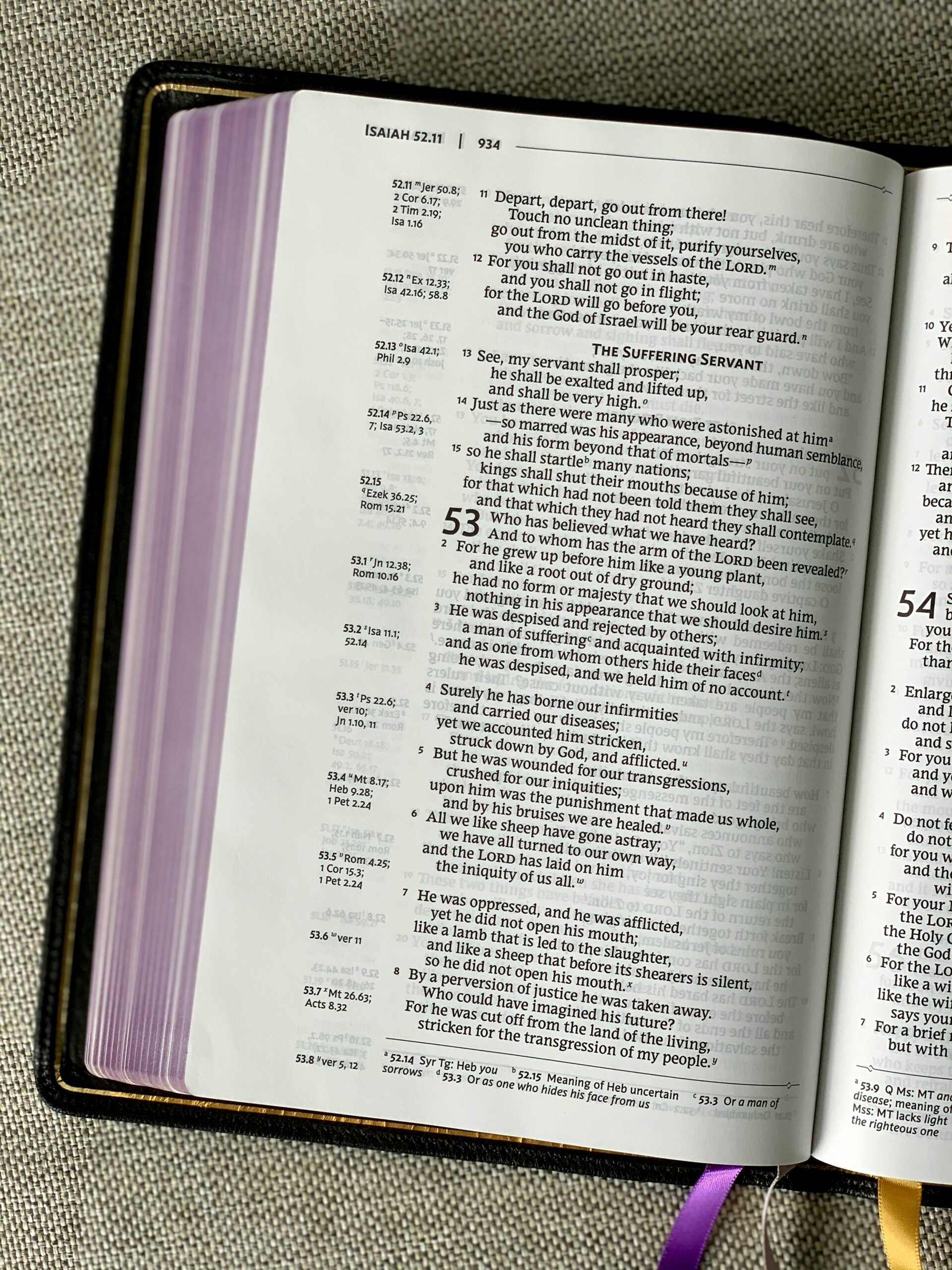
each of these five sections. In Isaiah 52, 13 through 15,
we have the servant’s astonishing reception. the servant’s astonishing
reception. Behold, my servant will prosper. He will be high and lifted up
and greatly exalted, just as many were astonished at you,
my people. So his appearance was marred
more than any man, and his form more than the sons of men. Thus
he will sprinkle many nations, kings will shut their mouths
on account of him. For what had not been told them
they will see, and what they had not heard they will understand.
It’s the first verse. The second verse. I would title
like this, it’s the servant’s astounding rejection. These verses
you know well. Who has believed our message
and to whom has the arm of the Lord been revealed? For he grew
up before him like a tender shoot, like a root out of parched ground. He has no stately form or majesty
that we should look upon him. nor appearance that we should
be attracted to him. He was despised and forsaken
of men, a man of sorrows and acquainted with grief, and like
one from whom men hide their face, he was despised and we
did not esteem him. The third verse, not only the
servant’s astonishing reception and astounding rejection, but
the servant’s amazing suffering. Look at verse four, if you would,
please. Surely our griefs he himself bore, our sorrows he
carried. Yet we esteemed him stricken,
smitten of God and afflicted. But he was pierced through for
our transgressions. He was crushed for our iniquities. The chastening for our well-being
fell upon him. And by his scourging, we are
healed. All of us like sheep have gone
astray. Each of us has turned to his
own way. But the Lord has caused the iniquity
of us all to fall on him. The fourth verse, the servant’s
awful death. Verse seven, he was oppressed,
he was afflicted, yet he did not open his mouth like a lamb
that is led to slaughter and like a sheep that is silent before
its shearers. So he did not open his mouth.
By oppression and judgment, he was taken away. And as for his
generation who considered that he was cut off out of the land
of the living for the transgression of my people to whom the stroke
was due, his grave was assigned with wicked men, yet he was with
a rich man in his death. because he had done no violence,
nor was there any deceit found in his mouth. We have the servant’s
astonishing reception, his astounding rejection, his amazing suffering,
his awful death, and finally, in verse 10 through 12, his awesome
sacrifice. But the Lord was pleased to crush
him, putting him to grief. If he would render himself as
a guilt offering, he will see his offspring. He will prolong
his days, and the good pleasure of the Lord will prosper in his
hand. As a result of the anguish of his soul, he will see it and
be satisfied. By his knowledge, the righteous
one, my servant, will justify the many. He will bear their
iniquities. Therefore, I will allot him a
portion with the great and he will divide the booty with the
strong because he poured out himself to death and was numbered
with the transgressors. Yet he himself bore the sin of
many and interceded for the transgressors. We know Isaiah 53 and now 52,
13 and forward, we know that this is one of the greatest chapters
in all of scripture. It’s a literary portrait of Jesus
captured in the act of atoning for the sin of the world. And
think of this, Isaiah is writing as though he’s there at the foot
of the cross. as if the crucifixion had already
taken place. But that is 700 years in the
future when Isaiah writes, such is the nature of divine prophecy. What a fantastic picture this
passage is of Jesus, our Savior. But as rich and wonderful as
that familiar song is, I want to focus our attention this morning
on the subsequent chapters. Those chapters that flow from
our response to the suffering Savior. Everyone upon hearing
about the Savior, even what we just read, everyone responds. They may respond out of curiosity.
They may respond out of grief, knowing that Jesus is pictured
there dying for their sin. Everyone responds. It may be
one of indifference. It may be that of outright rejection. It may even be one of empty sympathy,
feeling sorry for Christ, but no real repentance. So the first question, if everybody
has a response, what must that response be to Christ? What is
our response to the suffering servant of Isaiah 52, 53? Isaiah certainly leans into a
positive response. This is what he speaks about
in chapters 54 and 55, where he tells of the blessings of
our receptive response to this suffering servant. And there
are four sections presented in these chapters. We’ll take one
a week. The first is joy and redemption. I mean, what else
could there be? No more appropriate response
than rejoicing before God and what he has provided for a Messiah
such as Christ. There is assurance in reconciliation,
peace in our heart. There is an appeal to faith.
And there is an assurance for sinners of forgiveness. We’ll
look at each of those. If you’re in chapter 4, I want
to have you glance down at verse 1 because here, Isaiah says that
the response to the suffering servant produces joy in redemption. Joy in redemption. And so I would
have you, I know we’re doing a lot of reading today, but follow
along please as I read this first portion of our response to the
suffering servant. Shout for joy, O barren one,
you who have born no child. Break forth into joyful shouting
and cry aloud, you who have not prevailed. For the sons of the
desolate one will be more numerous than the sons of the married
woman, says the Lord. Enlarge the place of your tent.
Stretch out the curtains of your dwellings. Spare not. Lengthen
your cords and strengthen your pegs. For you will spread abroad
to the right and to the left, and your descendants will possess
nations and will resettle the desolate cities. Fear not, for
you will not be put to shame. And do not feel humiliated, for
you will not be disgraced. But you will forget the shame
of your youth and the reproach of your widowhood you will remember
no more. For your husband is your maker. whose name is the Lord of hosts,
and your Redeemer is the Holy One of Israel, who is called
the God of all the earth. For the Lord has called you,
like a wife forsaken and grieved in spirit, even like a wife of
one’s youth, when she is rejected, says your God. Isaiah 54, verses
one through six, that’s where we’ll focus in on today. We don’t typically think twice
about our understanding of Isaiah 53. It’s such a rich passage
about Christ that we embrace the depth and the revelation
about our Savior readily. Often we review those verses
during communion. The sad thing is, is that we
often stop there. We don’t often think about the
importance of the chapters that follow, but these following chapters
are part of God’s inspired word, given their proximity to one
of the most important chapters in all of scripture, we should
consider them more carefully. These ensuing chapters tell of
the blessings that are bestowed on those who properly receive
the suffering Savior. Let’s begin our consideration
of these meaningful chapters starting in verse one of chapter
54. The prophet seeks there to inform his hearers of the joy that the Messiah’s
redemption brings. And he does so with a particular
literary device. Exhortation. He issues three
exhortations that enlighten us to the joy that is lavished upon
the believer in Christ. This is so rich. The first there
in verse one is an exhortation to praise God for his provision. an exhortation of praise for
God’s provision. Shout for joy, O barren one,
you who have borne no child.” The question immediately arises
though, as we transition from Isaiah 53 to Isaiah 54, to whom
or about whom are these words spoken? I mean, if he’s issuing a command,
who is he talking to? Israel would largely reject Christ,
John 1, 10 and 11. And while there was a remnant
of Jews who believed, even at the foundational level, apostles,
early converts, it was the Gentile response to the gospel that was
really to account for the church’s rapid growth. I don’t see that
either the passage before us or the facts of history bear
out the conclusion that the description provided in Isaiah 54-55 is a
primary reference to the welfare and prosperity of the Jewish
church. It doesn’t make sense. The descriptions
of growth and expansion here in Isaiah 54-55 point to a much
more enduring growth. a much more enduring growth than
any initial interest or response by the Jewish nation. In other
words, this description has a primary reference to the church. Believers
in Jesus Christ, including those Jewish people who in time throughout
the centuries would come to faith in Christ. And so Isaiah says,
to all who receive the suffering servant, to all who call upon
Christ to be saved, to all who place their faith in the Savior,
shout for joy. It’s a nearly rhetorical command. To praise God for the undeserved
favor of salvation is, of course, the child of God natural response
to salvation. The child of God abounds with
gratitude for forgiveness. I want to pause for a minute
to grasp the nature and significance of this illustration, which Isaiah
employs here under the direct influence of the Holy Spirit.
He takes the most vulnerable person in any society, a woman,
but not just any woman, a childless woman, a barren one, he calls
her, And he further presents this woman as single, all alone,
completely vulnerable, and what is more, brokenhearted. This
is a sad picture. Yet the prophet here calls for
rejoicing, to break forth into joyful shouting. Because God
has seen her estate and has remedied it thoroughly. And it communicates
the hope of a change in fortune for her. He calls this woman
to rejoice. But mind you, this is an illustration. It’s a metaphor. The prophet
is speaking to the world. So men are going to have to work
hard to grasp the significance of this prophecy. It’s written
as much to the men as to the women. He pictures humanity,
languishing, brokenhearted, alone, as without child, barren, desolate,
forsaken, seemingly without any blessing or hope of assistance
from God or man. But suddenly there’s a mighty
wind of hope, a distinct change here, a cause for joy, because
God’s promise is a great blessing. Look at what it says, children
more numerous than the sons of the married woman. Whereas the
world had long languished in their sin, no hope of salvation,
now by their Messiah, the suffering servant, their quivers would
be made full. God’s kingdom will begin to overflow
with converted sinners. Shout for joy, O barren one,
you who were born no child. Joy in its adverb, or in its
verb rather, to rejoice, is a major theme in Isaiah. Together, these
words, rejoice and joy, are used more than 250 times in Isaiah’s
prophecy. Let’s go through each one if
we could. Bear with me, I’ve narrowed it
down to about 10. Isaiah 25, nine. Behold, this
is our God for whom we have waited that he might save us. This is
the Lord for whom we have waited. Let us rejoice and be glad in
his salvation. Isaiah 29, 19, the afflicted
ones will also increase their gladness in the Lord and the
needy of mankind will rejoice in the Holy One of Israel. Isaiah’s
whole angle is to stir the people to rejoicing. Rejoicing ahead
of time for the promise of the Messiah. Isaiah 35, verse two. It will blossom profusely and
rejoice with rejoicing and shout of joy. He uses the word three
times there. Isaiah 35, 10. The ransomed of
the Lord will return and come with joyful shouting to Zion
with everlasting joy upon their heads. They will find gladness
and joy. Sorrow and sighing will flee
away. Isaiah 41, verse 16, you will rejoice in the Lord, you
will glory in the Holy One of Israel. Isaiah 42, verse 11,
let the inhabitants of Selah sing aloud, let them shout for
joy from the tops of the mountains. Isaiah 44, shout for joy, O heavens,
for the Lord has done it. Shout joyfully, you lower parts
of the earth. Break forth into a shout of joy,
you mountains. O forest, and every tree in it,
for the Lord has redeemed Jacob, and in Israel he shows forth
his glory. Isaiah 49, 13. I’m not done.
Isaiah 49 13 shout for joy. Oh heavens and rejoice. Oh earth
break forth into joyful shouting Oh mountains for the Lord has
comforted his people and will have compassion on the afflicted
Clearly pointing to the provision of the Messiah Isaiah 61 10 I
will rejoice greatly in the Lord. My soul will exult in my God,
for he has clothed me with garments of salvation. He has wrapped
me with a robe of righteousness as a bridegroom decks himself
with a garland, as a bride adorns herself with jewels. Rejoicing. It’s a major theme for Isaiah. And for those countless sinners
who have come to faith in Jesus Christ over the millennia, The
most natural response is that of joy. To be rescued from sin
and darkness and death, and to be born again, to be redeemed,
forgiven, to be transferred into the kingdom of his beloved son. What else can be our answer,
our response but joy? And so with all the thousands,
even millions of people who have been converted to faith in Christ
alone for salvation, what more natural response than that of
exuberant praise, expressing our gratitude to Almighty God
for His abundant and efficacious grace, awakening sinners by regeneration
to new life in Christ. Now the prophet, It may very
well have had Abraham’s wife Sarah in view, the backdrop sort
of of this illustration. Sarah was one who knew all the
heartaches expressed in this verse, without child, barren,
advanced in age. But suddenly to be blessed, the
desolate one now blessed with numerous sons, This is a working
metaphor contrasting a world without God, sinners without
hope, strangers to the promises, now finding themselves blessed
beyond measure, brought near to God by His grace, redeemed,
justified by the Savior. How could we not shout for joy? And so we have in our response
to the suffering servant, not only an exhortation of praise
for God’s provision, but secondly, in verses two and three, an exhortation
of preparedness for the ministry of God’s blessing. Preparedness
for the ministry of God’s blessing. Look at verse two, enlarge the
place of your tent. Stretch out the curtains of your
dwellings, spare not. Here’s a new metaphor. And it’s
introduced to illustrate the richness of the blessings of
God upon the burgeoning church, erupted from a response to the
gospel of Christ. And he basically just says, enlarge
your tent. We need a bigger tent, Isaiah
says. Both illustrations are simple.
The first, the barren woman, practically outcast, now blessed
beyond measure with children, children of faith. And in this
illustration, so plentiful are these spiritual offspring that
it’s named as an urgent task to enlarge the space for the
covering over God’s people. This idea of a tent was familiar
and a recurring metaphor in the Hebrew scriptures. Look upon
Zion, Isaiah says in 3320, your eyes will see Jerusalem, an undisturbed
habitation, a tent which will not be folded, its stakes will
never be pulled up, nor its cords torn apart. But here in this
verse before us, The prophet speaks of enlarging, stretching,
lengthening the tent. And it’s a subtle but sure reference
to the increase of God’s people, especially with regard to the
inclusion of the Gentiles in God’s salvation. But as this,
since this is a result of the receiving of the Messiah, Jesus
Christ, it is the church that is in view now, It is the rapid
and great spread of Christianity that Isaiah presents. Isaiah
is prophesying of the stupendous growth of the church in the spread
of the gospel of Christ. When the prophet says spare not,
he insists that whatever the challenges are to accommodating
the increase to its numbers, do it. In a sense, he calls everyone
to get busy, spare no effort, whatever it takes, no matter
what the cost, no matter the toil involved, no matter the
arduous labor, do everything necessary to enlarge God’s kingdom. staying with the illustration
of the tent, he mentions two particular areas of focus, very
graphic. Lengthen the cords and straighten
the pegs. If you’ve ever gone camping,
every once, I try every once, once a year to go sleep in the
dirt just to remind me why I don’t sleep in the dirt. But this is
basic, this is camping 101 here. lengthen the cords, straighten
the pegs. He basically says prepare, he
urges them, to abundantly witness the growth of the church. And
having generally forecasted the rapid growth of the fledgling
church, Isaiah now makes it explicit as he provides the reasoning
for the tent expansion effort. Glance down, verse three, for
you will spread abroad to the right and to the left. Your descendants
will possess nations and will resettle the desolate cities.
This church is gonna get really big. The phrase to the right
and the left, it was a Hebraism, a common saying among the Hebrews. It just referred to the distance
of stretching either north to south or east to west. It meant
a vast, broad, unchecked expansion. And Isaiah says that the church
will know, will experience this kind of growth. This was the
result, and it still is today, of the preaching of the gospel.
The tent, so to speak, continues to grow in size, whether in new
frontiers or in burned over areas. needful of a fresh proclamation
of Christ. Every single time a person comes
to saving faith in Jesus Christ, the tent must give way to being
stretched. Whatever the gospel, wherever
the gospel is preached, it will bear fruit. As the Apostle John
put it, to every tribe and tongue and people and nation. The spiritual
descendants will win the whole earth for Christ. Every last
child of God, elect of God, will be saved. Jesus says, of God’s
sheep, I lost not one. As the church grows and as the
years and even centuries pass, generation after generation sees
the advance of the gospel. Now to this town, now to this
city, now to this people group, the church will continue to grow.
The tent must continue to get bigger. This response to the suffering
servant produces joy in our redemption. And Isaiah speaks of this by
a call of praise for God’s provision, an exhortation of preparedness
for the immensity of God’s blessing, and thirdly, an exhortation to
confidence in God’s promises. Essentially, he says in verse
four, fear not, for you will not be put to shame. Do not feel
humiliated, for you will not be disgraced. Prophet simply
returns to his initial illustration here in these final verses, the
illustration of the barren woman. And he turns to her, not merely
a barren woman, but a weak and fragile church. And he encourages
her to steadfastness, even courage in the face of the hateful world. Do not be afraid, he says. Do
not be ashamed. Do not be humiliated. First,
this admonition, do not fear, do not be afraid. You are not a barren, disgraced,
abandoned woman any longer, he says. God has taken it all away. From the world’s perspective,
the church is weak and languishing and in large measure irrelevant. but not from God’s perspective. The church is the apple of his
eye. Christ died for the church. God has taken it upon himself.
He will build his church. And as such, what was formerly
considered a barren woman, here now the church should take heart.
God is able. God is capable of strengthening
and winning the day. God will see her through. Why
such fearless confidence? Does Isaiah call his readers
to? Look at verse five. For your
husband is your maker. Whose name is the Lord of hosts
and your Redeemer is the Holy One of Israel, who is called
the God of all the earth. Here’s the support really for
the admonition of verse four. Why such fearless confidence?
Because God has provided for the forsaken and barren woman.
She’s given her a husband. Someone rather to love her and
to care for her and to provide for her. What a beautiful illustration
of what God has done for lost and hopeless sinners like you
and I. Because the very one encouraging
such was none other than their creator, their maker. The same one who crafted them
and everything in the world out of nothing. What a comfort and
encouragement that is. The very one who created the
world is the one who also ordained and executed this plan of redemption. Who else would you rather have
as a caregiver of your soul? What is more, He is the Lord. He is the one who is sovereign
over all. The sole being who controls all
the countless scores of the heavenly angels. He is the Lord of hosts,
Isaiah says. He has irresistible power, an
absolute sovereignty, a universal dominion. Kings who are lords
of some hosts, some armies. They find there are others who
are lords of other hosts, other armies. And they are as mighty
and as plentiful as their own. But God is the Lord of all hosts.
God is in charge of everything. Further still, he’s identified
here as the Redeemer. He’s the Redeemer, the Holy One
of Israel, the very one to who has come to our defense as sinners. He has faced our most formidable
enemies, sin and death. And he won. Christ is this woman’s
Redeemer. He has brought her out of captivity. He has vanquished sin in all
its horrific effects. He has purchased us by His blood
out of our wretched bondage to sin. And why should this surprise
us? For further still, we’re told
that this is the Holy One of Israel. This is the great God
of the Old Testament, the God of creation, the God of deliverance,
the God of protection, the God of the law and righteousness.
He is the God of the whole earth, not just the God of Israel. He
is the Holy One of Israel. He’s the same that presided over
the affairs of the Old Testament. He was the mediator of the covenant.
The promise is made to the New Testament are as rich and sure
as those made to the Old Testament, for He is our Redeemer. He is and shall be called the
Lord over the whole earth. As God and as our mediator, He
is heir over all things. But then He shall be called so
when the ends of the earth shall be made to see His salvation. Up to this point, Israel believed
in this kind of crass exclusivity of God’s care. They thought that
God only loved them, that God only watched over them. It was for them alone. God’s
promises were for them alone. God’s salvation was for them
alone. But as the gospel of Christ was
opened and introduced to the world by God’s longstanding purpose
and design. It was open to the Gentiles,
you and I. And it was now more clear than
ever that God was indeed the Lord of the whole earth. Would you glance finally at verse
six. For the Lord has called you like a wife forsaken and
grieved in spirit. Even like a wife of one’s youth
when she is rejected. So the prophet returns again
to this image, this illustration of the abandoned, forsaken, barren
woman, vulnerable, heartbroken, like a wife forsaken, grieved
in spirit, rejected, divorced. Isaiah refreshes this image to
refer to the object of God’s sovereign, loving care. In his
sympathy, in his mercy, in his goodness and grace, he comes
to her. He comes to his people and he
comes by way of the Messiah, the suffering servant. And this
he gives. as the reason for drawing near
to the Messiah in faith. Because the Lord has called you
out of this condition. We don’t have to wallow in our
sin any longer. We don’t have to be in bondage
to it anymore. Taking God at his word is the
very nature of faith. And God calls us to faith in
the Messiah. Would you humble yourself before
him? the strong, because he poured out himself to death, and was
numbered with the transgressors. Yet he himself bore the sin of
many, and interceded for the transgressors.” We know Isaiah 53, and now 52,
13, and forward, we know that this is one of the greatest chapters
in all of Scripture. It’s a literary portrait of Jesus
captured in the act of atoning for the sin of the world. And
think of this, Isaiah is writing as though he’s there at the foot
of the cross, as if the crucifixion had already taken place. But
that is 700 years in the future when Isaiah writes, such is the
nature of divine prophecy. What a fantastic picture this
passage is of Jesus, our Savior. But as rich and wonderful as
that familiar song is, I want to focus our attention this morning
on the subsequent chapters. those chapters that flow from
our response to the suffering Savior. Everyone upon hearing
about the Savior, even what we just read, everyone responds. They may respond out of curiosity.
They may respond out of grief, knowing that Jesus is pictured
there dying for their sin. Everyone responds. It may be
one of indifference. It may be that of outright rejection. It may even be one of empty sympathy,
feeling sorry for Christ, but no real repentance. So the first question, if everybody
has a response, what must that response be to Christ? What is
our response to the suffering servant of Isaiah 52, 53? Isaiah certainly leans into a
positive response. This is what he speaks about
in chapters 54 and 55, where he tells of the blessings of
our receptive response to this suffering servant. And there
are four sections presented in these chapters. We’ll take one
a week. The first is joy and redemption. I mean, what else
could there be? No more appropriate response
than rejoicing before God and what he has provided for a Messiah
such as Christ. There is assurance in reconciliation,
peace in our heart. There is an appeal to faith.
And there is an assurance for sinners of forgiveness. We’ll
look at each of those. If you’re in chapter 4, I want
to have you glance down at verse 1 because here, Isaiah says that
the response to the suffering servant produces joy in redemption. Joy in redemption. And so I would
have you, I know we’re doing a lot of reading today, but follow
along please as I read this first portion of our response to the
suffering servant. Shout for joy, O barren one,
you who have born no child. Break forth into joyful shouting
and cry aloud, you who have not prevailed. For the sons of the
desolate one will be more numerous than the sons of the married
woman, says the Lord. Enlarge the place of your tent.
Stretch out the curtains of your dwellings. Spare not. Lengthen
your cords and strengthen your pegs. For you will spread abroad
to the right and to the left, and your descendants will possess
nations and will resettle the desolate cities. Fear not, for
you will not be put to shame, and do not feel humiliated, for
you will not be disgraced. But you will forget the shame
of your youth and the reproach of your widowhood you will remember
no more. For your husband is your maker. whose name is the Lord of hosts,
and your Redeemer is the Holy One of Israel, who is called
the God of all the earth. For the Lord has called you,
like a wife forsaken and grieved in spirit, even like a wife of
one’s youth, when she is rejected, says your God. Isaiah 54, verses
one through six, that’s where we’ll focus in on today. We don’t typically think twice
about our understanding of Isaiah 53. It’s such a rich passage
about Christ that we embrace the depth and the revelation
about our Savior readily. Often we review those verses
during communion. The sad thing is, is that we
often stop there. We don’t often think about the
importance of the chapters that follow, but these following chapters
are part of God’s inspired word, given their proximity to one
of the most important chapters in all of scripture, we should
consider them more carefully. These ensuing chapters tell of
the blessings that are bestowed on those who properly receive
the suffering Savior. Let’s begin our consideration
of these meaningful chapters, starting in verse one of chapter
54. The prophet seeks there to inform his hearers of the joy that the Messiah’s
redemption brings. And he does so with a particular
literary device, exhortation. He issues three
exhortations that enlighten us to the joy that is lavished upon
the believer in Christ. This is so rich. The first there
in verse one is an exhortation to praise God for his provision. an exhortation of praise for
God’s provision. Shout for joy, O barren one,
you who have borne no child.” The question immediately arises
though, as we transition from Isaiah 53 to Isaiah 54, to whom
or about whom are these words spoken? I mean, if he’s issuing a command,
who is he talking to? Israel would largely reject Christ,
John 1, 10 and 11. And while there was a remnant
of Jews who believed, even at the foundational level, apostles,
early converts, it was the Gentile response to the gospel that was
really to account for the church’s rapid growth. I don’t see that
either the passage before us or the facts of history bear
out the conclusion that the description provided in Isaiah 54-55 is a
primary reference to the welfare and prosperity of the Jewish
church. It doesn’t make sense. The descriptions
of growth and expansion here in Isaiah 54-55 point to a much
more enduring growth. A much more enduring growth than
any initial interest or response by the Jewish nation. In other
words, this description has a primary reference to the church. Believers
in Jesus Christ, including those Jewish people who in time throughout
the centuries would come to faith in Christ. And so Isaiah says,
to all who receive the suffering servant, to all who call upon
Christ to be saved, to all who place their faith in the Savior,
shout for joy. It’s a nearly rhetorical command. To praise God for the undeserved
favor of salvation is, of course, the child of God natural response
to salvation. The child of God abounds with
gratitude for forgiveness. I want to pause for a minute
to grasp the nature and significance of this illustration which Isaiah
employs here. Under the direct influence of
the Holy Spirit, he takes the most vulnerable person in any
society, a woman. But not just any woman, a childless
woman, a barren one, he calls her. And he further presents
this woman as single, all alone, completely vulnerable, and what
is more, brokenhearted. This is a sad picture. Yet the
prophet here calls for rejoicing, to break forth into joyful shouting. Because God has seen her estate
and has remedied it thoroughly. And it communicates the hope
of a change in fortune for her. He calls this woman to rejoice. But mind you, this is an illustration. It’s a metaphor. The prophet
is speaking to the world. So men are going to have to work
hard to grasp the significance of this prophecy. It’s written
as much to the men as to the women. He pictures humanity,
languishing, brokenhearted, alone, as without child, barren, desolate,
forsaken, seemingly without any blessing or hope of assistance
from God or man. But suddenly there’s a mighty
wind of hope, a distinct change here, a cause for joy. Because
God’s promise is a great blessing. Look at what it says, children
more numerous than the sons of the married woman. Whereas the
world had long languished in their sin, no hope of salvation,
now by their Messiah, the suffering servant, their quivers would
be made full. God’s kingdom will begin to overflow
with converted sinners. Shout for joy, O barren one,
you who were born no child. Joy in its adverb, or in its
verb rather, to rejoice, is a major theme in Isaiah. Together, these
words, rejoice and joy, are used more than 250 times in Isaiah’s
prophecy. Let’s go through each one if
we could. Bear with me, I’ve narrowed it
down to about 10. Isaiah 25, nine. Behold, this
is our God for whom we have waited that he might save us. This is
the Lord for whom we have waited. Let us rejoice and be glad in
his salvation. Isaiah 29, 19, the afflicted
ones will also increase their gladness in the Lord and the
needy of mankind will rejoice in the Holy One of Israel. Isaiah’s
whole angle is to stir the people to rejoicing. Rejoicing ahead
of time for the promise of the Messiah. Isaiah 35, verse two. It will blossom profusely and
rejoice with rejoicing and shout of joy. He uses the word three
times there. Isaiah 35, 10. The ransomed of
the Lord will return and come with joyful shouting to Zion
with everlasting joy upon their heads. They will find gladness
and joy. Sorrow and sighing will flee
away. Isaiah 41, verse 16, you will rejoice in the Lord, you
will glory in the Holy One of Israel. Isaiah 42, verse 11,
let the inhabitants of Salem sing aloud, let them shout for
joy from the tops of the mountains. Isaiah 44, shout for joy, oh
heavens, for the Lord has done it. Shout joyfully, you lower
parts of the earth. Break forth into a shout of joy,
you mountains. O forest, and every tree in it,
for the Lord has redeemed Jacob, and in Israel he shows forth
his glory. Isaiah 49, 13. I’m not done.
Isaiah 49 13 shout for joy. Oh heavens and rejoice. Oh earth
break forth into joyful shouting Oh mountains for the Lord has
comforted his people and will have compassion on the afflicted
Clearly pointing to the provision of the Messiah Isaiah 61 10 I
will rejoice greatly in the Lord. My soul will exult in my God,
for he has clothed me with garments of salvation. He has wrapped
me with a robe of righteousness as a bridegroom decks himself
with a garland, as a bride adorns herself with jewels. Rejoicing. It’s a major theme for Isaiah. And for those countless sinners
who have come to faith in Jesus Christ over the millennia, The
most natural response is that of joy. To be rescued from sin
and darkness and death, and to be born again, to be redeemed,
forgiven, to be transferred into the kingdom of his beloved son. What else can be our answer,
our response but joy? And so with all the thousands,
even millions of people who have been converted to faith in Christ
alone for salvation, what more natural response than that of
exuberant praise, expressing our gratitude to Almighty God
for his abundant and efficacious grace, awakening sinners by regeneration
to new life in Christ. Now the prophet, It may very
well have had Abraham’s wife Sarah in view, the backdrop sort
of of this illustration. Sarah was one who knew all the
heartaches expressed in this verse, without child, barren,
advanced in age. But suddenly to be blessed, the
desolate one now blessed with numerous sons, This is a working
metaphor contrasting a world without God, sinners without
hope, strangers to the promises, now finding themselves blessed
beyond measure, brought near to God by His grace, redeemed,
justified by the Savior. How could we not shout for joy? And so we have in our response
to the suffering servant, not only an exhortation of praise
for God’s provision, but secondly, in verses two and three, an exhortation
of preparedness for the ministry of God’s blessing. Preparedness
for the ministry of God’s blessing. Look at verse two, enlarge the
place of your tent. Stretch out the curtains of your
dwellings, spare not. Here’s a new metaphor. And it’s
introduced to illustrate the richness of the blessings of
God upon the burgeoning church, erupted from a response to the
gospel of Christ. And he basically just says, enlarge
your tent. We need a bigger tent, Isaiah
says. Both illustrations are simple.
The first, the barren woman, practically outcast, now blessed
beyond measure with children, children of faith. And in this
illustration, so plentiful are these spiritual offspring that
it’s named as an urgent task to enlarge the space for the
covering over God’s people. This idea of a tent was familiar
and a recurring metaphor in the Hebrew scriptures. Look upon
Zion, Isaiah says in 3320, your eyes will see Jerusalem, an undisturbed
habitation, a tent which will not be folded, its stakes will
never be pulled up, nor its cords torn apart. But here in this
verse before us, The prophet speaks of enlarging, stretching,
lengthening the tent. And it’s a subtle but sure reference
to the increase of God’s people, especially with regard to the
inclusion of the Gentiles in God’s salvation. But as this,
since this is a result of the receiving of the Messiah, Jesus
Christ, it is the church that is in view now. It is the rapid
and great spread of Christianity that Isaiah presents. Isaiah
is prophesying of the stupendous growth of the church in the spread
of the gospel of Christ. When the prophet says spare not,
he insists that whatever the challenges are to accommodating
the increase to its numbers, do it. In a sense, he calls everyone
to get busy, spare no effort, whatever it takes, no matter
what the cost, no matter the toil involved, no matter the
arduous labor, do everything necessary to enlarge God’s kingdom. staying with the illustration
of the tent, he mentions two particular areas of focus, very
graphic. Lengthen the cords and straighten
the pegs. If you’ve ever gone camping,
every once, I try every once a year to go sleep in the dirt
just to remind me why I don’t sleep in the dirt. But this is
basic, this is camping 101 here. lengthen the cords, straighten
the pegs. He basically says prepare, he
urges them, to abundantly witness the growth of the church. And
having generally forecasted the rapid growth of the fledgling
church, Isaiah now makes it explicit as he provides the reasoning
for the tent expansion effort. Glance down, verse three, for
you will spread abroad to the right and to the left. Your descendants
will possess nations and will resettle the desolate cities.
This church is gonna get really big. The phrase to the right
and the left, it was a Hebraism, a common saying among the Hebrews. It just referred to the distance
of stretching either north to south or east to west. It meant
a vast, broad, unchecked expansion. And Isaiah says that the church
will know, will experience this kind of growth. This was the
result, and it still is today, of the preaching of the gospel.
The tent, so to speak, continues to grow in size, whether in new
frontiers or in burned over areas. needful of a fresh proclamation
of Christ. Every single time a person comes
to saving faith in Jesus Christ, the tent must give way to being
stretched. Whatever the gospel, wherever
the gospel is preached, it will bear fruit. As the Apostle John
put it, to every tribe and tongue and people and nation. The spiritual
descendants will win the whole earth for Christ. Every last
child of God, elect of God, will be saved. Jesus says, of God’s
sheep, I lost not one. As the church grows and as the
years and even centuries pass, generation after generation sees
the advance of the gospel. Now to this town, now to this
city, now to this people group, the church will continue to grow.
The tent must continue to get bigger. Response to the suffering servant
produces joy in our redemption. And Isaiah speaks of this by
a call of praise for God’s provision, an exhortation of preparedness
for the immensity of God’s blessing, and thirdly, an exhortation to
confidence in God’s promises. Essentially, he says in verse
four, fear not, for you will not be put to shame. Do not feel
humiliated, for you will not be disgraced. Prophet simply
returns to his initial illustration here in these final verses, the
illustration of the barren woman. And he turns to her, not merely
a barren woman, but a weak and fragile church. And he encourages
her to steadfastness, even courage in the face of the hateful world. Do not be afraid, he says. Do
not be ashamed. Do not be humiliated. First,
this admonition, do not fear, do not be afraid. You are not a barren, disgraced,
abandoned woman any longer, he says. God has taken it all away. From the world’s perspective,
the church is weak and languishing and in large measure irrelevant. but not from God’s perspective. The church is the apple of his
eye. Christ died for the church. God has taken it upon himself.
He will build his church. And as such, what was formerly
considered a barren woman, here now the church should take heart.
God is able. God is capable of strengthening
and winning the day. God will see her through. Why
such fearless confidence? Does Isaiah call his readers
to look at verse five? For your husband is your maker. Whose name is the Lord of Hosts
and your Redeemer is the Holy One of Israel, who is called
the God of all the earth. Here’s the support really for
the admonition of verse four. Why such fearless confidence?
Because God has provided for the forsaken and barren woman.
She’s given her a husband. Someone rather to love her and
to care for her and to provide for her. What a beautiful illustration
of what God has done for lost and hopeless sinners like you
and I. Because the very one encouraging
such was none other than their creator, their maker. The same one who crafted them
and everything in the world out of nothing. What a comfort and
encouragement that is. The very one who created the
world is the one who also ordained and executed this plan of redemption. Who else would you rather have
as a caregiver of your soul? What is more, He is the Lord. He is the one who is sovereign
over all. The sole being who controls all
the countless scores of the heavenly angels. He is the Lord of hosts,
Isaiah says. He has irresistible power, an
absolute sovereignty, a universal dominion. Kings who are lords
of some hosts, some armies. They find there are others who
are lords of other hosts, other armies. And they are as mighty
and as plentiful as their own. But God is the Lord of all hosts.
God is in charge of everything. Further still, he’s identified
here as the Redeemer. He’s the Redeemer, the Holy One
of Israel, the very one to who has come to our defense as sinners. He has faced our most formidable
enemies, sin and death. And he won. Christ is this woman’s
Redeemer. He has brought her out of captivity. He has vanquished sin in all
its horrific effects. He has purchased us by His blood
out of our wretched bondage to sin. And why should this surprise
us? For further still, we’re told
that this is the Holy One of Israel. This is the great God
of the Old Testament, the God of creation, the God of deliverance,
the God of protection, the God of the law and righteousness.
He is the God of the whole earth, not just the God of Israel. He
is the Holy One of Israel. He’s the same that presided over
the affairs of the Old Testament. He was the mediator of the covenant.
The promises made to the New Testament are as rich and sure
as those made to the Old Testament, for He is our Redeemer. He is and shall be called the
Lord over the whole earth. As God and as our mediator, He
is heir over all things. But then He shall be called so
when the ends of the earth shall be made to see His salvation. Up to this point, Israel believed
in this kind of crass exclusivity of God’s care. They thought that
God only loved them, that God only watched over them. It was for them alone. God’s
promises were for them alone. God’s salvation was for them
alone. But as the gospel of Christ was
opened and introduced to the world by God’s longstanding purpose
and design. It was open to the Gentiles,
you and I. And it was now more clear than
ever that God was indeed the Lord of the whole earth. Would you glance finally at verse
six. For the Lord has called you like a wife forsaken and
grieved in spirit. Even like a wife of one’s youth
when she is rejected. So the prophet returns again
to this image, this illustration of the abandoned, forsaken, barren
woman, vulnerable, heartbroken, like a wife forsaken, grieved
in spirit, rejected, divorced. Isaiah refreshes this image to
refer to the object of God’s sovereign loving care. In his
sympathy, in his mercy, in his goodness and grace, he comes
to her. He comes to his people. And he
comes by way of the Messiah, the suffering servant. And this
he gives. as the reason for drawing near
to the Messiah in faith. Because the Lord has called you
out of this condition. We don’t have to wallow in our
sin any longer. We don’t have to be in bondage
to it anymore. Taking God at His word is the
very nature of faith. And God calls us to faith in
the Messiah. Would you humble yourself before
Him?
Messages: 6