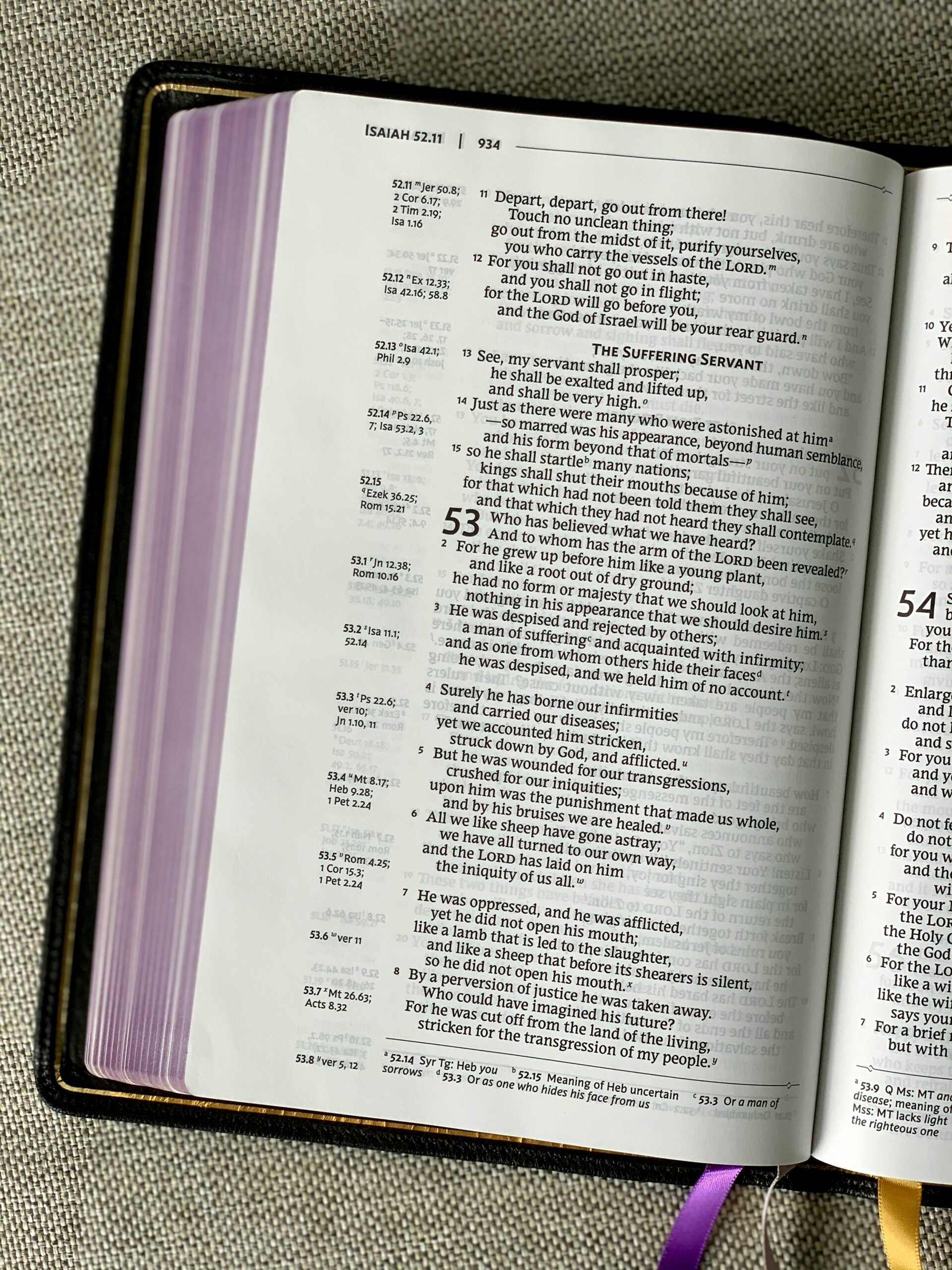
The Response to the Suffering Servant Pt3
This sermon explores Isaiah 55 as the appropriate response to the suffering servant described in the preceding chapters, emphasizing God’s direct invitation to salvation. The message highlights three distinct calls: an invitation to satisfy spiritual thirst through the free gift of grace, a challenge to abandon futile worldly pursuits in favor of true spiritual nourishment in Christ, and a promise of an everlasting covenant based on God’s faithful mercies. The preacher underscores that salvation is received purely by faith without cost, contrasting the emptiness of human efforts with the abundance found in God. Furthermore, the text illustrates the expansion of God’s kingdom to the Gentiles, fulfilling the promise made to David and demonstrating the universal scope of the gospel. The tone is both convicting and comforting, urging listeners to recognize their spiritual need and respond with humble faith to God’s gracious offer.
Transcript
We are drawn again to the general
vicinity of Isaiah 53. If God’s people would begin turning
there. We’ve actually been considering
the subsequent chapters that deal with our response to the
suffering servant spoken of in Isaiah 53. Isaiah, the prophet,
issued this prophecy some 700 years before Jesus was born. But his message is a very clear
and detailed announcement of the Messiah, Jesus Christ. If you’ve made your way to Isaiah
53, what I want to ask you to do, you’re almost there. Please
scroll backwards, if you would, to Isaiah 52 verse 13 if you’ve been with us the past
few weeks you already know why I’m having you track backwards
Isaiah 53 is a poetic Articulation about the Messiah the fourth
of such songs but in the first verse of this song Isaiah The
first verse of this song, rather, begins in Isaiah 52, 13, and
I want to take it in full once more. Isaiah 52, verse 13, or
the first thing that Isaiah tells us, he tells us about the servant’s
astonishing reception. Behold, my servant will prosper. He will be high and lifted up
and greatly exalted. Just as many were astonished
at you, my people, so his appearance was marred more than any man,
and his form more than the sons of men. Thus he will sprinkle
many nations. Kings will shut their mouths
on account of him, for what had not been told them they will
see, and what they had not heard they will understand. That opens
up into Isaiah 53, into the servant’s astounding rejection. Verse one,
who has believed our message and to whom has the arm of the
Lord been revealed? For he grew up before him like
a tender shoot and like a root out of parched ground. He has
no stately form or majesty that we should look upon him, nor
appearance that we should be attracted to him. He was despised
and forsaken of men, a man of sorrows and acquainted with grief
and like one from whom men hide their face. He was despised and
we did not esteem him. The servant’s astonishing reception,
the servant’s astounding rejection, and thirdly, the servant’s amazing
suffering. We see it in verses four through
six. Surely our griefs he himself
bore and our sorrows he carried, yet we esteemed him, we ourselves
esteemed him stricken, smitten of God and afflicted. But he
was pierced through for our transgressions. He was crushed for our iniquities. The chastening for our well-being
fell upon him, and by his scourging, we are healed. All of us, like
sheep, have gone astray. Each of us has turned to his
own way. But the Lord has caused the iniquity
of us all to fall on him. The fourth section in verses
seven through nine is the servant’s awful death. He was oppressed
and he was afflicted, yet he did not open his mouth like a
lamb that is led to slaughter and like a sheep that is silent
before its shearers. So he did not open his mouth.
By oppression and judgment, he was taken away. And as for his
generation, who considered that he was cut off out of the land
of the living for the transgression of my people to whom his, pardon
me, to whom the stroke was due? His grave was assigned with wicked
men, yet he was with a rich man in his death because he had done
no violence, nor was there any deceit found in his mouth. And
the fifth and final section, beginning in verse 10, the servant’s
awesome sacrifice. But the Lord was pleased to crush
him, putting him to grief. If he would render himself as
a guilt offering, he will see his offspring. He will prolong
his days, and the good pleasure of the Lord will prosper in his
hand. As a result of the anguish of
his soul, he will see it and be satisfied. By his knowledge,
the righteous one, my servant, will justify the many as he will
bear their iniquities. Therefore, I will allot him a
portion with the great and he will divide the booty with the
strong because he poured out himself to death and was numbered
with the transgressors. Yet he himself bore the sin of
many and interceded for the transgressors.” Those words, as you know, are
some of the most well-known in the Bible. because they tell
us about the suffering that our Savior endured on our behalf. Articulated in these five stanzas
are those things that Jesus endured for his people, the people for
whose sin he was atoning. Of Christ’s apostles, we know
only John witnessed the crucifixion. But it’s almost as if Isaiah
were there side by side with John as he witnessed Christ’s
arrest and his trials, his abuse, and the mocking, and ultimately
his crucifixion. But Isaiah wasn’t present at
Christ’s earthly ministry. The description in these verses
is divine prophecy regarding the Messiah’s atonement for sin.
is what it cost our Lord to pay for the sin of the world. Although
we understand Isaiah 53, that it’s prophecy about Christ’s
suffering and redemption, the subsequent chapters remain for
so many people unknown. We begun to study and examine
Isaiah 54 and 55, which we see are a proper response
to the words of Isaiah’s prophecy in 53. It’s our desire to respond
to these words appropriately. And this is Isaiah’s focus in
the two chapters that follow, a proper response to the suffering
Savior. Now thus far, we’ve only considered
chapter 54, a chapter that initiates a fitting response to the incredible
work done by a glorious Savior. In 54, one through six, we saw
that a proper response to the suffering servant produces joy
in redemption. There in 54, Isaiah uses a dramatic
word picture to present a contrast. A formerly barren woman representing
the lonely, godless world, now blessed beyond measure with the
knowledge of the Savior. Isaiah calls for a response to
this change. Shout for joy. Break forth into
joyful shouting. The reception of the gospel,
largely from the heathen world, will be massive. So great is
the response to the Messiah that Isaiah illustrates that her tent
will have to be enlarged. And gone is the fear, the shame,
the humiliation that the heathen world has known. Their Redeemer
is their creator, the Holy One of Israel. And as we observed
the second feature in Isaiah 54, not only does a right response
to the suffering servant produce joy and redemption, it provides
assurance and reconciliation. This is what we considered last
Lord’s Day. We noted that there were four
of these assurances. In verses seven and eight, we
see an assurance of mercy. that although God was angry,
he has now shown the most practical compassion. In verses 9 and 10,
Isaiah tells of an assurance of peace, a promise as sure as
that which God gave to Noah, that he would never again flood
the earth. In verses 11 through 13, we saw
that Isaiah presented a third assurance, an assurance of spiritual
blessing. a promise of glory and grace
bestowed upon his church. And then finally, in verses 14
through 17, we saw that Isaiah sets forth a final assurance,
an assurance of security, that as his people, we will be established
and even the gates of hell shall not prevail against his church.
Well, that brings us to Isaiah chapter 55, where The prophet
has two additional elements in this proper response to a suffering
servant. If you’re there in 55, glance
down, we’ll take only the first five verses. Ho, everyone who thirsts, come
to the waters, and you who have no money, come, buy, and eat. Come buy wine and milk without
money and without cost. Why do you spend money for what
is not bread and your wages for what does not satisfy? Listen
carefully to me and eat what is good and delight yourself
in abundance. Incline your ear and come to
me. Listen that you may live. and
I will make an everlasting covenant with you according to the faithful
mercies shown to David. Behold, I have made him a witness
to the peoples, a leader and commander for the peoples. Behold,
you will call a nation you do not know and a nation which knows
you will not, pardon me, a nation which knows you not will run
to you. because the Lord your God, even
the Holy One of Israel, for he has glorified you. What we notice immediately in
these verses is that a proper response to the suffering Savior
is a response to the invitation to saving faith. He has told
of the suffering servant in Isaiah 53. He has masterfully illustrated
the overwhelming reception to the Messiah that he’ll receive.
He has outlined the assurances that God provides. All that remains
is a direct invitation. And that’s what Isaiah provides
in chapter 55, verses one through five. It’s an invitation to draw
near to God. And what he provides here are
three distinct echoes of a call to salvation. Would you glance
down at verse one? The first has this suggestion
of commerce, buying and selling. Verse one, ho, everyone who thirsts
come to the waters. As we begin to consider this
remarkable chapter of scripture, we immediately notice that it’s
not just a unique opening, but a particularly arresting opening. Ho, everyone who thirsts, come
to the waters. And I would place that stunning
opening line right alongside other prominent opening sentences
of scripture. Genesis 1, in the beginning,
God. Psalm 23, the Lord is my shepherd,
I shall not want. Romans 8, therefore there is
no condemnation for those who are in Christ Jesus. These words
from God himself immediately suggest that he has something
important for us to hear and that it is by God’s design. It is meant to grab the attention
of the readers to awaken them out of spiritual slumber. It
calls us to pause. It calls us to stop what we’re
doing and attend to this message. That if we are among those who
thirst, he offers a remedy. There’s a plaintiff, compassionate,
merciful tone to these words. It’s a heart-wrenching situation
to which he’s speaking. It’s our situation as sinners. And so it’s an urgent plea. Oh,
he calls for our attention. And with a heart of compassion
couched in a tone of pity, he pleads for them to come to the
only means of redemption. Isaiah here employs a description
of one of the greatest human desires, the most common, something
to drink. Thirst and hunger are two of
the most intense and at times distressing of all human desires. Thirst is one of the most basic
sensations and at the same time one of the most serious. It’s
an often intensifying desire and most of you know that as
soon as we recognize that we are thirsty, it’s an indication
that we are already dehydrated. It’s a serious situation. But
here in verse one, the Lord’s purpose is not to encourage us
to satisfy some physical desire with a drink of water, but rather
it’s spiritual thirst that he’s discussing. And this illustration
of spiritual thirst is spoken of often in God’s word, Psalm
42. As the deer pants for the water
brooks, so my soul pants for you, O God. When shall I come
and appear before God?” Here, the psalmist paints this poetic
picture of the individual’s deep longing for God, the giver and
the sustainer of life. For the psalmist, there is a
joyful longing that will not be satisfied until he has communion
with God himself. David expresses the same thought
in Psalm 63 verse 1. Oh God, he says, my soul thirsts
for you. Jesus expressed this same idea
when he cried out in John 737, if anyone is thirsty, let him
come to me and drink. I want you to be very clear on
this. I want you to hear me. Because spiritually speaking,
all people are dehydrated. But while the effects of sin
have touched all mankind, all are truly in perilous condition
outside of Christ, not all are perceptive of their spiritual
condition. Not all are even aware that they’re
dehydrated, thirsty. There isn’t a single soul who
is not spiritually needy, but outside of Christ, we’re all
spiritually dehydrated. But we have to come to a point
where we recognize our thirst. The sad thing is most people
don’t even know they’re dehydrated, spiritually speaking. They’ve
learned to ignore their thirst. They’re drowning in the world’s
enjoyments or self-satisfied in their perceived goodness.
They don’t sense their spiritual thirst. They don’t know how thirsty
they are. But for those who do thirst,
Those who do recognize their condition, who do know that they
are thoroughgoing sinners in desperate need of divine assistance,
thirsty. They long for a supply of grace
that up to this point they’ve only tasted. God’s grace is distilled
in every good thing that we’ve ever experienced on earth. Most
people know of God, simply by being alive. But it’s been but a taste of
God’s grace, nothing more, like a drop of water on a parched
tongue. And so these individuals long
for the overflowing rivers of God’s grace. They long for salvation. They long to be forgiven. They
hunger for righteousness, to be welcomed into God’s holy presence. They desire with everything in
them to be right with God. They thirst. And so God calls
to any and all who thirst, come to the waters. Come and have
their intense desire satisfied. Of course, in a section of scripture
so full of rich themes and imagery, this cannot simply be literal
water. that he’s offering because it’s
not literal thirst he’s addressing. He’s calling his hearers to that
same living water that Jesus offered the woman at the well.
The free gift of eternal life through faith in Jesus Christ.
He invites the sinner to come and to be refreshed by spiritual
blessings, redemption, forgiveness, God’s own righteousness. Jesus
offered that woman at the well the same blessing, living water. And the offer here is as broad
as the ocean. Whoever is thirsty, everyone
who thirsts, there’s an infinite supply available. And so the
offer is to everyone. It’s not limited to any one nationality,
nor to the powerful, nor to the wise, nor to the wealthy, but
to everyone. Jesus echoes this same gracious
call, Matthew 11, 28. Come to me, all who are weary
and heavy laden, and I will give you rest. So God says, ho, everyone who
thirsts come to the waters. Do you see the simplicity in
this? This is the heart of the gospel.
This is God’s invitation to downtrodden, hopeless, burdened sinners. To
the spiritually thirsty, he says, come. To the one who has tried and
failed at every so-called remedy, every device under the sun, devices
that fail in their attempts to quiet the conscience and quell
our thirst, to that person, God says, come. Isaiah only intensifies
his call here in the second statement of verse one. You who have no
money, come buy and eat. Come buy wine and milk without
money, without cost. Come, come, come. Three times, he says. And here
he speaks even to the poor. And he intentionally creates
this kind of engaging conundrum. Though he’s speaking to those
who have no money, he tells them to come and buy. And he doubles
down on this puzzle. Come and buy wine and milk without
money, without cost. And so water, the basic sustaining
element of life, wine, the symbolic of the enjoyment of life, milk,
the basic nourishment of life, all of them combined to refer
to spiritual blessings. Everything we need is offered
and we may buy it for nothing. It’s an intentional riddle. He
wants his reader to wrestle with this equation. How can I come
and buy if I have no money? And the answer to that, the only
possible answer is grace, God’s grace. God’s grace has already
supplied it all so that no matter how poor you are, you can buy
it. No matter how wealthy you are,
you cannot receive it unless you accept it as a gift. All that the thirsty sinner has
to do is to come with open hands and receive. Everything is free. You know what? If God were to
put a price on salvation, $29.95 or $1,000, people would be thronging to
get into the church because it would meet people’s idea of an
exchange, something that they could do to contribute to their
salvation. That is the thinking of the natural
man. What must I do to gain eternal
life? But if you tell people that salvation
is free, that God’s gift is received by faith and only by faith, most
people want nothing to do with it. But that’s what God says
here, come by without money. This is not simply an offer of
a cool drink of water to a weary traveler. It’s an utterly unlimited
shopping spree, totally free of charge. God mentions here
wine and milk only, but they stand for the completeness of
what God gives to the thirsty soul. Every kind of provision,
all those things that figure in meeting our spiritual needs. God, first of all, calls us to
faith in the suffering servant, his son, Jesus, purely by faith,
not by any price. Secondly, the second thing we
notice about this passage, the second distinctive echo in this
call to salvation is an illustration of nourishment. Not surprising. Look at verse two, why do you
spend money for what is not bread and your wages for what does
not satisfy? Listen carefully to me and eat
what is good and delight yourself in abundance. God now challenges
those who, remember, have no money. They’re out of money,
broke, as Isaiah tells us in verse one, but look here at what
he says. What little money they do have
has been squandered on foolish things. Here the Lord changes his illustration
somewhat from water to bread. And it’s an illustration of another
of life’s basic necessities. Bread, but notice what is already
transpired. Those addressed are broke because
they’ve squandered what they had on emptiness, junk food,
and the like. Instead of purchasing bread,
they opted instead for what is not bread. The image here is
that of a foolishly spending money, wages. It indicates that
it’s not just a quick shopping trip with their last handful
of change. This is a lifestyle. A lifestyle
that is frittered away opportunities and time and resources all in
the course of vain pursuits. It’s a wholehearted life effort
seeking after that which can never satisfy. That’s what he’s
pointing to. Such individuals spend themselves
poor and they wear themselves out all for things that are utterly
unsatisfying. worthless. I would suggest to
you that this so-called bread, bread that is no bread at all,
bread that does not satisfy, could easily be summed up under
two headings. There are sinful things that
are pursued. There are pursuits which at their
very core are sinful and can never satisfy what only God can. Everything about them is sinful.
The means and the particulars, the end, the effects, all of
it. And of all that so-called bread,
it turns out that it’s no bread at all. Not only sinful things
that can be pursued, but good things pursued to sinful excess. or their pursuit in place of
the greatest supply, which is no other than God himself. This
is the life that is spent in pursuit of pleasing the God of
self. Self-serving, indulgent, self-centered,
self-pleasing. This so-called bread will in
the end be utterly unsatisfactory. We’re immediately reminded of
the parable of the rich man Luke chapter 12, the land of a rich
man was very productive, remember? And he began reasoning to himself
saying, what shall I do since I have no place to store my crops?
Everything was about him. Then he said, this is what I
will do. I will tear down my barns and build larger ones.
There I will store all my grain and my goods. I will say to my
soul, soul, you have many goods laid up for many years to come.
Take your ease, eat, drink, and be merry. But God said to him,
you fool. You ate bread, which is no bread
at all. This very night your soul is required of you, and
now who will own what you have prepared? You see, we not only
pursue sinful things, we pursue things to sinful excess. There is a kind of bread, God
says here, that is no bread at all. These things do not, cannot
nourish the soul. And not only do they not satisfy,
they make us only hungrier still to where we’re never satisfied. And so at the end of verse two,
the Lord challenges such behavior and he offers a change of course. Real, plentiful, nourishing,
Bread. He says, listen carefully to
me. Eat what is good and delight
yourselves in abundance. God says here, listen carefully
to me. And the clear and simple admonition
is eat what is good. This sounds so much like grandmother’s
advice, doesn’t it? But what he’s calling us to is
to a relationship with God himself through his Messiah, the Lord
Jesus Christ, which he had provided. He says you’ve had enough non-bread. You’ve had enough of that which
is called bread, but is no bread at all. It’s not nutritious.
It’s not spiritually beneficial. Come eat real bread. Not food that is merely packaged
well and marketed well, smells good, looks good. But come eat
that which is by nature good, truly good. Get the best spiritual
food possible and eat everything. Get the best spiritual food and
enjoy the feast of that which endures to eternal life. In other
words, once we know where to look, get food, get real spiritual
food, and feast on it. God calls us
to faith in the suffering servant, his son, the Lord Jesus, purely
by faith, and he calls us to spiritual nourishment. a relationship
with God Almighty through his son, the Lord Jesus. There’s
a third thing that Isaiah points us to here in this passage, not
only this call to faith and a call to spiritual nourishment, but
a revelation of promise. And we find it in verse three.
Incline your ear and come to me, listen that you may live,
and I will make an everlasting covenant with you. According
to the faithful mercies shown to David, behold, I have made
him a witness to the peoples, a leader and commander for the
peoples. Behold, you will call a nation you do not know, and
a nation which knows you not will run to you. Because of the
Lord your God, even the Holy One of Israel, for He has glorified
you. This is a very dynamic point
that God is making here. We’ll take our time with it.
Notice here, first of all, that it’s God himself beckoning people
to himself. And he speaks to all who know
that they are spiritually thirsty and hungry. This time, God issues
his call, not by the sensations of thirst or hunger, but by focusing
on the instrument of hearing. Incline your ear. Listen. Though the appeal is different,
the urgency is the same. Certainly, there can be no response
to God’s invitation without first hearing the divine call. Faith,
Paul says, comes by hearing and hearing by the word of Christ.
Romans 10, 17. But now, instead of the more
symbolic and vague promises of water and bread, God clarifies
this entire discussion by offering the promise of life. Listen, he says, that you may
live. Life, so often in scripture,
is life in the greatest sense. Spiritual wholeness, grace, forgiveness,
joy. And quite literally here, the
form of the word indicates a being revived, brought back to life. God calls the sinner to life,
new life. And based on the context, This
new life is not just a better version of life, nor is it extended
years of our present life. God is referring again to salvation,
spiritual life. God’s reasoning is that to ignore
this offer is to remain in peril. But listen and respond favorably. To listen and respond favorably
is to come to know life itself, life as it was intended, eternal
life. This is the declaration of the
gospel. This is the offer of life. Jesus,
the bread of God, John 6, 33, gives life to the world. By believing, John 20, 31, we
have life in his name. Paul tells us in Romans 5, 18,
that through one act of righteousness, Christ’s death on the cross,
there resulted in justification of life to all. He offers us
life, spiritual life, everlasting life. And the attending promise
here in verse 3 is that this offer of life is an offer of
an everlasting covenant with God. The covenant, as we’ve seen
many times, is a divine arrangement. It’s not a man-made agreement.
We don’t negotiate with God on this matter. This covenant of salvation is
on God’s terms. And here it’s spoken of as a
promise which God himself is offering by way of a covenant,
a new covenant. And here God makes the promise
to be a protection and care for his people. No longer exclusively
to the Jewish nation, but to all who will incline their ear
to him. This promise is extensively described
here from the end of verse three all the way through verse five.
Would you glance down at that third line of verse three for
just a moment? For all who will incline their
ear of faith to God’s promise of life, God extends a promise. God says that for all who respond
to his suffering servant, Jesus Christ, in faith, he makes an
eternal pact with them. A promise that can never be broken.
And this is a promise or a covenant that God has already made and
communicated. It’s a promise that is extended,
as God says there at the end of verse three, according to
the faithful mercies shown to David. It’s that promise about
which God speaks here. It’s the mercies that he mentions
refer to those things which orient from God’s kindness, compassion,
his grace. And He calls them here His faithful
or sure mercies because they’re certain. They’re immovable. They’re fixed. They can never
be taken away from us. It’s something in which we can
trust. It’s God’s promise of salvation, which will not be
withdrawn. The promise to David there in
2 Samuel 7. When your days are complete and
you lie down with your fathers, I will raise up a descendant
after you who will come forth from you. I will establish his
kingdom. He’s pointing to the Lord Jesus
Christ. He shall build a house for my
name. I will establish his throne, the throne of his kingdom forever. The same passage. from here in Isaiah 55.3, that
same passage is quoted in the book of Acts. There, Luke records
one of Paul’s great sermons. In it, he’s preaching to the
Jewish leaders of Antioch. You may remember this. And he
tells them upfront that his message of salvation is indeed for the
Jewish people. Even though their brethren in
Jerusalem had largely rejected this good news, not only did
they reject the invitation to the Messiah, they rejected him
personally, condemning him, putting him to death, Paul reminds. And though this Jesus was buried
in a tomb, God raised him from the dead. which only served as greater
motivation for Paul to proclaim the gospel to them. And to these
Jewish leaders, Paul concludes that Christ’s resurrection was
the fulfillment of this very verse. I will give you the holy
and sure blessings of David. He’s talking about Christ, he’s
talking about our Messiah. God here uses the name David,
he’s pointing to the blessed promises to David’s line, ultimately
to the Messiah himself, the suffering servant, the Lord Jesus Christ. This promise pointed not only
to, not to David’s birth so much as it did to Christ’s resurrection. And his resurrection was the
ultimate proof that Jesus indeed was the Son of God. two weeks
ago, I suggested to you that because of the massive response
to the suffering servant, through the gospel of Christ, that these
chapters, 54 and 55, were referring to the massive ingathering of
nations, non-Jewish believers, Gentiles. And that’s exactly
what is communicated here. It was prophesied. Would you
look at verse four, when God says here, behold, I have made
him, David, a witness to the peoples, a leader and commander
to the peoples. This was always God’s plan, to
proclaim Christ to the nations, to introduce them to the Messiah.
His use of the phrase here, the peoples, in plural, points specifically
to other nations in addition to the Jews, heathen, non-Jewish,
Gentile. And his suggestion here is that
David had been set before the world as a leader and a commander
to be a witness for God to these nations. And to these additional
people, these additional nations, the suffering servant, Jesus
Christ, will be a leader and a commander of their salvation.
Jesus will be to them a sovereign king and a ruler, such as he
was promised. God underscores this point. Would
you just glance at verse five? He closes out this section by
speaking directly to his servant, the Messiah. That is the Lord
Jesus Christ, and he assigns him a mission. Glance down at,
if you would, at verse five. Behold, you will call a nation
You do not know, and a nation who knows you not will run to
you. Christ’s mission is that he would call a nation, call
a people that at present is not intimately known to God. He is speaking of the entire
non-Jewish Gentile world. And he says that salvation will
be opened to all, every tribe and tongue and people and nation.
They have been, as Paul speaks to them in Ephesians 2, been
strangers to the covenants of promise. But God will be worshipped. And
if one people group rejects him, even if only temporarily, he
will open the door of his kingdom to others. When God called, when
he by the gospel called people to himself, he
beckoned them, summoned them. This previously unknown nation
responded. God issues a divine summons and
they respond in faith. Jesus illustrated this prophecy
with the parable of the wedding feast, remember? Matthew 22.
When the initial guests rejected the invitation by this king,
God sought to fill his banquet hall with other guests. He said,
go therefore into the main highways and as many as you find there,
invite to the wedding feast. Our verse here tells us that
this nation of Gentiles God did not lovingly know them, nor they
Him. But that was all about to change.
When God called them through the offer of the gospel, they
jumped and ran to the offer of salvation. They ran, not from Him, but to
Him. Because it was the Lord your
God, the Holy One of Israel, who was calling them. They were
once outsiders, strangers, but now they ran and embraced the
free offer of salvation. For some of us who have been
Christians for many years, we may have forgotten this sentiment.
That when we first heard the gospel message, how quickly,
how passionately we responded to the offer of salvation. almost
as if we might miss the offer. God calls us to faith in the
suffering servant, his son, the Lord Jesus, to come purely by
faith. There is no cost. He calls us
to his servant for spiritual nourishment, the only kind of
nourishment we could ever need. And God calls us as a fulfillment
of a promise. Would you humble yourself before
him as we ponder these things?
Messages: 6