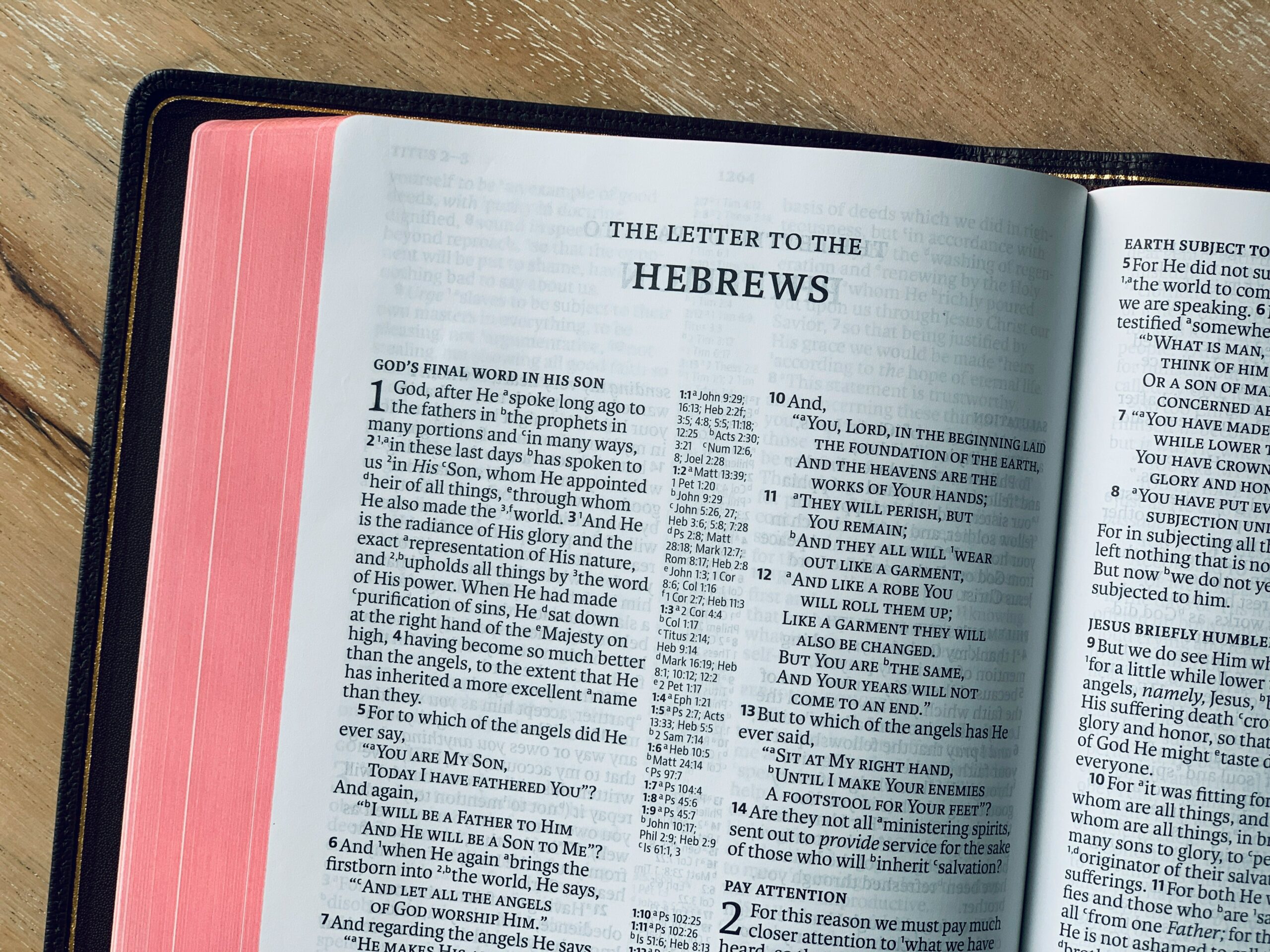
Approaching His Holiness
This sermon explores the theological foundation for Christian confidence in approaching God, rooted in the superior priesthood and atonement of Jesus Christ. It contrasts the limited access of the Levitical system with the new and living way opened by Christ’s sacrifice, which tore the veil of separation. The central message urges believers to draw near to God with full assurance of faith, recognizing that their access is secured not by their own merit but by the finished work of Christ. The tone is both instructional and encouraging, emphasizing that believers now have direct, intimate fellowship with a holy God. This exhortation calls for a sincere heart and a clean conscience, reflecting the transformative power of the new covenant.
Transcript
All right, we turn again, if
you would, to Hebrews chapter 10, and I know just that will
be a bit of a shock to you. We’ll get there in just a few
moments. We’re in the midst of our study,
Enduring Admonitions, and we have long since determined that
these admonitions are for us and that if we are to glorify
Christ in the midst of a trial, whether it’s as first century
Christians facing the destruction of our city or whether it’s as
modern day Christians facing this pandemic, if we are to glorify
Christ in the midst of a great trial, we must not only listen
to the one who is greater than angels, come to the one whose
salvation is greater than that of Moses, draw near with confidence
to the throne of grace. But as we learned last week,
we are to glorify Christ in great trial by becoming spiritual adults. Now, as we leave off Chapter
6, In this church, many people might
be alarmed when I suggest that we’re going to leapfrog all the
way into chapter 10. I just ask you to bear with me
and allow me to explain first. People sometimes have a misunderstanding
about expository preaching, exactly what expository preaching is.
I am. firmly committed, by the way,
to expository preaching, but expository preaching does not
necessarily mean verse-by-verse preaching sequentially through
an entire book. Expository preaching has more
to do with the source of the message, and is it exegetically
derived than either the scope how much of Scripture is preached
or the trajectory of a given message. In other words, a single
message can be considered an exegetically derived expository
sermon even though it is given in a single occasion without
any prior or subsequent message. We can work our way through a
book, dipping in here and there with varying degrees of depth,
and still be faithful to the text. Allow me to remind you
for just a moment of the nature of our approach in this study
of Hebrews. We did not set out to do a verse-by-verse,
line-by-line study through the entirety of the letter. Instead,
we built our study on the admonitions in this book, particularly what
we’ve identified as subjunctive verbs. Our study, you will now
recall, is enduring admonitions. And our study of this incredible
letter is built on admonitions or encouragements written to
first century believers and ultimately aimed at us as well. But as the
writer, by the Spirit, would have it, there are virtually
no admonitions in chapters 7 all the way through chapter 1018. No imperatives, no commands,
no exhortations, No subjunctive encouragements, just a glorious
supply of wonderful and sound doctrine. Again, from 7.1 all
the way through 10.18. In fact, our next admonition
isn’t found until chapter 10, verses 19 through 22, and that’s
where we’re heading this morning. But that doesn’t mean that chapters
7, 8, 9, and the early part of 10 are unimportant. They are
vitally so. They are the very foundation
upon which this next admonition rests. Our goal is not a verse
by verse exposition of every word of this epistle, but the enduring admonitions. But in order to fully grasp our
next admonition found, as I said, in chapter 10, verse 19 through
22, we have to inspect the foundation, the foundation upon which this
admonition is established. And so if you would, if you’re
in chapter 10, please turn back several chapters actually to
chapter six, Remember how it ended? A writer is encouraging
his readers to spiritual maturity, and he draws to a close in that
great exhortation in verse 19 of chapter 6. This hope we have
as an anchor for the soul, a hope both sure and steadfast, and
one that enters within the veil where Jesus has entered as a
forerunner for us, having become a high priest forever, according
to the order of Melchizedek. Now remember that his concern
here was that he wanted to tell them about the deep things of
God, including Christ’s relationship to Melchizedek, but he feared
that he would overwhelm them because of their underdeveloped
spiritual condition. And so he purposes, even in chapter
6, to press on to those things, he will get to them, But in chapter
7, ultimately, he takes up this subject. And while we may not
do an in-depth, verse-by-verse study of these chapters, we can
read them. And with only the briefest comments,
look at Hebrews chapter 7. And it fits the pattern of where
the writer has been all along. He has alluded to Melchizedek
already, but our writer begins to tell us about Melchizedek’s
priesthood in chapter seven. For this Melchizedek, king of
Salem, priest of the most high God, this was a priest of the
highest God. a man functioning in the priesthood
to Almighty God himself, a real God. This was not idolatry. This is the true and living God
and he was functioning as a priest. He had that kind of a relationship
with Almighty God. This priest of the Most High
God who met Abraham as he was returning from the slaughter
of the kings and blessed him. to whom Abraham appointed a 10th
portion of all the spoils. He tithed to Melchizedek. He was, first of all, by the
translation of his name, King of Righteousness, and then also
King of Salem. You can read all about this in
Genesis 14. It won’t take you very long,
a mere eight verses. He is King of Salem, which is
King of Peace, the King of Righteousness and the King of Peace, without
father, without mother, without genealogy, having neither beginning
of days nor end of life, but made like the Son of God, he
remains a priest perpetually. Then we have the greatness of
Melchizedek’s priesthood. to whom Abraham gave a tithe. Now observe how great this man
was to whom Abraham, the patriarch, gave a tenth of the choice’s
spoils. And those indeed of the sons
of Levi who received the priest’s office have commandment in the
law to collect a tenth from the people, that is, from their brethren. Although these descended from
Abraham, but the one whose genealogy is not traced from them collected
a tenth from Abraham and blessed the one who had the promises.”
In other words, he’s presenting Melchizedek as a superior figure
to Abraham. Without any dispute, the lesser
is blessed by the greater. In this case, mortal men receive
tithes, but in that case, one receives them, of whom it is
witnessed that he lives on. And so to speak, through Abraham,
Levi, who by the way, was not yet even born, Levi, who received
tithes, paid tithes, for he was still in the loins of his father
when Melchizedek met him. And here the writer begins to
put the Levitical priesthood in perspective. It was limited. Look at verse 11. Now, if perfection
was through the Levitical priesthood, for on the basis of the people
received the law, what further need was there for another priest
to arise according to the order of Melchizedek and not be designated
according to the order of Aaron? In other words, he says, what
is the point of Christ showing up on the scene anyway? Jump
down, if you would, to verse 15. And this is clear still,
if another priest arises according to the order, likeness of Melchizedek,
who has become such, not on the basis of law, of physical requirement,
but according to the power of an indestructible life.” His
point here is that Christ was not a Levitical priest. He didn’t
fit the mold, he wasn’t in the family line, but he did fit the
mold of Melchizedek’s priesthood. Jump down again to verse 20,
and as much as it was not without an oath, for they indeed became
priests without an oath, But he with an oath through the one
who has said to him, the Lord has sworn and will not change
his mind. You are a priest forever. So much more. Also, Jesus has
become the guarantee of a better covenant. The former priests
on the one hand existed in greater numbers. There were many, many
scores and thousands of Levitical priests. because they were prevented
by death from continuing. They had to continually be replenished. But Jesus, on the other hand,
because he continues forever, holds his priesthood permanently. Verse 25, therefore, he is able
to save forever. And this particular verse is
of special significance to me because I believe this was the
very first verse in its entirety all the way through the end of
verse 27. This was the first verse that
I memorized as a young Christian. Listen to this, it’s profound.
Therefore he is able to save forever those who draw near to
God through him, since he always lives to make intercession for
them. For it was fitting for us to
have such a high priest, holy, innocent, undefiled, separated
from sinners, exalted above the heavens, who does not need daily,
like those high priests, to offer up sacrifices, first for his
own sins, and then for the sins of the people, because he did
once for all when he offered up himself. We’ll come back to
that thought in a moment. And so he introduces us to the
priesthood of Melchizedek and the likeness of Christ’s priesthood. It is an eternal priesthood.
It was bestowed by God, not given through the lineage as a Jew. We come to a second section in
chapter eight. having just pondered, been introduced
to Melchizedek, what the writer is going to do is tell us how
great Christ’s atonement is in comparison to the atonement that
was made through the offerings of these priests. We have an
introductory paragraph beginning in verse one of chapter eight.
Look at this. Now, the main point in what he
has said is this, we have such a high priest who has taken his
seat at the right hand of the throne of the majesty in the
heavens, a minister in the sanctuary and in the true tabernacle. In other words, he says that
Jesus has a temple. Jesus has a sanctuary. He has a holy of holies that
is superior by far to anything that the Jews ever had. a minister
in the sanctuary and in the true tabernacle, which the Lord pitched,
not man. For every high priest is appointed
to offer both gifts and sacrifices. So it is necessary that this
high priest also have something to offer. Well, the writer is
going to go on to tell us what Christ brought by way of an offering,
just like every priest would if he were to go into the Holy
of Holies. Verse four. Now, if he were on
earth, he would not be a priest at all. In other words, Jesus
wasn’t born into the family line. He wasn’t a Levite. You would
not be a priest at all, since there are those who offer gifts
according to the law who serve a copy and shadow of the heavenly
things, just as Moses was warned by God when he was about to erect
the tabernacle. See, foresee, he says, that you
make all things according to the pattern which was shown you
on the mountain.” Well, Christ didn’t fit the mold. He didn’t
fit the pattern, but God can override that pattern. He wants
to tell us three things about Christ in these chapters, the
rest of eight, chapter nine, and into chapter 10, a portion
of chapter 10. The first thing that he wants
to tell us is that Jesus Christ is the mediator of a better covenant,
a better covenant. Look at verse six. But now he
has obtained a more excellent ministry by as much as he is
also the mediator of a better covenant, which is enacted on
better premises. Now this shouldn’t have been
news, it shouldn’t have been shocking to the Jews to whom
our writer is writing, but the suggestion of a better covenant
was to most Jews utterly unthinkable, it shouldn’t have been. Jeremiah
prophesied it. And our writer here quotes a
good portion of Jeremiah 31, 31 through 34. If that first
covenant had not had been faultless, in other words, if it didn’t
have some inherent flaws, there would have been no occasion sought
for a second. We needed a new covenant is essentially
what he says. Finding fault with them, he says,
behold, days are coming when I will effect a new covenant
with the house of Israel, with the house of Judah, not like
the covenant which I made with their forefathers. A day is coming,
a new covenant is coming, and he sews up this argument after
quoting Jeremiah 31. He sews up the argument in verse
13. Glance down if you would. When
he said a new covenant, He has made the first obsolete. It’s
not like we need two covenants running at the same time. He
has made the first obsolete, but whatever is becoming obsolete. and growing old is ready to disappear. In other words, he says the covenant
has its time and its place and it is already passing away. Jesus
Christ is the mediator of a better covenant. But secondly, remember
I told you he wants to show us three things in these chapters
that essentially serve as the foundation for our admonition
this morning. Second thing that he tells us
is that not only is Jesus Christ the mediator of a better covenant,
Jesus Christ is the priest of a more perfect tabernacle. Look
at verse one of chapter nine. Now, even the first covenant
had regulations of divine worship in the earthly sanctuary. There
was a tabernacle prepared, the outer one, in which there was
a lampstand and the table and the sacred bread called the holy
place. And the writer is just basically talking, he’s preaching
to the choir. The Jews all know this. Behind
the second veil, there was a tabernacle, which is called the Holy of Holies,
having a golden altar of incense, the Ark of the Covenant covered
on all sides with gold. There wasn’t anybody to whom
he was writing that didn’t know these things, even from children’s
Sunday school. But jump down to verse six. Now,
when these things have been so prepared, the priests are continually
entering the outer tabernacle, performing the divine worship. But into the second, that is
into the Holy of Holies, only the priest enters, the high priest
enters once a year, not without taking blood, which he offers
for himself and for the sins of the people committed in ignorance.”
The Holy Spirit is signifying this, that the way into the holy
place has not yet been disclosed while the outer tabernacle is
still standing, which is a symbol for the present time. Accordingly,
both gifts and sacrifices are offered, which cannot make the
worshiper perfect in conscience. In other words, they were temporary.
They had to be repeated year after year since they relate
only to food and drink and various washings, regulations for the
body imposed for a time of reformation. They were temporary. They were
fleeting. But compared to Christ, Christ was the priest of a better
tabernacle. He’s the mediator of a better
covenant. He’s the priest of a better tabernacle. But thirdly, he is the sacrifice
of a better atonement. And remember, this is the whole
thrust of these chapters. Chapter 7, chapter 8, chapter
9, the entire design is to show Christ as presenting a better
atonement, a superior atonement to anything that had been offered
in times past. Look at verse 11 of chapter 9.
But when Christ appeared as a high priest of the good things to
come, he entered through the greater and more perfect tabernacle. And any Jew might have wondered,
I didn’t know there was. a greater, more perfect tabernacle. And that is exactly the purpose
of our writer, is to show them this more perfect tabernacle. What was it like? Well, he tells
them, not made with hands, that is to say, not of this creation,
and not through the blood of goats and calves, but through
his own blood, he entered the holy place once. for all, having obtained eternal
redemption. The pre-sacrifice had to be offered
year after year after year. Christ went in one time, not
to an earthly temple, but into the very throne room of God,
into the Holy of Holies in reality, not an image of what they would
enjoy in the future. Look at verse 13, for the blood
of goats and bulls and the ashes of a heifer sprinkling those
who have been defiled sanctify for the cleansing of the flesh.
How much more will the blood of Christ? This is what was taking
place year after year after year. Goats and bulls and heifers. And those cleansed the sinner
for a time But if those cleansed the flesh, how much more will
the blood of Christ? We have a savior who has made
a better atonement. For this reason, verse 15, he
is the mediator of a new covenant. So that since death has taken
place for the redemption of the transgressions that were committed
under the first covenant, those who have been called may receive
the promise of the eternal inheritance. This is our salvation. This is
the foundation of our salvation. Jump over to verse 18. Therefore,
even the first covenant was not inaugurated without blood. This
was nothing new for Christ to suffer. It fit the pattern of
what a high priest would do. Only Christ didn’t bring goats
or bulls. He brought himself to sacrifice. For the sake of time, if you
would zoom all the way down to verse 23, therefore, it was necessary. It was necessary for the copies
of the things in the heavens to be cleansed with these, but
the heavenly things themselves with better sacrifices than these,
for Christ did not enter a holy place made with hands, a mere
copy of the true one, but into heaven itself, now to appear
in the presence of God for us. Nor was it that he would offer
himself often as the high priest enters the holy place year by
year with the blood that is not his own, otherwise he would have
needed to suffer often since the foundation of the world.
But now, once, at the consummation of the ages, he has been manifested
to put away sin by the sacrifice of himself, and inasmuch as it
is appointed for men to die once, and after this comes judgment,
So Christ also, having been offered once to bear the sins of many,
will appear a second time for salvation without reference to
sin to those who eagerly await him. Christ is a better atonement. If you would, we come into chapter
10 But again, for the sake of time, I wanna go all the way
to verse five. Therefore, when he comes into
the world, he says, sacrifices and offerings you have not desired,
but a body you have prepared for me in whole burnt offerings
and sacrifices for sin, you have taken no pleasure. Then I said,
behold, I have come in the scroll of the book it is written of
me to do your will, oh God. This is Christ speaking. After saying above, sacrifices
and offerings, and whole burnt offerings, and sacrifices for
sin you have not desired, nor have you taken pleasure in them,
which are offered according to the law. Then he said, behold,
I have come to do your will. Not my will, but thine be done. He takes away the first in order
to establish the second. And he, brings this point home
beginning in verse 10. By this will we have been sanctified. By this atonement we will be
set apart for Christ. set apart for God through the
sacrifice of Christ. By this we will have been sacrificed
through the offering of the body of Jesus Christ once for all. Every priest stands daily ministering
and offering time after time the same sacrifices which can
never take away sins. But he, having offered one sacrifice
for the sins of all time, sat down at the right hand of God,
waiting from that time forward until his enemies be made a footstool
for his feet. For by one offering, he has perfected
for all time those who are sanctified. The Holy Spirit also testifies
to us saying, this is the covenant that I have made with them. After
those days, says the Lord, I will put my laws upon their heart
and on their mind, I will write them. And then he says, their
sins and their lawless deeds, I will remember no more. Now, where there is forgiveness
of these things, there is no longer an offering for sin. In
other words, Jesus Christ’s atonement was so perfect It was so much
better than any previous atonement that it never needs to be repeated.
That is the foundation. Christ is the mediator of a better
covenant. He is the priest of a better
tabernacle. He is the sacrifice of a better
atonement. And that leads us to our encouragement
here in chapter 10, beginning in verse 19. Chapter 10, beginning
in verse 19, where now this faithful friend, the writer of this grand
exhortation moves from the doctrinal to the practical. In the break
here, much like that in Ephesians, after three solid chapters of
doctrine, he turns to practical matters in Ephesians chapter
four, applying the truth that he had
taught to believers’ lives. Romans, same thing. After 11
chapters of solid doctrine, the most solid doctrine, I would
say, he turns in chapter 12 to practical applications of that
doctrine, and same thing here. After nearly 10 full chapters
of doctrinal theological instruction, he moves to the practical, to
what I would call lessons from the preeminence of Christ. lessons
from the preeminence of Christ, this latter half of the epistle
to the Hebrews answers the question, so what do we do with all that?
And immediately the writer here in these four verses, even by
this lead word, therefore, he moves to make immediate, profound,
and eternal use to his readers of this doctrinal foundation. And here, basically, he opens
the eyes of his readers and he urges upon them a confidence
in the finished work of Christ. A confidence so strong that it
reveals and deepens a new and different level of relationship
with their great God. It is important to note that
the exhortation, the enduring admonition here in these verses,
specifically verse 22, this admonition is not new. It’s repeated from
earlier admonitions, as we will see, but their Savior in whom
they have placed their faith, as we’ve already seen, is the
mediator of a better covenant, the priest of a better tabernacle,
the sacrifice of a better atonement, By his one sacrifice for sin,
he has opened up access to a holy God as never before. He has atoned
fully and finally for sin and restored a peace and a fellowship
with God which no man ever enjoyed, not even Adam. Because Adam did
not know the blessing of mercy. He didn’t get to experience God’s
mercy. Not like you and I. The Christian
now has access, ready access to almighty God, full and free
access, an open invitation to the very fellowship with the
creator himself upon his throne of grace. The Christian is now
welcomed in the holiest place. Look at verses 19 through 22. Therefore, brethren, since we
have confidence to enter the holy place by the blood of Jesus,
by a new and living way which he inaugurated for us through
the veil that is his flesh, and since we have a great high priest
over the house of God, let us draw near. with a sincere heart
and in full assurance of faith, having our hearts sprinkled clean
from an evil conscience and our bodies washed with pure water.”
This writer has shown himself again and again a faithful friend.
He has spoken some of the strongest words, warnings, exhortations,
admonitions ever recorded in scripture. But it is not out
of a harsh and heavy, unfeeling heart. These have been the words
of a faithful friend, or as he reminds them again here, a brother,
a brother in Christ. In Hebrews 3, he referred to
them as holy brethren, partakers of a heavenly calling. In chapter
3, verse 12, He urges them, take care, brethren, that there be
not in any one of you an evil, unbelieving heart. And now, instead
of putting his exhortation to them up front, he’s going to
build it. The culmination of his thoughts,
building towards his encouragement in verse 22. And this buildup
is really a summary statement of all that he has communicated
thus far. Look at the passage. Since we
have confidence to enter the holy place, since we have a great
high priest over the house of God, let’s look at the first. Since we have confidence to enter
the holy place, this confidence is the effect of faith. faith
in the finished work of Jesus Christ on the cross, what he
will go on to point out as the blood of Jesus, because of Jesus’
shed blood on the cross on our behalf, the Christian can boldly
and confidently draw near to not just a place, but to a person,
to that place where the holy God himself resides, the holy
place. Now this would have been radically
new to the Jewish believer. You and I may be steeped in this
idea of drawing near just any time we want, praying to God,
almost casually, even flippantly, barging into God’s presence.
Not the Jew. The Jew was afraid to even mention
God’s name. and would not think or dare to
enter into his holy presence, this was the high priest duty
and privilege alone. But now, because of our saving
relationship with the Son, our Savior, we come before that same
holy God with the utmost confidence. Paul spoke about it. In Ephesians
2, he came and preached peace to you who are far away and peace
to you who are near. For through him, we both have
our access in one spirit to the Father. It’s a privilege that
has now been extended to us to come into the Father’s presence,
to not only speak his name, but to address him, to call out to
him. Paul in Ephesians, spoke of it a second time in that letter. To me, the very least of all
saints, this grace was given to preach to the Gentiles the
unfathomable riches of Christ and to bring to light what is
the administration of the mystery which for ages has been hidden
in God who created all things so that the manifold wisdom of
God might now be made known through the church to the rulers and
the authorities in the heavenly places This was in accordance
with the eternal purpose which he carried out in Christ Jesus,
our Lord, in whom we have boldness and confident access through
faith in him. This might be familiar to us
now, but to a first century Jew, this was radically new. What a priceless treasure the
believer has. To have placed our faith in Christ,
we have the ability to come into God’s presence anytime, not as
an occasional guest or a visitor, but as a fully welcomed child
of God whose sins are paid for in full. Who belongs. He belongs in the presence of
God. Look at the passage again, verse
19, therefore brethren, since we have confidence to enter the
holy place by the blood of Jesus. If you’re not a Christian, you
can’t come. You can’t go there. But if you’ve placed your faith
in Christ, in the finished work of Christ, in the sacrifice of
Christ on the cross for your sin, look at verse 19, he says, our confidence
is not in our upbringing, Our confidence is not in our youthful
good looks, it’s not in our power, whether physical or political
or social, it’s not in our goodness, whatever that is, but our confidence
is directly by means of, by way of, made possible by the blood
of Christ, the blood of Jesus. This is the clear case that the
writer has been making all throughout, which we just read, Hebrews 9,
remember? Through his own blood, he entered
the holy place once for all, having obtained eternal redemption. Hebrews 9, 28, Christ also having
been offered once to bear the sin of many. Hebrews 10, 12,
he having offered one sacrifice for sins for all time, sat down
at the right hand of God. Our confidence. Our confidence
to approach God rests solely on our faith, the perfected,
completed, and infinitely finished work of Christ, never needing
to be repeated. He says that this approach, this drawing near, This confidence
that we have is by a new and living way, verse 20. And depending
on our religious background, we may have tried different ways
of access to God in the past. Religion, as I said, ritual and
works. But the Jew knew one way, the
old way of the law. His way was the way of the priest,
preserving what very limited relationship he had with God.
But now a writer tells them there is a new and living way, a new
way and a living way. And by new, he means what we
might mean by the use of that word fresh, recent, previously
unused, To the Jew, this way was especially new and different. But even for the non-Jew, this
way was radically new. Never before was this access
to God open, not to Jews or Gentiles. No one had ever such a free and
open access to a holy God as believers do now. in their justification
by faith and their ability to stand before a holy God because
of what Christ has accomplished. Hebrews chapter nine, which verse
we read the Holy Spirit is signifying this, that the way into the holy
place has not yet been disclosed while the outer tabernacle is
still standing. But when Christ appeared as a
high priest of the good things to come, He entered through the
greater and more perfect tabernacle, not made with hands, that is
to say, not of this creation. And not through the blood of
goats and calves, but through his own blood, he entered the
holy place, once for all having obtained eternal redemption. And note that it’s not only new,
it was new to the Jew, it was new, it was new to humanity. But it’s not only new, it’s living. It’s not a temporary fix that
God made, but it’s a perpetual change to the way that God will
be approached. It is through his son, the Lord
Jesus Christ, alone, just as John recorded of Christ in his
gospel. John 14, you know the way where
I’m going. Thomas said to him, Lord, we
do not know where you are going. How do we know the way? Jesus
said to him, I am the way. And the truth and the life, no
one comes to the father. But through me. And a writer
uses additional imagery here in verse 20 that would have deeply
resonated with the Jew. The veil of the temple. Look at the passage once again.
Therefore, brethren, since we have confidence to enter the
holy place, the holy of holies, by the blood of Jesus, by a new
and living way, which he inaugurated for us through the veil that
is his flesh. When the Bible says here inaugurated,
it speaks of a newness, a previously unused path as we’ve talked about,
a new and different way, a way that Jesus himself initiated. Jesus himself was the first to
walk this road. The place where he went was to
the very throne room of God and the access into the Holy of Holies
which on earth was protected by a curtain, had to be torn
in order for him to gain access. This imagery the Jew would have
known. But the writer metaphorically
here likens the veil of the temple to Jesus’ flesh. By offering
himself as a sacrifice for sinners, the veil of his flesh was torn,
and full access to God was opened. The writer of Hebrews has already
referenced this image, remember, from last week. Hebrews 6, 19,
this hope we have as an anchor of the soul, a hope sure and
steadfast, one which enters within the veil. past the veil, into
the Holy of Holies, our anchor is set. Little did we know then
that it was Christ that was torn in order for us to access that
veil. He would not have needed to explain
this image to the Jew. They all knew full well the veil
of the temple had suffered overwhelming destruction at the death of Christ,
Matthew 27. Listen just briefly, Matthew
27, 51. Behold, the veil of the temple was torn in two from top
to bottom, the earth shook, the rocks were split, the tombs were
opened, and many bodies of the saints who had fallen asleep
were raised. Coming up out of the tombs after his resurrection,
they entered the holy city and appeared to many. The tearing
of the veil in the temple was not only miraculous, it was symbolic. J.C. Ryle said of that event,
the miracle must have been as striking and terrible to the
priest who ministered in the temple as the darkness was to
the inhabitants of Palestine. It signified the opening of the
way into the holiest by Christ’s death. The passing away of the
Jewish dispensation and the revelation of the gospel way of salvation
to all mankind. And so he explains that miracle
here. The tearing of the temple and
the sacrifice of Christ on the cross were inextricably linked. And just as the temple curtain
was symbolically torn, exposing the Holy of Holies, so also Christ’s
death on the cross opened up the very presence of God. Christ’s Tabernacle was better. Christ’s covenant is better.
Christ’s atonement is better. But our writer is driving home
the point. He’s still building upon the
foundation. Look at verse 21. Not only do
we have confidence to enter the holy place, verse 21 says, since
we have a high priest over the house of God, is he your high
priest? That’s the question. Here’s the
second portion of our writer’s summary statement, not only since
we have confidence to enter the holy place, but also since we
have a great high priest over the house of God. We do have
a priest, a great high priest as he has been extolling from
the earliest portion of this Epistle, Hebrews 3.1, therefore,
holy brethren, partakers of a heavenly calling, consider Jesus the apostle
and high priest of our confession. Hebrews 4.14, therefore, since
we have a great high priest who has passed through the heavens,
Jesus, the Son of God, let us hold fast our confession. And
so he encourages his readers once again Draw near. Draw near. Draw near to God. Do not be repelled because of
His holiness. Draw near. To God, look at the
passage once again, therefore, brethren, since we have confidence
to enter the holy place by the blood of Jesus, by a new and
living way, which he inaugurated for us through the veil that
is his flesh. And since we have a great high
priest over the house of God, let us draw near. This is not a new encouragement.
We might even say that this is the great theme of this epistle,
draw near to God. As believers in Jesus Christ,
we now enjoy a free and open approach and a relational access
to almighty God himself. Here’s the rest of Hebrews 4. Therefore, since we have a great
high priest who has passed through the heavens, Jesus, the Son of
God, let us hold fast our confession, for we do not have a high priest
who cannot sympathize with our weakness, but one who has been
tempted in all things as we are, yet without sin. Therefore, let
us draw near with confidence to the throne of grace so that
we may receive mercy and find grace to help in time of need.
He echoes that thought. Again, in chapter seven, as we
read, he is able to save forever those who draw near to God through
him. That’s why I memorized that verse. That was such happy, good
news to me, to a sinner. He is able to save forever those
who draw near to God through him. He echoed it again in chapter
10, verse 1. The law can never make perfect
those who draw near. You need a new way. This too would have been an unfamiliar
privilege to the Jew. They would draw near only in
so far as they could. They would walk on eggshells
on their way to the temple and come only so far as they could.
Only the priest could draw near into the Holy of Holies. They
could come to the sanctuary, but they could not come into
the sanctuary. They could come near the fellowship
of God, but they could not enter into fellowship with God. But
now as Christians. As those who have placed their
faith in the finished work of Christ, we have full access to
God. We can draw near in intimate
fellowship and all that without a priest. And so his exhortation
is simple. Much more clear than it was earlier
in chapter four. It is an active worship to come
into God’s presence, to express our love and gratitude to him,
to make our appeals for grace as he exhorted in chapter four. Therefore, since we have a great
high priest, let us hold fast our confession. Let us draw near. And he closes with this. that
we are to draw near. We have this opportunity. We
belong there. We have the confidence. Having
placed our faith in Christ, we believe that he has justified
us by his faith, by our faith. Since we have confidence, since
we have a great high priest who has accomplished this thing,
let us draw near with a sincere heart in full assurance of faith,
having our hearts sprinkled clean from an evil conscience and our
bodies washed with pure water. We come before God who knows
us fully. We do not come flippantly or
deceitfully or hypocritically or aimlessly. We come before
him humbly and confidently, knowing that he knows our frame. He knows our needs before they
are uttered. And we come, as he adds, in full
assurance of faith. We’re not wondering or waffling
or questioning any longer. This is again what provides us
the confidence which he urges from the outset. It is a full
and complete faith in Christ and in his work Part of that full assurance is
the belief that our sins are paid for, atoned for by Christ
himself, that our hearts have been sprinkled clean from an
evil conscience, that our bodies have been washed with pure water.
Both images, sprinkling and water, are symbolic. Our hearts and
our lives have been made new by the regenerating work of the
Holy Spirit. We now belong in God’s presence. Let’s go there. Our merciful
God, we humble ourselves in your glorious presence, and we thank
you for awakening us from the dead. We thank you for your work
of regeneration that brought us face to face with the reality
of our sin and its wretchedness, And we saw our Savior torn just
as the temple curtain, paving a new way for sinners, making
a full access to a holy God possible. Lord, we thank you for doing
that work in our lives, for bringing us to faith and to repentance. Lord, we thank you that each
day There is an opportunity to grow in that confidence, to grow
in that faith, to grow in our relationship with the Holy God. Lord, we thank you for our Savior,
our Lord Jesus Christ, who accomplished this all by his death on the
cross for us. We thank you for your Holy Spirit
that applied this to our lives in time And we thank you for
your eternal plan of redemption, Father. We come before you humbly,
and we ask for your grace to grow in the wisdom and knowledge
of our Lord and Savior. It’s in Jesus’ name that we pray,
amen.
Messages: 20