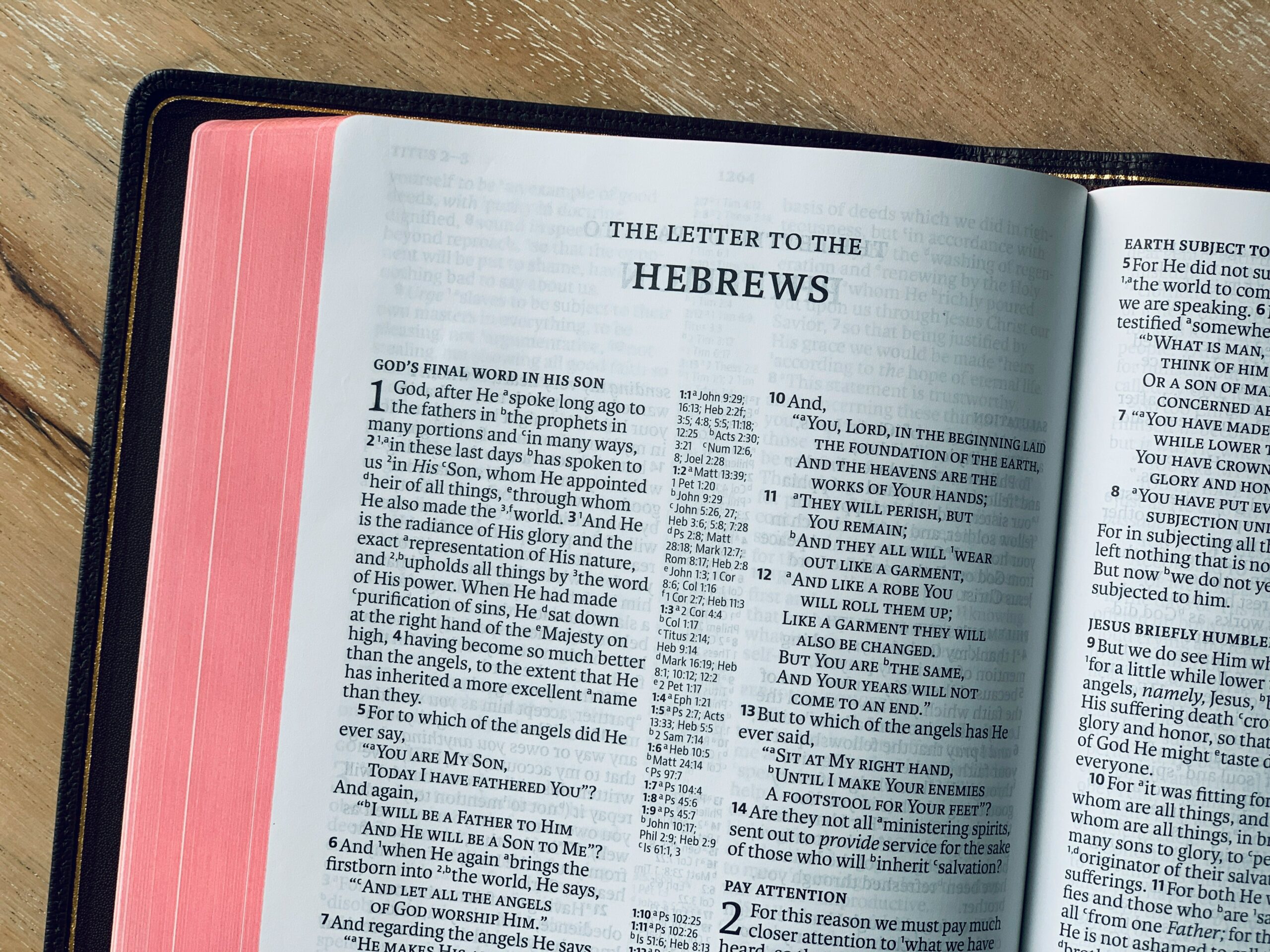
Enduring Admonitions (Pt. 1)
The sermon explores the epistle to the Hebrews, emphasizing the supreme preeminence of Jesus Christ over angels and the necessity for believers to maintain unwavering attention to the gospel. It argues that because Christ is the final and perfect revelation of God, His message carries infinite weight compared to the law mediated by angels. The text warns against spiritual apathy and the danger of drifting from the faith, using the nautical metaphor of a boat slipping its anchor to illustrate the peril of neglecting such great salvation. By highlighting Christ’s incarnation, death, and role as a merciful high priest, the message urges the audience to fix their eyes on Jesus, who has nullified the power of death and offers eternal hope. The tone is both convicting and encouraging, calling for a diligent and focused response to the grace provided through Christ.
Transcript
So this is true. I began to look
this week. Having finished James, I began
to try to think through what I would tackle next, really in
the interim. I do have a master plan. I do have a direction where I
would hope to head in due time. But I felt like there was a need
to speak more pointedly to our current circumstance. And so
I prayed through and looked through a lot of different things that
we had already preached. I seriously contemplated going
back to Romans 8. We spent nearly six months in
that great chapter, but it just didn’t seemed to fit our appropriate
or our particular need at this time. And so as I began to think
of the circumstances that we are facing, I began to think
of others who had faced similar circumstances in scripture, and
I was led to the book of Hebrews. And so for the next, I don’t
know how long, I wanted to delve into this great epistle to the
Hebrews. It’s interesting that we have
just finished the Epistle of James, where James was writing,
remember, to his fledgling church in Jerusalem, the very heart
of Israel. We discovered, or we were reminded,
that the Epistle of James was likely one of the first New Testament
documents ever written. James was already a leader of
the Jerusalem church, But it is very clear that he writes
long before the destruction of Jerusalem, which occurred in
A.D. 70. And while there was persecution
and harassment all around him, James was much more concerned,
wasn’t he, with how his church was responding to spiritual challenges
within, internal spiritual challenges rather than anything external.
And so when James writes again, approximately AD 50, he captures
a very distinct scene. The Jews were living in tension
under Roman rule, wishing and hoping and praying that God would
again deliver his people from foreign oppression. But at the
same time, they were peacefully enjoying many of the perks that
Roman rule provided. not the least of which was protection. But then if we jump forward 15
to 20 years, everything has changed. While the church had matured,
the political climate had dramatically worsened. Emperor Nero’s patience
with both Jews and Christians had worn thin. And there was
a dark cloud gathering over the region of Palestine. To make
matters worse, careful students of recent history, both Jews
and Christians would have easily recalled Jesus’ very uncomfortable
words recorded in Matthew 24. There, Matthew captures Jesus’
forewarning of the destruction of the city of Jerusalem and
its temple. Here’s what Matthew recorded.
Jesus came out of the temple, was going away when his disciples
came up, to point out the temple buildings to him. And he said
to them, Do you not see all these things? Truly, I say to you,
not one stone here will be left upon another, which will not
be torn down. Well, now we know, looking back,
that those words saw a literal fulfillment in A.D. 70. But in
the days and weeks and months leading up to that impending
cataclysmic event, the people of Jerusalem could feel the tension. The situation was greatly changed
from that of James’s day. In May of AD 66, a rebellion
broke out in Jerusalem in opposition to appointment of a brutal procurator. The Jews had finally had enough,
and they very unwisely picked a fight with a formidable opponent,
the Roman Empire. Emperor Nero impulsively dispatched
an army of more than 60,000, led by one of his most trusted
generals, Vespasian, and they set up camp around Jerusalem.
It had to be a sobering and a frightening scene to see such a show of strength
just outside the city gates. But then almost as soon as the
troops had amassed, Vespasian was summoned back to Rome. Nero
had committed suicide. Vespasian was declared emperor
and soon appointed his own son, Titus, as general over the unfinished
business in Jerusalem. This was personal now. By April
of AD 70, the Roman army had swelled to more than 80,000 and
they began a siege of the city. After many weeks of cinching
the noose ever tighter, no one coming, no one leaving, the attack
began on July 17th. It lasted more than three weeks.
Ultimately, complete destruction of the temple was ordered. Years
afterwards, Jewish historian Josephus remarked that the temple
and the city walls were so thoroughly dug up to the very foundation
that there was nothing left to make those who came near believe
that they had ever been inhabited. It was total and complete destruction,
just exactly as Jesus had said. Now that is what would and did
happen, but let’s step back in time to the months leading up to that
dreadful event. Because it is to this context
and to the Jewish converts to Christianity that the writer
of Hebrews writes. You well know that the identity
of the writer of Hebrews has been providentially hidden by
God. I love the way S. Lewis Johnson explained it, that
it really serves the function of presenting the book of Hebrews
as a message from God, that this is a divine revelation, not merely
a letter from a man. But God uses this human writer
who knows the situation in Jerusalem. He knows that it’s dire and greatly
troubling to those within the walls. He knows that there will
be loss of life. He knows that there will be persecution. He knows that the temple, which
even Jewish Christians revered as a source of national pride,
he knew the temple was about to be destroyed in fulfillment
of the Savior’s words. And so he wants the citizens
of Jerusalem to know that God is in control, even though Jerusalem
will be changed forever. The writer wants to prepare them.
The people of Jerusalem had once believed that their city would
be the capital of the whole world under Messiah, and now its utter
destruction was looming. Though many Jews had indeed come
to faith in Christ, they yet loved their city, and so here
is a severe crisis. like nothing anyone had ever
faced. The writer knows that there’s even more at stake than
the loss of life or the destruction of even magnificent buildings.
The shepherdly writer knows well that abandonment from the Christian
faith was a real possibility. Some, it seems, from the greater
portion of this letter, were even inclined to return again
to Judaism. Perhaps this pending judgment
was due to their own disloyalty to that religion. The writer
knows well that many have deferred a firm commitment to Christ. He knows that great doubt and
a great falling away from the faith is possible. Perhaps he had even heard rumblings
of such. And so he wants to speak in the
highest degree of the supremacy and the all-sufficiency of the
Lord Jesus Christ. Over and over again, a dozen
times over, Christ is extolled as better. He’s better than anything
and everything in all of God’s creation, including Judaism.
He wants to steal the saints of God from apostasy. He wants to buffet their faith
in Christ. He wants them to remain firm
to their resolve and faithful to Christ to the very end. Whenever
that may come. This great epistle rings throughout. as one long running exhortation
to the Jewish converts to Christianity. And so sometime, perhaps a year
or more, likely even just months or even weeks from the ultimate
destruction of Jerusalem, by way of this unknown writer, God
sends the clearest and most glorious message about the Lord Jesus
Christ. I want you to know as well a
little bit about this epistle. There is a very unique feature
in the epistle to the Hebrews. There occurs within it a remarkable
recurrence of a verb form known as the subjunctive mood. Mood in the realm of grammar
refers to the relationship of what is being spoken to reality. Has it existed? Does it now exist? Or will it or might it exist
in the future? The subjunctive mood falls into
the latter. It is the mood of potential.
It’s the mood of what should be, what ought to be. In this
particular epistle, this feature is repeated again and again,
and it’s issued as a powerful encouragement. not as a command
per se, but as an enthusiastic encouragement. It has the feel
of a coach’s urgency. Let’s go! But make no mistake,
these do not come as mere suggestions, but instead they come as close
as they can to commands. It’s as if the individual would
say, the house is on fire, let’s go. There are also commands as we
will see, but the subjunctive mood, these unique encouragements
are especially plentiful. We see it again and again in
the scriptures, we see it in chapter two, we see it in chapter
three and four, we see it in chapter five, six, we see it
in chapter 10, over and over again, we see it in chapter 12,
and then again in chapter 13. We’ll take some time to look
at these in the weeks to come, but today I wanna turn to chapter
one and two. Hebrews chapter 1 and 2, where
I want to look for a time at these enduring admonitions. Not
just commands, there are a few in Hebrews, but more often than
not, it is these subjunctive encouragements. We might even
just call them admonitions in general. Divine encouragements. for saints imperiled. Divine
encouragement for saints imperiled. And if we’re going to glorify
Christ in trial, we do well to hear and heed these divine encouragements. First of all, if we’re going
to glorify Christ in the midst of a great trial, we must listen
to the one who is greater than angels. We must listen to the
one who is greater than angels. Start at the very beginning,
chapter one, verse one, where we have essentially the preeminence
of Jesus Christ’s revelation. This is, as you know already,
one of my favorite verses. I think we reviewed it again
at Christmas this last year. God has spoken. That’s the simple sentence. Some
translations don’t always capture that, but that is the simple
sentence that God has spoken. God, after he spoke long ago
to the fathers and the prophets in many portions and in many
ways in these last days has spoken to us in his son. whom he appointed
heir of all things, through whom also he made the world.” Jesus
Christ’s revelation is preeminent. This is God’s greatest and final
message to humanity. But then it moves very seamlessly
right into the second point, the preeminence of Jesus Christ
over the angels. Not only is his revelation preeminent,
But Jesus Christ himself is preeminent over the angels. Look at verse
three. He is the radiance of his glory and the exact representation
of his nature and upholds all things by the word of his power.
When he had made purification of sins, he sat down at the right
hand of the majesty on high, having become much better than
the angels, as he has inherited a more excellent name than they. First of all, look at His brilliance.
His brilliance is the Father’s glory, verse 3. This whole verse,
verse 3, presents Christ in His eternal state, in His incarnate
state, in His exalted state. But here in His eternal state,
Jesus Christ radiates, He emanates, He shines forth the eternal glory
of Almighty God Himself. That word essentially describes
the light as orienting from another source. That’s what it means
to radiate something. What it means is that this glory,
which is humanly descriptive of a way of referring to the
complete manifestation of God’s attributes. He says that Jesus
Christ on display is a display of God. Jesus Christ perfectly
reflects all of the attributes of God. Remember the ancient
Nicene Creed? God of God, light of light, very
God of very God. Jesus Christ, God’s son, God
in the flesh, was a perfect display of deity. Look at the second
statement, His nature. His nature is divine. He is of
God. He is an exact representation
of His nature. It’s an echo of the first line,
but the writer, under the direction of the Holy Spirit, uses the
language of the shop or the commerce because he calls Christ a stamp,
the exact representation or image of an eternal God. The word was
used of an official seal embedded into wax on a document. It speaks of the full and final
and complete expression or the presentation of Christ as being
identical to that of his father, an exact representation of his
nature. The third line says that His
ongoing work is to support the saints. He is the sustainer.
He is the support of all creation. He upholds all things by the
word of His power. Suddenly here the writer takes
us beyond just imagery, that of glory and likeness, to deity
in action. This is God being God. He says
here of Christ that he is the one who holds or is holding all
things. He must hold all things. Every
possible aspect of the world must be held together by him. This is divine sovereignty and
omnipotence in action, supplying the whole, sustaining the whole
course of the universe immediately and constantly under his complete
control. Paul writing to the Colossians
said it very simply, in him all things hold together. Jesus Christ
is not only infinitely able, he’s not only infinitely capable,
he is absolutely and infinitely indispensable. If he were to
cease this upholding for even an instance, all would disintegrate
into irretrievable chaos and destruction. This creation, this is all affected merely by
His spoken word. Psalm 33 said, by the word of
the Lord, the heavens were made. And here in Hebrews 1, it says
that merely by His word, the entire creation is held together,
every aspect of it. Nothing happens by chance. Nothing
is out of control. There’s no heroic exertion by
God here. But it’s the almighty power of
his word. The fourth line there of verse
three, which is really just laying a foundation here. It’s his exaltation. He’s seated. It’s a familiar
illustration to the readers of the New Testament because it’s
used over 20 times. When he had made purification
of sins, he sat down at the right hand of the majesty on high.
The idea of Christ being seated after his great work of redemption
suggests completeness, it suggests finality. It is finished, as
Jesus said. Now comes the exaltation being
seated at God’s right hand. The majesty on high is really
just a nominative. It’s another name for God. The
Jews, as you know, were almost superstitious about using the
name of God, but that is exactly who is referred to here. He is
at the right hand of the majesty on high, none other than God
himself. Well. what you have flowing out
from those opening verses that talk about the superlative nature
of Christ, you basically have the proof in verses 5 through
14. Look at those verses just briefly.
You have support for the statement of verses 3 and 4 that Christ
is better than the angels. Look at verse 5. For to which
of the angels did he ever say, you are my son, did they have
begotten you? Psalm 2, 7. And again, I will be a father
to him and he will be a son to me. Second Samuel 7, 14. When
he again brings forth the firstborn into the world, he says, and
let all the angels of God worship him. Psalm 97, 7. And of the
angels, he says, who makes his angels winds and his ministers
flames of fire? Psalm 104, 4. The angels are
not unimportant. They’re just subordinate to the
Lord Jesus Christ. The angels have a God given calling. They have a duty to fulfill. They have a place in God’s economy. But Christ is so much more important. Jesus Christ, the son, is God’s
anointed one, the Messiah. Look at verse eight. But of the
sun, he says, your throne, O God, is forever and ever. The righteous
scepter is the scepter of his kingdom. Psalm 45, 6. You have
loved righteousness and hated lawlessness. Psalm 45, 7. Therefore,
God, your God, has anointed you with the oil of gladness above
your companions.” He speaks of Christ’s messianic anointing,
Isaiah 61, 1 and 3. Verse 10, “‘You, Lord, in the
beginning laid the foundation of the earth, and the heavens
are the works of your hands,’ Psalm 102, 25, spoken of Christ. They will perish, but you will
remain. They all will become old like
a garment. Psalm 51, 6. Like a mantle, you
will roll them up like a garment. They will be changed, but you
are the same. Your years will not come to an
end. Psalm 102, 26 and 27. But to which of the angels has
he ever said, sit at my right hand? Until I make your enemies a footstool
for your feet, Joshua 10, 24. No wonder the epistle to the
Hebrews over and over again, as we see these quotes from the
Old Testament scriptures, it has long been considered to be
one of the greatest commentaries on the Old Testament scriptures.
It’s explaining to us, even as they are quoted of Christ, it’s
explaining to us their initial and original significance. This
epistle abounds with quotations of the proof of the superiority
of Jesus Christ. But here he says Jesus Christ
is better than the angels. Look at the summary verse in
verse 14. And they, that is these so many
angels that he’s just spoken of, Not all, are they not all
ministering spirits sent to render service for the sake of those
who will inherit salvation? He says essentially here, they
are servants appointed by God himself to serve you. It’s astounding. These so many
angels, beautiful creatures of God made to serve and honor him
are not unimportant, but they are not all important, not like
Christ. They are subordinate creatures.
They are literal servants, deacons. They have an assigned duty to
fulfill. They are ministering spirits,
spirits who serve. They serve God and they serve
humanity. They are not so many deities,
but they are mere assistants, servants of those who will ultimately
benefit from the work of Christ’s salvation. One pastor said of
them, the angels are employed by God. He does the hiring. He
does the appointing. He sent them forth to minister
to the saved. to promote their improvement
and add to their enjoyment until they obtain full possession of
their inheritance. Salvation that is Christ with
eternal glory. It is noteworthy to me and somewhat
disturbing. That in our day and age, I fear
that some Christians pay more attention to the idea and the
thought and the reality of angels than they do to the reality of
Christ. and to the person of Christ.
And so the conclusion here up to verse 14, Jesus Christ is
preeminent over the angels, far superior. And you say, and so? I walked in here believing that.
But it’s an appropriate question to ask as you get to the end
of chapter one. Why is the writer telling us
all of this? Why the focus on angels? Why the interplay between
these created beings in Christ? Because the whole point is to
establish that Jesus Christ is utterly and completely preeminent
over the entire created order. And having established that,
the unknown author begins here to establish a pattern that he
will follow throughout the rest of the epistle. He will expound
upon a deep theological truth that Christ is better than the
angels. He will establish, rather, he
will expound on a deep theological truth, and then he will proceed
to issue one of these subjunctive admonitions, these encouragements,
these enthusiastic, let’s go. Remember, his aim is to ground
these believers in the truth about Christ so that they never
let go. Let’s consider the first subjunctive
encouragement. We find it in chapter two, verse
one. Where the writer says, for this
reason, we must, there’s our subjunctive. We must pay much
closer attention to what we’ve heard. so that we do not drift
away from it. Let’s not drift. Let’s not give up. Let’s not
lose sight of what’s important. And so our author seeks to make
his first admonition. He’s laid the groundwork in his
teaching that Christ is better than angels. And here is his
lesson. That because Christ is infinitely
better as the creator of creation, as the savior over the servants,
His word has ultimate claim upon our attention. Look at this first
part, for this reason, the author here with these three little
words looks back over his shoulder at the entirety of his argument
presented in chapter one. Look at this. Because he is God’s
final word of revelation to humanity, because he is the precise image
and likeness of God the Father, because he is the sovereign sustainer
of all the universe, because his work of redemption is complete
and final, because he is qualitatively better than the angels for this
reason. His message, whatever it is,
is infinitely more important than any message that would ever
be communicated by his creatures, even creatures of the highest
order in their service to God, those of angels. No message of
an angel could ever bring, could be in any part better than the
word of Christ. Because of that, we get his strong
encouragement. The first of our subjunctive
verbs, we must pay closer attention. We must be more attentive. Let
us listen to him. In his words, even in the form
of them, there is leadership, there is urgency, there is clarity,
there is passion, there is direction, all of it. And it’s just short
of a command, just short of a command. The admonition implies moral
obligation. It is a sharp warning. And the
writer here provides a logical necessity that if Jesus Christ
is really better and greater than the angels, then his message
must be infinitely more important. And must therefore be attended
to, listened to, considered most carefully. One Puritan said of
this activity, listening, giving heed. He said to give heed is
to apply the mind to a particular subject, to attend to it, to
consider it, opposed to neglecting the great salvation. No person
can read the scriptures without observing the stress that is
laid on consideration and the criminality and hazards which
are represented within consideration. He says, either we sit up and
take notice and hear him, because to be indifferent to Christ is
to imperil our very souls. So what should they consider?
What is the message to which they should pay such careful
attention? Look at the passage again. We
must pay closer attention to what we have heard. So what we have heard, what was,
what was it? What have we heard? What was
it that these first century converts to Christianity out of Judaism,
what did they heard that ought to have been their perpetual
focus? The gospel. It’s the good news
of salvation by Christ and only in Christ. It is the gospel that
they had heard, the principles of Christianity, the sinfulness
of humanity, salvation by faith in Christ alone. It was that
which they had made their profession of faith, that which brought
them the greatest comfort, the forgiveness of sin, eternity
with Christ. They’d heard it. They’d placed
their faith there. It was the whole great tradition
of the apostles as elsewhere, that to which the early church
had laid hold of in faith. These believers had heard the
testimony of these things and had had them confidently placed
in which they placed their faith. They must not be moved from that,
says the writer. They must not give up and give
in to other ideas, to sin. A loss of attention, any inattention
would spell disaster. This writer, this faithful friend
warns them again and again of this. In chapter three, verse
six, if we hold fast our confidence, the boast of our hope firm until
the end. Chapter five, verse 11, he challenges
them, you have become dull of hearing. Chapter six, we desire
each one of you show the same diligence so as to realize the
full assurance of hope to the end. He wants them to pay attention
to Christ and only to Christ. Look at the verse again. For
this reason, we must pay closer attention to what we have heard
so that we do not drift from it. We spoke of those sad people
in the history of our church that had drifted away from Christianity. They had abandoned the faith.
How does that even happen? Casualness, inattentiveness,
dullness of hearing. And the writer urges here that
they must pay attention. They must keep their focus. They
must not entertain other ideologies and false promises. If they do,
they will slip. The word is a nautical word,
and it pictures a boat anchored near the rocky reef beneath,
anchored safely some distance from it, but suddenly the line to the
anchor breaks and the boat begins to slip or drift towards the
perilous rocks. What the writer is saying is
that these Jewish converts to Christianity were in a very grave
danger of drifting away. They were growing indifferent
inexplicably to the glories of the gospel. And because of the
pressures of this life, the particular uncertainties that life was presenting
to them, they were growing increasingly apathetic to the truth. And what
the writer urges them is that by their carelessness, they face
the real possibility of slipping from their intended port Eternity
with Christ. One described it as being carried
away by the tide of temptation. They cannot be inattentive to
the gospel. We cannot be inattentive to the
truth. We must not be inattentive to
the apostles teaching to Christ, because if we do. The doom of
being dashed upon the rocks is sure. One caring and considerate
shepherd presented the dangerous standing of these inattentive
individuals when he said, the forces that with a continuous
action tend to move men away from the faith of Christ. And
we’re especially strong in the case of the Hebrews or the many
influences of this life. The feeling of isolation from
this world, the hardships and slights undergone at the hands
of those outside, the monotonous uniformity of the world, where
all things continue as they are and give no signs to the Lord’s
coming. Those are the things that permit
the mind to take a loose hold of truth. And so the writer moves to support
this strong statement, this strong admonition, this brotherly appeal
to his Christian friends that we must pay closer attention
to Christ. Look at verse two. For if the
word spoken through angels proved unalterable. And he leaves us hanging. with
that thought, if the words spoken through the prophets proved unalterable. Our faithful writer here moves
immediately to explain himself, to justify his position. Why
is apathy towards Christianity so dangerous? He answers it definitively
in verse 2. Look at the history of divine
revelation. Recall that the author must be a Jew, certainly speaking
to Jews, Jewish converts to Christianity, and he takes them as such to
the very giving of the law. The most important document to
any Jew. The Jews understood that the
angels played a significant role in the giving of the law. Did
you get that? Exodus doesn’t specifically mention
that. But it’s it’s interpretational. The Jews believe that the angels
were mediators of the law when God dispensed it to Moses. And
even though Exodus doesn’t mention it, that’s what the Jews believed.
And that’s what the Jewish writer is playing upon when he speaks
of it here. Do you know that the scriptures,
the Old Testament scriptures, also echo that same sentiment? Deuteronomy 33, just listen.
The Lord came from Sinai and dawned on them from Seir. He
shone from Mount Paran, and he came from the midst of 10,000
holy ones. At his right hand, there was
flashing and lightning for them. The angels attended the giving
of the law, is what he’s suggesting. Psalm 68, 17, the chariots of
God are myriads, thousands upon thousands. The Lord is among
them as at Sinai in holiness. The angels were there attending
to the giving of the law. In fact, in the New Testament,
when Stephen is rebuking the Jews, remember, he preached one
amazing sermon and then perished. at their hands. He said, Which
of the prophets did your fathers not persecute? They killed those
who had previously announced the coming of the righteous one,
whose betrayers and murderers you have now become. You who
received the law as ordained by angels. That was their tradition. That’s what the Jews believed.
The Jews believed that the angels were instrumental in the giving
of the law. And so the writer of the Hebrews
just plays right to them. Paul echoes that same thought
in Galatians, that the law having been ordained through the angels. So commonplace was this understanding
that Jewish historian Josephus said, The most excellent of our
doctrines and the most sacred part of our laws have been learned
through angels. So he says, our forefathers believed
that angels attended the very giving of the law, and that law
was verified by truthfulness. It was shown in time to be unalterable. Couldn’t be changed. And if the
law His point is mediated by mediated by angels proved to
be true. How much more should revelation
by Jesus Christ be heeded? Look at the passage, verse two,
if the words spoken through the angels proved to be unalterable
and every transgression and obedience received a just penalty. I want
you to note this. God backed up his law with authority. He backed up his law with punishment.
The law which had shown the angels mediated was not only the unchangeable
word of God, it was backed up and enforced by the very judgment
of God. It was backed up with God’s authority
so that to breach or to disregard it were both met with God’s rebuke
and punishment. This was no idle threat. This
was no wish list that God had issued to his people. Even that
from God’s revelation mediated by angels was divinely enforced. The Jews of old discovered very
quickly, didn’t they, how seriously God intended his law. As one
described, the law possessed a remorseless self-vindication. I told you what the rule was.
A remorseless self-vindication which could not be broken with
impunity. Couldn’t violate God’s law without
paying the consequence. It’s exactly what Nadab and Abihu
found out for their creative exercise of worship. The man
who went out to gather sticks on the Sabbath, he found out
very quickly. God meant what he said in his
law. Even though mediated by angels,
and his obvious point is how much more should the word of God and the
word of Christ be attended? How much more will the word of
Christ be enforced by God himself? Look at verse three. I’ll take a running start at
it from verse two. If the word spoken through the
angels proved unalterable and every transgression of disobedience
received a just penalty, how will we escape if we neglect
so great a salvation? The writer of the Hebrews says
to his readers, including us, if we have a savior who is superior
to the angels, any message he brings is infinitely and immediately
better and bears more weight than any message mediated by
angels. Whatever message that any servant
of God, angel or prophet, this message from God’s own son is
immediately superior. Note our author places himself
among them. He’s not exempt. We must all
give greater attention is essentially what he says. This is a greater
message mediated and revealed by a greater messenger, God’s
own son. And whereas the law which the
angels mediated brought condemnation, the message which Jesus presents
brings salvation. But look at this, not just any
salvation, so great salvation. It’s a very unique way of saying
it, isn’t it? This isn’t a mere earthly rescue,
but it’s eternal, absolute, ultimate salvation. It isn’t a rescue,
pardon me, it’s a rescue from the very wrath of God. How much
more should we attend to this message? Note this word neglect. It’s the same exact word used
of those slouches of the kingdom, remember, who when they were
invited to the prince’s wedding there in Matthew 22, they disregarded
it, neglected the invitation, refused to come, And in like
manner, the writer here warns of those who treat with casualness
or contempt the invitation and the responsibilities of the gospel. They make light of it. They neglect
it. But look at the sentence again.
How will we escape? If we neglect so great a salvation
for those who are neglectful, there is no escape. Only the
full measure of the wrath of God awaits such. In equal measure,
as great as the glory of the reception of Christ’s message
is, so great salvation, so great is the punishment for those who
neglect it. How do we know that the message
is the message of the gospel? Look at the end of verse three. speaks of this salvation after
it was first spoken through the Lord and confirmed to us by those
who heard. Verse three tells us about the
message. It tells us that it was first
spoken through the Lord, that it was spoken to us by the
Lord himself. The epistle, remember, started
with that great line that he has spoken to us in his son,
But Jesus Christ also articulated the gospel. Mark 8, 35, whoever
wishes to save his life will lose it, but whoever loses his
life for my sake and the gospels will save it. Glance, if you would, at the
end of verse three as we glide into verse four. After it was
first spoken through the Lord, It was confirmed to us by those
who heard, God also testifying with them both by signs and wonders,
by various miracles, by gifts of the Holy Spirit according
to his own will. Consider this. God preached the
gospel by sending his son. Jesus the Son preached the gospel
with his life and with his own words, and others believed the
gospel and began themselves to preach the gospel. And God attended
that preaching with supernatural affirmations, signs, wonders,
miracles, gifts. This was the general experience
of the early church. Acts 243, everyone kept feeling
a sense of awe and many wonders and signs were taking place through
the apostles. The signs verified that there
was infinite power behind the words. The wonders shook those
who observed them and leaving them in awe. The miracles powerfully
affirmed the message of the gospel. Those hearing the gospel were
doubly responsible as divine proof was added to the divine
message. Well, it’s here that the writer
returns to his primary argument that Jesus Christ is superior,
far superior to angels. Verses 5 through 13 really is
just an offer of proof to that end. Jesus Christ is superior
to the angels. But look at verse 14 in closing. Therefore, since the children
share in flesh and blood, he himself likewise also partook
of the same that through death he might render powerless him
who had the power of death. That is the devil and might free
those who who through fear of death were subject to slavery
all their lives. For he assuredly does not give
help to angels, but gives help to the descendants of Abraham.”
We walk around looking, right, at people who have the fear of
death in their eyes. It’s a great opportunity for
us. The children that the writer refers to in verse 14 are the
children mentioned in verse 13. Look back. It’s a quote of Isaiah
8. Because the children, all humanity,
are flesh and blood, Jesus Christ had to be flesh and blood. But
I want you to note something. It’s not merely an acknowledgment
of the necessity of the incarnation. It’s a statement of reality.
As eternal God, Jesus Christ could not die. Do you realize
that? He could not suffer, and He could not die, but in
order to fulfill His calling, the Savior had to die. And so the only way that that
could happen was to become flesh and blood, God incarnate. He
had to be able to die. In order to be able to die, He
had to take on flesh, and so Christ, by assuming the ability
to die, assumed the inevitability to
die. He took on flesh. He took on
death. And on taking on death, he would
render powerless the devil who wielded death over humanity.
When Jesus Christ yielded himself up as the atonement for sin,
he nullified death. We can walk around with a smile
on our face. We can greet the world with hope. We can say like the Apostle Paul,
oh, death, where is thy sting? When Jesus Christ yielded himself
in atonement for sin, he put an end to death. Death for the
Christian is the entrance to eternal glory. I close with verse 17. Therefore,
he had to be made like his brethren in all things so that he might
become a merciful high priest in the things pertaining to God.
to make propitiation for the sins of the people. Since he
himself was tempted in that which he has suffered, he is able to
come to the aid of those who are tempted.” This is Christ,
our Savior. The final line there had to be
stunning to the average Jew. There weren’t a whole lot of
priests in his day. nor throughout the history of
Judaism that were to any degree merciful or faithful. But Jesus
Christ, having become our high priest in the offering of himself
to pay for our sins, immediately perfected both of those character
qualities. In one glorious office, Jesus
Christ was immediately both faithful to God, and merciful to humanity. Let’s keep our focus on the Lord
Jesus Christ and on all that he has done for us. Let’s pray. Our merciful King, we come before
you and we thank you so much for the Savior that you sent,
and provided for his willingness to come and to suffer and die
on our behalf. Lord, we did not deserve it,
and that’s what makes it mercy. Father, we pray in this uncertain
time, may you, by your grace, maintain our focus, our explicit
focus on the Lord Jesus Christ, and on all that he has done on
our behalf, on the mercy that he’s shown to us, on the regeneration
that you initiated in our lives by the Spirit, bringing us to
repentance, on your sustaining grace that enables us to do any
good thing, on the sanctification that we
enjoy more and more every day. Lord, we pray, help us to attend,
to focus on Christ. It’s in Jesus’ name that we pray.
Amen.
Messages: 20