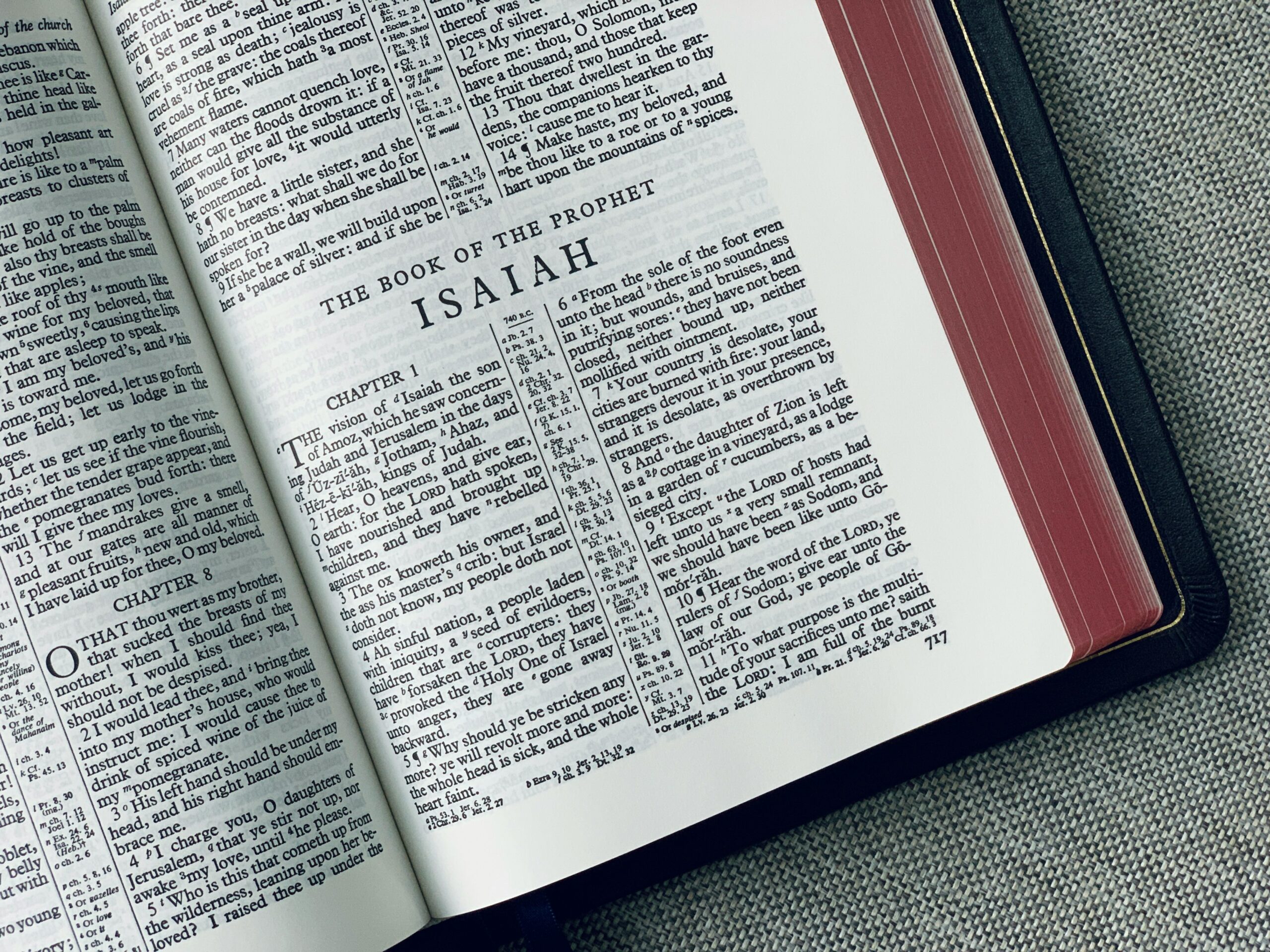
The Suffering Servant Pt 1
The sermon introduces a multi-week study on Isaiah 53, beginning with the servant’s astonishing reception and exaltation as described in Isaiah 52:13-15. It contrasts the theological error of creating physical images of Christ, citing the Second Commandment and historical Reformed perspectives, with the spiritual reality of Christ’s character and work revealed in Scripture. The preacher explains the structure of the four servant songs, emphasizing that the suffering servant’s role is one of voluntary submission and vicarious atonement. By connecting the prophecy to New Testament fulfillment, the message highlights that Christ’s prosperity and exaltation are the result of God’s acceptance of His sacrificial death. The sermon concludes with a pastoral exhortation to focus on the spiritual person of Christ rather than cultural distractions during the Christmas season.
Transcript
Turn to Isaiah 53. Isaiah chapter 53, it’ll take
me a few minutes to even get there. Actually, it’ll take almost
a week. But Isaiah 53 is where we want
to spend the next couple of weeks. One of the absolutely fascinating
studies. For a former Catholic was my
study in the Ten Commandments. When I first found myself by
God’s grace to be converted out of that. Religion. One of the things that immediately
began. To sit very uncomfortably with me were the statues the. Statues of the Saints, statues
of Mary, statues of. Even Christ himself. Pictures,
photos, all of those things really. Began to be very distasteful
to me, and it’s a fascinating study to dig into. The Ten Commandments
there recorded in Exodus chapter 20. In the Catholic version,
as compared with other versions. Essentially, what Catholics do
is blend a series of the commandments, which obscures some very clear
language on God’s part. Those verses read quite simply,
you shall have no other gods before me. And certainly, while
Roman Catholics would believe that or agree with that on the
surface that idolatry is a sin, What they obscure is what follows. You shall not make for yourself
an idol or any likeness of what is in heaven above or on the
earth beneath or in the water under the earth. You shall not
worship them or serve them. For I, the Lord, your God, am
a jealous God, visiting iniquity on the fathers, on the children,
on the third and fourth generation of those who hate me. but showing
loving kindness to thousands to those who keep who love me
and keep my commandments. Those words were uttered with
no ambiguity and with severe and solemn warning. That idolatry
in all of its forms is wrong, not just idolatry in false gods. But what is clearly articulated
there In the text. Is idolatry in an attempt even
to represent the real God, the true God. In. Statues and in pictures. Lorraine Bettner. And if you
wanted a book on Roman Catholicism, Lorraine Bettner gets my vote
in a number of for a number of different reasons. He has this
caveat at the start of it that he is not one of these that wants
to copyright and restrict the use of his material. That’s one
of the things that commends him to me. He’s not all about himself. He’s not all about protecting
his his writings. What he is about is speaking
the truth plainly and boldly in his work on Roman Catholicism. There just is no better book. on Roman Catholicism and all
of its sinful practices and misinterpretations. And the amazing thing about Vettner’s
book is he cites the sources. He goes to the Roman Catholic
sources and cites them. He isn’t making a straw man. He isn’t building up a false
report on these practices. Lorraine Vettner said this about
the images. He said closely akin to the use
of images is that of pictures of Christ. And these we are sorry
to say are often found in Protestant as well as Roman Catholic churches. But nowhere in the Bible either
in the Old or New Testament is there a description of Christ’s
physical features. Now I’ll come back and I’ll clarify
that in a moment. because one of the things that
we read this morning is a description of Christ’s physical state. What
he’s talking about there is he’s not. He doesn’t articulate his
hair color, what color his eyes were, how tall he was. He doesn’t. He says that the Scriptures are
silent as to the specifics and you can’t even begin. Legitimately. To draw a picture of Christ or
represent him graphically. No picture of him, Bettner goes
on, no picture of him was painted during his earthly ministry.
The church had no pictures of him during the first four centuries. The so-called pictures of Christ,
like those of Mary and the saints, are merely the product of the
artist’s imagination. Now, I know that some of you
have perhaps even read or looked at the Shroud of Turin. That
is not a God ordained documentation of Christ’s physical features.
It just isn’t. It’s an attempt to represent
Christ in graphic terms so that we can gratify our insatiable
desire to have something tangible to look at with regards to Christ.
And even to this day, for me, again, as a former Catholic,
it bothers me. I mean, it really stirs me up
and God has seasoned me just a little bit over the years on
the issue. But the one that really bothers
me is is the more modern one. I think it came out in the 70s
or 80s which pictures Jesus in this short cropped beard you
know buff robust you know handsome guy that anybody would have followed. One Puritan said it this way,
there is nothing less fitting. Than to wish to reduce God, who
is immeasurable and incomparable to a five foot measure, he says,
how ridiculous are we that we would even stoop to the idea
of crafting an image? And representing that is allegedly
to represent our God. Likeness. No less than a graven
image is forbidden in pictures. God is represented falsely and
with an insult to his majesty. I love that. It’s insulting to
God that we would put a picture on the wall and say, here’s Jesus. Stephen Charnock. One powerful
writer. who you literally have to you
have to outline every almost every word, if not every line
of what he says. So it’s simply in one line, if
God be a pure spirit. It is unreasonable to frame any
image or picture of God. God is holy, God is completely
other, and even though Jesus took on human flesh, it wasn’t
about his flesh. It was about his deity that we
were to focus. It was about his nature, not
about some physical image. Another said that images dishonor
God, they obscure his glory, and finally, in closing, James
Boyce said images mislead the worshiper. You know what it does?
It brings God down. It brings Christ down to our
level so that we can look at him and say, there is a statue
that I can worship. There is a tangible image. I
can put God in a box. Images mislead the worshiper,
and as such, we should take the utmost care to discover what
he is truly like. And thus increasingly worship
him as the only great transcendent, spiritual, spiritual and inscrutable
God of the universe. You might say. It’s a curious introduction. For a
passage that is going to go on in a great length, describe what
Christ was like. But I would have you note that
what it talks about is not some precise feature that Christ possessed,
not some impeccable description by which we could begin to paint
a picture. What it tells us is what Christ
was really like, what he was really like in his role as the
Savior, what he was really like in his deity and in his blended
humanity. What was he really like? If you
would, Isaiah 53 actually begins in Isaiah chapter 52, beginning
in verse 13. Isaiah 52, verse 13, where Isaiah
writes, Behold, my servant will prosper. He will be high and
lifted up and greatly exalted. Just as many were astonished
at you, my people, so his appearance was marred more than any man
and his form more than the sons of men. Thus, he will sprinkle
many nations. Kings will shut their mouths
on account of him. For what had not been told them,
they will see. And what they had not heard,
they will understand. Who has believed our message?
And who to whom has the arm of the Lord been revealed where
he grew up before him like a tender shoot and like a root out of
parched ground? He has no stately form or majesty
that we should look upon him, nor appearance that we should
be attracted to him. He was despised and forsaken
of men, a man of sorrows and acquainted with grief. And like
one from whom men hide their face, he was despised and we
did not esteem him. Surely, our griefs he himself
bore and our sorrows he carried, yet we ourselves esteemed him
stricken, smitten of God and afflicted. But he was pierced
through for our transgressions. He was crushed for our iniquities. The chastening for our well-being
fell upon Him, and by His scourging we are healed. All of us, like
sheep, have gone astray. Each of us has turned to his
own way, but the Lord has caused the iniquity of us all to fall
on Him. He was oppressed and He was afflicted,
yet He did not open His mouth. Like a lamb that is led to slaughter
and like a sheep that is silent before its shearers, so he did
not open his mouth. By oppression and judgment, he
was taken away. And as for his generation, who
considered that he was cut off out of the land of the living
for the transgression of my people to whom the stroke was due? His
grave was assigned with wicked men, yet he was with the rich
man in his death. because he had done no violence,
nor was there any deceit in his mouth. But the Lord was pleased
to crush him, putting him to grief. If he would render himself
as a guilt offering, he will see his offspring. He will prolong
his days and the good pleasure of the Lord will prosper in his
hand. As a result of the anguish of
his soul, he will see it and be satisfied. By his knowledge,
The righteous one, my servant will justify the many. As he
will bear their iniquities, therefore, I will allot him a portion with
the great and he will divide the booty with the strong because
he poured out himself to death and was numbered with the transgressor
transgressors. Yet he himself bore the sin of
many and interceded for the transgressors. We speak just a word about Hebrew
poetry for a moment. That’s what we find ourselves
engaged in considering is Hebrew poetry and Hebrew poetry is of
a different kind than what you and I might think. We tend to
think of rhymes and meter where everything is measured out and
it’s predictable. The pattern is predictable. The
rhyme is predictable. We can almost complete the sentences
once the rhyme has begun. Once a little poem is recited
we know the pattern and it flows naturally. Hebrew poetry is of
a different kind and if you read the book of James the book of
James though written in Greek is of the Hebrew mindset. And
as such what you have in the book of James is and what you
have in Hebrew poetry is what I might describe as impressionist
painting. An impressionist painting, I
mean, this is the original set of pixels, you know, I mean,
if you walk right up close to an impressionist painting, what
you see is just a series of dots, colored dots, mind you, but they’re
just they seem to be haphazardly placed. But the beauty is in
stepping back and in stepping back, the dots begin to take
shape and take form. And it begins to mean something
and it begins to exhibit great beauty and significance as you
see the dots begin to form. Really, an image, a beautiful
painting. Well. That’s essentially what
Hebrew poetry is like. Where the artist will dip in
and he’ll take some color here and place it and then he’ll dip
in and grab some other color. And he’ll dip back in and grab
some of that same color that he just used. And in James, you
have this ever developing argument. And in Hebrew poetry, you’ll
have these repeating thoughts and phrases and ideas. Glanced
down at the passage again, you’ll have exaltation, for instance,
at the very beginning of this section, Isaiah 52, 13, you have
exaltation. But then at the very end, You
have exaltation again. Where the Savior will be blessed. You have the servant introduced
at the start and then you have the servant again interjected
throughout. You have his the abuse that he
suffers there in verse 14 that his appearance was marred more
than any man and then later on in that poem. You have a detailed
description of what he Endured on our behalf. Repeatedly, you have not only
what he did, what he was like, but what he accomplished. That
he did bear our sins, that he did go before God and to take
on the sin of the world. So when it comes to outlining
this. We’ve got a little bit of a difficulty, but we’ll get
there. People had clamored for an earthly
king and God provided them what they wanted. Even though God was their king
and was a good and loving and gracious king, as a result, Israel
would have some good kings and some very bad kings. The glorious
days were those of David and Solomon. And then came the division
in the kingdom where Judah separated from Israel and Israel from Judah.
Israel, as you might remember from our study in the kings,
Israel was chronically vexed by evil kings, kings that did
what they wanted to do, kings that sinned high handedly against
God. And then you had Judah. Judah
had good kings and they had bad kings. And they seem to constantly
vacillate between the two. And as a result, Judah as well
struggled. And in the midst of this great
season of just a variety of kings coming in and serving. In comes this new prophet, the
prophet Isaiah, you know, his commissioning, you know, his
if you will, his ordination service there in Isaiah six. And immediately
after that, Isaiah goes out to confront one of Judah’s most
wicked kings, King Ahaz. Judah is facing attack and immediately
Isaiah sets to the task of confronting wickedness and proclaiming the
glory and righteousness of God. As a result, Isaiah is often
been referred to as the Apostle Paul of the Old Testament. He
feared nothing. except God himself. Isaiah responded
to God’s call to be a prophet. And from the end of King Uzziah’s
reign to King Hezekiah, a very difficult life period in the
life of Judah and Israel. In comes Isaiah to proclaim not
only severe judgments and threatenings, but also the mercy of God. As one described him, Isaiah
is called the messianic prophet because he was so thoroughly
imbued with the idea that his nation was to be the messianic
nation to the world. Did you hear that? That not only
were they to receive the Messiah, they were supposed to be proclaiming
the Messiah to all. Isaiah, this great prophet, Coming
to the kingdom that was to be destroyed soon. Isaiah would
come and bring his messages of both judgment and hope. Isaiah
is quoted more frequently in the New Testament than any other
prophet. In the Talmud, which the early
church fathers accepted as a historical of an accurate historical account,
It’s recorded of Isaiah that he ultimately would resist Manasseh
in his idolatry and his idolatrous decrees. And ultimately, it says
that he was fastened between two boards and sawed in half.
Many scholars believe that that’s what’s referred to in Hebrews
1137. Speaking of all those saints who have gone before us, they
were stone, they were sawn into, they
were tempted, they were put to death with the sword, they went
about in sheepskins and goatskins being destitute. The prophet
Isaiah, faithful to the end. The book itself, I’ve shared
with you before, kind of mirrors our Bible. The book of Isaiah,
one scholar referred to as the Mount Everest of Hebrew prophecy.
The Bible in miniature. And if you want to just look
at a brief outline, the first 39 chapters of Isaiah’s prophecy
talk about righteousness and holiness and justice, severity,
you might say. But the last 27 chapters, which
tend to mirror our 27 New Testament books, he begins to speak about
glory and compassion and favor. And God’s provision of salvation. Now, I’ve told you before, I
think I’ve alluded to this in the past, that there are many
who say that Isaiah is the Bible in miniature, but it is so easy
and and some can’t resist the temptation to go way too far
in this. Some say one went so far as to
detail every chapter and the points of similarities to the
relating New Testament book. Isaiah 1, for instance, obviously
would refer to the first book of the Bible, Genesis. This is
how the argument goes. Isaiah 1 calls God upon the heavens,
calls, pardon me, in Isaiah 1, God calls upon the heavens and
earth to hear his complaint. Well, that is supposed to hearken
back to Genesis 1, the creation of the heavens and the earth. And that’s how this entire argument
goes. The 16th chapter of Isaiah is
supposed to correspond with the 16th book of the Old Testament,
Nehemiah. Now, where they get this precise
numbering of the books, because that has varied throughout the
centuries. But the 16th book of the Old Testament, as we have
it. Is Nehemiah. In Isaiah, there are 16 professing
Christians. Moab and they’re admonished to
do the same and in the end time, whereas in Nehemiah, King Cyrus. Begins to show kindness and gives
protection to Israel and allows the establishment of worship
after the Babylonian captivity also related to Cyrus. We have
this really muddying of the details of the. The God given. Record. I think what you can
say really rather than trying to get hard and fast and some
of these people that really advocate this come very close to what
really is no more than numerology kind of a mystical approach to
the scriptures that seeks to apply and find meaning that really
isn’t there at all. I think what you can say is there
are 66 chapters to Isaiah just as there are 66 books of the
Bible, there are there do happen to be two main divisions which
breaks at chapter thirty nine verse the last twenty seven chapters
being the second part of the book. And it’s that second part
of Isaiah that I want to focus on for the next couple of weeks.
What we’re doing essentially is narrowing our focus, just
like increasingly or decreasingly in size, concentric circles. As we zero in on the latter half
of the book of Isaiah, we come to a section that really just
foretells, proclaims comfort, salvation, the glory that awaits
the nations. And in chapters 40 through 48,
you have a delivery A deliverer, rather, that is announced for
the first time. You have this clarifying of that
as things unfold to where when you get to the middle chapters,
Isaiah 49 through 57, you have a zeroing in on what is articulated
as the servant of God. Who is this servant of God? He’s the servant of Jehovah and
he’s a servant that undergoes great and terrible suffering. So much so that he is called
the suffering servant. And it’s a position that is assumed
and can only be assumed by the Lord Jesus Christ himself. He’s
the only person throughout history who fits. As one Described this servant
of the Lord, this mysterious servant, who is the central figure
of the last part of Isaiah’s prophecies now is seen now standing
apart from all others in solitary greatness and solitary suffering. Isaiah begins to draw our focus
in those chapters 49 through 57 to God’s servant, the suffering
servant. Throughout His prophecy thus
far, Isaiah has alluded numerous times to this unique person,
this servant, whoever he is. And he has some unique features. He is seen to be not only a prophet,
but a priest. And he has everything that he
needs to function in those capacities. throughout these chapters, he
is alluded to as the servant more than 20 times. But there
are four distinct what are called servant songs. And we’ve looked
at a couple of them in the past. But the first servant song is
found in Isaiah chapter 42. It is a poem that is really describes the servant’s
gentle manner. If you would just flip back a
couple of chapters to Isaiah 42. You’re familiar with it,
and we have studied it in times past. Today, just a brief allusion. Isaiah, Chapter 42, verses one
through nine, behold, my servant whom I uphold, my chosen one
in whom my soul delights. I have put my spirit upon him.
He will bring forth justice to the nations. He will not cry
out or raise his voice, nor make his voice heard in the street.
A bruised reed he will not break, and a dimly burning wick he will
not extinguish. He will faithfully bring forth
justice. He will not be disheartened or
crushed until he has established justice in the earth and the
coastlands will wait expectantly for his law. Thus says God, the
Lord who created the heavens and stretched them out, who spread
out the earth and its offspring, who gives breath to the people
on it and the spirit to those who walk in it. I am the Lord. I have called you in righteousness.
I will also uphold you by the hand and watch over you and I
will appoint you as a covenant to the people as a light to the
nations to open blind eyes to bring out prisoners from the
dungeon and those who dwell in darkness from the prison. I am
the Lord. That is my name. I will not give
my glory to another nor my praise to graven images. Behold, the
former things have come to pass. Now I declare new things. Before
they spring forth, I proclaim them to you.” That’s the first
of four songs. And when I say song, it’s not
likely that these were ever set to music. It merely alludes to
the fact that these were of Hebrew poetry. And if they were sung
at all, they were chanted not according to precise meter, but
according to the truths exposed in them. The second servant song
is found in Isaiah chapter 49. We won’t read it in full, but
I’d have you turn there if you would. What this servant song
describes is the servants mission and its success. And again, some of these verses
very familiar to you. Isaiah 49, verse one, listen
to me, O Lance, pay attention, you peoples from afar. The Lord
called me from the womb, from the body of my mother. He named
me. He has made my mouth like a sharp sword in the shadow of
his hand. He has concealed me. He has also
made me a select arrow. He has hidden me in his quiver.
He said to me, you are my servant Israel, in whom I will show my
glory. Then he closes, behold, these
will come from afar in verse 12 and low. These will come from
the north and from the west, from the land of Sinim. Shout
for joy, O heavens and rejoice, O earth. Break forth into joyful
shouting, O mountains, for the Lord has comforted his people
and will have compassion on the afflicted. That’s the second
of four servants songs, but there’s a third. And in the third, you
find it in Isaiah chapter 50. And in Isaiah 50, you have now
the idea of suffering. And a perfecting of this servant
through suffering. Look at verse four, the Lord
God has given me my the tongue of disciples that I might know
how to sustain the weary one with a word. He awakens me morning
by morning. He awakens my ear to listen as
a disciple. The Lord has opened my ear and
I was not disobedient, nor did I turn back. I gave my back to
those who strike me and my cheeks to those who pluck out the beard.
I did not cover my face from humiliation and spitting for
the Lord. God helps me. Therefore, I am
not disgraced. Well, the prophecy goes on. all the way down to verse 11,
the third servant song. But as I pointed, there is a
fourth. And the fourth servant song talks about the sufferings
being vicarious on behalf of others, that he is undergoing
these terrible things for a purpose and for a people. And ultimately,
because of those vicarious sufferings, this servant would be exalted. The last of these four servant
songs here essentially is the apex of the argument. What one
referred to as the profoundest thoughts in Old Testament revelation. It is a vindication of the servant
so clear and so true and wrought out with such pathos and potency
that it holds the first place among messianic prediction. You
and I knew that even in a cursory reading of Isaiah 53, it was
different. The writer here just affirms
not only is it different, not only is it profound, this is
it. This is the place. If there was
one place that you could turn in all of the Old Testament revelation,
he says this is the place. This is the place where you would
turn To have a clear articulation of Christ. Another said so vivid
is the detail that one would almost think of Isaiah as standing
at the foot of the cross. So clear in his mind that he
speaks. Speaks of it in the past tense as if it had already come
to pass, yet it was written seven centuries before Calvary. Do
you hear what he says? It says it’s almost like Isaiah
has a sketchbook. and begins to draw a picture,
not a physical picture of Christ and His sufferings on the cross,
but of His character with words. He tells us what Christ was like
700 years before He even came. That’s why another said that
this is one of the greatest prophecies of the future conversion of the
nation This prophecy points as plainly as can be at Jesus Christ. You and I knew that it was special.
But I took great comfort. In the words, even as we read
these words so frequently in our time of. Preparation before
the Lord’s table. Who knows? how these words are
used with those people among us. But I took great comfort
in these particular words. How many are those whose eyes
have been opened when reading this golden passion of the Old
Testament evangelist? It looks as if it had been written
beneath the cross upon Golgotha. and was illuminated by the heavenly
brightness of the full glory of God, the most central, the
deepest and the loftiest thing that Old Testament prophecy has
ever achieved. And as I pointed to you, it isn’t
just Isaiah 53. There are actually three verses
that introduce that great section. That great section on the suffering
servant One who suffered purposefully. And was rewarded for it. The bottom line is, if you glance
back, there are there’s almost no connection at all between
verse 12 of Chapter 52 and verse 13. It’s a fresh break. It’s
a fresh prophecy. And there’s not a good natural
break between the end of Chapter 52 and the beginning of Chapter
3 and almost everyone. Almost every notable scholar
appends these verses to the great chapter, chapter 53. There are
four sections. Four sections to this song that
we would call the suffering servant. The first verse, if you will,
of this song is Isaiah 52, verse 13 through 15, where we have
the servants astonishing reception. This servant. Whose sufferings. Just almost grip us as we read
of them ultimately is exalted and in utter amazement, the nations
tremble at what they see. The second verse Isaiah 53 verse
one through three, you have the servants astounding rejection. That amazingly, while others
are receiving him, Against all odds, his own people are rejecting
him. Almost en masse. The third verse,
Isaiah 53 verses four through nine, you have the servant’s
amazing suffering. When you describe these things,
you can hardly believe that Jesus lived even to be crucified. That he lived through the anguish
of knowing the sin that he would one day bear. He lived through
the anguish of rejection of his own people. He lived through
those to the cross, only to die on that cross. We have the servant’s
amazing suffering. And then in the fourth verse,
verses 10 through 12, you have the servant’s awesome sacrifice. A sacrifice of such a nature
that for the first time in history, this sacrifice really did something
for sinners. It transformed them. It made
payment for their sin. It gave them justification. It
communicated to them that which they needed most, the righteousness
of God. In the weeks to come, we’ll look
at the servants’ astonishing reception, the servants’ astounding
rejection, The servant’s amazing suffering and the servant’s awesome
sacrifice. Let’s start at the beginning,
though. The servant’s astonishing reception. Glance, if you would, again at
Isaiah chapter 52, verses 13 through 15. Look at the servant’s astonishing
reception. Behold, my servant will prosper. He will be high and lifted up
and greatly exalted. If by nobody else, the servant
will be accepted, received, if you will, by God himself, just
as many were astonished at you, my people. So his appearance
was marred more than any man and his form more than the sons
of men. Thus, he will sprinkle many nations.
Kings will shut their mouths on account of him. For what had
not been told them, they will see and what they had not heard,
they will understand. See, what he points to here is
the servant of Jehovah, the servant of God, the suffering servant. Those sufferings that he has
already pointed to that would stir the hearts of people for
centuries, but ultimately have meaning and significance. It’s
not just suffering for suffering’s sake, it’s purposeful suffering.
Spurgeon entitled this opening section The Sure Triumph of the
Crucified One. Isn’t that encouraging to your
own hearts? The Sure Triumph of the Crucified One. He died
for you and I. And his death was effectual.
His death had meaning and significance. As we come to him, we don’t come
You know, out of pity, we come out of absolute worship for what
God did. But this has been accomplished.
But it’s done. And he opens by saying, behold,
my servant will prosper when he points to Christ as a servant,
he points to him as one who is literally owned, he’s owned by
God himself. And he’s owned through his submission
to take on human flesh and to come to the earth. That’s exactly
what Paul talks about in Philippians 2. When he urges us to have this
attitude in yourselves, which was also in Christ Jesus, who,
although he existed in the form of God, did not regard equality
with God, a thing to be grasped, held on to. seized hold of, but
he emptied himself, taking the form of a bond servant and being
made in the likeness of men. He made himself a slave. He enslaved
himself to God. He was a servant. This attention is now focused
in on this servant like nowhere else in Scripture. Consider the
servant. Consider the servant of God.
Consider the suffering servant. And immediately, even by virtue
of that title, the servant, especially the suffering servant, you think
immediately of one who was made low, who submitted himself, who
yielded himself, who was as nothing to the rest of society. Matthew Henry, that great commentator,
said of him, God owns him as one employed by him, he is my
servant. Though he was a son, yet he was
a mediator. He took upon him the form of
a servant. He learned obedience to the will
of God and practiced it and laid out himself to advance the interests
of God’s kingdom. And so was God’s servants. Scriptures speak of Christ in
exactly those terms. Essentially, the theme of the
entire Gospel of Mark, Mark 10, 45, For even the Son of Man did
not come to be served, but to serve and to give His life as
a ransom for many. His service had significance. His service had meaning. His
service had a purpose to it. And that’s exactly what Matthew
alludes to in chapter 12 of his Gospel when he cites these verses. The Gospel of Matthew He quotes
these verses in verse 18 through 21. Behold, my servant whom I
have chosen. Behold, in whom my soul is well
pleased. I will put my spirit upon him. He shall proclaim justice to
the Gentiles. He will not be. He will not quarrel
nor cry out, nor will anyone hear his voice in the streets.
A battered reed he will not break off. Smoldering wick he will
not put out. It’s almost an exact quote. of Isaiah 42. It’s that kind of a picture.
That Isaiah is painting for us, not one that we can hang on the
wall. Not one that we can run through a full color printer.
Not one of an artist’s rendering, but one that is written by the
Spirit of God himself. It’s the servant of God, it’s
the servant of Jehovah, whose picture he’s painting here in
our mind’s eye. As one said, it is in his heart,
as we now most clearly discern, that the changing of Jehovah’s
wrath into love takes place. It’s here that he’s introducing
the great Redeemer, the one that was going to change the course
of history. He suffers with his people. He
suffers for them. He suffers in their stead because
he has not brought suffering upon himself like the great mass
of people. He’s not a sinner like you and
I. But he is voluntarily submitted
to this role as the guiltless and righteous one in order that
he might entirely remove it. This is a servant of a different
kind. And as such, Isaiah says, he will prosper. He’s going to
be successful. He is going to be effective in
what he does. God himself is going to bless
it. A lot of us have this crass idea
when we hear the word prospering, we think of some kind of financial
gain. That’s not at all what it was
talking about. Not at all. When it says that
he will prosper, Mary knew this kind of prospering. Mary knew
what Isaiah was speaking of the kind of blessing that God was
going to bestow. The angel said to Mary, do not
be afraid in Luke chapter one for you have found favor with
God and behold, you will conceive in your womb and bear a son.
You shall call his name Jesus. He will be great and will be
called the son of the Most High and the Lord God will give him
the throne of his father David. And he will reign over the house
of Jacob forever. And his kingdom will have no
end, he will be blessed, he’s going to prosper, he is absolutely
going to succeed. This isn’t wishful thinking that
we have in the baby in the manger. This is one who God’s blessing
is on from the very start. See, the word here simply It
does simply mean to gain or to to improve one’s lot. You can
either do that with some creative act of intelligence or even through
some deceitful means. But ultimately, what it points
to is that your actions, whatever they are, for good or for ill,
they’re going to be successful. It talks about you are going
to prosper. And that’s what God says here
about Christ. Joshua 1 8. The word is used
in almost the same context, the book of the law shall not depart
out of your mouth. She meditated on a day and night so that you
may be careful to do according to all that is written in it,
for then you will make your way prosperous. It’s in that context
that you’ll be blessed. And I ask you, as you draw near
to what we really should be focusing on all year long. As you draw
near to this Christmas season, do you think of Christ? Is there
any greater gain that anyone could ever gain than the full
affirmation of God the Father? That’s what Jesus earned. That’s
what Jesus enjoyed. The full affirmation of God the
Father. And what about you? Is there any greater blessing?
Than to be owned by the one loved by the one. Paid for by the one. Who God fully accepted, prospered,
blessed. Isaiah says not only will he
prosper. He will be high and lifted up
and greatly exalted now tell you. We know what Jesus thought
of these words. What Jesus pointed to was the
reference to his crucifixion. Jesus looked to the immediate,
but he also knew what lie beyond that. John 3, 14, Jesus referred
to Moses as Moses lifted up the serpent in the wilderness. Even
so, must the son of man be lifted up, crucified. John 8, 28, Jesus,
when you lift up the son of man, Then you will know that I am
he and I did nothing on my own initiative, but I speak the things.
That the father taught me. John 12, 32, the third time that
Jesus makes this reference, if I am lifted up on the earth,
I will draw all men to myself. Jesus meant his crucifixion.
But it’s interesting. Following the crucifixion. The
Holy Spirit himself made it absolutely clear to the apostles themselves
as they began to write what was ultimately in reference here
to these words. That he will be high and lifted
up. And greatly exalted. Actually, 23. Therefore, having
been exalted to the right hand of God, it was God’s doing to
take Christ and to accept His sacrifice and to put Him right
at His very right hand. The full acceptance of what Christ
had accomplished on the cross for you and I. Not only did He
prosper, God absolutely accepted that sacrifice. Philippians 2. And actually,
think of it in these terms, Philippians 2, 8 and 9, being found in appearance
as a man, he humbled himself by becoming obedient to the point
of death, even death on the cross. That’s really what Christ tried
to impress upon his disciples. And they saw that and they saw
the full implication of it, which flowed from it. Philippians 2,
9, for this reason also, God highly exalted him, super exalted
him. and bestowed on him the name
which is above every name.” The Apostle Paul, when he wrote to
the Ephesians, he said it even more profoundly, even more dramatically,
even more powerfully. Listen to what he said. He said
to the Ephesian believers, I’m praying for you. I wish that
your eyes could be opened. I pray that the eyes of your
heart might be enlightened. I want you to see Christ for
who He is. I want you to see what God has
done through Him. I pray that the eyes of your
heart may be enlightened so that you will know what is the hope
of his calling. What are the riches of the glory of his inheritance
of the Saints and what is the surpassing greatness of his power
toward us who believe? Well, how did we see that power?
These things are in accordance with the working of the strength
of his might, which he brought about in Christ when he raised
him from the dead and he seated him at his right hand in the
heavenly places far above all rule and authority and power
and dominion and every name that is named. Not only in this age,
but also in the one to come, and he put all things in subjection
under his feet and he gave him his head over all to all things
to the church, which is His body, the fullness of Him who fills
all in all.” Isaiah first and foremost says
of the Christ that He will prosper. He is my
servant. He has yielded Himself to that
position that I am going to bless Him. like no one has ever been
blessed. I am going to guarantee his work
like no one has ever seen. And in the end. He is going to be greatly exalted. As you draw near. To this season,
there are so many countless ways. The Christ can be dethroned.
Either by our inattention to him or by distractions of all
the things that take place. Not dethroned in actuality, but
in our hearts, just with regards to the significance of what God
has done. As you draw near, think of a
savior. Think of a savior who willingly subjected himself for
you. Who willingly subjected himself
not just to take on human flesh, but to all the abuses all the
mistreatment that Isaiah outlines that we’ll consider in the days
and weeks to come. That the Lord Jesus Christ willingly
took on these things for a purpose. And it was for the salvation
of those for whom He would die. Let that be your focus. Not the
lights. Not the presents. Not the pictures. not the images, not the gatherings. Let Christ be our focus. Let’s pray. Our merciful King, we humble
ourselves before you. We know in our hearts we didn’t
deserve such a Savior, but we have long since given up trying
to figure out why in the world you would turn your eye to us
We simply know that you have, out of your abundant mercy, set
your love upon us. You’ve begun to draw us to yourself.
And we thank you, Father, for the words of these testimony.
This prophecy is true. We’ve already seen it unfold.
History knows this to be true. That there’s only one man that
can fit the bill. There’s only one man that can
Fill out all of these truths and prophecies. It is none other
than our Lord Jesus Christ. Father God, grant us the grace
to maintain our focus upon Him at this time. And glorify Him
in that image. Lord, we thank You. And we praise You. And we ask
Your blessing on our week. In Jesus’ name,
Messages: 15