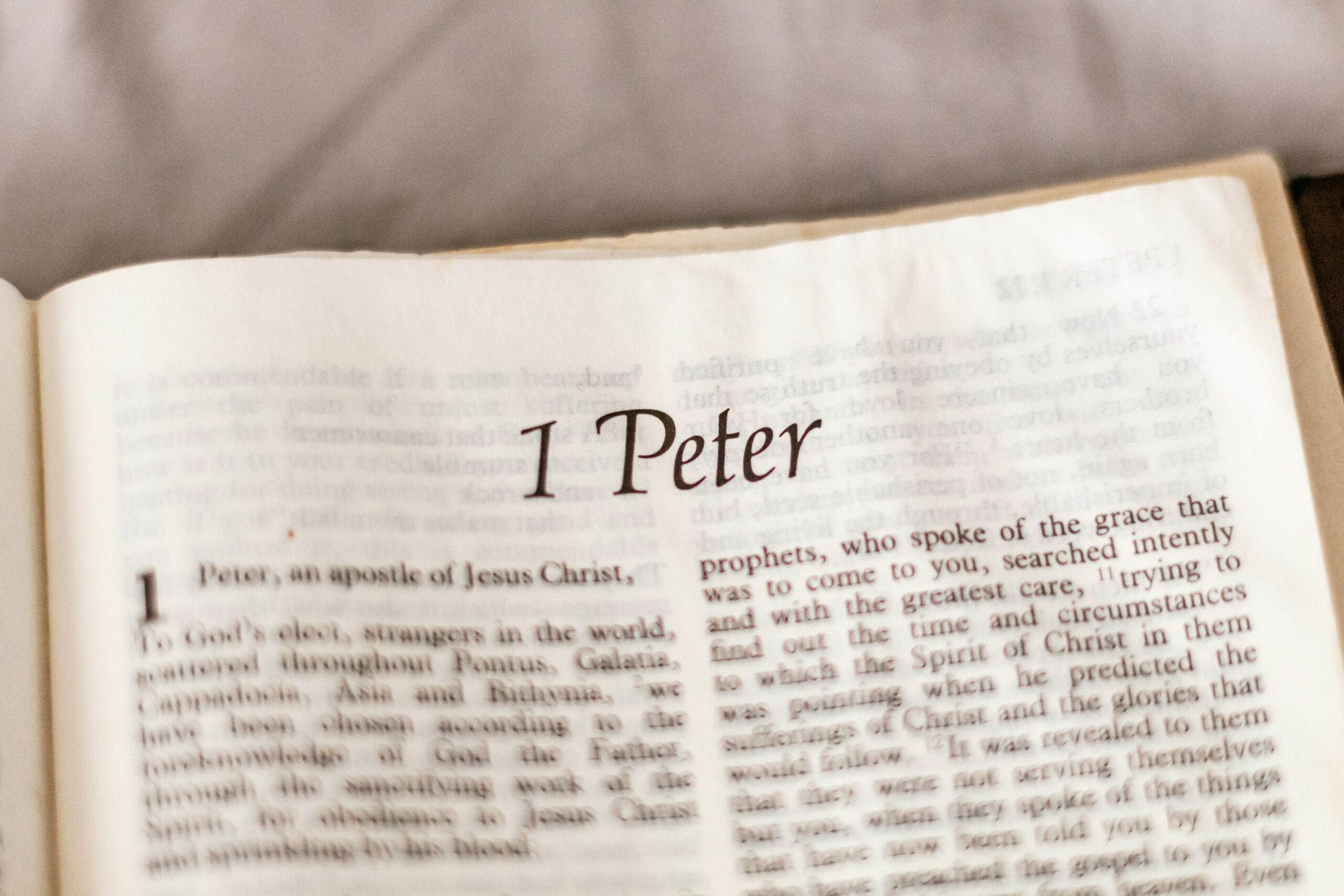
The Shepherd’s Flock
This sermon examines the opening verses of 1 Peter, highlighting the context of persecution faced by the early church under Nero and the enduring nature of the Christian community. The central message identifies three defining characteristics of the church: believers are aliens in the world, scattered by God’s providence for the spread of the gospel, and chosen by His sovereign grace. The tone is pastoral and encouraging, urging believers to find hope in their heavenly citizenship rather than their earthly discomfort. It emphasizes that while the world may view Christians as outsiders, their identity is secured by God’s eternal purpose and the promise that the gates of Hades will not prevail against the church.
Transcript
We will make it past the first
word today. For those of you who are joining
us, the tongue in cheek comment is due to the fact that for the
last three weeks we focused our attention on Peter, literally
the first word of Peter’s epistle, and I don’t. I wanted to be careful
that it wasn’t so much Peter we were looking at as much as
the grace of God that we were looking at in Peter’s life. And
we did so by way of comparing and contrasting the epistle that
we have before us with the life of Peter that we see recorded
for us in the Gospels and the dramatic, drastic, overwhelming
transformation that took place. We saw many of those things in
which Peter was corrected by the Lord Jesus Himself in the
pages of the Gospels play themselves out in Peter’s epistle. Repeatedly,
we came across major topics of Peter’s epistle that had direct
links into the Gospels. The ability of God as opposed
to the ability of man. The nature of God’s holiness,
not as that which is intended to drive us away, but that which
is intended to draw us to God in holiness. The sufferings of
Christ. The sufferings of the saints. A dramatic transformation took
place directly related to the rebuke that Peter received from
Christ. The need of watchfulness. Peter’s
view of the Word in action. Peter’s view of the church. Peter’s
view of the proclamation of truth in the Gospel. Peter’s view of
service to others. Peter’s view of submission to
earthly authority. Peter’s understanding of humility
and service. And Peter’s understanding of
the devil’s ability to influence. All of those things and much,
much more. We saw. And as we looked at what was
supposed to be a one week devotional before the Lord’s table, it became
a three week study of what God had done by his grace in Peter’s
life. And I just tell you, nothing
touched me more personally as a shepherd than to watch Peter
restored into his ministry. There on the shores of the lake,
where Peter had abandoned the ministry and chosen instead to
go fishing, Christ repeatedly admonished Peter to tend his
lambs. And in view of that, in view
of that dramatic scene where Christ restored Peter to the
ministry, We saw the direct relation of that in Peter’s epistle in
chapter five, when Peter wrote, I exhort the elders among you
as your fellow elder, not as the apostle, certainly not as
the first pope, not as a bishop. I exhort the elders among you
as your fellow elder and witness of the sufferings of Christ.
I was there. And a partaker also of the glory that is to be revealed,
Peter was looking forward. Peter said, I exhort the elders
among you as your fellow elder, shepherd the flock of God. I believe right then and there
on the shores of that lake. Where Peter’s heart was seized
by the Lord Jesus Christ. Put him back into ministry, a
ministry that he had abandoned, a Lord that he had forsaken.
I believe right then and there, Peter, And his love and understanding
for the church was transformed. He finally got it. And it was
right then and there that his view of the church would pour
out eventually on the pages. Shepherd the flock of God among
you. Exercise oversight, not under compulsion, but voluntarily
according to the will of God. I believe the church, right then
and there, took its high and rightful place in Peter’s heart
and mind. And there was no other place
that Peter could start when he began to write his epistle than
a view of the church, a view of God’s people called the flock.
If you would, I want to just look at the first two verses,
which after our last three weeks is a monumental undertaking.
1 Peter chapter 1. Let’s begin in verse 1. Peter,
an apostle of Jesus Christ to those who reside as aliens scattered
throughout Pontius, Galatia, Cappadocia, Asia and Bithynia,
who are chosen according to the foreknowledge of God the Father
by the sanctifying work of the Spirit, that you may obey Jesus
Christ and be sprinkled with his blood. May grace and peace
be yours in fullest measure.” Peter wrote to a church that
was already beginning to taste difficulty and persecution. The
church had known persecution almost from its first day. If I could take you Just for
a moment, I promise, on a brief tour of the book of Acts. Turn
to the book of Acts. We’re not going to read these
verses in their entirety, but I want to take you just for a
tour to get a feeling of what the church was enduring and why
the church would be at the forefront of Peter’s heart and mind as
a shepherd. Christ was gone. The world had
already dispatched with Christ on the cruel cross. The enemies
of Christ had attacked him mercilessly. And now they turned their attention
to his followers. Jesus had promised that it would
be just so. He told them not to expect anything
any different. He told them to expect the same
kind of ill treatment that he experienced in the world. They
couldn’t understand the rapid and overwhelming growth of this
movement. The Jews hated the movement.
The Romans hated the movement. And both sought to eradicate
Christianity at its inception. It is none other than a miracle
of God that Christianity survived at all. They were overwhelmed by the
growth and they did everything they could to remove it. Look at Acts chapter 4, verse
1 through 3. where Luke there notes that Peter
and John were speaking to the people, the priests and the captain
of the temple guard and the Sadducees came up to them being greatly
disturbed because they were teaching the people and proclaiming in
Jesus the resurrection from the dead. And they laid hands on
them and they put them in jail until the next day, for it was
already evening. The Sanhedrin immediately ordered
them to stop preaching. They didn’t want to hear any
more about Christ. They were done with this movement, and
they figured that if they admonished them, that it would die. They
didn’t count on the apostles tenacity, they didn’t realize
that Peter had already denied Christ three times and that he
wasn’t going to deny him anymore. The apostles continue to preach
the gospel. And because of that, the high
priest rose up along with all of his associates, all the Sadducees
and Pharisees, and they were filled with jealousy and they
laid hands on the apostles and put them in a public jail. Chapter five. They were miraculously
released from the jail and they went to the temple and kept on
preaching the gospel. Eventually, they were hauled
before the Sanhedrin a second time and the apostles again were
commanded to stop preaching and they would not. Stephen, bold, powerful, first
martyr of the church, faced that kind of opposition. He was arrested
and tried before the Sanhedrin and ultimately martyred. That really is just the beginning
of what has turned out to be a perpetual persecution of the
church. And it is to this church that
Peter writes. And it would get much worse.
And it would get much worse after Peter’s letter. It is written, this letter is
to Christians, Gentiles and Jew dwelling in all kinds of portions
known as Asia Minor. But the backdrop of this letter
is written to a church that has already faced definite persecution
and is preparing to face some of the worst persecution the
church has ever known. Let me give you that backdrop,
if I may. Even the element of persecution,
just the little word means to harass in a manner designed to
injure. There were those that not only
wanted to poke fun of the church. It’s not that they wanted to
ridicule the church. They wanted to damage the church.
They wanted to ruin and destroy the church at its root. And it’s
no less true today. There are those who really and
truly seek to eradicate the church from this world. You see it on
bumper stickers all the time. I was born right the first time.
You know, all those kinds of things. Religion is for the weak,
that mentality. These converts, these new Christian
converts were in the midst of cruel hardships and temptations,
the likes of which we don’t know. And as I’ve said before, so often
it it minimalizes what persecution really is to call what we endure
in this day and age as persecution. These people knew persecution.
They weren’t They weren’t suffering from just a persecution that
was initiated by the state, but from a social ostracism from
the Jewish system, from the Romans. They were ostracized from society. And also from the fanatical Jews
and the hostile pagans that they faced, they were people without
a country. They were compelled to endure
slander and violence and hatred and suspicion. And because of
that, they suffered the loss of goods and even the loss of
life. As one pastor said, the dark
clouds of the first great outbreak of the official persecution were
already gathering on the horizon. It is to that that Peter writes. Emperor Nero would ascend to
the throne, and this is what the the readers of Peter’s epistle
would eventually face was Nero’s wrath. This is what Peter is
readying them for. The first great persecution in
the church took place in AD 67. Nero was the sixth emperor of
Rome, and he gave way to what the church history has described
as the greatest extravagance of temper and the most atrocious
barbarities, said John Fox in Fox’s Book of Martyrs. Now, for
John Fox, who recorded hundreds and hundreds, if not thousands
of atrocities to attribute to Nero, the greatest extravagance
of temper and most atrocious ferocities is really saying something. People. Let’s look at Nero. Fox records that it was this
cruel tyrant who put to death the apostles, Peter and Paul.
I mean, how much more germane to Peter’s epistle is Nero? It is he who began what is called
the first general persecution of the Christians, and in order
to get money, this is the heart of this tyrant, in order to get
money to complete his palace, he would make accusations against
the rich people of the community. And then he would see them tried
in a kangaroo court, and as such, he would take away their property
and eventually kill them. They were put to death, their
property taken. At one point, just merely it seems for his
sheer pleasure, he ordered that the city of Rome be set on fire.
The order was executed by his officers and guards, his servants.
Thousands perished in the blaze. The dreadful conflagration, Fox
records, continued for nine days. The people were panic stricken
and they believed it to be directly related to Nero. Fox records, That it was said when the flames
were at its height, he went up into a tower, sat there looking
down upon the city and played his harp. It’s exactly where
we get the phrase fiddling while Rome burned. When Nero began
to find out that his conduct was being blamed for the fire
and that a severe hatred was directed at him, he determined
to blame the Christians in his community for the fire. Fox records
that he therefore accused the Christians of having set fire
to Rome and ordered them to be hunted down, slain and tortured
in such a variety of horrible ways as awakened the pity of
even the heartless Romans themselves, even new citizens who perhaps
some of which even believed that the Christians were part of this.
Had pity on them, but not Nero. Fox records that this just began
to glut his sight with new cruelties. He became greedy for blood. Some
of this is even hard to read, and so I apologize ahead of time.
Fox records that he had some Christians sewn up in skins of
wild beasts, and then he would have them attacked by savage
dogs until they died. Others he dressed in shirts made
stiff with wax, tied them to poles and set them on fire in
his gardens in order to illuminate the night skies. Nero, meanwhile,
reclined on a balcony and watched the blazing of what he called
torches.” And that’s why I say, people,
we don’t really know what persecution is. To us, persecution is when
a friend or a coworker won’t talk to us because we’re Christian
or they won’t talk about Christianity with us or we don’t get some
favor because we’re Christians. Or because somebody won’t engage
in a lengthy conversation about Christ or because somebody curses
or takes the Lord’s names repeatedly in front of us because we’re
a Christian. That’s what we think persecution is. I believe, just like in this
day, what Peter was trying to tell the people was that these
things were mere harbingers of much worse to come. People, I
don’t believe that we’re facing persecution at all right now.
I believe they’re harbingers of things to come. If it’s true
that evil men will proceed from bad to worse, then our society
will face this again. Our Christian society will face
the sword and the cross all over again. It’s part of the sufferings
of Christ that Peter introduced us to last week. When you see
the spiritual climate in our own country, our world and the
things of God impugned, good and holy things vilified. We live in a very fragile day,
but thanks be to God. that as Tony Evans once said,
Christians are like tea bags. They’re best in hot water. The
true heart, the true nature of the Christian, unfortunately,
can only be seen when the fires of persecution are stoked to
their hottest. To these Christians, Peter writes.
It’s in these circumstances that Peter writes. Peter writes a
letter of encouragement. not only for what they’re facing
already, but for what they will face. Not only for them, but
for us. For us, for whatever kind of
persecutions we face already, and I don’t doubt that some can
be relatively legitimate. None of us have faced the fires
of persecution unto death. None of us have faced even the
threat of death. But Peter writes to us, as to
them, And we will face difficulty in this life. Let me take you
just on a brief tour of Peter again with regards to these sufferings,
this persecution that we are due to face. Chapter 1, verse
6, he acknowledges that they are in the midst, already in
the midst of manifold, all different kinds of trials. In chapter 3,
verse 14, He tells them that they may well have to suffer
for righteousness’ sake. If you are a Christian, if you
are following Christ, then that becomes a good question for us.
If we don’t feel any persecution, if we don’t feel any kickback
from the world, maybe there’s good cause to wonder about our
own walk. In verse 16 of chapter 3, they
are likely to be falsely accused as evildoers. In chapter four,
verse 12, Peter says that a fiery trial is going to try them. Whether
he meant a literal fire or not is up to debate, but he speaks
of an extreme difficulty. In chapter four, verse 19, he
says that when they suffer, they are to commit themselves to God. Not whether they suffer, it’s
when. In chapter 5, verse 9, he tells them that they are merely
sharing in the afflictions which the Christian brotherhood throughout
the world is already called upon to endure. It’s part of our calling
as Christians. John Fox, in the opening pages
of his great book, Fox’s Book of Martyrs, He merely validates what Peter
has already said here by looking back over the course of history.
And he says, what force of princes, kings, monarchs, governors and
rulers of the world with their subjects publicly and privately,
with all their strength and cunning, have bent themselves against
this church? And how the church, all this
notwithstanding, has yet endured and held its own. What storms
and tempests it has endured, it is wondrous to behold.” You
know what? I believe that’s exactly what
was in Peter’s mind. How wondrous it was to behold.
Because Peter knew the church wasn’t going to go away. We introduced
ourselves to Peter over the last three weeks. Peter, Simon, Cephas,
Petras, That image of the stone taken from firmness and strength,
taken from Matthew 16. Peter knew. Peter knew about the nature of
the church because Christ told him. In that great section, and I
repeat just what we read the other day, now when Jesus came
into the district of Caesarea Philippi, He began asking His
disciples saying, who do people say the Son of Man is? And they
said, some say John the Baptist and others, Elijah, but still
others, Jeremiah or one of the prophets. He said to them, but
who do you say that I am? And Simon Peter answered and
said, Thou art the Christ, the son of the living God. And Jesus
answered and said to him, Blessed are you, Simon Barjona, because
flesh and blood did not reveal this to you. You are exactly
right and you got it from God. This understanding of Christ. But my father who is in heaven,
he’s the one that gave it to Peter. Also, I say to you that
you are Peter and upon this rock, that rock of this confession
that you just made, I will build my church and the gates of Hades
shall not overpower it. That’s what Peter was building
on when he opened this epistle. He knew what was coming. He knew
that this was just the harbinger of much more difficulties to
come. When he talked about a fiery
trial, I’ll bet you Peter didn’t even doubt that there would be
those burned at the stake. But he knew. Peter knew and he
believed with all of his heart that the gates of hell would
not prevail over Christ’s church. It would be persecuted, but it
would persevere. One pastor wrote in similar terms,
no matter how beleaguered and persecuted, martyred, rejected
and maligned, poor or ignoble the true church may seem, the
Lord will not abandon His chosen ones. When the people of God
seem weakest, look again. Jesus is still building His church. The original plan is still in
operation. Modern times are no threat to
His sovereign purposes. The circumstances of our troubled
world did not alter his design. And no matter how corrupt and
how worldly the visible church has been or may become, Jesus
Christ is still building his church. I believe that was in Peter’s
mind when he opened this epistle with these words. It’s an interesting sentence
structure as we begin to get into the text itself. Peter,
an apostle of Jesus Christ, to those who reside as aliens scattered,
who are chosen. It’s an interesting sentence
structure. The sentence structure in the original is the chosen
strangers or aliens who are dispersed. The primary purpose of these
three clauses is essentially to open up at the very outset
The transcendent origin and nature and purpose of the church. That’s
what’s in the forefront of Peter’s mind is the church, and he wants
the people of God to know about the nature of the church. As
I told you in the original, the word order is completely different
upside down, if you will. From what we have it, but we’ll
take it in the order in which it’s translated in the N.A.S.
aliens scattered and chosen. We’ll take it in that order. Peter wants us to know about
the flock. He wants us to know about God’s church. And I just
want to give to you three unmistakable features of the church. Three
unmistakable features of the church. First of all, we want
to look at God’s flock as seen from the world’s perspective.
As seen from the world’s perspective, we are aliens. It’s an interesting
word. It’s an interesting word in our
own day and age. Big debate going on. All kinds of discussion and
dialogue and people marching about the whole issue of alien
status. What makes a citizen? It’s a
fascinating word. Aliens emphasize, the word there,
emphasize the transitoryness of those who were staying. It
spoke of somebody who was just passing through, not a permanent
resident, not a citizen. The word is paroikos, oikos being
a home, para being to pass by the home. Paroikos was a man
who was away from home in a strange land whose thoughts were ever
turned towards home. From the Christian perspective,
We are just passing through. We know ourselves to be aliens. And from the world’s perspective,
that’s exactly what they think of us. We don’t belong here. We don’t fit in. We bother them.
We make them nervous. We make them irritable. We make
them uncomfortable. And they consider us to be aliens.
It denotes temporary residents, those who are foreigners, refugees.
Here, what he’s talking about is spiritual aliens. It’s not
just that they were people without a country. It’s not that they
didn’t fit in politically. They didn’t fit in spiritually
by God’s design. They were heavenly people in
an ungodly land. They were Christian people in
the world, but not of the world. They lived here, but they didn’t
fit here. Does that describe you? Do you feel like you don’t
fit in? Do you feel like you can’t participate
in all the conversations at the office? Do you feel like you
can’t get along with all the neighbors in what they do and
how they play? In a sense, Christians have. settled
down in the midst of unbelievers, along with the unsaved, along
with the unregenerate, along with the heathen. And we don’t
fit in. We are just passing through.
We live in tents. We’ve got our eyes and our sights
set on the heavenly city. And that’s where Pilgrim’s Progress
is just such a masterpiece in articulating these truths.
It’s an interesting word I told you about, paroikos. It only
occurs twice in the New Testament, pardon me, twice in the Septuagint,
Genesis 23, 4 and Psalm 38, 13. In the first reference, it’s
interesting, Abraham uses it of himself. Abraham says that
as a stranger and a sojourner, a temporary resident in the land,
in a strange country, dwelling in tents, he is an exile from
heaven because that is his true home. There is a particular malice,
said one Puritan, in the world against all those that are born
of God. They can expect reproaches. These
evil speakings of the world against pious men are partly gross falsehoods
invented without the least ground or appearance of truth. How much
more will the wicked insult upon the least of real blemishes that
can spy out among professors of godliness and in essence,
what he says is watch out, Christian, how you live. You’re an alien,
you are subject to accusation. And if they will fabricate falsehoods
about you, what will they do with that little grain of sinful
truth that they see in you? They strictly pry into and maliciously
object against Christians in the smallest imperfections and
frailties of their lives. Men are apt to impute the scandalous
falls of some particular Christians to the whole number. In other
words, if they see it in you, they’re going to see it in you
and you and you and me as well. They disparage religion because
of those who profess it. How sad. In other words, he says
people don’t give them anything to go on. We’re not going to
live perfect lives, but we ought to try. We ought to seek for
holiness. We ought to seek for godliness. The Christian is the one is the
person who is called and chosen by God. We ought to live as such. We ought to live as citizens
of a heavenly kingdom. The way we live ought to draw
others into that kingdom. All of this makes us a pilgrim.
We’re on the way someplace else. We’re on the way to someplace
better. Someplace far more glorious. Someplace where holiness dwells. One said the pilgrim journeys
by slow stages through many dangers. towards the far off promised
rest. The pilgrim is sustained by a
faith in the unseen, by hope, godly fear and the love of Christ.
He tastes the joy, but only as the wanderer drinks of the brook
in the way.” This will never be home for you people. It’s
not our home. We should be uncomfortable. We
should desire to be elsewhere. I love the psalm that speaks
of the Christian or the godly one as a bird on a lonely housetop. It’s an accurate image of us,
isn’t it? It should be. We don’t fit in. We shouldn’t
fit in. We can’t fit in. The Christians, said one, are
a group of people whose eyes are turned towards God. and whose
loyalty is beyond. The Christian sees life as all
things in light of eternity. And he sees life as a journey
towards God. It is this which decides the
value and the importance of which he attaches to anything. It is
this which dictates his conduct. Hebrews 13, 14 says, here we
don’t have a lasting city. Wherever you’re going to put
down roots, it’s going to be gone in time. It may last a hundred,
a thousand years. But in time, it’s going to burn
up like all the rest of the cities. There is no city here of refuge. Hebrews 13, 14 says, Here we
do not have a lasting city, but we are seeking the city which
is to come. Are you? Or are you so comfortable
here that the term alien perhaps doesn’t even apply. There’s an
old Chinese saying, a Chinese proverb that says, the world
is a bridge and the wise man will pass over it, but he will
not build his house upon it. That’s an interesting saying.
You get a lot of people building their house on the bridge. People,
if you build your house on the bridge and the bridge ultimately
is destroyed, you’re going in the river along with your things. We’re not to park on the bridge.
We’re not to build our lives and place our value and our hopes
and dreams in this life, here in this place. We’re heavenly citizens. Still
another Puritan said it this way, Christians are not marked
out from the rest of mankind by their country or their speech
or their customs. They dwell in cities, both Greek
and barbarian, each as his lot is cast. They inhabit the lands
of their birth, but as temporary residents thereof. They take
their share of all the responsibilities as citizens and endure all the
disabilities of aliens. Every foreign land is their native
land and every native land is a foreign land to them. They
pass their days upon the earth, but their citizenship is in heaven. People, what card are you holding? I remember one time when we went
across the border into Tijuana. To do just a day’s worth of ministry,
and I’m telling you, I was never so happy to have my little driver’s
license that said California, U.S. citizen, so I could get
back across. And I ask you, what what documents
are you holding? Where do you want to live? Because
a Christian is one, an alien is one with different interests
than what this world has. A Christian is one with different
priorities. An alien is somebody who has
different methods about how he goes about life, different loyalties,
different comforts, different goals. Christians, if we rightly consider
are calling in Christ, we cannot settle here. We must never settle
here. We are travelers. We’re passing
through. In fact, a sure sign of danger. What the Scriptures call worldliness
is that of blending in and beginning to feel too comfortable. And
so when Peter writes to these people, the first point that
he tells them, the first acknowledgement of God’s church that he points
out to them is that God’s flock from the world’s perspective
is that we are aliens and it should be our perspective too.
We’re not one of them. We can’t act like them. We can’t
live like them because we’re not them. Secondly, God’s flock,
not only seen from the world’s perspective, but seen from the
gospel’s perspective. Point two, we are scattered. And that is by God’s design,
that is as it should be. Peter elucidates here when he
says scattered throughout Pontius and it’s not just in the city
of Pontius. But around the region of Pontius,
around the region of Galatia, around the vicinity of Cappadocia
in the great area of Asia and Bithynia. There were all kinds of attempts
to describe and explain why Peter picked these particular cities
and the significance and all kinds of spiritualizations that
took place and allegorizations as to what these cities meant.
I don’t believe Peter had any fixed intent on trying to communicate
any particular purpose in using these specific cities. It would
be as if he said Fort Collins and L.A. and New York and all
points in between. Not leaving out Kansas City. These were some of the cities.
toward to where Christianity had already spread. There were
Christians that were scattered about there. Some try to make
a great big deal, as I said, about this word, and it’s unfortunate
because in essence, they try to make Peter’s epistle an exclusive
letter to the Jewish church. I’ll tell you why in a moment.
And that cannot be the case. There was and is one church. It’s a constant mix of believers
at the time, largely Jewish, but including the Gentiles. And
here is where the argument originates. In the New Testament, the word
diaspora, which is exactly the word here for scattered diaspora
in the New Testament, often is a technical term. Referring to
the dispersing of the Jews. Let me tell you about this word,
because I’m a gardener. The word spora, spore, seed,
referred to the means of planting. Dia is just the process of doing
so and the end product thereof. Seed that has been scattered. The Jews, after the Assyrian
and the Babylonian captivities, had been dispersed. They had
been sewn in and around the world and their influence was substantial. But in here, in this particular
use, Peter doesn’t include the definite article. There are other
places where the definite article is used when it says the dispersion,
and that does refer to a group of Jews that has been scattered.
James uses it that way. But not here. Peter doesn’t use
the definite article, he doesn’t say the dispersion, he just says
that these are Christians chosen people, aliens who happen to
be scattered. Even though God called Peter
to be an apostle to the Jews, that’s true. The absence of this
little article, this little word the, argues or suggest that Peter
wasn’t addressing the Jews as such or not exclusively anyway.
What he addressed was those who were dispersed not only from
their native land, but all believers who were dispersed spiritually. This is similar to the point
made earlier about being aliens in the land. The church is composed
of strangers and pilgrims who are scattered throughout the
earth away from their true home in heaven. And that is by God’s
design. The Lord likes it that way. Because
if you go back to the image, diaspora, to thoroughly cast
the seed, Christians are supposed to be Christianity seeds. And the more they’re scattered,
the more they’re dispersed throughout this whole land, the better. Christians are Christianity seeds
wherever they end up, wherever by God’s providence He plants
them. And their Christianity has the capacity to grow and
flourish in a new place. It’s a beautiful point that Peter
makes. So from the standpoint of the gospel, God has us, each
of us, exactly where He wants us. It doesn’t mean you can’t
move. It doesn’t mean that you can’t
go. But wherever you go, you’re going
to scatter the seed of the gospel, the seed of Christianity there.
In that sense, it’s a good thing. And so from the gospel’s perspective,
we are scattered in thirdly and just by way of introduction,
because, you know, if you look at the third point, there is
no way I’ll ever finish it in five minutes. We’re looking at three unmistakable
features of the church, God’s flock is seen, first of all,
from the world’s perspective, we are aliens from the gospel’s
perspective, we are scattered from God’s perspective, we are
chosen. What hope that must have given to these people who are
already facing persecution, already feeling like they didn’t fit
in, already scattered and thinned out through the world, to know
that they are chosen by God, it must have welled up within
them. A well of hope. A life-changing,
life-encouraging concept The Jews particularly would have
been familiar with the concept. Deuteronomy 4.37, they knew the
Scriptures well. Because He loved your fathers,
therefore He chose their descendants after them. They knew about the
concept, at least, of election. It wouldn’t have come as a surprise
to the Jew. Deuteronomy 7, you are a holy
people to the Lord your God. The Lord your God has chosen
you to be a people for His own possession. The Jews would have
seen this merely as an extension of this grand truth of Scripture.
It wouldn’t have shocked them in the least. Moses was chosen
by God. The tribe of Levi was chosen
by God. King David, hand selected by
none other than God himself. The prophets were not sent by
their own authority. They were chosen by God. The
apostles were chosen by the Lord Jesus Christ. God’s sovereign
exercise of selection was a pattern that was established in the Old
Testament. And so it is in the New Testament and explained right
here from the very start of Peter’s epistle that salvation is a sovereign
act of God. It is a pure act of God’s sovereignty. And you know what? It shouldn’t
be surprising to us that many don’t understand the significance
of the doctrine of election. Let’s put it in perspective for
a moment. A thorough understanding of election is not necessary
for salvation. People can come to Christ and
live in Christ for years without really coming to grips with the
understanding of what happened in eternity past. In fact, even George Whitefield,
a firm proponent of the doctrine of election, said this. So let’s
put it in perspective. In essence, he said, let a man
go to the primary school of repentance and faith before he goes to the
university of election and predestination. It’s not important for salvation.
And we burden people with it unnecessarily at times. But it is a truth. And for the
Jew, it wouldn’t have been a hard concept for them to understand.
For the Gentile, for those living in heathen lands who suddenly
found themselves saved, believing in a earthly Christ who had come
and died on a cross, they knew the truth. They had had their
eyes opened. It wouldn’t have been a difficult
thing for them to come to. They knew that they didn’t deserve
the grace of God. They knew that they didn’t deserve
His mercy. They knew that they had lived,
well, like heathens. The word for chosen here is ekletos,
used 24 times in the New Testament. At least 17 of these speak of
the elect as opposed to the rest of the world. You cannot get
away from this concept. You cannot get away from this
sovereign exercise of God’s will. That’s exactly what it means.
It refers to the act of God in sovereign grace, choosing out
from among certain people for himself. And now that I’ve got your blood
flowing. We’ll take it up there next week, we’ll look at the
doctrine of election and we’ll look at what Peter describes
it to be and we’ll look at the nature of what it is. Next week,
let’s pray. O Lord God, we are so humbled
before You. We had precious sampling over
these past three weeks of seeing a man so dramatically changed. Some have believed that he couldn’t
even have written this epistle. And when you compare the Gospel
accounts To what is written here, Lord, we even struggle to believe
it. But we see, Lord, that you changed this man and in a very
real sense, he’s not the same man. He’s a new creation. Lord, we thank you for his love
of the church, his passion for the church. We thank you that
you put it there. You placed him back into ministry.
Father, grant that we examine our lives And that if we don’t
find ourselves to be living as aliens in a foreign land, correct
us where needed. Lord, remind us that wherever
we are, we are scattered there by your sovereign providence.
To land and to grow and to flourish and to spread the grace of Christ. Grant us examine our hearts,
Lord, for your glory. It’s in Jesus’ name that we pray.
Amen.
Messages: 61