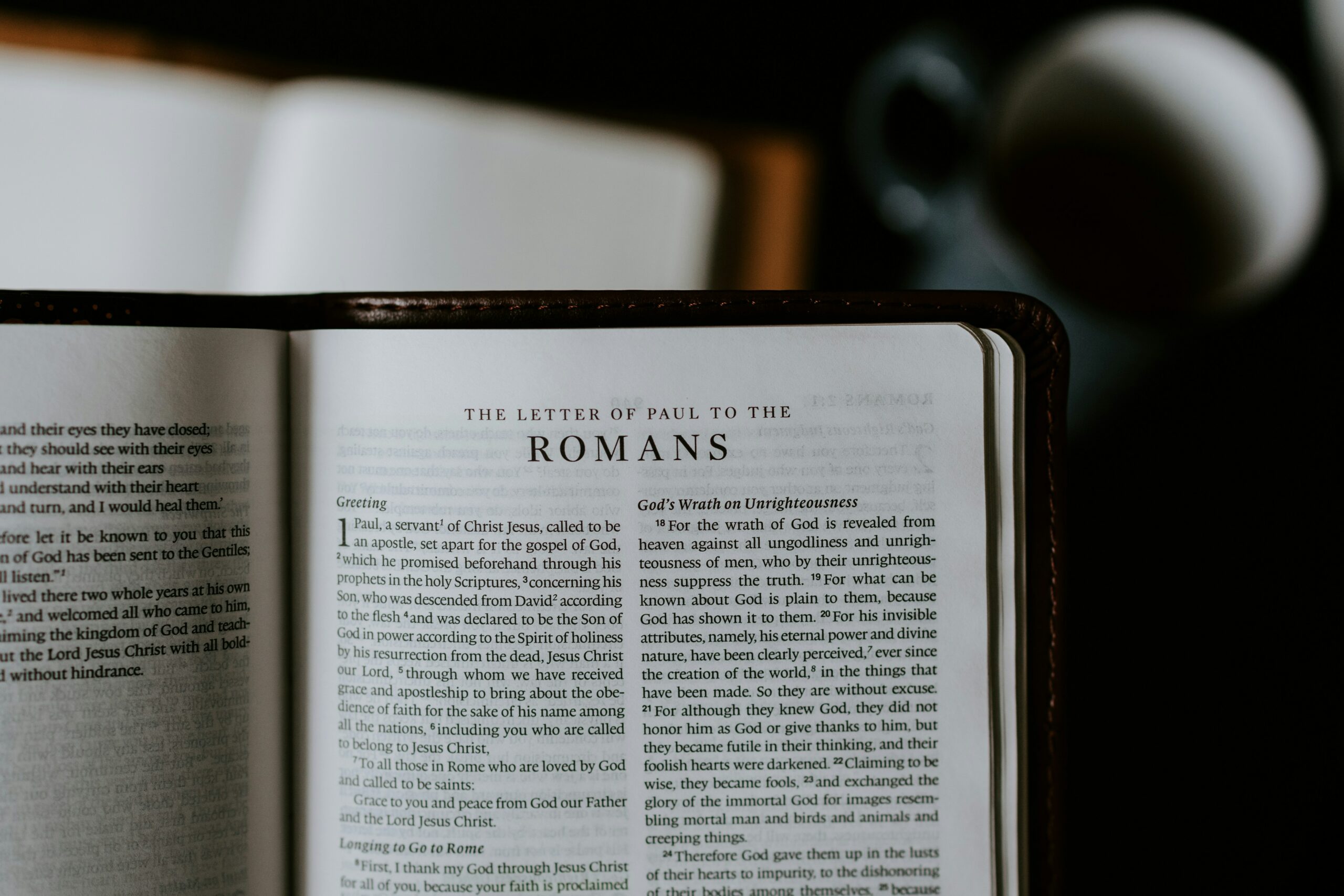
Death to Sin, Part 3
This sermon examines Romans 6 to clarify the theological relationship between justification and sanctification, arguing that believers are not to continue in sin because they have already died to it through union with Christ. The speaker distinguishes between the ritual of water baptism and the spiritual reality of being immersed into Christ, asserting that Paul’s language points primarily to this profound spiritual union rather than merely the external sign. By analyzing the Greek term for baptism and its diverse usage in Paul’s epistles, the exposition demonstrates that the core message is the believer’s incorporation into Christ’s death and resurrection. The sermon concludes by enumerating the extensive spiritual blessings, such as redemption, peace, and eternal life, that flow from this union, emphasizing that the reality of being ‘in Christ’ is the foundation of the Christian life.
Transcript
Romans chapter six. Romans chapter six, and if you’ve
been with us, well, especially if you haven’t been with us,
essentially what we’re doing is working our way through the
book of Romans. We have been through the section
that declare that all have sinned and fall short of the glory of
God. Not only Gentiles, but also Jews are thoroughly sinful and
in desperate need of the righteousness of God, which is the subject
that is introduced in Chapter 3, verse 21. Salvation comes
into view. the only means of salvation for
humanity that God has provided that righteousness that we so
desperately lack. We come then immediately into
Romans six into a new section. Sin, salvation, and here in keeping
with the S theme, sanctification or practical holiness, as many
have referred to it. The whole purpose of this chapter,
as it begins to unfold, is in essence to counter some misperceptions
that might be raised in the doctrine of justification by faith. Paul
is building upon his arguments, and here, as we will see, he
has raised a number of questions, potential questions, Which, if
left unanswered, could potentially lead to serious error. And so,
Paul wants to combat that. In order to do that, he takes
this doctrine of justification by faith to the next step. And
he essentially says that the same God who saves us, the same
God who saves us by his own righteousness through faith in the Lord Jesus
Christ, is the same God who is going to sanctify us and ultimately
glorify us. If you would, Romans chapter
six, beginning in verse one, will course down through to verse
seven. What should we say, then, are
we to continue in sin? The grace might increase. May it never be. How shall we
who died to sin still live in it? Or do you not know that all
of us who have been baptized into Christ Jesus have been baptized
into his death? Therefore, we have been buried
with him through baptism into death in order that as Christ
was raised from the dead through the glory of the Father, so we
too might walk in newness of life. For if we have become united
with him in the likeness of his death, certainly we shall also
be in the likeness of his resurrection, knowing this, that our old self
was crucified with him, that our body of sin might be done
away with, that we should no longer be slaves to sin. For
he who has died is freed from sin. Paul begins that section
with a direct question, what shall we say then? That then
a little word, then pointing back to his doctrine introduced
in three twenty one and following that he draws a conclusion there
in chapter five, verse twenty and twenty one. And Paul basically
begins to reason as his enemies would reason. Perhaps he had
actually heard these accusations verbalized, but Paul wants to
deal with it and deal with it once and for all. And that he
does. He’s drawing a conclusion here, his enemy’s conclusion,
if you will. And he reasons like they would
reason and ties this directly back to his statement in Chapter
5, verse 20. Listen, just as I read it, unless
you’ve got it right there in front of you. And the law came
in that the transgression might increase, but where sin increased,
grace abounded all the more. that as sin reigned in death,
even so grace might reign through righteousness to eternal life
through Jesus Christ, our Lord. Well, given that then those conclusions,
having made such a bold statement, Paul then draws this logical
conclusion, shall we say. that we can continue in sin so
that grace might increase. I mean, that lies logically within
the realm of possibility. But Paul won’t entertain it for
a moment. Paul says that even to think
such as foolish may it never be. We pointed out last Lord’s
Day that when we say, are we to continue in sin? This is not
a skirmish. This is not the struggles that
you and I are well acquainted with. Those occasional flare
ups, those new things that the Lord brings to mind, sinful habits
and tendencies that God in his word by his spirit will faithfully
expose to us throughout our lives. Not talking about those things.
He’s talking about a life that is thoroughly continuing in a
life of sin. sinful patterns throughout one’s
life. Are we to continue to live like
that so that grace would increase? Paul says, may it never be the
strongest possible way that he could think of to say it. The
strongest possible denial that such thinking is even plausible. This idea that the end justifies
the means, that if we just continue sinning, God will continue lavishing
us with grace. It’s foolish thinking, Paul essentially
points out. May it never be. This points
to the fact that Paul’s doctrine of justification was deeply misunderstood. And that if they don’t understand
justification, they’ll never understand the process of sanctification. And so Paul’s challenge there,
his denial is followed by that little sentence that we we almost
would trip over. We almost would ignore Paul says,
may it never be. And here’s his reasoning. How
shall we, verse two, who died to sin, still live in it? And I think the the average person
would say, that’s right, we died to sin. That’s right. When exactly
was that Paul? How exactly did… I appreciate
your argument Paul, but bear with me. You know, he’s teaching
Sunday school. You know, let me just ask one
clarification question. How exactly did that happen?
When was that again that we died to sin? Well, we discovered that death
to sin is part of the gospel. When we’re called to follow Christ,
we’re called to die to self, we’re called to take up our cross. And that that death refers, as
one pointed out, to a specific point in history when it was
a dying to sin, a dying to self, it was the time when we accepted
Jesus Christ as our savior, that was death to sin and self. And that act. involved not only
a willing separation from sin, but a purpose death to sin. When we turn from sin to God. Well, we took up began to take
up last Lord’s Day Paul’s continuing argument, he’s giving an answer
to the question raised in verse one. Shall we continue to sin
that grace might increase? His answer begins in verse two.
It continues in verse three, and that’s where we started last
Lord’s Day, and that’s where we pick up this morning. We’re
Paul adds by saying, or do you not know? Don’t you remember? Have you maybe forgotten some
of those basic theological lessons? Do you not know that all of us
who have been baptized into Christ Jesus have been baptized into
his death? This whole thing raised a question,
this whole idea of death to sin raised a huge question. When
exactly did we die to sin and how? How did we die? What are
the implications of that? Some of us don’t remember that
on the card that we signed, you know, death to sin. But as we began to learn last
week, the very purpose of Christianity was to deliver us from sin, not
to continue to carry us through a life of sin by just lavishing
us with grace in the midst of that sin. One Puritan said it
this way, by way of reminder, the sanctification of believers
rests on the same foundation and springs from the same source
as their justification. Namely, the union, the oneness
with Jesus Christ, and therefore, so far from their being contrary
to each other, they are not merely in perfect harmony, but absolutely
inseparable. And not only so, but the one
cannot exist without the other. In other words, you cannot have
a justified person who is never sanctified. And you certainly
can’t ever be sanctified unless you have first been Justified,
crucial. And what he points to. Is the
fact that what what another characterized this entire chapter as being
an exposition of the doctrine of our union with Christ, that’s
a very important thing, and I’ll come back to it. It’s an exposition
of the doctrine of our union in Christ. It’s going to become
very important for understanding what Paul means when he says
we were baptized into Christ. Look at the passage again. Do
you not know that all of us who have been baptized into Christ
Jesus and we spent no little time last week because on the
face of it, we hear that we say, oh, well, that’s talking about
our water baptism. That’s that’s what that’s talking about, talking
about baptism as we know it. The word sounds like I mean,
that’s exactly what he’s talking about. But as we said last week,
it isn’t as cut and dried as it may initially seem. Is Paul
referring to baptism here? Is there water in Romans six?
Those are the questions that we began to entertain last week.
Remember, the question that Paul is answering was that he had
already told us that we died in Christ. And now here he’s
going the extra mile. He’s stretching out his argument
to tell us exactly when that happened. When did we die to
Christ? According to many commentators,
the moment that we died to Christ was the moment that we went down
in the waters of baptism, when we were drowned, as it were,
in baptism, buried with Christ there in baptism. Is that what
Paul’s referring to here? Is Paul referring to water baptism
here in Romans six? Is Paul referring to the right
R.I.T.E. or the reality? I came to suggest
to you last Lord’s Day. There are a number of options.
Many people take the baptism, water baptism. That’s what Paul
was talking about in Romans six. There were some and some heavy
hitters, frighteningly heavy hitters. that said that no, the
only thing Paul is talking about here is the reality. And as I
suggested last Lord’s Day, the only problem with that is that
Paul uses an extremely loaded word, a word that absolutely
would have been known to the Roman church as referring to
the right of baptism. What Paul does here, I believe,
Because he puts forth the reality, the incredible reality. And I hope, I hope when you walk
out of here in 37 minutes, I hope that you walk out of here with
your hearts swelled with the knowledge of all that it means
that we have been placed into Christ and all of the blessings
that come with that. That’s what Paul is putting forth
primarily. But what stands in the background
as a ready and able and perfect figure of that reality is the
figure of baptism. That’s what I believe Paul’s
doing here. We began to look at a number of considerations
that I told you this is all born out of my God given love of grammar. It didn’t start out that way.
As I told you, this was and it didn’t work with math either.
You know, math was another deal that would be another miracle
for God down the road to deal with me. But he did give me the
love of grammar. And that’s where we’re going
to park today. Maybe someday I’ll stand up here and give you
a math lesson. Well, we pointed out there were
a number of things that I’m going to go through these and really
rapid fire succession by way of reminder. That we pointed
out that there are a number of things that we need to consider
when we look at this, this issue of is it the right of water baptism
or is he talking about something much, much deeper? Is he talking
about the reality of our having been placed into Christ? And
I suggested that we have to first begin by considering the difficulty
presented by transliterated words in general, and I spent no little
time, and I don’t have time to repeat any of it today, other
than to say that transliterated words are those that sound like
what they sounded in the original language. We have them in Hebrew,
we have them in Arabic, we have them certainly in Greek. They
sound like what they are in their original
language. The problem is they don’t import over the meaning
and so the meaning then becomes yet to be defined and it can
grow and flourish and we can keep on on whatever meaning we
want onto the word to the point where with baptism, as we pointed
out, you hear the word baptism. We only think of one thing. When
in reality. The word baptism, point two,
as we looked at our outline, the word baptism simply meant
to immerse, to dip, to dunk, to plunge. That’s what baptism
meant. As one defined it, the introduction
or placing a person or thing into a new environment. And many of us have experienced
that kind of event, being immersed into some new society, being
immersed or placed into some new relationship. That’s what
the word means. And rather than allowing the
word to take this course where its meaning becomes defined over
time, it’s far better to look And to consider the word itself,
what did it mean in its original sense? It meant to immerse. And
as I suggested last week, it is not illegitimate to translate
verse three in this way. Do you not know that all of us
who had been immersed into Christ Jesus have been plunged into
his death? If you don’t change the translation,
some of us would never get it. Some of us would never even consider.
Oh, yeah. Immersed into Christ, I get it
now. Thirdly, I suggest I suggested
that we have to consider the preparation of preposition used,
the preposition used. Consider the preposition. We
are baptized into Christ. And we pointed out last week
that we don’t tend to speak of it this way, though it is true
that when we are baptized, we are baptized into water here. We are immersed into that water,
but Paul doesn’t say that here. What Paul says here in Romans
6 is that we are baptized into, immersed into Christ Jesus. And he’s got a point to make,
and it’s a profound point. And if we miss it, we miss really
even the symbol of baptism. Come with me. The fourth thing
that we talked about is that we have to consider the potential
abuse of baptism otherwise. If Paul is just merely Talking
about the figure of baptism here, no wonder that throughout history
people have said, yes, you’re saved at the moment you go down
in the water, you go down with your sins and when you come up,
your sins are washed away and we should write hymns about it.
Well. That’s not what happened. The New Testament clearly teaches
that. The only ones that are to be baptized are those who
have already provided evidence that they are regenerated. Whom
God has already placed into Christ and that baptism then for them
becomes a figure and a mighty figure at that. New material begins here. Point five and we just opened
the door last week. We just cracked the door and
peaked our toe in. Number five is essentially this.
Consider Paul’s diverse use of the word baptism elsewhere throughout
his. And you’re going to have to just jot down some of these
because I’m not going to turn to all of them. Paul only uses
the word baptism just over a dozen times in all of his epistles.
The interesting thing is that not all of those occasions refer
to the right R.I.T.E. of Christian baptism. They don’t. Now, he does make a big deal
of baptism in a number of places. He does refer, I mean, explicitly
to water baptism. It’s not that we could draw a
conclusion and say Paul didn’t care about baptism or Paul, you
know, didn’t know about baptism or Paul didn’t play up the importance
of baptism. That’s not true at all either.
1 Corinthians 1.13, absolutely talking about believers baptism,
a lengthy discussion. Has Christ been divided? Here’s
what was going on. People were arguing over that
their baptism was more important than another’s. And that boy,
I really, I’m a much better saint in God’s standing because I was
baptized by Paul. Well, Paul would have none of
that. Has Christ been divided? Paul was not crucified for you,
was he? Or were you baptized in the name of Paul? Paul says
it’s ludicrous to get into that kind of argument. If you’re ever
baptized in this church, it doesn’t matter who baptizes you. I thank God that I baptized none
of you except Crispus and Gaius, so that none of you would say
you were baptized in my name. Now, I did baptize also the household
of Stephanus. Beyond that, I do not know whether
I baptized any other. For Christ did not send me to
baptize, but to preach the gospel, not in cleverness of speech,
so that the cross of Christ would not be made void. Now, Paul does
not downplay baptism there. He just says that wasn’t his
particular calling. There are many in the church
that followed along with Paul, co-workers as it were, whose
duty it would have been to baptize. It wasn’t Paul’s. Ephesians 4, verse 5, absolutely
talking about literal water baptism. One Lord, one faith, one baptism. Colossians 2, 12, absolutely
talking about literal water baptism. Having been buried with him in
baptism, in which you were also raised up with him through faith
in the working of God, who raised him from the dead. I think that’s
absolutely talking about water baptism. And the imagery is very
similar to Romans six, but it’s imagery in Romans. I mean, in
Colossians, whereas Romans here is talking, as I said, about
the reality. Galatians 327, here’s a difficult
one. If you want to turn to these,
if you’re fast enough to turn, that’s fine, too. But I’m going
to move along quickly. Galatians 327. There’s a that’s
one to be studied. I’ll just tell you what he says
for all of you who are baptized into Christ have clothed yourselves
with Christ. He’s using the same imagery that
we have here in Romans, and he’s using the same word. But the
very fact that we are baptized into Christ raises the question,
does he have here again the reality in view or is he merely talking
about the ritual? I personally believe that Paul’s
intent here is not unlike his intent in Romans six. The reality
of the immersion into Christ is prominent with the figure
of baptism in the background. That’s that’s a fairly easy one. 1st Corinthians 10 to now we
get a little more difficult. 1st Corinthians 10 to where Paul
says in verse one, I do not want you to be unaware, brethren,
that our fathers forefathers in the faith were all under the
cloud and all passed through the sea and all were baptized. Into Moses. In the cloud and
in the sea and all ate the same spiritual food. We that’s a difficulty. Some suggested that the Hebrews
maybe have this baptism, this right of baptism, which we know
almost nothing about. The word here, though, if you
use it in its general sense or of dipping or immersing, does
begin to make sense when you talk about being that the Hebrews
were immersed into Moses. into Moses economy, they were
immersed into a close communion and relationship with Moses. As one said, it made them disciples
of Moses. It placed them under obligation
to recognize his divine commission, to submit to his authority. The
display of God’s power in the cloud and in the sea brought
the people into the relation of disciples of Moses. It inaugurated the great congregation. I think that’s accurate. I think
what it’s talking about is that they were literally immersed
into Moses into the mosaic economy. That very passing through the
cloud brought them from a state of bondage into from that yoke
that they were under. for Pharaoh in Pharaoh into this
new relationship, guidance by God through the leader who was
Moses. Enough of that way. First Corinthians
1213 is another difficult one. First Corinthians 1213 says,
for by one spirit, we were all baptized into one body. Whether Jews or Greeks, whether
slave or free, we were all made to drink of one spirit. Remember
that time? We don’t typically tend to speak
of things that way. We don’t tend to think of our
water baptism as having been baptized by the spirit. The Bible
distinguishes between those two events, a baptism by the spirit
which is a baptism into Christ, I believe, and a water baptism,
which represents what the Spirit has already done. As one said,
it is not, therefore, by baptism as an external right, but by
the communication of the Holy Spirit that we are made members
of the body of Christ. That’s what water baptism represents. First Corinthians 15, 29, the
most difficult of all. hang on your hat for this one. Where Paul says in first Corinthians
fifteen twenty nine. Otherwise, what will those do
who are baptized for the dead? If the dead are not raised at
all, why then are they baptized for them? Now, if you want to stay tuned,
because in about twelve years, I purpose to take up the study
of the Book of Corinthians. And in probably three or four
years, hence, I will be in chapter fifteen of First Corinthians
approaching probably my seventies. By the time I even take a stab
at answering what this question means. There are three possible
three viable explanations, one said that it was a practice that
was prevalent in Paul’s day, permitting persons to be baptized
on behalf of on behalf of their dead relatives. Now, as outlandish
as that seems, when you begin to think of the Catholic doctrine
of saying masses for the dead and getting people out of purgatory
and that whole thing, it had to start somewhere. Perfectly
plausible explanation that Paul is addressing this. He’s not
endorsing it. He’s just saying he’s acknowledging
you believe in resurrection, obviously, because you’re being
baptized for your dead relatives. It’s a possibility. Like I said,
I’ll let you know, as baptism was a death and to sin, everyone
who was baptized was baptized for the dead. That’s another
plausible explanation. The third possible explanation
was that it referred to the baptism of trial and suffering through
which the disciples were called upon to undergo. Well. I mean,
when Paul talks about a baptism for the dead, I think he’s talking
about something a little more literal than just the potential of death
that’s out there. By the way, there are at least
36 known explanations of that particular verse. So, I need
some time to study it. Stay tuned on that one. So, Paul uses this
word very diversely. Very diversely, he uses the word
baptism. And as such, we need to take
pause when he says here in Romans 634 that we were baptized into
Christ. What does that mean? What does
it mean? As we’re considering the facts
of the case, consider also point six, consider the imagery used
about our relationship to Christ elsewhere in Scripture. Consider
the imagery when he talks about the vine and the branches that
we are one with Christ, that we have a absolutely crucial
unity to Christ. You cut off the branch, the plant
dies. Not the vine itself, Christ will
flourish, Christ will live, but if you clip off a twig, it’s
dead. He also uses the relationship
of the husband and wife. to the point where it’s so back
and forth in Ephesians chapter five, that at some point you
don’t know what he’s talking about. Is he talking about the
husband wife relationship? No, he’s talking about Christ
in the church. I’m talking about Christ in the church. But then
all of a sudden you think he’s talking about the husband wife. One of the regular images that
Paul uses is the body of Christ, of which Christ is the head.
Now, you ask me, why am I telling you all this? Because if Paul
is talking about merely a ritual and he’s putting the ritual in
front of the reality when we never, ever focus on the reality,
when in throughout the rest of the scriptures, there are these
rich images that point to the reality that we are in Christ
like a husband, wife, that we are in Christ like a vine in
the branches. What about a building? We are
in Christ like a building of which Christ is the cornerstone. It’s rich imagery throughout
scripture, and it’s there and it’s real. Point seven. Consider the description of baptism
in our confession. Now the confession, whether you
look at the Westminster or the 1689 Baptist confession, essentially
they’re the same. So it’s not talking about the
mode of baptism. That’s not the concern here.
What’s in view is what is the imagery of baptism? What is the
meaning? Listen to what the 1689 describes
it as. Baptism is an ordinance of the
New Testament. We would all say yea and amen
to that. Ordained by Jesus Christ, yes, to be to the party baptized
a sign of his or her fellowship with him in his death and resurrection,
of his being engrafted into him of remission of sins and of his
giving up to God through Jesus Christ to live and walk in newness
of life. An echo of Romans six, one of
the verses that’s quoted. But it’s absolutely crucial to
pause and reread that. That it is to be to the party
baptized a sign. It’s not the reality. It’s a
sign of the reality. It’s a sign of the fact that
we have fellowship with Christ. It’s a sign of the fact that
we have been engrafted into Him. It’s a sign of the remission
of our sins. It’s a sign of our giving up
to God. It’s a sign that we rise to live and walk in newness of
life. But it’s not the reality. It’s
a symbol. Consider the significance point
eight of baptism. What is baptism all about anyway?
And I would say that based on this very passage, immersion,
that is, baptism in water where the professing believer goes
down into the water is an appropriate image for what God has done in
our lives. As one pastor said, only immersion
fits the reality which baptism is the picture. The reality is
that the believer at salvation is united with Christ in his
death and resurrection. Only immersion symbolizes death,
burial into the water and resurrection of new life coming out. Only
immersion maintains the picture, the image of the reality that
baptism signifies. And so based on Romans six, Baptism
by immersion in water is the best illustration of all. It’s
a God given illustration of what God did. Immersion in water is
a perfect illustration, a perfect symbol of what Paul is referring
to here, but it’s not the reality. It’s not the reality. The image
of water baptism is nothing without the reality. It’s nothing without
the reality. So our immersion into Christ,
the symbol. The symbol is presented elsewhere.
And it’s alluded only alluded to only here by a creative use
of a very loaded word, the word baptism, but what Paul has in
view is the reality. Number nine, consider the context
of the passage. The context of the passage is
literally the oneness of life. That’s the fundamental thought
of this passage, that we have oneness with Christ, that we
are in Christ. As one said, baptism merely with
Christ in view. In other words, we’re baptized
and Christ is out there in some general fashion. We know about
him, but we’ve never experienced him. Baptism merely with Christ in
view falls short of the argumentative requirements of the passage.
which demand the idea of an actual union to or incorporation in
Christ. To say that faith justifies but
baptism regenerates, breaking the Christian life into two unrelated
pieces, is to throw away the apostles case. Justifying faith. Looking to Christ and his death
really and truly unites us into him who died and rose again. But Paul is speaking of here
is one of one pastor said he is speaking metaphorically of
the spiritual immersion of believers into Christ. That’s pure and
simple what he’s talking about. But there’s a 10th thing, and
this is what we’ll close with. It’s that lengthy. There’s a
10th element that I want you to consider this morning. Consider all of the blessings
that we enjoy as Christians. Because of the reality of our
being in Christ. I began to do this several weeks
ago, and it is an absolutely overwhelming list. It produced
a book, a booklet, And I don’t want you to even try to take
notes because you won’t keep up. I have a book for each of
you at the door for each of the families. What I’m suggesting
to you, and when I say, by the way, that I’m preparing to close,
I don’t mean fold up your Bibles and get ready. We’re not going
anywhere for a while. What I’m suggesting to you is
that what Paul is talking about here is not water baptism, not
the image, but the reality. The image stands directly behind
the reality, but the reality is in focus, that we are in Christ. We have been immersed into Jesus
Christ, and it is not an obscure concept. In fact, everything
that we enjoy as Christians hangs on that truth, on that reality,
that we are in Christ. In other words, I want you to
consider the sphere into which we have been placed because of
our union with Christ. I’m going to go book by book.
So does the little booklet. I arranged it in that fashion
and you can use it devotionally later on. These are great things
to meditate on, to take and savor. and to take them down and to
really meditate upon what it means to have been placed into
Christ and to now enjoy these special blessings. There are
dozens and dozens and dozens. I’m just going to skip along
the peaks. First of all, from the book of
Romans. We have redemption. We have redemption. I know that
sounds simplistic, but when Paul started his articulation of the
gospel, he said that now, apart from the law, the righteousness
of God has been manifested, being witnessed by the law and the
prophets, even the righteousness of God through faith in Jesus
Christ for all who believe, for there is no distinction for all
have sinned and fall short of the glory of God being justified
as a gift of his grace through the redemption. which is in Christ
Jesus. We have redemption. We have peace
with God, Romans 5.1 says. We have peace with God through
our Lord Jesus Christ. We enjoy God’s grace, which we
never before experienced outside of Christ, nor would we. Our
Lord Jesus Christ, through whom also we have obtained this introduction
by this grace in which we stand, we would have no hope. Without
the grace of God, we have been saved from the wrath of God.
Romans 5 9, because of our union with Christ, we have reconciliation
with God. Romans 5 11, speaking of the
Lord Jesus Christ, through whom now we have received the reconciliation. As a result, we have eternal
life. Romans 5 21. We have union with Christ, and
I don’t I pause specifically at Romans six, three and four
to point that out. It’s the only place in all of
Scripture. If you put that forward, it’s
the only place with that that reality is clearly articulated
that we have been placed into Christ. All of the rest of these
are the blessings that come with that reality. We enjoy resurrection. Because of our union with Jesus
Christ, Romans 6, 5, united with him in the likeness of his death,
united also in the likeness of his resurrection. We have no
condemnation. There is therefore now no condemnation
for those who are in Christ Jesus. We enjoy the love of God, Romans
8, 38. We enjoy union and unity. That not only are we placed into
union with Christ, but we are placed into unity with one another. We who are many are one body
in Christ. First Corinthians introduces
us to a whole new host of blessings. First Corinthians 1.2 says that
we are sanctified in Christ. First Corinthians 1558 tells
us that when we labor, whether it’s Sunday school or picking
up chairs or teaching or preaching, whatever we do in the cause of
Christ serving our brothers, we have fruitfulness of service
because of our union with Christ. Paul says, therefore, my beloved
brethren, be steadfast, immovable, always abounding in the work
of the Lord, knowing that your toil is not in vain in the Lord. Second Corinthians opens to us
a number of additional blessings that we are established. We are
established. That’s something we don’t talk
about every day, is it? What was the last time that you
told someone I have been established in God? Now, he who establishes
us with you in Christ is God. God is the one that establishes
us, but he does it in union with Christ. In Christ, we have regeneration. The spectacles of faith have
been given to us. We now see the veil has been
removed in Christ. 2 Corinthians 3, 14, 2 Corinthians
5, 6 talks about how we will enjoy our eternal home because
of our union with Christ in Christ. 2 Corinthians 5, 17. We have renewal. We’ve been made
new. Therefore, if anyone is in Christ,
he is a new creature. Old things have passed away.
Behold, new things have come in Christ. We have righteousness. The very thing that Paul talked
about as he articulated that the gospel itself, the hope of
humanity, he made him who knew no righteousness. Second Corinthians
521 to be sin on our behalf so that we might become the righteousness
of God in him. Wow, Galatians gives us more. The book of Galatians says that
in Christ we have liberty, in Christ we have justification.
We have been justified through faith in Jesus Christ, in Christ
Jesus, we are justified by faith. Ephesians, you know this. You open up chapter one of the
book of Ephesians and they just begin to roll one after another. All of the blessings that we
have because of our union with Christ. Listen, Paul says that
at the outset, and maybe this would have been enough for some.
Blessed be the God and father of our Lord Jesus Christ, who
has blessed us with every spiritual blessing in the heavenly places
in Christ. But that has reality. There are things that that speaks
of that Paul can’t wait to share. What blessings, Paul? Election,
Ephesians 1.4, adoption as sons, Ephesians 1.5, revelation, Ephesians
1.9. He made known to us the mystery
of his will according to his kind intention, which he purposed
in him, that is, in the Lord Jesus Christ. We’re not let in
on the secrets if we’re not in Christ. We have an inheritance
in him. Ephesians one eleven. We are
sealed in him. Ephesians one thirteen. Ephesians
one eighteen through twenty says that in him we have hope and
glory and power. Ephesians two four through seven
says that we have regeneration and resurrection and enthronement
and grace. Ephesians two seventeen says
that in him. Through Jesus Christ, we both
have access to one spirit in the Father. We have access to
God because of our union with Christ. In Christ, Ephesians
219 says that we are being built up into a whole new spiritual
temple never before seen in the economy of God. In Christ, Ephesians
311 says that we have boldness and confident access through
Jesus Christ, our Lord. In Jesus Christ, because of our
union with him, we have growth, we grow. We begin in this process
and we grow and we flourish. Through whom the whole body being
fitted and held together by that which every joint supplies, every
one of us has a role, every one of us. Finally, in Ephesians
610, we have strength. Be strong in the Lord. There
is no strength outside of Christ. Not really. And in Christ, there
is strength like no other. Philippians gives us more. Philippians
tells us of our sainthood in Christ, joy in Christ, the upward
call of God in Christ Jesus, steadfastness in the Lord, harmony
in Christ. What about spiritual needs? Paul
says that in Christ, Our God will supply all of our needs
according to his riches and glory in Christ Jesus. There is nothing.
There is nothing that God withholds from us. Colossians tells us
of completion, that we are made complete in Christ, that we are
literally brought to life in Christ. Colossians 2.13, that
we are hidden with Christ only to be ultimately revealed with
Christ. Colossians 3.2-4. First Thessalonians
tells us about the rapture and eternal life and joy. Second
Thessalonians points to our glorification in Christ Jesus. Second Timothy tells us that
in Christ we have divine purpose and grace. Second Timothy 2.10
says that there is salvation in Christ Jesus and with it eternal
glory. And finally, in the book of Titus,
it points to the fact that we enjoy the Holy Spirit because
of our union with Christ. What Paul is pointing to here,
he’s not talking about a ritual that talks about those things.
He’s talking about the reality of our being in Christ, the profound
reality and all of the blessings that that brings. Paul is referring
to the reality, not merely the symbol. The symbol stands in
the background, and it’s a powerful and mighty symbol. But what Paul
wants us to know, first and foremost, is the reality of our union with
Christ. Lloyd-Jones said it this way.
There is nothing. Perhaps in the whole range and
realm of doctrine, which, if properly grasped and understood,
gives greater assurance. greater comfort and greater hope
than this doctrine of our union with Christ. The great thing
in salvation is that we are not only justified, not only forgiven. In a sense, the most glorious
aspect of salvation is that I am in Christ and Christ is in me.
All that is in Christ and true of Him in His relationship to
the redeemed is mine and I in Him. And all that Adam did and
accomplished became mine. All that Jesus Christ has done
and accomplished now becomes mine. What Paul is talking about is
the reality. And the children of God need to hear about the
reality of what God has done in placing them in Christ. In
Christ we have every spiritual blessing. Let’s pray. Our merciful God. We humble ourselves
before you. We knew that it was salvation.
We began to grasp some of the blessings, but when we stand
back and we see all of the blessings and really, we’ve reviewed this
morning only a few. Of the blessings that you’ve
given to us because of our union with your son. The Lord Jesus
Christ, Father, we are humbled and we are thankful and we rejoice
in the goodness and grace of the God that placed us in Christ
and he and us. We thank you and we praise you
in Jesus name. As we close, if you take your
bulletins, let’s stand together and sing one pure, holy passion. Give me one pure and holy passion
Messages: 204