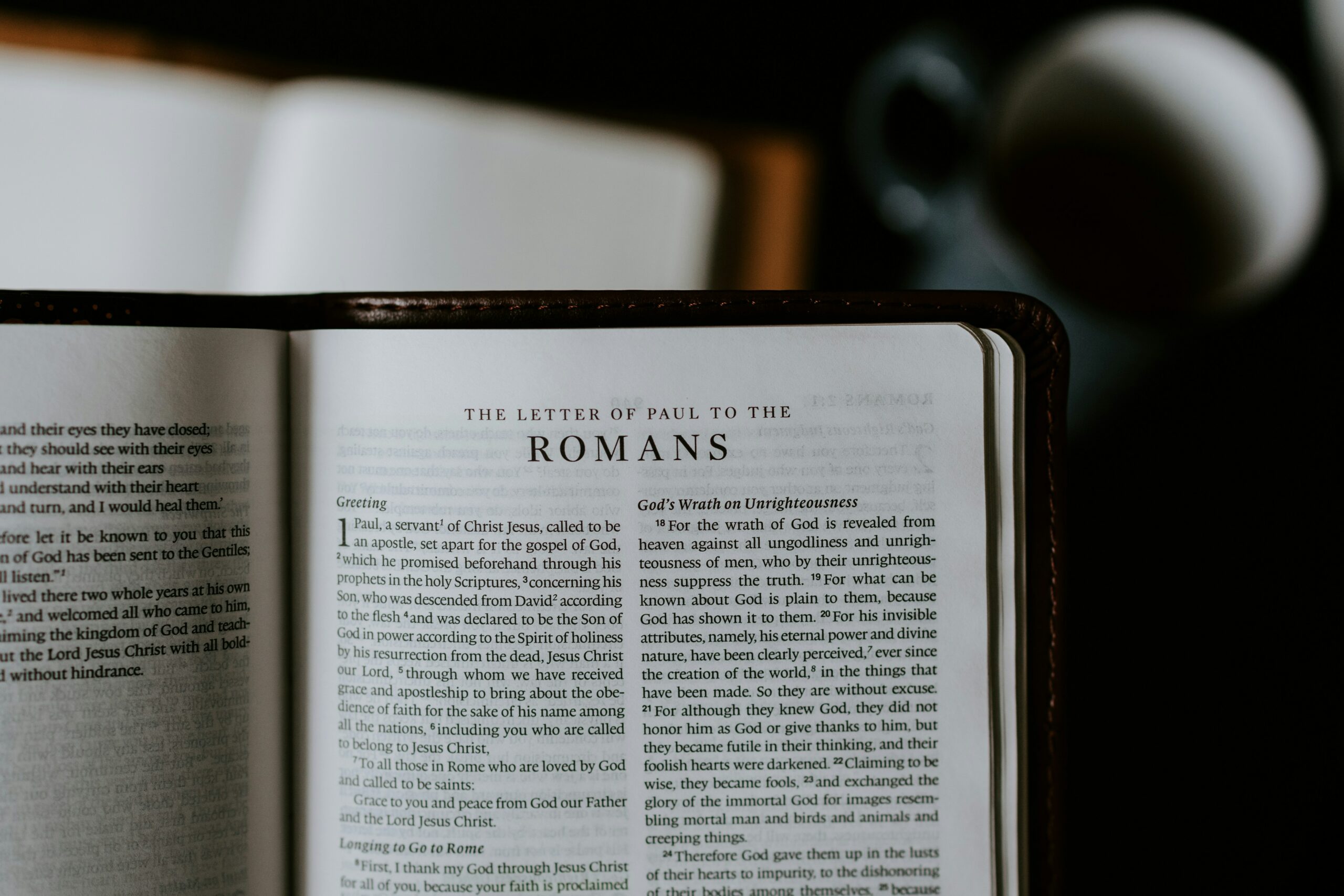
Grace: The Blessing of Faith
The sermon examines Paul’s argument in Romans 4, demonstrating that Abraham was justified by faith rather than works to dismantle the Jewish reliance on human merit. It highlights the theological concept of imputation, where God reckons faith as righteousness, contrasting the obligation of wages with the gift of grace. The text asserts that even the patriarch Abraham was an ungodly sinner who relied entirely on God’s promise, establishing a divine history of salvation that precedes the Mosaic Law. This exposition emphasizes that boasting is excluded because salvation is wholly of God, achieved through faith in Christ alone. The tone is instructional and convicting, urging believers to abandon self-effort and rest in the finished work of Christ.
Transcript
If you go back once again to
the Book of Romans, to Chapter 4, there are no provided notes
for you today. If you would find Romans 4 in
your Bible, that would be adequate for us today. We’re going to
take a stealthy pace through these eight verses. Paul has begun this incredible
subject of salvation as he opened in 321 with that great theme
of salvation that now apart from the law, the righteousness of
God has been manifested. And with those words, Paul does
delved into this great theme of salvation as we have been
meditating and enjoying just the sheer reminder of all that
God has done on our behalf over these past few weeks. We saw
that that was the simple sentence that the righteousness of God
has been manifested, not as something new, but in a new way and a deeper
understanding of it. The righteousness of God has
been opened to us, that righteousness we came to learn was a righteousness
that is completely apart from the law, not by virtue of what
we can attain to by living according to the law. We saw also, and
it will be particularly germane to the discussion this morning,
we saw that this righteousness that has been manifested was
testified to by the law and the prophets. This wasn’t anything
new. This was God’s program, as we’ll
see even this morning. This righteousness was that which
is through faith in the Lord Jesus Christ for all who believe. We spend no little time on that
opening section, but the theme will carry itself not only through
the verses that we consider today, but even through the greater
portion of the entire book of Romans, the righteousness of
God, justification by faith. That is the means of salvation. And we’ll visit some of those
same themes even this morning. Now, Paul moved on from there.
And he told us that the revealed means the way that God has opened
up this righteousness to us, first of all, completely is of
God. It is wholly of God. That’s what
verse twenty seven speaks about. When Paul says where then is
boasting, it is excluded. It is utterly obliterated, as
we’ll see again by way of reminder this morning. Salvation is purely and completely
of God. By what kind of law, Paul says,
of works? No, but by a law of faith. For
we maintain that a man is justified by faith apart, again, from the
works of the law. It is completely of God. Salvation
is an act of God’s mercy, not an act of our works. We saw further in that section
that This salvation, this salvation by the righteousness that God
has now manifested is consistent. It just fits with the God of
salvation. It fits with who God is in his
nature. God isn’t the God of Jews. Only
God is God. And as God, he is God of all. And the same laws that apply
to one apply to all the same means of salvation that is available
to one is available to all. Thirdly, we saw from that section
in verse twenty seven to thirty one that this revealed salvation,
this justification by faith, this righteousness of God, which
has now been opened up to us, doesn’t nullify or obliterate
the law. Instead, it affirms it. Paul
said it in verse thirty one. Do we nullify the law through
faith? Does justification by faith nullify
the law? Paul essentially says heaven
forbid. No way. May it never be on the
contrary. We establish the law. Paul had
said we wouldn’t even know what sin was. If we did not. First, have the law. If we did not have that echo of the weightiness of our own
sin, knowing that God disproved of our life in that regard. And with that, Paul turns to
present a case before them. He has said that salvation was
testified to by the law and the prophets. And now he takes opportunity
to present that before them. To turn again to the Old Testament
and to point them back to the patriarchs, back to the prophets
and back to those who testified clearly that salvation has always
been justification by faith. The case first presented is the
case of Abraham, which is essentially presented as an illustration
to Paul’s argument already advanced that when it comes to salvation,
all boasting is utterly denied. There is no room for boasting
before God. The Jews. would often cite the
case of Abraham. And that’s exactly what Paul
does here. Remember, there is a rich dialogue taking place. There isn’t somebody sitting
before him literally, but Paul is, as it were, playing off all
of those Jewish arguments that so often were advanced in contrast
to the Gospel. And Jews would often cite the
case of great father Abraham. as a case that was so clear that
he had been justified under the old covenant and under the law. And because he had obeyed God
for them, it was a clear case of justification by works. He
had been obedient. We, too, must be obedient. That
was their argument. Paul points out that it’s absolutely
to the contrary. That everything here from this
point forward depends on faith, and it’s an act of faith parallel
to that which Abraham exemplified. So essentially, the function
of this section here, beginning in chapter four, verse one, is
to essentially confirm what Paul had already said. Where then
is boasting? It is denied, it is utterly denied. If Paul took them, as it were,
back to verse 26 through 31, what he did was say, where is
boasting if you look at the great truths already advanced? As we
saw last week, righteousness, the righteousness of God has
been manifested in a brand new and powerful way like never before. Never before have sins been so
completely paid for. by a suffering Savior. Since
this saving righteousness was completely apart from the law,
that was a new concept to the Jew. It was proclaimed throughout
the Old Testament, and yet they missed it. It comes only through
faith in Jesus Christ, regardless of which side of the cross you’re
living on. It was always salvation through
faith in Christ. It comes to all who believe. There is no longer any distinction
between Gentile and Jew, all had sinned and fall short of
the glory of God, all are justified only by faith in Christ and by
His grace alone. And since justification and redemption
and propitiation are all accomplished through Christ, where then is
boasting, Paul says? How can we have any cause to
boast? And as we saw, there is none.
There is no cause for boasting for the Christian. There is no
cause for boasting when it comes to the great subject of salvation. I repeat the quote that I used
several weeks ago from Robert Haldane. He said this way of
justification clearly shows that a man has no righteousness of
his own and that he can obtain nothing by means of conformity
to the law, which impels him to flee out of himself and to
lay hold of the righteousness of another. Leaves no room for
glorying or boasting in himself. or in his own performances, his
justification is solely by faith. And it is clear that to believe
a testimony and rely on what has been done by another furnishes
no ground for boasting. Where then is boasting, Paul
says? It is denied. That is the entire
focus of this section, because what Paul does is bring on stage,
as it were, The one great example that would obliterate Paul’s
example, Paul’s doctrine, if the Jew could bring up Abraham
and press him forward as a great example of justification by works,
then Paul’s doctrine would in an instant be destroyed. But Paul attacks their doctrine. Using essentially their their
own argument. Paul attacks this opposing view,
this salvation by human merit. That so-called impenetrable fortress
that they had with regards to Abraham, this great patriarch. Who, according to the Jews, had
earned his way. Into heaven. Everybody admits
that Abraham was a great man. Everybody admits that God deemed
him to be a righteous man. The question that remains to
be answered is how? How was Abraham righteous? As one said, after asserting
both Jew and Gentile are justified by faith, the apostle brings
Abraham into the picture because he knew that this greatest of
Jewish patriarchs, used by the rabbis as the ultimate example
of man’s being justified by works, Paul would demonstrate that to
the contrary, scripture clearly teaches that Abraham was saved
by his faith alone. That would destroy the Jewish
argument. And it does. Look with me, if you would, Romans
chapter four. Romans chapter four, just the
opening eight verses. What then shall we say that Abraham
Our forefather, according to the flesh, has found. For if
Abraham was justified by works, he has something to boast about,
but not before God. For what does the Scripture say?
And Abraham believed God, and it was reckoned to him as righteousness. Now, to the one who works, his
wage is not reckoned as a favor, but as what is due. But to the
one who does not work, but believes in him who justifies the ungodly,
his faith is reckoned as righteousness. Just as David also speaks of
the blessing upon the man whom God reckons righteousness apart
from works. Blessed are those whose lawless
deeds have been forgiven and whose sins have been covered.
Blessed is the man whose sin the Lord will not take. into
account. We’ve begun to consider this
great subject of salvation and what Paul does is reach back
and destroy the argument of justification by works with the Jews favorite
illustration of justification by works that of Abraham. And he does so in order to give
us what I would call a divine history of justification that
this plan of salvation wasn’t new. Even Abraham himself was
justified by faith. Even Abraham himself laid hold
of not his own righteousness, but the righteousness of God.
Turn with me back again to verse one of chapter four. where immediately
we come upon a difficulty in the text. We’ll deal with that
quickly and first. First of all, I want to look
at the case of reckoning introduced. Number one, the case of reckoning,
this idea of reckoning. We’ll look more at that in a
moment, but first of all, you have a difficulty. We just do.
In verse one, it says, What should we say that Abraham, our forefather,
according to the flesh has found? Now, I say it’s a difficulty,
and I don’t I don’t mean this lightly. Those of you who’ve
seen my study know that I read about 20 plus commentaries on
the text, and they are almost everybody had a different idea
of exactly what these words mean. This. phrase, according to the
flesh, what does it attach to? Well. We have about 20 different
answers, I’ll give you about the top six. Some said that it
was these words, according to the flesh, attached to forefather,
our forefather, according to the flesh and on the face of
it, especially depending on what translation you’re using, that
is popular and Physically speaking, Abraham was the father of many
nations. All nations propagated from him.
Makes the most sense. We’ll see in a moment. There
were others that said that these words, according to the flesh,
must attach to what then shall we say? According to the flesh,
being human. As we look at the physical world,
the flesh, what do we conclude? It’s an interesting argument.
I don’t think that it holds water. Some said that these words, according
to the flesh, attached to our. Our father. In other words, he
was our father, according to the flesh, he’s others father
by another means, assuming that Paul is focusing here on the
spiritual family that Abraham would have. Still, others said
that these words, according to the flesh, must attach to these
two little words has found. What did Abraham find, according
to the flesh? What did Abraham discover as
a mere man? Now, I’ll tell you, this argument
has a lot of weight. Listen to how one described it. What did Abraham discover as
a mere man, according to the flesh? It is plain that Paul
uses according to the flesh and by works as equivalent. Paul
uses the word flesh for what is external as opposed to what
is internal and spiritual, external rights, ceremonial works. And
yet, if you remember back in Philippians three, Paul, and
this is the passage to which he alludes, Paul includes under
the flesh not only his Hebrew descent, his circumcision, his
being a Pharisee, his blameless adherence to the Jewish law,
but everything that was understood under his own righteousness.
So when Paul says. Here in this passage. What has
Abraham found according to the flesh? He likely is implying
that according to the flesh, Abraham realized he was utterly
bankrupt. He had nothing, according to
his humanness, to commend to God. But I said also that there
is another good possibility. If you want to narrow them down,
I think you could narrow them down to two and be comfortable
there. And I, at that point, walk away
from the discussion. I think there’s two perfectly
plausible arguments. The other one is that Abraham
was our forefather, according to the flesh. It is a statement and an idea
that is in concert with the rest of Scripture. Paul uses this
exact expression a number of times. Paul was rather, Abraham was
the human standard of a genuine Jew, as one said, in a man who
was right before God. What you have, I think, best
here is a blend of these two ideas. that Abraham was not only
the forefather according to the flesh, but that in the flesh
he had discovered some things about his humanness that salvation
could not possibly be of works. As one pastor said, the whole
Hebrew race came from his loins and what was true regarding his
relationship with God must therefore be true regarding all of his
descendants. It refers first to his physical
lineage, But it also suggests human effort with regards to
salvation. In other Abraham, in other words, rather, Abraham,
our forefather, according to the flesh, went before us in
many ways. And first and foremost, he went
before us in this great discovery. That the flesh profits nothing.
That to think that we could work our way to heaven is utter foolishness. And that’s what Paul, I believe,
is saying here. What then shall we say that Abraham,
our forefather according to the flesh, has found? Do we really
think that Abraham thought that he had saved himself by his works? Abraham was a righteous man,
as we would acknowledge, but how did he become so? Scripture says it was by faith. The whole point of this verse
is to pose this question that Abraham is the most likely candidate
for the Jews to place forward as an example of justification
by works. Is utterly contended. Paul says in verse two, if you
glance down for Abraham was justified by works, he has something to
boast about. Paul begins to explain and answer
the significance of the question about Abraham, why bring up Abraham?
Well, the Jews knew exactly why bring up Abraham. And if you
really could be shown to have secured his salvation by adherence
to the works of the law, As they really believe, we’ll see in
a moment, then not only could he boast before other people,
he could go and boast, as it were, face to face with God.
Look what I did. You set your law forth and I
lived perfectly according to your law. That’s what Paul’s
saying. He has cause for boasting, he
has cause to stand before God and in a sense, thumb his nose. What Paul offers here by way
of a proposal is that Abraham, and it’s just a suggestion, Paul
isn’t for a minute entertaining this idea. He’s putting it forward
as an argument, as a hypothetical argument. Paul says, let’s say
for a second that Abraham might possibly have attained justification
by works. And then he draws this conclusion
that if that were so, then he has the greatest cause for boasting
of anyone who’s ever lived. He could boast in his own self-achievement,
he could boast in the fact that he had saved himself. That’s not what happened. As one man described Abraham
of all the righteous men in the Old Testament record, none could
surpass Abraham. Abraham, my friend, as God called
him in Isaiah 41.8. God’s own testimony of Abraham
was in Genesis 26.5. Abraham obeyed my voice. He kept
my charge, my commandments, my statutes and my laws. And here
is where the Jews launched. They would take Abraham and say
the most outlandish things based on some of these scriptural statements. Listen to some of them. These
are the Jewish assessments of the great father, Abraham. One
rabbi said that Abraham was perfect in all his deeds with the Lord
and well pleasing in righteousness all the days of his life. I mean,
could it be any more superlative than that? Another, we find that
Abraham, our father, has performed the whole law before it was given. I mean, that’s that’s quite an
accomplishment, right? In other words, Moses just look
at Abraham as he penned. Well. Another said he was one
of the righteous ones not needing any repentance, do you get that?
That Abraham and honestly, a lot of us slip into that assessment
as we go through Hebrews 11, as we look back on the Old Testament
saints and see that there was a model of faith. Or was it? Was it the fact that Abraham’s
faith was so great or was it the God of Abraham in whose faith
Abraham trusted? Another. Another Jewish scholar
said, oh, Lord, God of the just, who has not appointed repentance
to the just, to Abraham, Isaac and Jacob, which have not sinned
against you. Shocking, just shocking. Abraham was considered by so
many as the only righteous man of his generation. As one said, they maintained
that it was for the very that very reason that he had been
chosen, that God chose him because he was perfect. Just shocking. And even the passage that Paul
cites here, Genesis 15, six, the Jews so often used to support
their idea that Abraham was justified by his good words. Here’s how
their line of reasoning goes. If a man is justified by works.
He has grounds for glorying, boasting, Abraham was justified
by works, therefore, Abraham has ground for that’s basically
Paul’s line of reasoning. One pastor began to dismantle
this argument when he said the minor premise is that Abraham
is a man was justified by his works, but they they believe
that’s what they thought. The major premise is true, if
a man could be justified by works, he would indeed have something
to boast about, that if you could live according to the law, you
could march into heaven proudly that you had conquered God’s
law. But what Paul will do is begin
to go and show that that minor premise. That Abraham was justified
by works is not true. And because of that, the conclusion
is not true. Not only was Abraham not justified
by works, he has nothing to boast about, nor would he. Paul had already shown in chapter
327 that all boasting is denied. That salvation. The justification is by faith
alone, it is God’s gift and all boasting is denied because of
that. But because Paul was thoroughly
steeped in this pharisaical doctrine, he knows what his opponents are
up to. He knows what he must do. And he brings Abraham up
in order to obliterate this argument, because if Abraham was justified
by works. Not only did he have cause for
boasting, it would absolutely obliterate Paul’s doctrine of
justification by faith, and it isn’t Paul’s doctrine, it’s,
as I said, biblical doctrine of justification by faith, and
that’s why Paul. It’s almost as if he can’t even
stomach the argument without putting in a caveat. Glance down
again at verse two. For if Abraham was justified
by works, he has something to boast about, but not before God.
Paul can’t even stomach the argument. Paul has a difficult time even
presenting this idea of justification by works. He’ll do it. But mind yourself, Abraham, don’t
begin to entertain this idea that you somehow achieved your
own salvation. Paul would have none of it. The
second point here. Actually, let me let me take
care of verse three first, look at verse three. Verse three, Paul cites the scripture
that I just alluded to Genesis 15, six. And he says, for what does the
scripture say? He takes the Jew to his own text. He takes the
Jew to the Old Testament. He takes them to the sacred scriptures
and he takes them to the testimony to which they had built their
case on. And Abraham believed God and
it was reckoned to him as righteousness, even in our own day, we have
a tendency to think of faith as meritorious. Well, I believe
and they didn’t. That I placed my faith in Jesus. That I practically, you might
as well say, converted myself by my great faith. No, you didn’t. And neither did Abraham. Abraham
believed God and it was reckoned to him as righteousness. That
righteousness was what saved him. His faith was the vehicle
for laying hold of that. As one said, when the divine
promise came to Abraham in spite of the extreme and probability
of its fulfillment by all natural consequences, he believed in
the Lord and it was counted to him as righteousness. He simply
took God at his word and acted accordingly. Abraham’s acceptance
of God with God was clearly not based on his works as good as
they were. If you would turn to Genesis
chapter 15. Let’s consider this passage in its context. Genesis, chapter 15. Look at verse one, after these
things, the word of the Lord came to Abram in a vision saying,
Do not fear, Abram. I am a shield to you. Your reward
shall be very great. Abram said, Oh, Lord God, what
will you give me since I am childless and the heir of my house is Eliezer
of Damascus, not even my own son? Essentially, Abraham points
out. And Abram said, since you have
given no offspring to me, one born in my house is my heir.
Then, behold, the word of the Lord came to him, saying, This
man will not be your heir, but one who will come forth from
your own body. He shall be your heir. And he
took him outside and said, Now look toward the heavens and count
the stars if you are able to count them. And he said to him,
So shall your descendants be. God promised him a son. God promised
him a progeny. God promised him a land. God promised him a blessing. God promised to Abraham and all
Abraham did was say, OK. I get it. Look at verse six, it couldn’t
be any more simple than he believed in the Lord. OK. Then he believed in the Lord
and he, that is God, reckoned it to him, that is Abraham, as
righteousness. His faith was reckoned to him
as righteousness. He wasn’t righteous in himself.
We’ll see that in a moment. Abraham was a sinner just like
you and I. Desperately in need of God’s
grace, which he receives here by faith. Not by a life of good
works. One said with absolutely no guarantee,
but God’s word, Abraham left his business, his homeland, his
friends, his relatives, many of his possessions. He abandoned
temporal security for a future uncertainty as far as human eyes
could see or as human eyes could comprehend. The land he was promised
to inherit was inhabited by pagans, perhaps even more wicked and
idolatrous than those even of his own home country. Abraham
may have been only may have had only a remote idea where the
land of Canaan even was, and it is possible that he had never
heard of it at all. But when God called him to go
there, Abraham obeyed and began the long journey, and just like
with his regards to the promise of his son. OK. Abraham, I want you to go to
this country, I know you’ve never heard of it, OK. Abraham, you’re
going to have a son, even though you’re of advanced age and your
wife is of advanced age. OK, Abraham, I want you to take
your son, your only son and slay him. OK. And Paul records here that it
was reckoned to him as righteousness, just exactly what the text says. It was considered to him. It’s
interesting. I want you to glance down, because
five times in this short section, this word or its equivalent is
used. Five times in this short section. It’s used in verse three, which
we just quoted. Abraham believed God and it was
reckoned to him as righteousness. Look at verse four. Now, the
one who works his wage is not reckoned or considered as a favor,
but is what is due. Goes into the books. You owe
me this money. Look at verse five. But through
the one who does not work, but believes in him who justifies
the ungodly, his faith is reckoned as righteousness, just like Abraham’s
was. In verse six, he quotes David.
And says that David also speaks of the blessing upon the man
whom God reckons righteous. And then the last one, which
you might overlook, but it occurs again. This word does all the
way at the end in verse eight. Blessed is the man whose sin
the Lord will not reckon. Take into account, consider. Five times in this short section,
this word, what does it mean? It says it has some diversity
to it, this word. But the basic meaning of it was
to count or to impute, to reason, to consider, to number, to esteem,
to regard something, to number something as belonging to a certain
class of things, to impute, to set to one’s account. It is laying,
as one said, anything to one’s charge and then treating them
accordingly. And what’s utterly crucial here
is to realize that it produces no change in the individual to
whom the imputation is made. It simply alters his standing. When God. Took Abraham’s faith. And considered it, he reckoned
it to him as righteous. As righteousness, he didn’t make
Abraham righteous in that instance, certainly not perfectly so, just
as when a sinner comes to the Lord Jesus Christ and places
his faith in Christ alone for salvation. You are considered
them righteous, you’re not made perfectly righteous, I don’t
need to take any time to convince you of that. But as God now sees you, he sees
you just as he saw now Abraham as possessing the righteousness
of Christ, perfect righteousness, righteousness that in Abraham’s
case wouldn’t be paid for hundreds and thousands of years. But righteousness in our case.
We know well, it’s the righteousness of Christ, we can look at and
behold Talk about faith. Abraham took God in his word
and God said, I. I consider you righteous. I reckon
it to your account, that word is used a number of times in
Scripture and listen to how it’s used. Act 760, falling on his
knees, Stephen cried out with a loud voice, Lord, do not hold
this sin against them. Don’t put it in their account.
An amazing prayer. Second, Timothy 416. At my defense,
no one supported me, but all deserted. May it not be counted
against them, Lord, please. Do me this prayer in my dying
days as the great pastor and church planter that Paul was.
Do me this one last favor, Lord, don’t put this in in their account. Repeatedly, that’s how the scriptures
use it. Second Corinthians 519 Paul again,
Paul had a good handle on this concept, didn’t he? That God
was in Christ reconciling the world to himself, not counting
their trespasses against them, not putting that sin in their
account. And he’ll make that point again
here in these very passages. The Lord reckoned or considered. This individual, this Abraham
as righteous. He wasn’t righteous in and of
himself. But the Lord was able to look
down and to do this because it was done in the courtroom of
God, it was done instantaneously, as we’ve seen. The Lord was doing
was able to do this without Anyway, being unjust, as we saw several
weeks ago, this didn’t this making a sinner righteous wasn’t in
any way a sin or unjust on God’s part, because the penalty in
Abraham’s case would be paid for in full. And all on this
side of the cross, it was in no way unjust because the penalty
has been paid for in full. As one said, this verse, which
refers to Abraham believing God and God’s word to him, his promise.
Was proven. That Abraham was not justified
by works. Abraham was justified by faith
and faith alone. The second point I want to consider
this morning. As we look at the divine history
of justification, All we’ve seen so far is to have this case,
this reckoning introduced, this case with Abraham, this idea
of God reckoning his faith for righteousness. All we have is
introduced. What Paul wants to do is explain
it. And he does that, secondly, by pointing to the fact that
work reckons obligation. That’s all he does in verse four.
Work means obligation. Work means someone is in your
debt. Someone owes you something. Look
at verse four. Now, to the one who works, his
wage is not reckoned, considered as a favor. It doesn’t come by
grace. This pile of money that they
owe you is owed you. It’s your money. That’s why Paul says, but it’s
considered as what is due. That’s why Paul would say if
Abraham was really justified by works, he has something to
boast about, he earned his salvation. The one who works this the word
here talking about those who work for for a living work for
hire. They agree, they contract, if
you will, that they’re going to do such and such work for
such and such amount of money. And when the work is done, the
bill is due and payable. Paul argues this whole point
from the words of Scripture, it was an act of faith that was
met by the act of God, that if you do this, I will do that.
But the funny thing is throughout this whole section, no works
are mentioned. No works were included in the
consideration if there had been works. Abraham would have obligated
God. Look again at verse four, the
one who works his wages reckoned as a favor. See, when a man works
for some reward, when he works for some amount of money, that
reward is his due. But when he puts his trust in
God. It is purely by grace. that we
are ever reckoned righteousness. And that’s why Paul inserts this
little word favor. He’s tipping his hand as to what
direction he’s going. It’s no longer by grace. If you
want to work your way to heaven, you don’t need God’s grace. But
you’re going to have a difficult time working your way to heaven
because no one ever has done it. Not even Abraham. And so salvation by grace becomes
Quite appealing, doesn’t it? As one said, his reference to
grace is to deny that reward of the worker is according to
grace. The antithesis, therefore, between the idea of compensation
and that of grace, the worker has compensation in view. He
who does not work must have regard to grace. There’s only two ways
to go about it. You either work your way to heaven
and you do so starting, well, you’re overdue, with a perfect
life. As one said, if Abraham had remained
faithful and rendered perfect obedience, the promised reward
would have been due as a matter of justice. When the apostle
speaks of Abraham as having a ground for boasting, his works had made
him righteous, it’s not to be understood simply of boasting
before men, he would have had grounds for boasting before God. So the best explanation of Genesis
15, 6 and these two little verses would be that. It turns on this
verse, it makes no mention of works, any work of Abraham that
simply refers to his faith, if work had been referred to and
Abraham would have been just to stand before God and demand.
Is due. Look at verse five, verse five,
introduces a third consideration, not only the case of this reckoning
introduced, And secondly, the fact that work reckons obligation. But there’s another side to this.
Line of reasoning, if work reckons an obligation, faith reckons
righteousness, that’s the argument. Look at verse five, but to the
one who does not work, but believes in him who justifies the ungodly,
his faith is reckoned as righteousness. It’s not that this is an individual
who is. Utterly. Devoid of all goodness. Any sinner
can be considered ungodly, even a good person. Even one who is
seeking to please God in various terms, he’s never going to do
it perfectly, and in that sense can be labeled ungodly. The contrast here isn’t simply
between someone who is avidly working his way to heaven and
someone who absolutely does nothing in God’s service, but between
someone who does everything to try to work his way to heaven.
And the person who finally comes to himself that says it’s doing
no good. I’ll never get there at this
rate. But he believes that’s the contrast,
that’s the difference here. Believing him who justifies the
ungodly, in other words, it’s a coming to God with the absolute
admission, I know that I’m a sinner. I know that I’m ungodly. I know
that I don’t deserve heaven. I know that I haven’t measured
up. I know that. As one said, the faith which
justifies it isn’t mere assent, it’s an act of trust. The believer
falls upon God for justification. He believes that God will justify
him even though he’s ungodly. That’s faith. And Abraham had
that kind of faith. You know, it was amazing to me.
Is that even in Christian commentators, it was one thing to hear of all
the Jewish testimonies of Abraham, but it was another to read Jewish
or read commentaries, Christian commentaries that almost deified
Abraham. When it says that he. He believes
in him who justifies the ungodly, one said not of Abraham. This
isn’t talking about Abraham. They were quick to dismiss the
idea that Abraham could be even remotely considered as ungodly.
Heaven forbid. Listen to Abraham’s. Resume. His faith wasn’t a perfect he
wasn’t a perfect man. Memory had to face the famine
in Canaan. And instead of going to God,
instead of falling before God, he went to Egypt for help. That put him in a difficult position
with the Pharaoh, didn’t it? And as a result of that, instead
of being bold and instead of placing himself upon God, he
concocted this lie to suggest that his beautiful wife was his
sister. Because he was so afraid of Pharaoh. Wasn’t a perfect man. When after waiting for a long
season for the promised son that God had promised him, his wife
suggested a creative approach. And Abraham took the bait and
Abraham went with the creative approach, and that’s where the
great nation of Islam came from. Well, Abraham wasn’t a perfect
man. But he did. He did know enough
to come before God and to place his faith in one who is able
to justify the ungodly, one who is able to make right what is
wrong. He was able to place his faith. And to believe in one who justifies
the ungodly, to say that Abraham was one that had no claim on
God is basically the equivalent of saying that he was ungodly.
He didn’t measure up. He was a sinner, just like you
and I. And the faith which he had was absolutely necessary. It was absolutely the only way
out for Abraham. Abraham had come to the end of
himself. And that’s what every sinner
must come to. Every sinner must come before God and say, look,
you know what? I’ve tried. I’ve done all I can and I can’t
go any further. God, I can’t do any more good
things. I can’t do any more work. I can’t
be any better than I’ve already been. I know that all of my goodness
doesn’t measure up. But just like with Abraham, that
one act of faith In Abraham’s case was an active faith in who
God was faith in taking God at his word. In our case, we have
it so much more clear, so much more clearly presented to us
that the Lord Jesus Christ has come. The Lord Jesus Christ had
paid the penalty. The Lord Jesus has done it all,
as we saw redemption, propitiation. Justification, the Lord Jesus
has done it all. Abraham was living on merely
a promise. We have a clear testimony. It’s
faith alone in Christ alone for salvation. Let’s pray. Well, merciful God, we humble
ourselves in your presence and thank you for this reminder.
This reminder about Abraham. Who didn’t seek to justify himself
before God, he didn’t seek to exonerate himself as being in
the crowd with sinners based upon his own works. But when
he had come to the end of himself. When he realized that he, too,
was ungodly, that he, too, had not measured up. He simply believed. He believed in a God who could.
Justify him. Lord God, we pray for any. In our midst, who do not know
the Lord Jesus Christ. Who are still seeking by their
own efforts to please God and to earn God’s favor and kindness. Father, if there are any who
do not know the Lord Jesus Christ and that their sins are forgiven.
There is no hope. For those who try to live good
enough lives, we can’t do it. That’s why Paul said it is by
faith alone in Christ alone. That we will ever. See heaven. Lord God, we thank you for your
word, we thank you for this reminder. And we ask your rich blessing
on the remainder of our day, be glorified in it. In Jesus’
name we pray, Amen.
Messages: 204