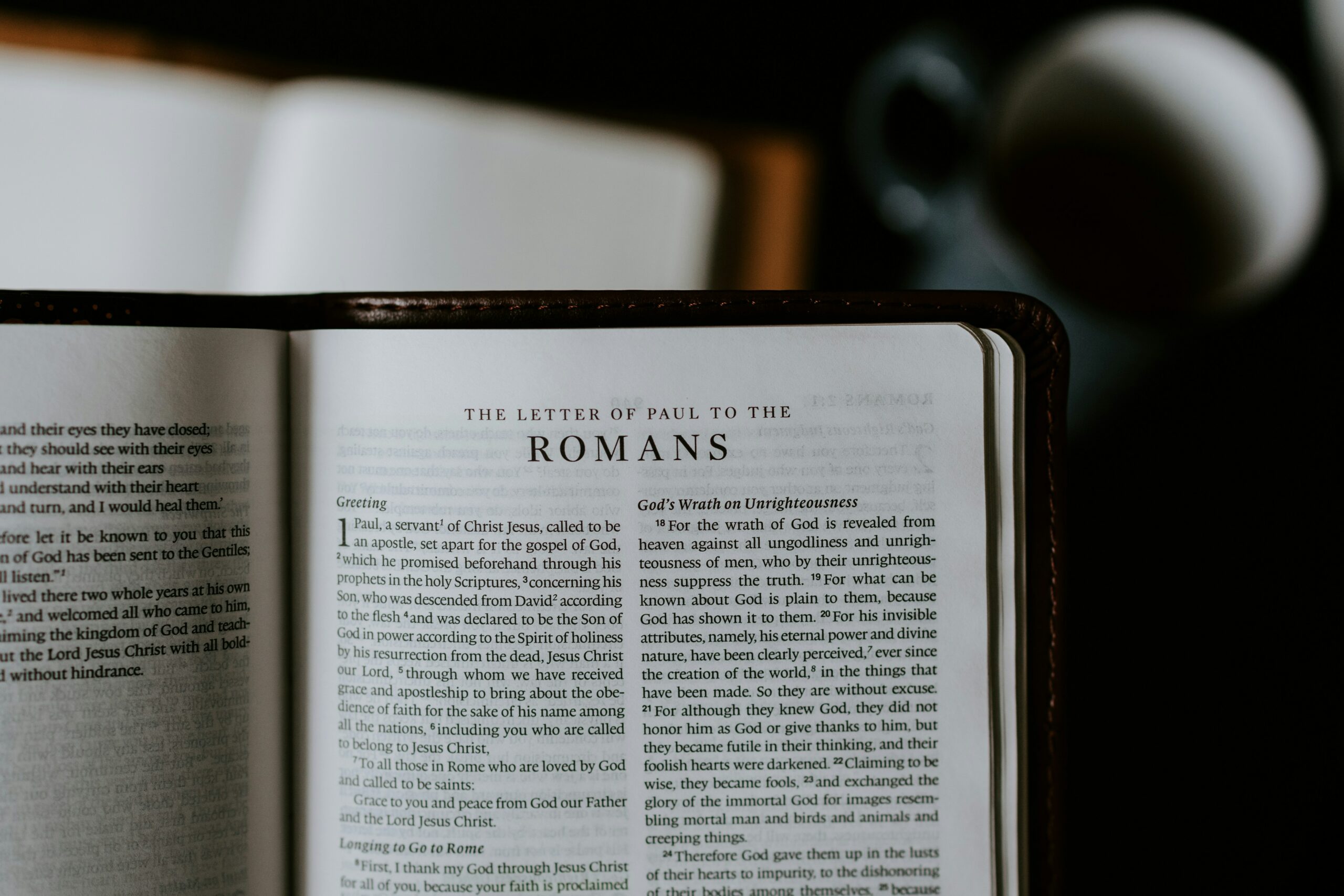
Divine Covering, Part 1
This sermon explores the profound assurance of salvation found in Romans 8:31-39, framing the passage as a divine covering that secures the believer in God’s hands. The central message encourages Christians to conduct a spiritual inventory by examining four key questions: the status of their enemy, the sufficiency of God’s grace, the silence of the accuser, and the presence of God. By tracing Paul’s argument back through the entire book of Romans, the text demonstrates that if God is for the believer, no external force or internal doubt can separate them from His love. The tone is comforting and instructional, urging the audience to trust in the finished work of Christ and the sustaining power of the Holy Spirit rather than focusing on earthly difficulties or personal weakness.
Transcript
Once again, the Book of Romans. Where we find ourselves beginning
to wrap up chapter eight. It has been a great chapter,
it’s a powerful chapter, one of the the greatest chapters
in all of Scripture, as many have pointed out. Paul has been reminding us That
the Christian essentially has received divine assistance, and
I don’t mean by that we’ve pointed it out many times through our
study. We’re not talking about just health. We’re not talking
about just a little bit of assistance, we’re talking about divine assistance
where God has stepped in and rendered us aid that we completely
lacked ourselves. We were completely unable to
remedy the the trouble and the difficulty in which we found
ourselves and God has stepped in. We saw in those first 11
verses that our life by God is established on Christ. We are
established on Christ. We saw in the following verses,
verses 12 and following that our life is sustained by the
Holy Spirit. And we saw in the most recent
verses, beginning in verse 28 through 30, that our life really,
as you step back and as God reveals it to us, our life is ordained
by God. All three members of the Godhead
have a strong hand in the divine aid that has been rendered to
us. And so the the obvious question
is, what’s what do we make of this? What do we conclude from
this? What are we to do with this information? Well, Paul has a point. He’s
had a point from from the very beginning. And here in verse
31, he begins to drive home that point. What has God been doing? What what is the reason that
Paul has shared all of these things established? On Christ,
sustained by the spirit, ordained by God. Paul wants to tell us. He’s eager to tell us. He’s eager
to rejoice in what God has done and what God is doing. If you
would begin with me in verse 31 as we begin to watch Paul
wind down this great, great chapter. What then shall we say to these
things? If God is for us who is against
us. He who did not spare his own
son but delivered him up for us all. How will he not also
with him freely give us all things. Who will bring a charge against
God’s elect. God is the one who justifies
who is the one who condemns. Christ Jesus is he who died. Yes, rather, who was raised,
who is at the right hand of God, who also intercedes for us. Who shall separate us from the
love of Christ? So tribulation or distress or
persecution or famine or nakedness or peril or sword? Just as it
is written. For thy sake, we are being put
to death all day long. We were considered a sheep to
be slaughtered. But in all these things, we overwhelmingly
conquer through him who loved us. For I am convinced that neither
death, nor life, nor angels, nor principalities, nor things
present, nor things to come, nor powers, nor height, nor depth,
nor any other created thing. shall be able to separate us
from the love of God, which is in Christ Jesus, our Lord. Paul was stirred, moved. He obviously
wanted to tell the Romans the great result, the great application
of those strong points that he had already made. that the Christian
is in God’s hand, that God is bringing him along for his own
glory. And Paul now begins to apply
all of those previous facts that we have considered so carefully
as the final proof that the child of God is safely in God’s hands. If the child of God has been
established on the firm foundation of Jesus Christ, if the child
of God is literally being sustained by the Holy Spirit, if the child
of God and his entire life or her is ordained by God himself,
then that’s a pretty secure position, isn’t it? This is one of the strongest
statements The most encouraging statements that Paul ever makes.
And I would liken it to many of the Psalms, but I want to
take you to one in particular just to set the tone. I have
referred to don’t turn yet. I’ve referred to this section
versus 31 through 39 as a divine covering, and if you don’t, it
doesn’t always that covering that idea of a covering isn’t
always used in a good idea in the Old Testament. Not used always
in a good sense, you can be covered with evil, you can be covered
with jealousy, you can be covered with murder. But there are occasions
and there are few in number where the child of God is seen, as
it were, to be covered by God himself. And that’s what Paul
wants to tell us. We’re covered. We use that kind
of language even now, if we’re in trouble. And all of a sudden
we notice it and we mention it to a friend. What does he say?
I’ve got you covered. Well, in a very real way, we
were in desperate straits, impossible straits. We have no way to remedy
our situation. And God says, I have you covered. If you would now please turn
to Psalm 91. Psalm 91. If nothing else, it’ll tell you
It will allow me to give attribution rather to where I got my title.
Divine covering. Psalm 91 says he who dwells in
the shelter of the most high, what a comfortable position,
what a comforting thought to dwell in the shelter of the most
high, he will abide in the shadow of the Almighty. A shadow also
isn’t always used in a good sense in the Old Testament, but to
be in the shadow of the Almighty, to be in his wake is a good thing. I will say to the Lord, my refuge
and my fortress, my God, in whom I trust. For it is he who delivers
you from the snare of the trapper and from the deadly pestilence,
he will cover you with his pinions. Do you get the image? Sometimes
you’ve seen baby birds, perhaps in the nest, even worse out of
the nest. And the mother comes and literally
hovers over the baby bird and literally covers it with her
pinions, her feathers. The psalmist says that that that
is true of the child of God, the child of God in great need,
the child of God in great danger. is hovered over by God himself
and covered. And under his wings, you may
seek refuge, his faithfulness as a shield and bulwark. You
will not be afraid of the terror by night or of the arrow that
flies by day or of pestilence that stalks in the darkness or
of the destruction that lays waste at noon. A thousand may
fall at your side and ten thousand at your right hand, but it shall
not approach you. You will only look on with your
eyes and see the recompense of the wicked. For you have made
the Lord God for pardon me, for you have made the Lord my refuge,
even the most high your dwelling place. No evil will befall you,
nor will any plague come near your tent, for he will give his
angels charge concerning you to guard you in all your ways.
They will bear you up in their hands. that you do not strike
your foot against a stone. You will tread upon the lion
and the cobra, the young lion and the serpent you will trample
down. Because He has loved me, therefore I will deliver Him.
I will set Him securely on high because He knows my name. He will call upon me and I will
answer Him. I will be with Him in trouble. I will rescue Him and honor Him. With a long life I will satisfy
Him and let him see my salvation. You’re covered. If you have placed your faith
in the Lord Jesus Christ, Paul wants to tell you that you are
comfortably covered as it were by the wings of the very God
himself. You are in his shadow. You are
under his shelter. You are in his care. You’re covered. That’s exactly what Paul wants
to tell us Back now in Romans 8. That there is over us a divine
covering. And what we want to see this
morning, what we want to begin to look at is discoveries. From the Christians spiritual
inventory. You know, there’s not a lot of
things I inventory. Sometimes I will. Inventory the
vegetables that I gleaned from my garden. How many did I get?
What was the biggest one measured? Sometimes I’ll do those quirky
kinds of things. I certainly inventory my tools
and from time to time you go out there right and you’re inventorying
your tools and all of a sudden you come up empty. You’re missing. You’re missing your favorite
level or you’re missing if anybody’s got it by the way. You begin to inventory those
things. I’ll tell you one other thing that I inventory that causes
me so much distress, sometimes my books. The Lord gives me the
books I freely receive and I freely give. I loan them out frequently.
And from time to time, I remember one time I went back and I was
missing six commentaries on Ephesians. I think I contacted every brother
I knew. Did I loan you my six commentaries on Ephesians? Finally,
I confessed it to God. Lord, I was foolish and not writing
down who I loaned those to. If that is a rebuke, I’ll take
it from you as a rebuke. If you would have mercy on me,
please prompt a brother to take one off the shelf, see my name
and return them to me. And that’s exactly what happened.
That’s exactly what happened. But I’d have never known it if
I hadn’t taken spiritual inventory. I prayed the prayer. A brother
did exactly that. He was cleaning out his bookshelf.
He came across, oh, these are Ron Frasco’s. I hardly even remember
where he is. He found me. He gave me the books.
You need to do inventory from time to time. And what Paul wants
to do here, what Paul has been doing is a spiritual inventory. He essentially wants to remind
us as we step back and take inventory of our life. Where things really
are. Where God really has us. Because
the Christian can often get quite sidetracked. We begin to focus
on the difficulties before us. We begin to focus on our frustrations. We begin to focus on the troubles
that life brings and other people. We begin to focus on our health
woes. We begin to focus on anything
but the truth. And Paul says we need to take
an inventory, and he does it essentially in this great ending
to this chapter with four little questions. The first one is, where is the
Christian’s enemy? That’s something we need to inventory,
isn’t it? That’s something that we need to discover, be reminded
of. Where is the Christian’s enemy? And that’s exactly what he asks
in verse 31. What then should we say to these
things, if God is for us, who is against us? Where is our enemy? But there’s another question.
In this grand spiritual inventory, Where is the Christian’s grace?
And don’t tell me that you’ve never wondered that. Don’t tell
me that you’ve never begun to wonder, have I expended the extent
of God’s grace? Have I as God run out? Is God
even going to step in and give me what I need for this battle? In fact. Just from my experience,
not only as a Christian, but as a pastor, that is probably
one of the most frequent questions That the Saints utters. Right,
where is my grace? God, you said you wouldn’t forsake
me. How come I can’t make it through
this? How come I can’t conquer this sin? How come I feel so
downcast and despondent in this situation? Where is the Christians
grace? That’s what he says in verse
32. He who did not spare his own son, but delivered us up
for us all, how will he not also freely give us all things?” God
hasn’t run out. Take inventory. God hasn’t run
out of the ability to help you. God hasn’t run out of the desire.
God hasn’t lost sight of who you are and what your circumstances
are. Not in the least. There’s a third question in this
spiritual inventory, and we’ll get to all of them, we’ll spend
more time with each. I suppose you knew that, didn’t
you? The third question is, where is the Christian’s accuser? We
know him well. All of our life has been spent
being attacked by him. And most of what he said about
us is and was the truth. But where is he now? Where is
the accuser now? We’ve heard his testimony about
us for far too long. But now we’ve heard the testimony
of God himself. Now we’ve heard the judgment
of God himself, and now let’s take inventory and discover for
a moment, where is our spiritual accuser? Where is the Christians
accuser? Look at verse 33, who will bring
a charge against God’s elect? God is the one who justifies
who is the one who condemns. And there’s a fourth question,
I said there were four. You glance down at verse 35, there is a
fourth question. And this, too, is a common experience
of the child of God seen often in the Psalms. Where is the Christians
God? One of the most comforting things
that we see in the Psalms, isn’t it? Is that very sentiment? Where are you, God? How could
you abandon me? How can I feel and be so alone? Where is the Christian’s God?
Paul wants to deal with that, too, and he says, who shall separate
us from the love of God? You’ve got your facts all wrong.
If you think that God is missing, if you think that an accuser
stands with the testimony, if you think that God has run out
of grace, if you think that you are susceptible to any enemy.
Then you need to take inventory. That’s what Paul wants to do.
Let’s go there. Let’s begin back in verse 31.
When Paul says, and this is just. So masterful. When he says, what should we
say to these things? He’s drawing a conclusion here. And you could very easily look
back and see that Paul is touching upon what he has just said in
Romans 830. But I believe it goes back further
than that. If you would have your fingers
ready and let’s look. Paul says, what then shall we
say to these things? Certainly the most logical, and
it certainly includes these things, would be to look back to verses
28 through 30, because they are a unit, and to say that that’s
what Paul is talking about. For whom he foreknew, he also
predestined to become conformed to the image of his son. That
he might be the firstborn among many brethren and whom he predestined,
these also he called and whom he called these also he justified
and whom he justified these also he glorified. If God is for us,
who is against us? What a. What a God given conclusion. But it doesn’t stop there, go
back. Go back one verse. In one back
one verse, you find in verse 28, we know it’s empirical now. We took it
in faith that God causes all things to work together for good.
We took it in faith. But now we’ve seen it. We know
that God causes all things to work together for good, not for
everybody. We discovered that, too. We know
that God causes all things to work together for good to those
who love God, to those who are called according to his purpose.
If God is for us, who is against us? What a masterful conclusion. But that’s not complete. Go back. Go back to verse 26 of chapter
eight. In verse 26 of chapter eight,
Paul had testified, and in the same way, the spirit also helps
our weakness, for we do not know how to pray as we should. But
the spirit himself intercedes for us with groanings too deep
for words, if God is for us, who is against us? Masterful. But incomplete. Go back. Go back to verse 12
of chapter 8. In verse 12 of chapter 8, Paul
says, So then, brethren, we are under obligation. We are obligated
before God to esteem Him and value Him and live accordingly.
We are under obligation not to the flesh to live according to
the flesh. For if you are living according
to the flesh, you must die. But if… And what a grand if
it is. If you are living by the Spirit,
you are putting to death the deeds of the body. You will live
for all who are being led by the Spirit of God. These are
the sons of God. If God is for us, who is against
us? What a powerful conclusion, but
he’s not done. He’s only getting started. Go
back, go back to verse 10. Verse 10, Paul is concluding
about the work of Christ, the foundation upon which we stand,
and he says, if Christ is in you, though the body is dead
because of sin, yet the spirit is alive because of righteousness. If God is for us, who is against
us? Go back. Go back to verse one. There is therefore now no condemnation
for those who are in Christ Jesus, for the law of the spirit of
life in Christ Jesus has set you free from the law of sin
and death. If God is for you. Who is against
you? Go back. Go back to chapter seven. You see where this is going,
don’t you? Goes beyond chapter eight. Paul’s
talking about more than just a conclusion to chapter eight.
He’s talking about a conclusion to everything that he said thus
far in Romans. And we’re going there. Paul says in verse 24, Wretched
man that I am, who will set me free from this body of from this
body of death? Thanks be to God through Jesus
Christ, our Lord. If God is for us, who is against
us? Go back to chapter six. And verse
22. These great spiritual truths
that have rolled one after the other. Off the pen of this apostle. By the direction of the Holy
Spirit himself, as he is instructing not only the Roman Church, but
you. Look at verse 22, but now having been freed from sin and
enslaved to God, you derive your benefit, resulting in sanctification
and the outcome. Eternal life for the wages of
sin is death, but the free gift of God is eternal life in Christ
Jesus, our Lord. If God is for us, who is against
us? Look at verse four of that same
chapter, go back. Paul says, therefore, we have
been buried with him through baptism into death in order that
as Christ was raised from the dead through the glory of the
Father, so we too might walk in newness of life. If God is
for us, who is against us? Go back, go back to chapter five. Back to chapter five in verse
nine. Much more than having now been
justified by his blood, we should be saved from the wrath of God
through him. For if, while we were enemies,
we were reconciled to God through the death of his son, much more
having been reconciled, we shall be saved by his life. If God is for us, who is against
us? Go back to verse one of that
chapter. Where Paul says, therefore, having
been justified by faith, we have peace with God through our Lord
Jesus Christ, through whom also we have obtained our introduction
by faith into this grace in which we stand. If God is for us, who
is against us? Chapter four, if you would. In
chapter four, Paul says in verse twenty three now, not for his
sake only, that is not only for Abraham’s was it written that
it was reckoned to him, but for our sake also to whom it will
be reckoned. As those who believe in him who
raised Jesus, our Lord from the dead, he who who was delivered
up because of our transgressions and raised because of our justification,
if God is for us, who is against? Turn back to chapter 3 if you
would. In verse 21, what great truth. This essentially started it all.
The positive turn on this horrible story of sin. But now, verse
21, apart from the law, the righteousness of God has been manifested. Being
witnessed by the law and the prophets. Even the righteousness
of God through faith in Jesus Christ for all who believe. For
there is no distinction. If God is for us, who is against
us? Turn back to chapter 2. Even
there, in the midst of such a grave discussion of sin, there is hope,
there is God, and there is promise. Look at verse 9. There will be
tribulation and distress for every soul of man who does evil. Of the Jew first, and also of
the Greek. but glory and honor and peace
to every man who does good to the Jew first and also to the
Greek. If God is for us, who is against
us? What a great conclusion this
is. But Paul’s not done. Go back. Go back to chapter 1
where the entire discussion started. It’s the Gospel. It’s the gospel,
it’s the hope of the gospel. And without the gospel, without
the good news, without the Savior. Taking our sin upon himself. And putting his righteousness
upon us, we are hopeless. Look at verse 16, for I am not
ashamed of the gospel. For it is the power of God for
salvation to everyone who believes to the Jew first and also to
the Greek. For in it, the righteousness
of God is revealed from faith to faith, as it is written, that
the righteous man shall live by faith. If God is for us, who
is against us? And then you turn back to Romans
chapter eight and you look at verse 28 that says, all things
work together for good. to those who love God, to those
who are called according to His purpose. And everything fades,
doesn’t it? Mustn’t it? Every difficulty
that we face in this earthly life, from this point forward,
from the time of placing our faith in the Lord Jesus Christ,
to the time when Christ takes us home to glory, everything
else, every difficulty must fade. If God is for us, who is against
us? Every enemy, Every accuser. Every difficulty. Everything
must fade. Such is the great climax that
Paul gives us. The great climax to the entire
epistle. Go back, though, if you would,
to verse 31. What then shall we say? To these
things, we know what these things are. We know that Paul has just
essentially summarized the entire book of Romans. What should we
say to these things, these teachings over these last eight chapters,
not limiting ourselves to chapter eight. If God is for us, who
is against us? Now, that if. Don’t panic there. Don’t take it as being unsettled
in God’s mind or As if it’s unsettled in our own mind, that’s something
that we need to deal with. If you don’t know for certain
that you are secure in Christ, having placed your faith in Christ
alone for salvation, that’s an if that you need to fix. But
the word there in the original really points to a settled matter
since God is for us, because God is for us. Paul isn’t. In any way, trying
to shake our confidence in God. There’s no suggestion of doubt
here. He’s pointing really to the assurance. That if God is for us and we
know he is, we just had eight chapters of testimony to that
end. We know that God is for us, and
since God is for us, who on earth is against God is for us. We’ve seen it. We’ve seen it in the testimony
of the book of Romans that God God and his anger towards us
has now been satisfied. God, our heavenly father, loves
us in the most practical ways. And as we have most recently
seen, God is sovereign and he is the one that controls all
events. He oversees all things after
the counsel of his will. Nothing slips by him. He’s not about to allow anything.
To come between him and his children. If God is for us and we know
he is. Who is against us? We’re taking
inventory. We’re looking about, we’re trying
to answer in this particular moment, where is the Christian’s
enemy? Who is against us? What Paul points to here is all
kinds of adversaries, those who would persecute us for our faith,
those who would tempt us with sin. Those who would falsely
accuse us before the brethren, those who, as Satan so often
does, falsely accuse us before God himself. It’s essentially a rhetorical
question that Paul asks. It doesn’t even need to be answered,
right? Of course, we have enemies. We
know of one great foe, the accuser of the brethren. We know the
devil is active in his work. We know that this life is full
of difficulty. We know that the world is against
us in the world system. We know that there are people
who hate us because of our love of the Savior. Paul isn’t saying
that there are no enemies. Essentially, what Paul is pointing
to is that compared to God, Standing next to God, standing as it were
under the cover of his wing, standing in his shadow. What
enemies? What enemies? Is it possible that there’s any
greater encouragement? A prompter to faith and faithful
living than the consideration of God. Being your covering as
you walk through this. sinful and fallen world. Because
God is for you, what force on earth could possibly come against
you? This is the testimony so often that we see in the Psalms,
isn’t it? Listen, just momentarily, as I course through just a few,
Psalm 23, 4. Even though I walk through the valley of the shadow
of death, I will fear no evil for you are with me. Psalm 56,
9. Pardon me, Psalm 56, 11. In God
I have put my trust. I shall not be afraid. What shall
man do to me? We have no cause to fear any
enemy if we’re standing under the covering of God, if we’re
standing under the shadow of the Almighty. Psalm 118. The Lord is for me, I will not
fear what can man do to me. The Lord is for me among those
who help me. Therefore, I will look with satisfaction
on those who hate me. Paul isn’t saying that there
are no adversaries. We know that there are, in fact,
in verse 35 and 36, he goes to specific instances of the most
terrible kinds of adversaries. Tribulation, trouble. Just a
very general word for trouble. We are going to have trouble.
We know that we’re going to have it. Distress. That’s the kind of feeling that
you get inside from the trouble. This is the feeling that you
get from the trouble. Persecution. We know that it’s
coming. They hated Christ. They will hate you too. Famine. Nakedness. Peril. Sword. Preferably, it wouldn’t surprise
you to know that saints have died in every century that the
church has been on the earth. What Paul merely points to here
is that no adversary stands up to almighty God, no adversary
comes close. Because nothing ultimately can
work evil in our lives, nothing ultimately can take us from God,
nothing ultimately can destroy the salvation that God has bestowed. This first little question essentially
could be a question of the power of God. Are we to doubt the power
of God to maintain his grip on us? One pastor said it this way,
there are terrible forces against us. We are faced with the devil
in all of his power and malignity, a powerful and subtle enemy whom
we are to withstand. And there is but one way to do
so, to realize that though he is powerful, he is as nothing
face to face with the one who is on our side and who is working
on our behalf. He’s nothing. He has nothing. He frightens us not. God is our
refuge and strength, Psalm 46, one of very present help and
trouble. Therefore, we will not fear. Those aren’t just words to encourage
us, that’s the truth. That’s the truth. Where is the
Christians enemy? But I said there were four questions
in beginning to take this Christian spiritual inventory We’re looking
at the divine covering, and I said there were four questions. Not
only where is the Christian’s enemy, but second, and we’ll
just get started. Where is the Christian’s grace? This is one we wonder about from
time to time. Like daily. God, where’s my help? God, I need more help. God, I
need more grace. What if I don’t make it? What
if God runs out before I get to heaven? Look at verse 32. Paul wants
to address this. Paul wants to comfort the Christian.
He who did not spare his own son, but delivered him up for
us all, how will he not also with him freely give us all things? Now, for the most part, you’re
going to have to take that as a comfort and run with it. We’ll
expound on it more next Lord’s Day, but I want you to look at
just a couple of things. What Paul does here is classic line
of reasoning argues from the greater to the lesser, if God
has done the greater thing. Doesn’t it make the easier thing,
the lesser thing that much easier if God has done the greater thing,
won’t he also do the lesser if God has accomplished a great
feat in conquering your own sinfulness by what he did through his son?
Won’t he get you through your earthly difficulties? Won’t he
get you through to glory despite whatever physical struggles you
have in this life? Won’t he get you through to heaven,
even if you have great and terrible persecution in this world? If
God has already done the greatest possible thing that he could
ever done in sending his own son, then how could he possibly? fall short. How could he possibly
choose to refuse to do anything but bless us toward the great
end of glorifying us in heaven? We’ll part there. Go with this encouragement. Take your own spiritual inventory
this week. Consider, as you look about,
where is your enemy? As you look at all that God has
done for you, as you look at all that God has accomplished,
even as you, if you would, review Romans, even just Romans 8. Look about you and see where
is the Christian’s grace? Where is your grace? Does God
have an adequate supply for you? Where is your accuser? Are you
truly forgiven? Are you still listening to the
echo of the evil one? As he calls you down. Does he have a case? Have you
been forgiven? Have you placed your faith in
the Lord Jesus Christ? Because if you haven’t, he’s
got a good case against you. Finally, where is the Christian’s
God? You feel like God has abandoned you? If you placed your faith
in the Lord Jesus Christ, it’s you, it’s your perspective that’s
off, not God’s. God hasn’t lost sight of you.
Let’s go before him in prayer. Our merciful King, we humble
ourselves before you as we begin this process of examining our
hearts in light of this great, great chapter. And this just
profound conclusion. Father, as we look to our own
hearts, we know that we are spiritually feeble in so many ways. We neglect
to build ourselves up in prayer. We neglect various means of grace. Walking with God’s people. Confessing
our sins to one another, reading your word, praying to you. No
wonder we’re weak. And when we are weakened, our
perspective gets off and we begin to wonder these classic questions. What about our enemy? Where is
God’s grace? What about our accuser? Where
is our God? Grant us your grace as we wrestle
with these things. in our inventory of our very
spiritual lives and be glorified in us in the outcome. It’s in Jesus name that we pray,
Amen.
Messages: 204