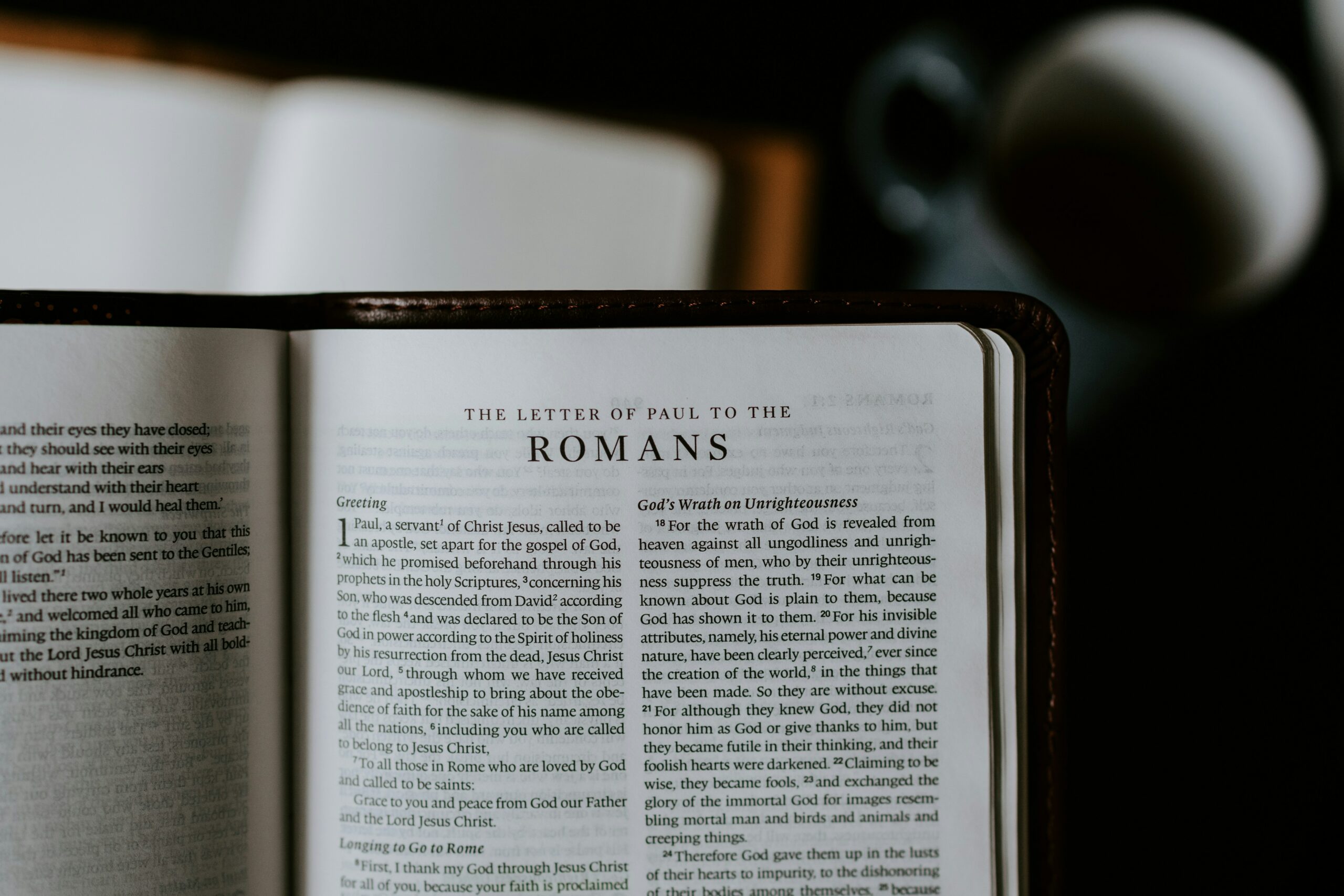
Law and Promise
This sermon examines Paul’s argument in Romans 4 regarding the relationship between God’s promise to Abraham and the Mosaic Law. It asserts that justification by faith alone is the sole means of salvation, systematically dismantling the notions that works, religious rituals, or legal adherence can secure a right standing before God. The text highlights that Abraham was declared righteous prior to circumcision and the giving of the Law, establishing that the promise of being heir of the world was granted purely by grace. Consequently, the Law serves to reveal sin and bring wrath rather than to provide salvation, which is found exclusively in the righteousness of faith in Christ.
Transcript
A lot of times I will come up
here and I will have mercy on those who have just wandered
in and I will take you on a review of where we have been for the
sake of bringing those along who perhaps are guests or maybe
who have been providentially away. But today I will be pulling
your leg to suggest that I’m doing that for your sake. I’m
going to review for my sake since I was away last Lord’s Day, just
to remember in my own heart and mind where we are and to bring
you along as well. Paul had already established
that the world is all entirely under sin. The Jews are under
sin. The Gentiles, likewise, are under
sin. Chapter one. Everyone is under
sin. Everyone is utterly sinful and
completely in need of God and his righteousness. They need
God for salvation. We finally come to the good news
in chapter three. In verses 26 and following that
talked about how that righteousness that is so desperately needed
by sinners has been revealed, it has come, that now there is
access to that righteousness through the Lord Jesus Christ.
Well, that had to have been stunning news to any Jew that this system
that he had placed his faith in, that he heretofore understood
as his great means of salvation, was no longer valid. And the
thought that this salvation that Paul now spoke of, this justification
by faith alone in Christ alone, was to be found in the Old Testament. What would become of his system?
And what Paul does, as we have seen in chapter four, is enter
into, as it were, a dialogue. Now, there isn’t anyone present,
not literally, I don’t believe. But Paul is playing upon the
arguments that any self-respecting Jew would present to this idea
of justification by faith. The thought that someone merely
by believing in God, that his sins would be forgiven based
on what the Lord Jesus accomplished on the cross, that alone? What
about works? What about religiousness? What
about the law? That’s where Paul is. And Paul is playing off these
arguments and he’s destroying them one by one. If you will go all the way back
to chapter four, verse one. Where Paul took us on essentially
a divine history of justification. He skirts from there into a subject
that we normally wouldn’t entertain, but he does and does so fully
in dealing with the whole doctrine of circumcision. The right of
circumcision. And from there. We’ll come to
the passage that we’ll consider this morning, but I want to take
you all the way back to verse one of chapter four. What then shall we say that Abraham,
our forefather, according to the flesh, has found for if Abraham
was justified by works, he has something to boast about, but
not before God. For what does the scripture say?
And Abraham believed God and it was reckoned to him as righteousness. Now, to the one who works, his
wage is not reckoned as a favor, but as what is due. But the one
who does not work, but believes in him who justifies the ungodly,
his faith is reckoned as righteousness. Just as David also speaks of
the blessing upon the man to whom God reckons righteousness
apart from works. Blessed are those whose lawless
deeds have been forgiven and whose sins have been covered.
Blessed is the man whose sin the Lord will not take into account.
Is this blessing then upon the uncircumcised or upon the pardon
me, upon the circumcised or upon the uncircumcised also, for we
say faith was reckoned to Abraham as righteousness. How then was
it reckoned? While he was circumcised or uncircumcised? Not while circumcised, but while
uncircumcised. And he received the sign of circumcision,
a seal of the righteousness of the faith which he had while
uncircumcised. That he might be the father of
all who believe without being circumcised. That righteousness
might be reckoned to them. and the father of circumcision
to those who not only are of the circumcision, but who also
follow in the steps of the faith of our father Abraham, which
he had while uncircumcised. For the promise to Abraham or
to his descendants that he would be heir of the world was not
through the law, but through the righteousness of faith, for
if those who are of the law are heirs, faith is made void. And the promise is nullified
for the law brings about wrath. But where there is no law, neither
is there violation. Paul has essentially destroyed
two arguments so far. The first argument we looked
at was essentially came in the form of a challenge. What about
Abraham’s salvation by works? All Jews held that Abraham was
justified by his deeds. His deeds, his works, are what
posited him in a favorable position before God. What Paul does, as
I said, is take us on a divine history of justification. How
does the Scripture lay out this justification? How does the Scripture
speak of Abraham in his situation before God? Salvation was a divine
reckoning we saw that was exemplified as being wrought by Abraham’s
faith, not his works. It’s exactly what the verse says.
It was distinguished from the obligation that work brings.
If you work, you have earned something. But Paul says not
before God. This was a reckoning that was
completely of faith and devoid of works. Verse five. And it
was a it was a reckoning that utterly and completely deals
with man’s sinfulness. Paul destroyed the argument of
salvation by words. He destroyed it. And so perhaps
the Jew sitting there proposes another argument, that’s the
dialogue that Paul is having, and even if it wasn’t presented
right there where Paul was sitting, Paul had heard the argument many
times before, even as we have. That of the role of rights. R.I.T.E.S. What is the role of
rights? Isn’t circumcision required?
Would say the self-respecting Jew. Well, Paul, what he does
here in verses nine and following is put rituals in perspective.
Let’s consider Abraham’s circumcision. And what he does is give us four
clarifying comments on this right of circumcision. First of all, the difficulty that the means
of Abraham’s justification poses to the right, the problem with
it was that Abraham received the promise of God long before
he was circumcised. Fourteen years we saw. Secondly, we saw the relationship
of the right to the timing of God declaring Abraham righteous.
Not only did Abraham place his faith in God long before he underwent
any ritual, God pronounced him righteous apart from the participation
of any ritual. We went on to look at the nature
of the ritual itself and the purpose of the ritual, and in
total, that argument destroyed the second challenge posed by
the Jew. But the system being what it
is. Even though it’s damaged and wounded. Salvation by works
doesn’t hold water, salvation by religious ritual doesn’t hold
water. Can’t be sustained, Paul has
done them serious damage, if not utterly destroyed them. And
so the Jew perhaps brings up a third argument, and it’s that
argument that we consider this morning. What about the law? What about the law? We need to
consider this relationship between the law and the promise God made. We know that God made Abraham
promises, but we also know that the law existed. What is the
relationship between the two? Paul will go on here to demonstrate
the truth. That this doctrine of justification
by faith is not through the works of the law. And that that is proven by the
Old Testament scriptures itself. These verses, verses 13 through
17, really present to us two additional arguments. We’ll take
just one this morning in favor of the doctrine of justification
by faith. Paul is defending it even still.
This is the third argument. Having dealt already with works,
having dealt already with rights, now Paul puts the law in his
crosshairs. We want to look at the relationship
between God’s promise and God’s law. What there are here in this
short passage are three elucidating features of that relationship
that destroy this third argument that salvation could ever be.
by the law. First of all, look at the promise
detail, look at verse 13. The promise detail, what I mean
there is what is the promise? Paul talks about the promise
scriptures certainly talked about the promise, but what is the
promise? As you know, my habit is to first of all, carve out
what is the simple sentence and the simple sentences here is
for the promise that Abraham would be heir of the world. Now,
that’s incomplete so far, we’ll get to the rest of it in a moment,
but let’s pause there and find out what is this promise that
he would be heir of the world? This word promise that is so
much a part of biblical thought with regards to redemption, especially
with regards to Abraham, is so much a part. You would think
that we would have come across it already in Paul’s epistle,
but this is the first time. It’s the first time that Paul
begins to turn and focus upon the promise of God. What was
this promise? The bottom line is when God made
a promise to Abraham, he didn’t do it in terms of law. We speak
often of the Abrahamic covenant and the idea behind the covenant
is almost a deal. Look, if I do this, you do this. And if you do this perfectly,
I will do, I will fulfill my end of the bargain perfectly.
That’s not what happened with Abraham. This is not what happened. He didn’t lay down the law, did
God. He didn’t lay down the law to
Abraham and say, look, Abraham, if you’ll uphold your end of
the bargain, I’m going to return to you a threefold promise. We’ll look at that in a moment.
It was just grace. It was a gracious promise. By
a gracious God. As Lloyd-Jones says, he didn’t
lay down particular conditions as to what Abraham had to do
or did not have to do, it was entirely a matter of promise. God just graciously reached out
to Abraham and promised. The promise. The difficult part
of this is That there isn’t anything recorded anywhere in scripture
that sounds anything like what Paul records here. That he would
be heir of the world. At least it’s not literally found. It’s not a formal quotation,
if you will, of anything that was found in Old Testament scriptures.
Rather, it’s this summary of Paul that he makes here in verse
13, that Abraham would be heir of the world is essentially an
interpretation, a summary of all the promises that were given
to Abraham. If you will, it’s a it’s a free
translation. A free summary of the promises
that God had spoken to Abraham. As I said, nowhere in the Old
Testament were these promises put in these particular terms. Because if you take in complete
summary, I think that you can you can easily say that, indeed,
Abraham is the heir of the world. First of all, Abraham was promised.
What one referred to as a numberless progeny. Now, I don’t want you
to get hung up on that particular title. He promised them a whole
lot of descendants. Here’s how it went. Genesis 12,
2. I will make you a great nation. A numberless progeny, if you
want to go with fancy language. I will bless you. I’ll make your
name great. You will be a blessing. Genesis 13, 16. I will make your
descendants as the dust of the earth. That’s a lot of people. A numberless progeny. So that if anyone can number
the dust of the earth and your descendants can also be numbered
while we were away last week, The workmen invaded our home.
Well, they didn’t. They didn’t invade. They were
invited to do come and do some work on our home in preparation
for Barb’s dad who’s coming. And I’m relatively convinced
that. Maybe not all, but a good measure
of the dust that here must be counted was there in our basement
when we arrived home. Genesis 15 5 says he took him
outside and said, Now look toward the heaven and count the stars.
There’s a project. If you are able to count them
and he said to him, so shall your descendants be. In other
words, you’re going to be you’re going to have as many descendants
as the dust in the earth, as many as the stars in the sky,
Abraham. Since Abraham, verse 1818, was
sure to become a great and mighty nation in him, all the nations
of the earth would be blessed. He’s going to have a number of
this progeny. He’s going to have a whole lot of descendants. The
second promise to Abraham was that he was going to possess
the land of Canaan, that God was going to give him a parcel
of land. Genesis 12, 7 to your descendants,
I will give this land Genesis 13, 14 and following 15, 7. I
am the Lord who brought you out of Ur of Chaldeans to give you
this land to possess it. Well, now that’s not the entirety
of the earth. As it says here in this passage,
it’s hard. It can hardly be said that he’s
heir of the world, right? But he has this numberless progeny.
He has this possession of the land of Canaan. But that’s only
two of the three promises. The third is that all the nations
of the earth would be blessed in Abraham. That all of humanity
would come to see God’s blessing through Abraham. That promise
was given in Genesis 12, 3. I will bless those who bless
you. The one who curses you, I will curse. And in you, all
the families of the earth will be blessed. Genesis 18, 18, which
first we just read, since Abraham will surely become a great and
mighty nation, in him all the nations of the earth will be
blessed. 22, 18, in your seed, all the
nations of the earth shall be blessed. So when Paul summarizes,
He’s not being biblically inaccurate when he says the promise to Abraham
was that he would be the heir of the world. It’s not an inaccurate
summary. It is the promise to Abraham
of the ultimate restoration of humanity, his spiritual seed
on man’s inheritance, which was God’s blessing to Abraham’s spiritual
seed through the innocence that man lost through their struggle
and sin. As one pastor said it in light
of Paul’s teaching as a whole, we cannot exclude from the scope
of this promise the most inclusive messianic purport It is defined
as the promise to Abraham that he should be the heir of the
world, a promise to his seed, and can hardly involve anything
less than the worldwide dominion promised to Christ and to the
spiritual seed of Abraham and him. This was a broad promise,
a grand promise, as we’ll see in a moment. But I said that
there were three elucidating features that will destroy this
idea that salvation can ever be by law. We saw the promise
detail that looks secondly at the promise, pardon me, the promised
identified the promised identified, it’s right there at the beginning
of verse 13 anyway. For the promise to Abraham or
to his descendants that he would be heir of the world. Now, when
it says or that I think the. The potential is here that we
would trip up and say that God was promising to one or the other.
It’s not one or the other, it’s both and and then some. It’s
to Abraham and to his descendants. There’s no doubt that the promise
was to Abraham, Abraham was indeed promised by God, as we have just
seen in all of those passages in the book of Genesis. But the descendants likewise
were promised. The word here in the Greek is
literally seed, as so often is translated in the Old Testament
scriptures, perhaps even some of your New Testament scriptures
retain that idea of seed, your family seed, the descendants
that come directly from you. The promise was likewise made
not only to Abraham, but to his seed, to his descendants. The
seed here is introduced as being a recipient of the promise that
God had made. God was underscoring what he
had already said. Paul was ultimately here in even
referring to this Probably, and I say probably because I don’t
think you can say it with absolute definitiveness here, but he was
possibly bringing up the idea of Christ as the ultimate seed
of Abraham. If you remember in the opening
pages of the book of Matthew. It has that list of names, right,
and so and so begat so and so, most of which names we can’t
even produce or pronounce rather. But one clear figure in that
list of Jesus’ family tree, which is what is produced there in
Matthew 1, is Abraham. Abraham was in Jesus’ family
tree. Abraham was, in a sense, Jesus’
great, great, great grandfather. Jesus was ultimately the seed,
the descendant, the offspring of Abraham. What Paul perhaps
has in mind here is ultimately when he thinks of descendants,
he’s bringing in that hint that also the ultimate descendant
of Abraham is the Lord Jesus Christ. What possibly he’s bringing
in here is a hint of the gospel. Galatians 316, hear this. When Paul writing Galatians 316,
Paul brought it up again when he said, Now the promises were
spoken to Abraham and to his seed. He does not say and to
seeds referring to many, but rather to one and to your seed,
that is Christ. It’s at least possible that that
idea is contained here as well. That this promise to Abraham
and his descendants, ultimately, who was Christ, would refer to a much greater
inheritance than merely some earthly inheritance, some land.
But it was talking about it was opening the door, as Abraham
already knew, he didn’t know exactly what the Messiah would
look like. He didn’t know exactly what God’s
plan of redemption looked like, but he trusted in the God of
it. He trusted that God was able to provide a lamb. He trusted
that God was able to redeem a people. He trusted that God was able
to bless him. And so his thoughts. When he uses this expression,
your seed, which occurs over and over again in those accounts
to Abraham. Ultimately, he’s speaking of
redemption, which is in Christ. The promises that Abraham received
not only involved people, a great progeny. It involved the land,
the land of Canaan, it involved a great blessing, blessing on
essentially the whole world. But it ultimately involved the
promise of a redeemer. It entailed that idea of redemption. And so the promise to Abraham
was essentially, as I said, a proclamation of the gospel. As one pastor
said, Jesus told the unbelieving Jewish leaders, your father,
Abraham, rejoiced to see my day and he saw it and was glad that
we don’t know exactly. I mean, scripture leaves it very
vague what Abraham knew. But Jesus seems to hint that
Abraham knew of his day, that he knew in some way, shape or
form of the Redeemer. He knew that he was coming and
he was glad. He continues. It says, In a way
that is not explained, Abraham foresaw the coming of the Messiah
who would be born as one of his promised descendants. It was
through that descended Messiah, the Christ, that Abraham would
be would bless the entire world and be heir of the world. So
note, he doesn’t say seeds, he says seed. to his great descendants, including
Christ. There’s a third elucidating feature
that destroys salvation by law, by adherence to the law. Not
only the promise detailed and the promised elucidated, but
the promises means what are the means of this great promise?
How is it put into place? How is it affected? How is it,
if you will, receive? Look at again, verse 13, for
the promise to Abraham or to his descendants that he would
be heir of the world was not through the law, but through
the righteousness of faith. It was not through the law. In the Greek, there is no definite
article there. And so it makes this a question
of what kind of law is Moses referring to? Is he referring
to any legal command? Is he referring to any law or
to the Mosaic law specifically? I would say that it was general,
that it’s not only the Mosaic law, but all of God’s law in
the very broad sense of the word. Any of God’s commandments, all
of God’s commandments, any of God and all of God’s standards. He basically is talking about
this idea of law keeping as a means of salvation. The Gentiles didn’t have the
Mosaic law. But they did, as we saw so often
have idolatry, which so often sought to gain salvation by adherence
to a standard. And so what Paul does in one
sweep of the pen is to do away with all of them by simply leaving
out the definite article. He says this idea of law keeping
of any kind is foolishness. As one said, Abraham was not
under the law when the promises were made. Abraham wasn’t under
any obligation to God. Abraham wasn’t trying to adhere
to the law because the law, the Mosaic law, hadn’t even been
given. Nor could the fact that his seed
came under the law eventually, in other words, Abraham looking
down through the annals of history, seeing the Mosaic law given,
could he even foresee this? I mean, it’s just a ludicrous
argument. Affect the range of the condition
of the original promise, in other words, Abraham looking down and
conceiving that, you know what, God, you’re going to have to
put some rules in place here. We need some help. Because he goes on to say, because
promise and law have two quite different offices in God’s hands.
To make inheritance really based on promise depends on law. Depend
on law is to evacuate the faith. In other words, you empty faith
of all meaning, all value. If you make salvation depend
upon law and in fact nullify the promise. Well, the promise,
because while the promise is given to faith, the law has for
its function to emphasize the nature of sin, and that’s where
Paul will go in the remainder of this passage. It wasn’t by
law at all. It wasn’t by legal standard at
all. Lloyd Jones has a great comment
here, he says. The promise was made by God to Abraham, not through
the law, because the law was only given later. God gave this
promise to Abraham four hundred and thirty years before he gave
the law through Moses to the children of Israel, just as the
promise was given before the introduction of circumcision.
So it was given before the introduction of the law. And so you cannot
hold the law up as a standard of salvation, because here is
The very example that the Jews would stand before us is the
great example of works by the law. Paul obliterates and says,
no. Abraham was justified before
the law was ever even given. Look at verse 14. For if those
who are of the law are heirs, faith is made void and the promise
is nullified. If at once you say. That perhaps it’s true that someone
could live according to the law, which is utterly unthinkable.
The law standards are so perfect, the law of God is so lofty and
so high that the standards are impossible. We’ve seen that.
We’ve made that point. But let’s go for a minute, it’s
as if Paul says, let’s pretend. If those who are of the law,
if there was somebody could live a perfect life according to God’s
law. If that was true, then their
heirs, they deserve heaven. They’ve earned it. And if that
were true. Faith and the promises of God
by that faith are utterly nullified and destroyed. If people were
able to live according to God’s law perfectly, they would indeed
be heirs of heaven. And you and I know that that’s
impossible just by virtue of our own life. That’s what leads
us to Christ, is that frustration that we can’t do it, that we
can’t live good enough to earn our way into heaven. Paul says, look, you want to
try and live a perfect life? If that were theoretically possible,
faith is destroyed. The promise is destroyed. Yet,
it hasn’t been. Paul takes them back one last
time to the reminder of what the purpose of the law is. And
he does so. Almost dusting off his hands,
as it were, this is his parting comment. He’s done with the arguments
of the Jews, he’s done quibbling over silly things that God never
intended to be misconstrued in such manner. Look at verse 15,
he says, for the law brings about wrath, that’s what it’s for.
The law doesn’t bring salvation in any way. The law was never
designed to bring about salvation. The law condemns sinners. It pronounces a curse on all
of those who don’t comply perfectly with God’s standards. Galatians
3 10. As many are of the works of the law are under a curse
for it is written, cursed is everyone who does not abide by
all the things written in the book of the law to perform them.
You see, this is the argument of Jesus so often as he would
come across the Jews. They would have perfected perhaps
one little article of the law or usually an element that they
had introduced and added to God’s standard. They have perfected
man-made things. But in no way were they able
to live up to the totality of God’s law. They weren’t able
to live up to it perfectly. And as such, they stood condemned. If you’re trying. If you’re trying. To secure some
kind of salvation. Based on works. Based on effort
based on going to church. Keeping regular quiet times.
If that’s your standard on getting into heaven, it’s an empty standard
and it won’t work. If you’re maybe trusting, maybe
even just a little bit. In rights, as we talked about
last for two weeks ago, Lord’s Day. Not just circumcision, but what
about baptism, if you’re trusting in that to save you? If you’re
trusting in the law, if you’re trusting in God’s word and somehow
your ability. To live according to it. Not
only to do good works, but to live according to all of God’s
standards, if you’re trusting in those things, You’re chasing
a dream because God says. God’s message to the world is
that God’s righteousness has been revealed. It is salvation
by the faith in the Lord Jesus Christ and in him alone, and
that is the great privilege that we have in coming to the Lord’s
table this morning is to celebrate and rejoice that we don’t have
to try to work our way to heaven any longer. That we don’t have
to try to hold on to some religious practice or habits as the means
of salvation. That we don’t have to try to
adhere to every point and letter of the law. Jesus has already
done that. Jesus lived the perfect life
and he sacrificed the perfect sacrifice on our behalf. What a great recollection we
have. in coming to the Lord’s table,
being prepared by Paul’s words to the Romans in chapter 4. It
isn’t by works. It isn’t by ritual. It isn’t
by the law at all. If we are saved, if we are saved
at all, it is by faith in the Lord Jesus Christ and in Him
alone. Let’s bow in prayer. O merciful
King, we thank You for providing our Savior. By providing that
sacrifice that fully atoned for our sin. Lord, we thank you and
praise you for the privilege that we have to ponder and meditate
now at the Lord’s table. To come and to enjoy what Christ
has told us to commemorate. And to do so with a heart and
mind to really be turned from an idea of works and rituals
and adherence to written standards to come before you in mercy and
grace and to rejoice in what you’ve done and to plead with
you and to appropriate your grace in our lives. Father, we thank
you for what Christ accomplished. We thank you for salvation in
him and in him alone. And it is that that we come to
celebrate now at our Lord’s table. It’s in Jesus name that we pray. Before we came to know Christ,
we knew our hearts were regenerated. We were hostile enemies of God. And while we were yet sinners,
Christ died for us. And on the last night, the night
in which he was betrayed, Christ said these to me amazing words. Greater love is no one than this,
but one that he hath for his life, for his spread. It’s amazing.
Messages: 204