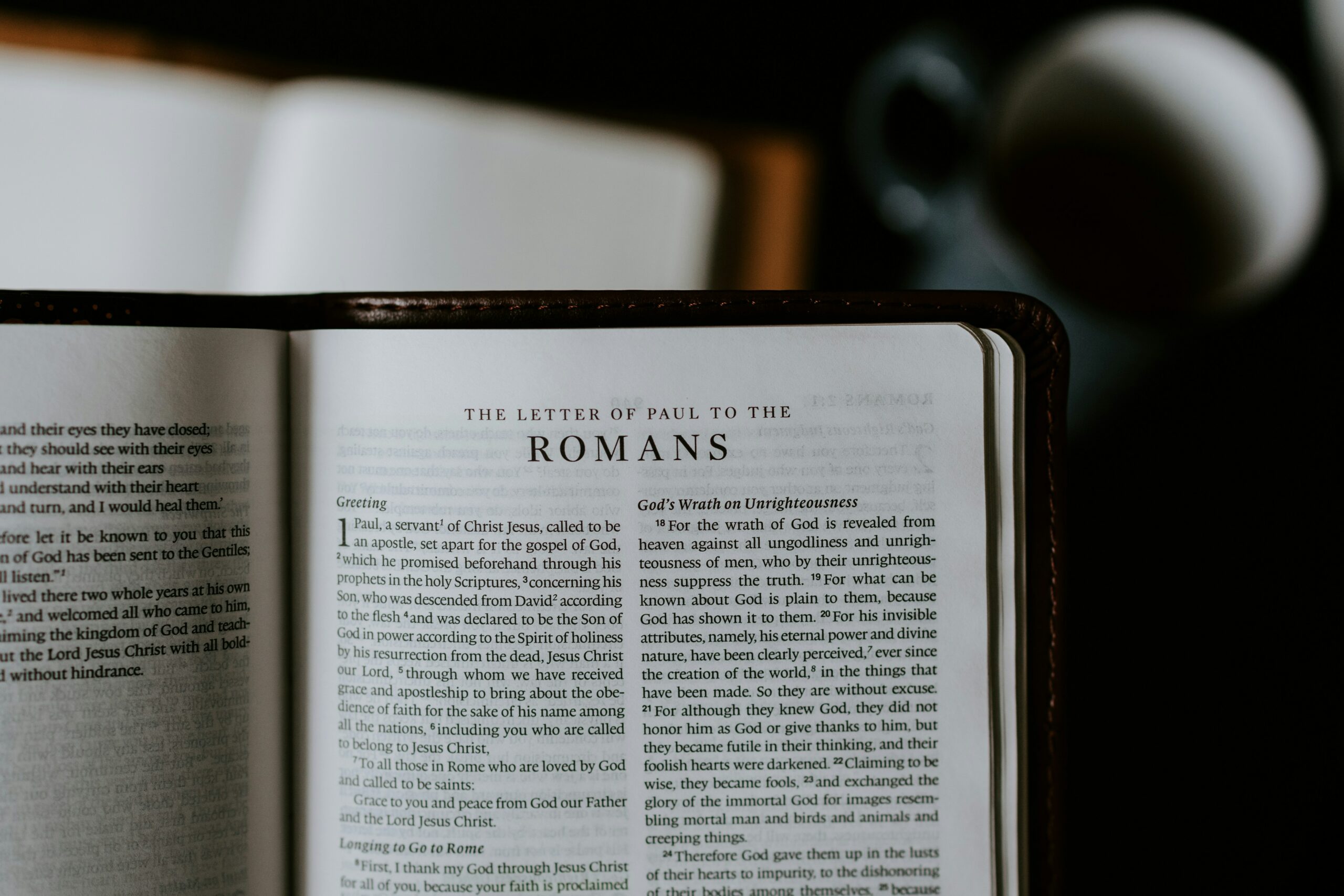
The Legacy of Adam
This sermon examines the theological doctrine of original sin by analyzing Romans 5:12, which asserts that sin and death entered the world through one man, Adam. The speaker contrasts humanity’s initial state of primitive integrity, as described in Genesis, with the subsequent condition of total depravity resulting from the Fall. By citing J.C. Ryle and Thomas Boston, the message emphasizes that a correct understanding of human nature is essential for recognizing the necessity of Christ’s redemption. The exposition highlights that Adam acted as the representative of the entire human race, meaning his guilt and corruption are inherited by all, thereby establishing the foundation for the gospel’s offer of grace and justification.
Transcript
If you would turn in your Bibles
to Romans, chapter five. Romans, chapter five. And when a guy like Martin Lloyd-Jones
says that this verse, verse 12, is one of the most important
verses, theologically speaking, in the entire Bible. You could
understand the difficulty I would have in setting this aside for
something else. for just the cause that lies
before us. We’ve been looking at what Christ
has accomplished in securing our redemption and in providing
to us justification by faith, that righteousness that is so
desperately needed. For the last several weeks, intensively,
we have been looking at the first 11 verses which spoke of the
blessings of salvation. We want to pick up now and we
won’t even make a dent in verses 11 through 12, much less 11 through
21, but I want to read them in their entirety to honor and to
put in context these words. that ultimately come from God
himself. Therefore, just as through one
man sin entered into the world, and death through sin, and so
death spread to all men because all sinned. For until the law,
sin was in the world, but sin is not imputed when there is
no law. Nevertheless, death reigned from Adam until Moses, even over
those who had not sinned in the likeness of the offensive Adam,
who was a type of him who was to come. But the free gift is
not like the transgression. For if by the transgression of
the one, the many died, much more did the grace of God and
the gifts by the grace of the one man, Jesus Christ, abound
to the many. And the gift is not like that
which came through the one who sinned. For on the one hand,
the judgment arose from one transgression, resulting in condemnation. But
on the other hand, the free gift arose from many transgressions,
resulting in justification. For if by the transgression of
the one death reigns through the one, much more those who
receive the abundance of grace and of the gift of righteousness
will reign in life through the one Jesus Christ. So then, As
through one transgression, there resulted in condemnation to all
men, even so through one act of righteousness, there resulted
justification of life to all men. For as through the one man’s
disobedience, the many were made sinners, even so through the
obedience of the one, the many will be made righteous. And the
law came in that the transgression might increase. But where sin
increased, grace abounded all the more, that as sin reigned
in death, even so grace might reign through righteousness to
eternal life through Jesus Christ, our Lord. One of the great difficulties.
Spiritually speaking, is making an accurate assessment of The
human condition, we have a tendency to flatter ourselves, debate
ourselves with false ideas of what we’re really like spiritually
speaking before God. And so there is great necessity
to accurately diagnose the human condition. The study of man is
of crucial nature. We call it in theology, anthropology,
a true study of all of the elements of man, the spiritual element
most critical. J.C. Ryle summed it up this way
when he said there are very few errors and false doctrines of
which the beginning may not be traced up to unsound views about
the corruption of human nature. Do you hear what he said? He
said of all those strange theologies and heresies and false teachings,
most of them, and I’m interpreting what he says, most of them can
be traced to a faulty view of anthropology, a faulty view of
the doctrine of man. He goes on and he says wrong
views of a disease will always bring with them wrong views of
a remedy. So if you have a wrong assessment, You’re given the
wrong medication, bad things will happen, and that’s what’s
happening in our society just over and over again. Even in
our church, as I shared with Frank this morning, I don’t know
the last time that this verse in this theology, this doctrine
was laid out in detail in this entire city. Wrong views, J.C. Ryle says, of the corruption
of human nature will always carry with them wrong views of the
grand antidote and cure of that corruption. There is only one
cure, and it’s the Lord Jesus Christ, as we have seen. No wonder
Lloyd-Jones felt this verse, verse 12, is the most important
in all the Bible. The overall nature of the verses
12 through 19 is in the form of a contrast. It’s a contrast
that is begun in verse 12 and really never explicitly answered. We know what the answer is. We
know what the counter contrast is just as we work our way through
these remaining verses all the way down to verse 21. Listen
to the contrast. Therefore, just as through one
man sin entered into the world, And death through sin, so death
spread to all men. Because all sin, you would expect
a counter clause to follow immediately, if not eventually, that goes
something like this. So also, through one man’s righteousness,
through one man, check that, righteousness entered into the
world and life through righteousness and so life spread to all men. That’s what we would expect.
Paul has this tendency to set up these contrasts. One of his
favorite ones is to set up Christ as what he calls the last Adam,
the counterpart to the first Adam. It is a regular feature
in Paul’s theology 1 Corinthians 5, 22, pardon me, 15, 22, as
in Adam all die, so also in Christ all will be made alive. He does
the same thing, essentially, in 1 Corinthians 15, verses 45
through 49, which verses we’ll consider another day. The main
function of these verses in front of us today is to show how one
man’s death, that is, our Lord Jesus Christ, Open the door of
salvation to. So many. But in order to do that
and to drive the point home, what Paul is really doing is
bringing in after the fact, the facts of the case. To show the
the Jesus dying was a reasonable application of grace to so many. First, we needed to know the
facts. And the fact is that mankind was lost hopelessly,
if not for God. Just as death came, entered into
the world through one man’s disobedience, that is, Adam, so life has come. Righteousness has come. Salvation
has come through one. We’ll take our time in this passage. I would probably suggest that
we may not even make it through verse twelve this morning, because
I want to take you back by way of a consideration of verse twelve,
all the way back to the beginning of the Bible, to Genesis chapter
one. If you would keep your finger
in Romans five, turn to Genesis chapter one. I want to show you
the good news first. I want to show you and remind
you that things as they are now, as we look at them really, that
mankind is utterly corrupt. This has not always been the
case. It is not God’s design. This is not how God made us. Man, if you would remember, was
created in God’s image. Far less than corrupt. According to God’s providence
and after the counsel of his will, God purposed to create
humanity when he declared, let us make man in our image, according
to our likeness. And if you know the biblical
account, God first created a man. Subsequently, he created out
of a man woman. God created humanity to have
dominion over all creation. And that man was created in the
image and likeness of God himself, which refers to man’s what I
would call moral integrity, a rationality, a spiritual nature, upright and
an immoral, pardon me, and immortal, at least at the start of creation. Years ago, I did a study on the
anthropology that we are considering this morning, and I came across
a very helpful book, Thomas Boston, a Puritan, human nature in its
fourfold state. Well, that just any time you
can distill it down for me in a title where that’s helpful
for elements. And I began looking at. Thomas Boston’s work, and he
basically distilled it down to these four elements, mankind
lives In one of these states, when he called the innocence
or what I would call innocence or what he called primitive integrity
in the very start, man was in a state of integrity. He was
whole and complete and spiritually speaking, upright. Total depravity
is point to his second state or total inability, and we’ll
consider that as the morning unfolds. The third condition
that man might be found in is what he called begun recovery,
what I would call simply conversion, where God has begun to recover
man. God has begun to restore them
to what they should be and ought to be by God’s grace. And then
the final stage or the final condition in which men are found
is innocence or pardon me, is consummate happiness or Consummate
misery, it’s one or the other. I want to go back, if you would,
I want to see how this unfolded. This original state that we were
found in, primitive integrity, as Thomas Boston called it. If you look at Genesis chapter
one, you see the first two days unfold before us. The earth in
verse two is formless and void and darkness was over the surface
of the deep and the spirit of God was moving over the surface
of the waters. Then God said, let there be light.
And that is the first beginning of God’s creation with regards
to our enjoyment of it. Let there be light. And there
was light. God saw that the light was good. And there will be a
refrain throughout this where God’s creation assessed by him
is deemed as being good. God called the light day and
the darkness he called night, and there was evening and there
was morning one day. On day two, God creates the seas
and the dry land. Skipping down to verse nine,
God creates vegetation. It says, let the waters below
the heavens be gathered into one place. Let the dry land appear. And it was so. And God called
the dry land earth and the gathering of the water. She called seas
and God saw that it was good. On day four. Skipping down to verse 13, it
was evening and morning. The third day, verse 14 says,
then God said, let there be light in the expanse of the heavens
to separate the day from the night and let them be for signs,
for seasons, for days and years. Here he creates the sun, the
moon and the stars. And at the end of that fourth
day, God saw that it was good. Verse 18, day five, God creates
the birds and the fish. And at the end of that, at the
end of verse twenty one, God’s assessment was it was that he
looked and God saw that it was by his own assessment good. Verse twenty two continues. Culminating in verse twenty four,
where day six begins in the development, the creation of animals, and
at the end of that, God’s assessment was that it was good. God looked,
God assessed it, and his assessment was that it was good. And then in verse 26, God said,
Let us make man in our image, according to our likeness, and
God created man in his own image, in the image of God, he created
him. In verse 31, it says, And God saw all that he had made
and behold, it was very good. Now, that statement prefigures
chapter two. Chapter two, in a sense, is absorbed
into those verses, because at one point God looked down at
his creation when Adam only had been created. The only time in
all of creation where God said, behold, it was not good, not
good for man to be alone. And so it absorbs chapter two
and the creation of woman into those verses that we’ve just
read. Then it says in verse twenty-nine,
check that, verse twenty-eight, God bless them. God said to them,
be fruitful and multiply and fill the earth and subdue it
and rule over the fish of the sea and the birds of the sky
and over every living thing that moves on the earth. Then God
said, behold, I have given you every plant yielding seed that
is that lies on the surface of the earth and every tree which
has fruit yielding seed. It shall be food for you. And
to every beast of the earth, and to every bird of the sky,
and to everything that moves on the earth, which has life,
I have given you every green plant for food.” And it was so. And God saw all that he had made,
and behold, it was very good. And there was evening and morning
the sixth day. You see, God created humanity
free from sin. and a sin nature whose purpose
was to exercise dominion over God’s creation and glorify and
enjoy God himself. I read a portion of this quote
several weeks ago, I read it again for a different purpose
this morning. Thomas Watson, the Puritan, says, See what a
glorious condition man was in when he entered into covenant
with him, he was placed in the garden of God, which for the
pleasure of it was called paradise. He had his choice of all the
trees, one only accepted. He had all kinds of precious
stones, pure metals, rich cedars. He was a king upon the throne
and all the creation did obeisance to him. Man, in his innocence,
had all kinds of pleasure that might ravish his senses with
delight and be as bait to allure him to worship and serve his
master. He was full of holiness. Paradise
was not more adorned with fruit than Adam’s soul was with grace. He was the coin on which God
had stamped his own lively image. Light sparkled in his understanding
so that he was like an earthly angel and his will and affections
were full of order, tuning harmoniously to the will of God. Adam was
a perfect pattern of sanctity. Adam had intimacy of communion
with God and conversed with him as a favorite with his prince. He knew God’s mind. He had God’s
heart. He not only enjoyed the light
of the sun in paradise, but the light of God’s countenance. God created humanity free of
sin and free of a sin nature. But we know that Adam and Eve
did not remain long in that condition, in that holy paradise. This became,
sadly, a probation period, a test, an agreement, The covenant was
established and in Genesis 2, 16, it says that the Lord commanded
the man saying from any tree of the garden, you may eat freely. But from the tree of the knowledge
of good and evil, you shall not eat for in the day that you eat
from it, you shall surely die. That is what Paul begins to allude
to as you jump back into Romans chapter five. In Romans chapter
five, Paul is building a case. Paul is always building a case
throughout the entire epistle. And he begins this section with
therefore, and there’s all kinds of different understandings as
to what this ties back to. What is Paul tying it back to?
Is he tying these words simply back to verse eleven? Or even
expanding it to verses eight through eleven or chapter five,
one through eleven, or even if you want to go all the way back
to the introduction of righteousness by faith, is he tying it all
the way back to their this great summary? I think. I appreciated the way
one commentator did it when he said it is simply a conclusion
intimately germane to the doctrine unfolded earlier. In other words,
he punts. He doesn’t lock himself down
to any one particular verse. And if you look at it, this could
easily tie all the way back to the very beginning of this great
epistle, at least to Romans one, verse 16 and 17. It is the summation, as another
said, of all that has gone before. I wonder, Paul says, therefore. In view of the fact that God,
through the sacrificial death of his own son and the resurrection
of that same, Jesus Christ has brought righteousness to the
land, reconciliation, what Paul had just called peace and life
everlasting. This is a solid conclusion to
what God has accomplished. As one faithful commentator said,
Paul had treated largely the doctrine of justification by
faith. He had shown its necessity, its accordance with the Old Testament
scriptures and unfolded some of the privileges of a justified
state. And now he illustrates and displays
the gospel salvation by contrasting it with the misery and ruin introduced
by the fall. Therefore, let’s look at this
passage, and you can tell that the outline was not my focus
this week. There’s three simple points,
and they’re there with plenty of room. If you want to break
this outline down, the flip side is verses 12 through 17. That’s
what I would call wishful thinking. We might make it through verse
12 today. That’s on the flip side with places for notes. Look
at the opening statement through one man sin entered the world. It’s obviously Adam that is in
focus, it’s Adam’s sin, and by the mere fact that Adam sinned,
he brought sin into the world that created humanity. That’s
exactly what not only Paul states here, but that’s the account
of Genesis. That’s what it records. One man’s
sin gave sin an open door into this world in which we live.
What will come to. Acknowledged later is that the
entire human race was included, bound up with Adam, he was our
representative in the garden so that when Adam sinned, we
sinned. That’s a tough equation to gulp
down. When Adam sinned, Steve sinned. When Adam sinned, Caleb sinned.
When Adam sinned, TJ sinned. That’s as explicit as it gets. We were utterly bound up with
Adam’s sin. The rest of you as well, by the
way. The entire human race was included
in Adam’s sin. That one man, as I said, is absolutely
and without any doubt Adam, because in verse fourteen he’s mentioned
explicitly. Genesis three is obviously the
basis of that statement that Paul makes that sin entered through
one man. It’s a basic component of this
comparison. As one pastor said it, when Adam
sinned in the Garden of Eden, he sinned not only as a man,
but as man. It was man in the garden, not
just Adam. His very name meant man. When he and his wife, woman,
sinned against God, all of their descendants, the entire human
race, would share in that sin and their alienation from God
and subjection to death that were its consequence. So, when
it says that sin entered the world through one man, no one
escapes. No one escapes. Let’s look at
the word sin for a moment. Through one man, sin entered
the world. Sin, as Grudem so carefully defined
it, is any failure. to conform to the moral law of
God in act, attitude, or nature, even if Adam hadn’t bit the apple
or whatever piece of fruit it was. He had already sinned in
his heart, in his attitude towards God. That’s what I appreciate
most about Grudem’s definition. You can break that word sin out
a lot of different ways. It can refer to actual particular
sin, an act, a deed that some individual performs in disobedience
or a lack of conformity to God’s ways, God’s laws. It can be used
and is used to speak of a sinful principle or disposition, a state
of mind, the guilt of sin. But in this passage. The meaning,
as one said, is that actual sin commenced its course. Men began
to sin. Depravity entered in. Corruption
of nature invaded the world. Men became corrupt at that point. That includes depravity and guilt
and actual transgression. It is the sinfulness of that
state into which men fell. It consists of the guilt of Adam’s
first sin, the lack of original righteousness, the corruption
of his whole nature, which is commonly called original sin,
together with all actual transgressions which proceed from it. We’ll
talk more about that in a moment. The effects of the fall. Or maybe
seven days from now, we’ll talk about it. This sin isn’t talking
about any particular act of unrighteousness, but sin is the concept sin, sin
is the great propensity towards unrighteousness. It is the sin
nature that he’s pointing to. As Lloyd-Jones put it, he means
an act of transgression and disobedience which leads the way to guilt
and depravity, to change in one’s nature of falling away from righteousness
and becoming unrighteous. A nature that is depraved and
corrupt, a new reigning principle has come into the life of man. So, through one man, sin entered
into the world. Look at that third little portion
of the phrase. Through one man, sin entered
the world. And Paul doesn’t say, if you
notice, that sin originated with Adam. And that has raised the
question, well, then sin, if it was already existing, must
have existed with God. You can’t blame God either. It
didn’t start with Adam, only the passage only says that it
was in the world, in the human realm, it began with Adam. But sin originated with Satan,
didn’t it? John or 1st John 3 says the one
who practices sin is of the devil, for the devil has sinned from
the beginning and that from the beginning of time as the devil
knew it. God doesn’t sin. God can’t be
blamed for sin. It was men and angels sin, but
and when they sin, they sin willfully by choice. They’re not coerced
into sin by God. Sin entered into the world, and
this word was a fascinating one, it literally means it burst in. Unannounced and unwanted, it
invaded the world. Sin broke in and intruded into
man’s life. There was, as one said, a period
of history of the world when it was entirely free from sin.
Sin is an invader. Sin entered in and led to that
act of rebellion and disobedience, which produced guilt and that
habit of corrupt course of life, which we all know too well. It
burst into the scene. And it ruined everything. When it says it burst into the
world, the word there is cosmos. It doesn’t mean in some kind
of, you know, airy fairy way that it just existed out there
as some kind of a concept. It doesn’t mean that sin burst
into the universe. Sin existed before the fall of
Adam, as I just pointed out, and it can only mean that sin
burst into the world of humanity. Sin entered into this world.
It literally invaded the human race. As one said, when he says
sin entered into the world, he refers to the beginning of sin,
to the beginning of the human race, and the world means the
sphere of human existence. Sin burst in and we were forced
to reckon it because it was a. It was an absolutely overwhelming
component that man now had to contend with. Look at this phrase
again. And let’s pause and we’ll probably
meditate and make it not much past this first phrase through
one man, sin entered the world. What Paul is pointing to Here
is what we would call the doctrine of original sin, the fall of
mankind through Adam. What Wayne Gridham called inherited
sin, that’s a good way to put it, because through the sin of
Adam, all people have sinned. Adam was our representative,
and because of that, his fall was our fall. His sin was our sin. His guilt
was our guilt, and his sentence is our sentence. I suggested
earlier that men live in various states of existence before God.
We’re not even going to get to the last two of those. The begun
recovery, that’s for another day. Glorification, that’s for
a completely different day. But I do want to look at the
second of the four. We looked at innocence or primitive
integrity, but Thomas Boston also pointed to a second state,
and so does scripture. That of total depravity or total
inability, and for that we have to go back again to Genesis to
chapter three. If you would back to Genesis
and chapter three. Chapter three verse one. Now,
the serpent. Was more crafty than any beast
of the field, which the Lord God had made. And he said to
the woman, indeed, has God said you shall not eat from any tree
of the garden immediately introducing doubt about God’s character,
about God’s command. About what God had said to them
clearly, The woman said to the serpent
from the fruit of the trees of the garden, we may eat, but from
the fruit of the tree, which is in the middle of the garden,
God has said you shall not eat from it or touch it. Or you will
die, there is as much a tendency to add to scripture and to add
to God’s God’s commands as there is to take away from God’s commands. God never said don’t touch it.
Although there is wisdom and staying as far as we can away
from sin, God never said that. The serpent said to the woman,
you surely will not die, bringing doubt to God’s clear command,
for God knows that in the day you eat from it, your eyes will
be open and you will be like God, knowing good and evil. In
other words, This God that you trust is doing you wrong. He’s robbing from you the very
ability to become like God. When the woman saw that the tree
was good for food and that it was a delight to the eyes and
that the tree was desirable to make one wise, she took from
its fruit and ate. And she gave also to her husband
with her. And he ate. Then the eyes of
both of them were opened and they knew that they were naked
and they sewed fig leaves together and made themselves loin coverings.
They heard the sound of the Lord God walking in the garden in
the cool of the day. And the man and his wife hid
themselves from the presence of the Lord, presence of the
Lord God among the trees of the garden. Then the Lord God called
to the man and said to him, where are you? He said, I heard the
sound of you in the garden and I was afraid because I was naked. So I hid myself. And he said,
who told you that you were naked? Have you eaten from the tree
of which I commanded you not to eat? The man said, the woman
you gave to be with me, she gave me from the tree and I ate. Then
the Lord God said to the woman, what is this you have done? And
the woman said, the serpent deceived me and I ate. You know, one of
the most tragic. Truths of our own day is that
most people look at that just as a story. These were real people
in a real garden dealing with a real creator. and a real disaster. Even though Eve was the first
one to disobey God’s command, and that had effects all of its
own. Read 1 Timothy chapter 2. Even though Eve disobeyed first,
The culpability lie on Adam’s shoulders. Adam was the one who
sinned. Adam was chiefly the one who
sinned, it was he that had been given the command not to eat
of that tree. He had headship over Eve. He
should have taken control. He should have admonished her
sternly for her own sin. Not participate in it. What exactly
was this sin? I love the way Burkhoff said
it. The essence of sin lay in the fact that Adam placed himself
in opposition to God. You’re not going to tell me what
to do. I’ll show you who’s boss. That’s what we do every time
we sin. He goes on and says he placed
himself in opposition to God that he refused to subject his
will to the will of God. and to have God determine the
course of his life and that he actively attempted to take the
matter out of God’s hands and to determine the future for himself. Isn’t that what we all do each
and every time we sin? It absolutely is. But Adam was
first. Adam was first, and since he
was completely representative of us, their sin nature, Adam
and Eve’s, was passed to us all. Along with its deadness, leaving
us completely unable to commend ourselves to God to do anything
that would warrant mercy towards salvation. No wonder the Bible
presents unbelievers as being without hope and without God
in the world. We’ll talk more about the effects
of the fall in a moment. But I want to go to that second
clause for just a moment. Through one man, sin entered
into the world and death through sin. It’s amazing that. Theology is still wrestling with
the simple meaning of that statement, 2000 years hence. So with regards to Christ. We
have no idea what Paul is talking about here in the simplest terms
possible. It is compound, it is complex,
these are deep truths. But when God said to Adam in
the day you eat from it, you shall surely die. And then God showed him, in a
sense, the door of the garden and let him walk. Was God bluffing? Adam didn’t die physically that
day. Is God afraid of Adam? Did God’s
word not mean anything? What does it mean that death
came through sin? Because in Adam’s case, he lived
for another nine hundred and thirty years. 930 years. We’ll have to find out exactly
what death means next Lord’s Day. Through one man, sin entered
into the world and death through sin. And believe me, you cannot
live without knowing the nature of that death. You’ve got to
hear it next week. Let’s pray. Merciful God, we humble ourselves
because we know it is bad. The assessment is bad, very bad. This assessment is literally
what ruined the wonderful world that you had created, brought
it literally beyond its knees. Lord, this is where corruption
entered in and destroyed your good creation. Lord, but thanks
be to God, there is hope. There is in Christ hope for the
hopeless and life for the lifeless. And righteousness for those who
have none. Lord God, we thank you for Paul’s
words and chronicling these great truths. Deep theology and truth
without which any Christian dares to live. The fact that. The ruin of humanity came to
the sin of one man. But so that we can embrace the
hope that through the life of one man, the Lord Jesus Christ,
we may own the righteousness of God by faith. We thank you and we praise you
in Jesus’ name. Amen. as we close. I will sing of my Redeemer, and
His wondrous love to me. On the cross He took me, and
the curse has set me free. Redeemer, with His blood He purchased
me For the Lord, He sealed my path He paid the debt and made
me free I will tell no one the story
How my love was made to stay Take it down as love and mercy
Be the ransom for the day Say nothing of my Redeemer. I will praise my dear Redeemer
In His triumphant power I’ll tell How the vict’ry He giveth
Over sin and death Sing, oh, sing of my Redeemer, in His blood
He purchased me. On the cross, He sealed my pardon,
He is dead and made me free. I had His heavenly love to me. He from death to life hath brought
me. I would not die for Him to be. Redeemer, with His blood He purchased
me. On the cross He sealed my pardon. It is the death that made me
free. You are dismissed. you.
Messages: 204