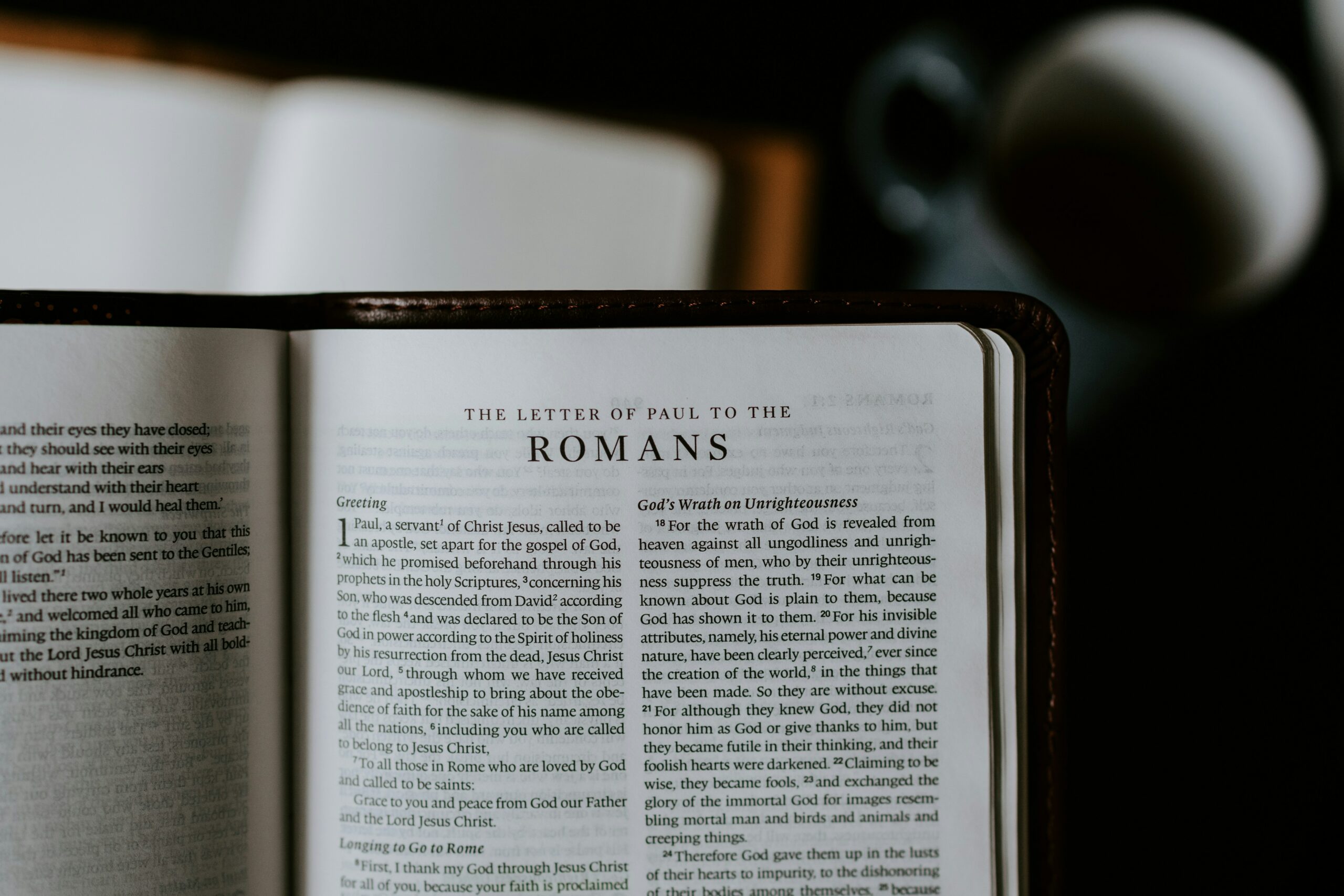
Salvation by Grace
The sermon explores the nature of divine grace as presented in Romans 4, emphasizing that salvation is a free gift received through faith rather than earned by works or adherence to the law. It highlights the inseparable relationship between faith and grace, arguing that grace remains valid only when it is unmerited and dependent on God’s initiative. The message underscores the certainty of God’s promise, asserting that salvation is secure because it rests on God’s sovereign character rather than human stability or effort. Furthermore, it illustrates the universal scope of this grace, which extends beyond ethnic boundaries to make Abraham the spiritual father of all believers. Finally, the sermon points to the attributes of God, who gives life to the dead and calls into being that which does not exist, as the ultimate foundation for trusting in His redemptive plan.
Transcript
And in Romans chapter four, we
are in the midst of. A dialogue, as it were, Paul,
perhaps not sitting face to face with detractors and controversialists,
but he is discussing their various arguments. If I can, I gave a
literally a. a one minute review to a friend
of ours just yesterday about what we are doing here in the
book of Romans. Chapters one and two convinced
us that we are all utterly sinful. Not only the Gentiles in chapter
one, but the Jews, the nation of Israel in chapter two, carrying
down through the greater portion of chapter three. Chapter three,
finally, and what a relief it was to us, wasn’t it? When we
finally got to salvation. Chapter three, verse twenty one,
where he talked about the righteousness that now is available to all
and salvation and discussing those things, justification by
faith. What a relief it was. And then
seemingly and even in a little bit of a tedious fashion, Paul
gets into this argument, as it were, in chapter four, and he
starts talking about what salvation isn’t. And how we can’t have
salvation, how salvation can’t be earned by works. It can’t
be secured by ritual. It can’t be gained through the
law. What an utter relief, then, when
he tells us how he’s already told us about salvation, and
we have gleaned a great degree of information from chapter three,
verse twenty one through twenty six. And in a sense, these verses
before us this morning, verses 16 and 17, are a refreshment,
if you will, or a refrain of what Paul has already said. But
these, to me, are among the most refreshing verses in all of this
epistle so far. If you would want to go back
to chapter three, verse 21, we’ll take a running start, we’ll take
it all in. We’ll go all the way down through 417. Paul gave us
the good news. In 321, when he said, But now,
apart from the law, the righteousness of God has been manifested, being
witnessed by the law and the prophets, even the righteousness
of God through faith in Jesus Christ for all those who believe. For there is no distinction,
for all have sinned and fall short of the glory of God, being
justified as a gift by His grace through the redemption which
is in Christ Jesus, whom God displayed publicly as a propitiation
in His blood through faith. This was to demonstrate His righteousness
because in the forbearance of God He passed over the sins previously
committed For the demonstration, I say, of his righteousness at
the present time, so that he would be just and the justifier
of the one who has faith in Jesus. If you would jump into chapter
four. What what then shall we say that
Abraham, our forefather, according to the flesh, has found for if
Abraham was justified by works, he has something to boast about,
but not before God. For what does the scripture say?
And Abraham believes God, and it was reckoned to him as righteousness. Now to the one who works, his
wage is not reckoned as a favor, but as what is due. But to the
one who does not work, but believes in him who justifies the ungodly,
his faith is reckoned as righteousness. Just as David also speaks of
the blessing upon the man whom God reckons apart from works,
blessed are those whose lawless deeds have been forgiven and
whose sins have been covered. Blessed is the man whose sin
the Lord will not take into account. Is this blessing then upon the
circumcised or upon the uncircumcised also? For we say faith was reckoned
to Abraham as righteousness. How then was it reckoned? While
he was circumcised or uncircumcised? not while circumcised, but while
uncircumcised. And he received the sign of circumcision,
a seal of the faith which he had had while uncircumcised,
that he might be the father of all who believe without being
circumcised, that the righteousness may be reckoned to them. And
the father of circumcision to those who not only are of the
circumcision, but also who follow in the steps of faith, of our
father Abraham, which he had while uncircumcised. For the
promise to Abraham or to his descendants that he would be
heir of the world was not through the law, but through the righteousness
of faith. For if those who are of the law
are heirs, faith is made void and the promise is nullified.
For the law brings about wrath, but where there is no law, neither
is there violation. For this reason, it is by faith
that it might be in accordance with grace in order that the
promise may be certain to all the descendants, not only to
those who are of the law, but also to those who are of the
faith of Abraham, who is the father of us all, as it is written,
a father of many nations. I have made you in the sight
of him whom he believed even God. who gives life to the dead
and calls into being that which does not exist. Now, that is
a lengthy passage, and it is, in a sense, a review. Paul had
introduced us to justification by faith, to this salvation that
was so desperately needed, the righteousness of God, the literal
key to heaven. And then he enters into this
discussion with the Jews and with the Jewish arguments. that
would be presented against this doctrine of justification by
faith. What about works? Paul said it’s
not by works. What about ritual? It’s not by
ritual. What about the law? It’s not
by the law or through the law. Well, what then? And that’s the
great news today, Paul discusses what then? If it isn’t by works,
if it isn’t by the law, if it isn’t through ritual, how then
are we saved? And verses 16 and 17 tell us
this is the positive side of the argument. This is the good
news indeed. The negative side has been given.
Verses 16 and 17 give us the conclusion from all of Paul’s
previous argumentation. With the law, conditions were
laid upon men. But with grace, all of the conditions
are assumed by God himself. I want to take you to a consideration
of grace this morning. Specifically, the grace that
leads to salvation, that’s why I titled it the grace of salvation. And what we get in this passage
are a series of overwhelming truths. that if we really pause
and ponder them this morning, they should make us in awe of
God. Overwhelming truths of the nature
of grace. First of all, and there’s place
in your bulletin for notes, if you so choose. First of all,
the first overwhelming truth of this, the nature of this grace
about which Paul speaks, is an amazing relationship, an amazing
relationship that between grace and faith. There’s an amazing
relationship that is introduced to us really here, at least for
the first time in Romans, the relationship between grace and
faith. Look at verse 16, where Paul
says, and he says it without hardly an explanation. For this
reason, it is by faith. That it being salvation, this
salvation about which we’ve been speaking, this great news, this
justification by faith, which we already learned was by faith
in Christ alone. This, he says, is by faith. That it might be in accordance
with grace. Now, typically, when you have
that little word for stand at the head of a sentence, typically
he’s explaining something that preceded. But it can be used
and often is in Scripture. It can be used to introduce something
that follows for this reason. It is by faith. What reason is
that, Paul? That it might be in accordance
with grace, faith and grace, he says, go together. They fit. They are in concert with one
another. We have seen faith. Even in the
book of Romans, we know that salvation is by faith. Romans
322, the righteousness of God through faith in Jesus Christ
for all those who believe. Later on in that same passage,
25 and 26. Speaks of Jesus being the justifier
of the one who has faith in Jesus. We saw it in his reply to the
Jews in 4.3. What does the scripture say?
Abraham believed God. We know that faith is crucial
to salvation. Paul addresses it again in 4.5
and 4.9 and 4.11 and 4.13. Over and over again, Paul has
posited faith as being crucial to salvation. We must believe
and we must place our faith in the Lord Jesus Christ. And we
have even seen or at least have hinted about this issue, this
concept of divine grace. Romans 3, 24 said it, that we
are justified as a gift by his grace through the redemption,
which is in Christ Jesus. What a great sentence that is. But the average person would
read past that so quickly. that we wouldn’t do justice,
not really to what is grace. We wouldn’t really stop and ponder
and really savor the truth of the substance of that word. Romans
four, four, Paul introduces it again in contrast to works, he
says, the one who works his wage is not credited as a favor. It’s not considered as a grace
gift of God. But that’s what grace is. That’s
what we do need to do on this occasion. We need to pause and
we need to consider what exactly grace is. Grace is, I mean, in
its simplest form, you’ve heard it a thousand times, it is unmerited
favor. It’s not just that you didn’t
deserve it. You positively deserved the opposite. And yet God favored you. God
graced you. Grace, said one, is the divine
power that brings justification in order that the promise may
be certain to all descendants. Grace means that free unmerited
favor. We knew we didn’t deserve it.
We knew that we hadn’t earned it. We knew that we couldn’t.
In fact, we knew that we deserve just the opposite. And yet. As
one said, grace is kindness shown to someone who does not deserve
it at all, but who deserves the exact opposite. It is absolutely
free, entirely unmerited on the part of the recipient. It has
to be a faith, otherwise it cannot be grace. If you bring works
into the realm of grace, it is no more grace. If you bring grace
into the realm of works, it is no more works. So, in other words,
Paul begins to introduce here the concept that faith and grace
are totally interrelated. You can’t place your faith in
God and somehow earn your way to heaven. As soon as you begin to work
your way, as soon as you begin to keep a ledger of your efforts
Godward. You’ve set aside grace and you
no longer need faith. God has established his plan
of redemption. God has his plan of salvation
of mankind, and he has made it to depend not on our efforts,
not on our works, not on our attendance to rituals, not on
our circumspect consideration and life according to the law. The only. article of faith that
read the only. Article of salvation is faith.
And a laying hold of the grace that leads to salvation. This truth is played out in many
times through Scripture, the. The antithesis between law and
grace, and that is because, as one said, if salvation is in
any form or any degree, dependent on merit, goodness or the stability
of man. Can you imagine us having to
maintain a hold on God? If any of those things are requisite,
it can never be sure. Why? Because it depends on us.
It depends on me. It depends on feeble people.
Rather, if that’s the case, it’s utterly and completely unattainable. As he summarized, unless we are
saved by grace, we cannot be saved at all. That’s great news. That’s great news. When we come
to the end of ourselves, when we come to the end of the road
of saying, look, I’m going to work a little harder at being
a Christian, I’m going to try a little harder at being a good
person. I’m going to try a little more rituals. I need to attend
to some new form of baptism, some new ritual. I need to dig
deeper into the rules of God’s word and become a better Christian
on my own. No, you don’t. You need to lay hold of the grace
that is available through faith in Jesus Christ. That’s what
you need. Grace is utterly against the
idea of merit. Grace is against the idea of
working your way to heaven. It is believing in Jesus Christ.
It is placing your faith in the resurrected Christ. It cannot
in any sense be a work or the exercise of the human mind and
heart, or it would be no salvation at all. One pastor said it this way,
in summary of this first amazing point, the relationship with
grace and faith. He said that God reckons the
believers faith is righteousness in order that salvation might
be in accordance with grace. If it were not for God’s sovereign
grace, providing a way of salvation, even a person’s faith could not
save him. Fascinating point. That is why faith is not simply
another form of human works. Haven’t you heard that your standard
Arminian argue that works are, you know, they argue as if works
are a faith rather is a work. It isn’t a work of man. It’s
a gift of God. That is why faith is not simply
another form of human works, as some theologians throughout
the centuries have maintained. The power of salvation or justification
is in God’s grace, not in man’s faith. Abraham’s faith was not
in itself righteousness. But was reckoned to him as righteousness
on the basis of the one who would himself graciously provide for
believers. including Abraham, the righteousness
they could never attain by themselves. If you’re trying to work your
way to heaven, if you’re trying to effort your way to heaven,
if you’re trying to please God on your way to heaven. If that’s the way that you’re
trying to be saved. If you’re trying to earn God’s favor or
please him so that he might save you, you’ve got to let go. Because
Paul says here, the second, the second that you put effort into
the equation in the sense of earning your salvation, not in
walking with Christ and pleasing Christ as a Christian, but in
trying to earn that relationship. The second you do that, grace
drains right out. Secondly, there’s a second overwhelming
truth about the nature of the grace, a nature of grace in this
passage, not only this amazing relationship between grace and
faith, but a marvelous promise, a marvelous promise in the assurance
of grace. And I want you to pause and get
this. Look again at verse 16. Where
Paul says, for this reason, it is by faith that it might be
in accordance with grace in order that the promise may be certain. To all the descendants. Now,
the amazing thing about this. Consider, perhaps the first time
that you heard about election. That’s a tough pill to swallow,
right? That God shows you from eternity past, not because of
anything in you. But God set his electing love
upon you. He chose you. He didn’t choose
you because you would believe in him later. That’s no kind
of election at all. God chose you purely out of his
mercy. I remember the first time you
heard that concept. Why me? How can that possibly be? How
could it possibly be that God chose me? Well, to me, If it’s
second place at all, this is a very close second. In fact,
I’d call it a tie. This statement. When Paul says,
for this reason is by faith that it might be in accordance with
grace in order that the promise may be certain to all the descendants
who are the descendants, we already said it. We already discovered
that last week, any who place their faith in the Lord Jesus
Christ or the descendants, what God says here is there are going
to be descendants, Abraham. There are going to be people. God already knew it. God already
knew how big the pool was. God already knew how many stars
were in the sky. And God said more than even that
are going to be your descendants, Abraham. There are going to be
a people of faith. There are going to be people
who believe in God. There are going to be people
who believe in the Lord Jesus Christ. And what he says here
is this marvelous promise, this assurance of grace that when
they are there and the gospel is preached, they will come to
know this truth. They won’t have to work, they
won’t have to fulfill some rituals, some requirements. They’ll have
to look upon Christ and believe, that’s it. What Paul gives here is the purpose
of divine grace. And when he says certain. The
word there literally is sure. Fast, it’s stable, it’s valid,
it’s something that is already practically realized, and it’s
completely opposite to that word that we learned in verse 14 nullified. Contradistinction to that. Not
only is. Grace not nullified. Grace is
absolutely certain it’s absolutely out there. It’s absolutely out
there and available to your friends and family who don’t know Christ.
It’s absolutely out there and available to your neighbors who
don’t know Christ and the people in this city who don’t know Christ.
It’s out there and all we have to do is proclaim it. And some
of them are descendants. Some of them are the recipients
of divine election from eternity past. We don’t know who they
are. Listen to this. Anything that depends on our
faithfulness, on our decision, on our ability to be tough in
our faith and to hold on to God is completely uncertain, isn’t it?
Isn’t that one of the most scary thoughts that wakes you up in
the middle of the night? If it depended on me to stay faithful to God,
heaven forbid. Pull the plug on me now, right?
Spiritually speaking, the blessing here is the fact that if you
are in Christ, if you have placed your faith in Christ, if you
have received the grace of God, it isn’t you hanging on to him.
Him hanging on to you, and it’s absolutely certain. Because God
had promised. Martin Lloyd-Jones said it this
way, salvation, thank God, is all of God. It is all of the
grace of God, and it is for this reason alone that it is sure
our ultimate salvation in glory is guaranteed by one thing only. that it is by grace and through
faith. Our salvation is sure because
it is founded on the character of God Himself, His everlasting,
abounding grace. That’s why Paul can say elsewhere
in Philippians, I am confident, I’m absolutely sure, I’m positive
of this very thing that He who began a good work in you will
perfect it. Until the day of Christ Jesus,
I’m confident. That’s why Paul can say later
on in Romans eight, which verse we’ll get to one day, for I am
convinced that neither death or life nor angels or principalities
or things present or things to come nor powers nor height nor
depth nor any other created thing will be able to separate us from
the love of God, which is in Christ Jesus. In order that the
promise may be certain If you’re sitting here today and you’re
wavering, you’re wondering, maybe you’re a young person and you’ve
talked to your parents about Christ. But if you’re not absolutely
positively certain, maybe you’re an adult who sat here for way
too long wondering about your particular eternal condition.
Maybe the sin in your life is testimony enough that you’re
not really saved. If you’re not absolutely certain,
talk to me. Because it’s here, it’s available. That’s what God says, and that’s
why I call it a marvelous promise. The whole thing is astounding,
an amazing relationship, this grace and faith, a marvelous
promise, this assurance of grace. The whole thing is incredible,
overwhelming. If we just pause and ponder. Paul had already told us and
shown us in verses 11 and 12 that Paul was the father of these
believing Gentiles and also believing Jews. These descendants that he speaks
of here, this seed includes everybody who believes, all believers,
whether they were natural descendants of Abraham or just children of
Abraham, even as the Psalms spoke about this morning, those who
would come later, other nations, The salvation about which he
speaks, the salvation by faith through grace is not only available
to the physical seed of Abraham. That’s what the good news is. Who? Have come to Christ in faith,
even though they were raised in the law. But also to those
who were never under the law, never tried to live according
to the law, who become children of Abraham by faith. That’s what
Paul means when he says he is the father of us all. There’s
a third overwhelming truth of the nature of grace. Not only
this amazing relationship between grace and faith and this marvelous
promise, the assurance of grace, but third, look down an incredible
conclusion. This is exactly why a hymn writer
would write a hymn called And Can It Be? Are you talking about
me? I received this gift. Look at
the incredible conclusion, inclusion, the recipients of grace. Verse
16, again, pick it up in stride for this reason, it is by faith
that it might be in accordance with grace in order that the
promise may be certain to all the descendants. Not only to
those who are of the law, but also those who are of the faith
of Abraham, who is the father of us all, as it is written,
a father of many nations. I have made you be one thing
we almost expected in the book of Genesis, don’t we? It would
be one thing if God said, I’m going to make you the father
of this nation, the father of this nation. That is the apple
of my eye. This Israel of God. Well, He didn’t say that, did
he? He said, I’m going to make you a father of many nations. God in his sovereignty is the
one that’s calling the shots, God and his sovereign plan of
redemption said that it will start with Israel, but it will
never stay there. And this salvation is going to
break through borders and boundaries. And it will spread and be available
to all. And the fact that so many sit
here this morning, Gentiles from a Hebrew designation. It’s true. God has broken through. He is the father of us all. Not only those who are of the
law, not only those who were raised by the law and lived under
the law, but also to those who are of the faith of Abraham. We have the same kind of faith
that Abraham had, and we’ll talk more about that faith in a second.
He’s the father of us all. Abraham was not only the father,
according to the flesh of all the Jews, he’s the father in
a very different sense, in a spiritual sense, that’s no less real Of
all believers, without exception. And Paul is really revisiting
this truth. He’s already talked about it
in a number of different times. Look back at chapter four, verse
one. What should we say, then, that Abraham, our forefather,
according to the flesh, has found? Paul knew when he wrote the book
of Romans that he was writing to Jews and Gentiles. He could
never say our father, according to the flesh, to simply a Jewish
audience, nor would he say it to simply a Gentile audience. He intends to say it because
he knows that God has made Abraham the father of many nations. Look
down at verses 11 and 12 of Romans four, speaking of Abraham, who
received the sign of circumcision, a seal of the righteousness of
the faith, which he had while uncircumcised so that he might
be the father of all. Paul’s revisiting this point.
He’s already made it and established it. And he even goes back again
and quotes for the third time from Genesis, a father of many
nations, I have made you. And it’s almost a parenthetical
thought. It’s almost under the breath, if you will. But it’s
a powerful declaration, it’s a reminder to us and to all that
salvation is available and it’s full and it’s free and it’s there
for the taking for any who believe. One commentator said this, this
declaration. The apostle informs us contains
a great deal more than the assurance that the natural descendants
should be very numerous. It would be one thing to tell
Abraham, look, you’re going to have a son and then you’re going
to have this prolific, amazing family tree. But God doesn’t
stop there. He didn’t stop there. Father of many nations. Not one. In connection with the promise
that in him all the nations of the earth should be blessed,
it refers to his natural descendants and finds its full accomplishment
in the extension of the blessing promised to him to all of those
nations who are his children by faith. Don’t lament that you weren’t
born Jewish. Salvation is no less available to you now than
it is to anyone. By God’s plan of redemption. I told you there were four overwhelming
truths of the nature of this grace that has been shown and
given to us. And it is overwhelming when you
begin to ponder the nature of this grace. The eternity past,
God established a plan of redemption. He began to let that plan unfold.
Now he’s approaching Abraham and he says, look, I’ve got a
people. I’ve got these descendants, you see, I can see them. I can
see it laid out as clearly as the stars in the sky, Abraham,
and there’s more of them than even you could count. I can see
them. This is an amazing thought, watch
this. Go all the way back to verse 16. Point four is. The fourth overwhelming truth
on the nature of God’s grace is a magnanimous benefactor,
I want you to look at the giver of this grace. The giver of this grace, look
at verse 16 again, for this reason is by faith that it might be
in accordance with grace in order that the promise may be certain
to all the descendants, not only to those who are of the law,
but to those who are of the faith of Abraham, who is the father
of us all, as it is written, the father of many nations, I
have made you. And then this thought. And that’s
why I say that the beginning of verse 17 is parenthetical.
This thought in the sight of him whom he believed, even God,
who gives life to the dead and calls into being that which does
not exist, that attaches to the word Abraham all the way back
in verse 16. To those who are of the faith
of Abraham. In the sight of him whom he believed,
even God. Here’s what you have. You have
Abraham and God having a conversation where God is telling Abraham
about these promises and he tells him to look up at the stars in
the sky and he says, your descendants are going to be more than that. This promise. Where Abraham is
told that he is the father of us all in God’s sight, don’t
go by Abraham’s sight. Don’t go by your own eyesight. It isn’t human vision that’s
in view here at all. It’s in God’s sight that Abraham
was the great father of nations. That’s how God saw him. Whatever
some of the Jews thought that they were, they had the exclusive
right to Abraham and to the law and everything else, not to God. That’s not how God saw the plan
as it was unfolding, as he was communicating it to Abraham. Paul says, look, God looked upon
Abraham and he stood before God Almighty and God in his all seeing
eye. Said that one day you are going
to be surrounded by hundreds and hundreds of thousands of
people, many nations. One pastor said, of course, he
was not so an actual fact, of course, Abraham, you know, Abraham
looked around, there wasn’t anybody. Not only was there no great nations,
there wasn’t even one nation. Not only was there no single
nation, there wasn’t even a son. He was not the father even of Isaac.
At that point, it seemed impossible that he ever would be, because
Abraham was 99, Sarah was 90, a childless couple. But in the
sight of God, he was already the father of Isaac. In the sight
of God, he was already a father of many nations. In the sight
of God, he already had a multitude and a seed. God looked at Abraham
and he saw Abraham in that light as God sees and as only God can
see. It points to the idea here of
the great father of nations is one. Who stood before God in
this incredible scene. And he has essentially. This God in view and these promises
in view. And he places his faith in that
God. OK. It was that simple. It’s childlike
faith. The whole remainder of this verse,
and this is what really gets fascinating for us. The whole
remainder of this verse is really a characterization of God. Let
me tell you about this God in whom Abraham had placed his faith.
Let me tell you for a moment about this God, as Paul is so
wont to do. Paul has this tendency, if he
just even mentions the name of God, he goes off on a rabbit
trail telling you all about him. And that’s what he does here. What he wants to do is point
out a couple of attributes of this God to point out his divine
sovereignty in all of these things, what one called descriptive of
the aspects of God’s character, which are peculiarly appropriate
to the faith exercise. In other words, he says they
point to the attributes of God, which are the specific basis
of Abraham’s faith. Here’s Abraham standing before
God, looking up at the stars in the sky, and he’s got a decision
to make, essentially, do I take this God at his word? And he
essentially comes to the conclusion, how could I not? Knowing what
I know, how could I not? Another said it this way, it
is not unusual for the apostle to attach the name of God, a
descriptive paraphrase, bringing into view some divine attribute
or characteristic suited to the subject at hand. So here, when
speaking of God’s promising to Abraham, a childless old man,
a posterity as numerous as the stars in heaven, it was most
appropriate to refer to the omnipotence of God to whom nothing is impossible. Abraham believed to what all
human appearance appearance could never happen because of the God
who made the promise. In other words, he took this
God at his word. What is he like? Two things.
Two simple sentences, he gives life to the dead and he calls
into being that which does not exist. Well, that’s a pretty
good resume, right? That’s pretty good to start with.
Let’s look at him individually as we close. Some said that when
he says he gives life to the dead, he was referring to Isaac,
which had not happened yet. Not only had Isaac not even been
born, you could say that he was referring to that. Abraham knew
that God was the life giver, that if he wanted to give him
a son, he’d give him a son. If he wanted to take his son
away and give him back again, God could do that, too. If he
wanted to raise the dead or bring to life that which was dust,
God could do that. Abraham had that kind of faith
in this God. It said, one, to originate life
is the prerogative of God. It requires almighty power and
is therefore specified in Scripture as one of God’s peculiar works.
The being who can call the dead to life must be able to fill
one, although as good as dead, the promise of a numerous austerity. In other words, Abraham looked
at God and he looked at himself and he said, nothing is impossible
with God. The God that I know can give
me a son, and if he gives me a son, he can give me a nation,
and if he gives me a nation, he can give me many nations. Deuteronomy 32 tells us about
this God. See now that I am he. There is
no God besides me. It is I who put to death and
I give life. I have I have wounded and it
is I who heal. And there is none who can deliver
out of my hand. Abraham knew that God. 2 Corinthians 1 9 Paul testifies
of it there. First Timothy 6 13. I charge
you in the presence of God who gives life to all things. Paul
knew it. This is one of the foundational
truths about God himself and Abraham knew this God. John 5 21 John 5 25 over and
over again, it’s testified in Scripture. Let’s move on. Paul
has in mind a number of things here. That he was going to somehow
quicken or create a situation where Abraham advanced in age,
Sarah advanced in age, were somehow going to be able to bear a child.
That that child now given was going to be taken away and if
possible given back from the dead. And then the backdrop of
all of this Abraham knows he doesn’t know who the Lord Jesus
Christ is. He doesn’t know how the gospel
is going to play out, but he knows God has the ability to
pull this off, that he can raise the Savior from the dead, that
he can raise him who is in the tomb. It is life giving power
that he’s testifying to. Abraham knew that kind of God.
Abraham experienced it firsthand of God, didn’t he? Listen to
how Hebrews 11 testifies of God. By faith, even Sarah herself
received the ability to conceive even beyond the proper time of
life, since she considered him faithful who had promised. Therefore,
there was born of even one man and him as good as dead at that,
as many descendants as the stars of heaven in number, innumerable
as the sand. There’s another attribute. Not
only he who gives life to the dead, he who calls into being
that which does not exist. And this baffled many, many commentators. I think I counted eight or nine
different ideas of what this could refer to. When he says he calls into being
that which does not exist, you have some commentators say, absolutely,
this is the works of creation. You have a creator God, a God
who’s able to create and bring from nothing. Yes, you do. I
think that’s a good answer. You have a God who is able to
make out of nothing a nation of people. Yes, you do. You have
that God. And I think that’s a good answer.
You have a God who is able to regenerate the dead, bring the
dead spiritually speaking to life, have them place their faith
in the Lord Jesus Christ and live forever. You have that kind
of God. Who calls into being that which does not exist. There’s
no reason here to limit the scope of this truth about God. God
has the ability. God can bring from nothing. God
can make a nation. God can make a people for Himself. God can, because He’s God. Paul here is speaking about the
almighty power of God. And he’s pointing us, if you
remember, back to the faith of Abraham. Abraham looked up at
the stars of the sky in an instant thought in his mind of the nature
of the God who is promising him these things. The very God who
gives life to the dead, the very God who calls him to being that
which does not exist, and Abraham said, how can I not believe? As my brother Alan said, today
is the day of salvation. You know, in your heart that
there is a God, you know, in their heart, in your heart. About
his ability, you know that he’s the God of creation, you know,
just from even what we’ve talked about this very morning, that
he sent a Savior to die for sinners and that he raised that Savior
from the dead. The only way of salvation. is to enjoy this grace, this
free gift that God has provided. The only way to enjoy this salvation,
to have your sins forgiven, is to place your faith in the same
God that Abraham placed his in. Able to raise the dead. Able
to bring from nothing something. Place your faith in what God
has accomplished through the Lord Jesus Christ. Let’s pray. Our merciful God, if there are
any in the room who do not know the Lord Jesus Christ with certainty,
as Paul spoke of, may today for them be the day of salvation.
Encourage them to speak to any Christian around them. We’ll point them in the direction
of Christ Jesus, our Savior. We thank you, Father, for your
word. We ask your blessing on our day. It’s in Jesus’ name
that we pray. Amen.
Messages: 204