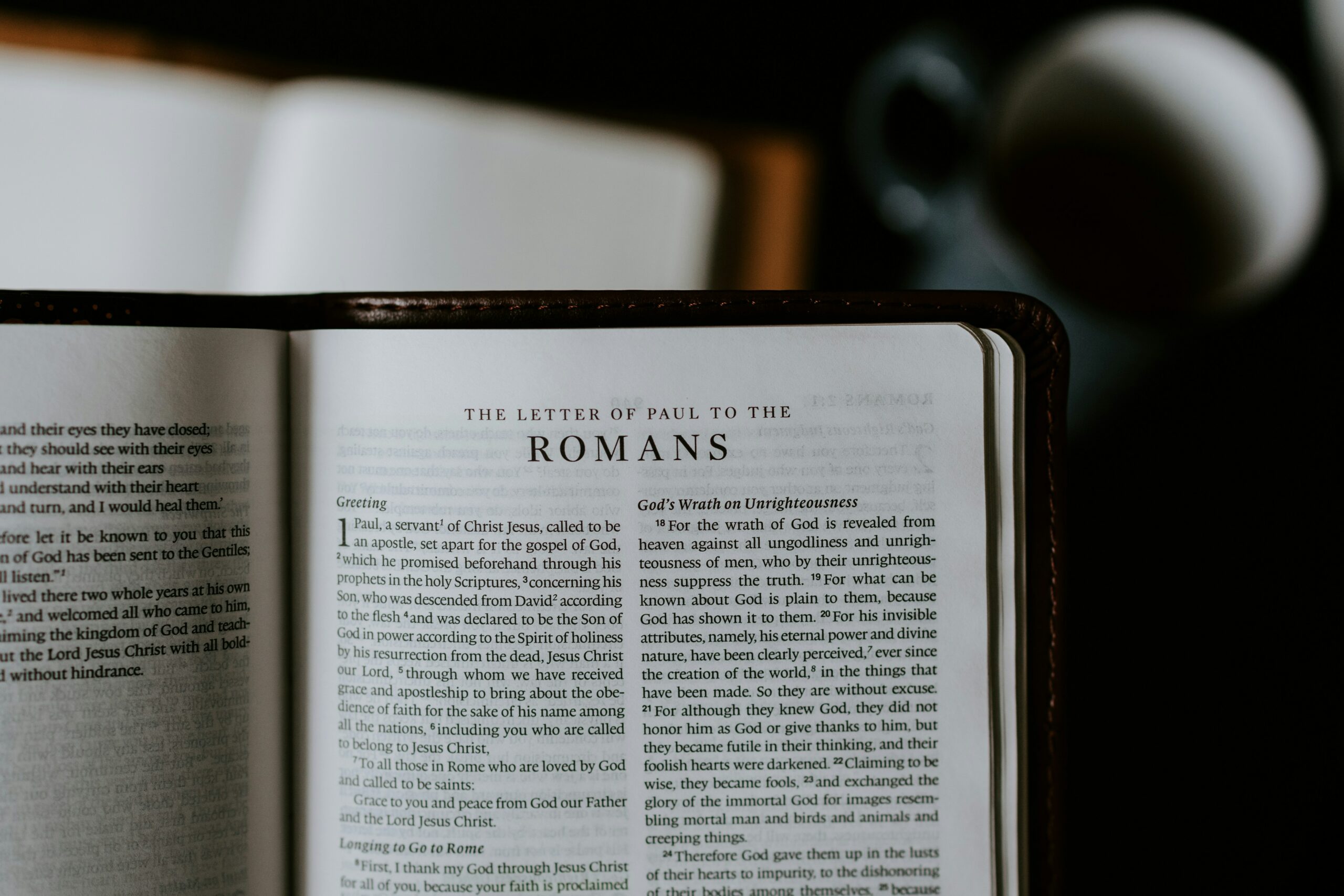
Ordained by God
The sermon explores Romans 8:28-30, distinguishing the biblical truth that God works all things for good from the world’s passive optimism. It addresses the textual debate regarding the presence of the word ‘God’ in the Greek manuscript, affirming that the Father is the active agent orchestrating the believer’s life. By referencing Psalm 104 and Acts 14, the message emphasizes that God is not a distant observer but the sustaining force behind creation and history. The central theme is that both suffering and joy are sovereignly used by God to conform believers to the image of Christ, providing profound assurance that no circumstance is outside His purposeful control.
Transcript
If God’s people would take their
Bibles and turn to Romans chapter 8, once again, Romans chapter
8. I did not provide notes today,
we’ll really ultimately be looking only at one verse, verse 828,
we’ll be looking at it in context, but the structure being what
it is, is Simple enough that your Bibles are more than adequate.
Today and every other day. When I was growing up. My grandmother would regularly
offer. What I considered sage wisdom. For those of you who
don’t know, my great grandmother lived to the age of 104. And
just because of that, I figured that she must have all the answers. And whether it was a skinned
knee or as time would go on, a breakup of a girlfriend or
the difficulty of a job or some world crisis, my grandmother’s
wisdom was always the same. Everything works out for the
best. Everything works out for the
best. Well, I can tell you that. During the course of my upbringing,
those words rang in my head through the course of experiencing various
difficulties in my life, and I would try to play them over,
everything works out for the best. But I found them to ring
somewhat hollow. Because I found it not to be
true, frankly, everything didn’t always work out for the best,
at least not according to me. Things don’t always work out
according to our personal best. There are wars, people die, people
get sick, people suffer, bad things happen. And to a degree,
I began to quite dislike that advice, everything works out
for the best. I can tell you, I was quite shocked.
When, as a young Christian, I came across this verse. And in a sense,
my grandmother’s words came back haunting me all over again. Everything
works out for the best. All things work together for
good. But what I soon discovered is
that there was a very big difference between the homespun wisdom that
my grandmother offered. I never knew her to profess faith
in Christ. These were not biblical principles
that she was uttering. It was it was a principle that
had literally been lifted from scripture and distilled down
through the ages. what one brother called a false
optimism by the world. The world is good at that. The
world is good at reaching in and grabbing out principles that
sound good or seem good. There’s another one I discovered
years later. Money is the root of all evil.
No, that’s not true either. That’s what the world says. Though
they don’t operate on it. What the world says is money
is the root of all evil, what the Bible says, love of money
is the root of all evil, right? And so I began to ponder this
verse because now I knew it to be a biblical principle and there
was some truth to it. I had to determine. What I had
to separate fact from fiction, I had to figure out where does. The world stop and God take over. With regards to this principle,
because I knew that everything wasn’t right in the world. The
things do happen. That on anybody’s scale aren’t
good. If you would. Let’s go back to
the book of Romans. Into a short passage of scripture,
verses 28 through 30. where Paul writes, and we know
that God causes all things to work together for good to those
who love God and to those who are called according to his purpose.
For whom he foreknew, he also predestined to become conformed
to the image of his son, that he might be the firstborn among
many brethren and whom he predestined these. He also called and whom
he called these Also, he justified and those and whom he justified
these. He also glorified. Well, it shouldn’t surprise us
that in what Lloyd-Jones referred to as one of the greatest chapters
in the Bible, we should come across arguably one of the greatest
passages And in my opinion, one of the greatest verses in all
of Scripture. There aren’t too many verses
of Scripture that are more familiar to the Christian than the one
before us this morning. As one pastor said, for Christians,
this verse contains perhaps the most glorious promise in Scripture,
and that’s true. And there are others that come
close to echoing these truths. He goes on to say that it’s breathtaking
in its magnitude, encompassing absolutely everything that pertains
to a believer’s life. We come to an incredible passage
of Scripture this morning, and the best I can do is mess it
up, right? Gilding the lily once again. Another pastor said that these
precious verses We are considering here one of the most remarkable
statements that even this apostle ever made. And when you think
of the totality of Paul’s writings, even that statement is grand
in itself. It is one of the most comforting
statements in the whole range of scripture in respect of the
statement of exalted doctrine. There is really nothing higher
than this. I don’t mean to imply that it’s all downhill from here.
All scripture is inspired by God and profitable for teaching.
We don’t have to pause or stop or draw the line here at Romans
828. But let’s go. Let’s go to Romans
828 and the first thing that I would do is nestle it into
its context. We’ve been looking at Romans
Chapter 8 and I propose to you that it is a chapter that is
essentially a discussion discussion an exposition really of God’s
help. Divine assistance, we have called
it an assistance, not as if God comes alongside of us, but assistance
to provide us that which we are absolutely destitute of. We have seen that the Lord Jesus
Christ. Rendered us assistance because
our very life is established in Christ at the very opening
of this great chapter, it says there is therefore now no condemnation. For those who are in Christ Jesus,
God places us in Christ. We spent no little time considering
that great principle. We are established in Christ. But the Spirit also has his role. We began to see that as that
great statement is made in verse 12 that the Christians life is
sustained by the Spirit of God. The Holy Spirit renders us Divine
assistance, look at verse 12. So then, brethren, we are under
obligation not to the flesh to live according to the flesh,
but to the spirit to live according to the spirit. And from there,
Paul unfolds before us those five means of assistance that
the spirit provides. And likewise, the father. Certainly,
it is to go too far to say that any of the members of the Godhead
work completely independently of one another. To say that the
Lord Jesus has his part is not to say that the Father and the
Spirit were not part of that. Nor is it to say that the Holy
Spirit in exercising these things did so independently. He didn’t.
But what Paul, I believe, means to show is that we have all of
the resources. Of God. At our disposal as Christians,
God has given us everything pertaining to life and godliness. And we see here, beginning in
verse 28, the father’s contribution. The father has ordained the Christian’s
life. The Christian’s life is ordained
by the heavenly father. Now, in the weeks to come, I
believe that if you’ve never really looked and considered
these verses before, they will be absolutely shocking to absolutely
revolutionary to Christian life. The Holy Spirit has done his
work, we are embedded already into Christ, but the father has
ordained it all. The father has sovereignly not
only planned it all, but carried it out. It’s an absolutely profound
study. Let’s go to verse 28. The reason
that I say that this is. Parallel, if you will, with what
the Lord Jesus has done and what the Holy Spirit has done is the
little word and that stands at the head of most of your translations.
It could be and there were those that argued that this makes it
coordinate with that little thought that we don’t know how to pray,
but we do know that God causes all things for the good. That’s
not a bad connection. I would refer to that as a subsidiary
Segway, if you will, but I don’t think that’s the main thought.
What Paul is getting at here is that the Holy Spirit has done
something for us. The Lord Jesus has done something
for us and the Heavenly Father has done something for us. And
this is what he wants to unfold to us here. It’s a fresh assurance to us. It’s a fresh assurance that God
himself has acted on our behalf and rendered to us aid that we
could not possibly have done ourselves. Paul says, and he
starts with a fairly familiar phrase for Paul, he says, we
know. And we know that God causes all things to work together for
good. He says that this is common knowledge. It’s an acknowledged
fact among Christians that God, as it were, has their back. God
is watching out for them. God is working things out for
them. Paul says. Not only does he know
it to be true, but that we as believers know it to be true,
he calls upon us even not just the Roman Christians to check
our memory bank and to remember not only how God has operated
through the saints recorded in Scripture, but how God has operated
even in our own lives. We know. It isn’t just a promise
that we take by faith, we look back on the totality of our own
lives and in the totality of the testimony of Scripture, and
we come away with a settled conviction. As one described it, it is a
knowledge which enters into the heart and the affections, producing
in them confidence in its truth, we know, and because we know
we are bold for Christ. What do we know? What we know is. What began to
trouble me early on in my. Christian upbringing. As I began
to grow in Christ. One verse really stands above
all others as having rescued me. One verse I can really think
of that shed such a light and such clarity on my otherwise
confused state that it remains one of my all-time favorites.
The scene was simple. I was in college, interacting
largely with Campus Crusade, and I’m not suggesting that these
thoughts are endemic to Campus Crusade, but that’s where I learned
it, and I’ve seen it only a few places since. The idea was this. That we’ve got to pray for God’s
will. We’ve got to pray, pray for it
so specifically and so intently that in every moment we’ve got
to be worried about whether we’re in God’s will. We’ve got to be
worried about whether we’re making the right decision on almost
every sphere. Almost every possible contingency
that comes up, we’ve got to pray about. And I woke up one morning and
I wondered, does God really care what color socks I put on this
morning? Does God really care which which
sock I put on first? Which decisions? Where is that
continuum? Where are we and where do we
fall? And I’ll tell you, I got hamstrung for a long time. And I called it this conundrum
between faith and irresponsibility. I didn’t want to be irresponsible.
I didn’t want to wear blue socks if God wanted black. I didn’t
want to do what was irresponsible. And I knew that there was in
that a relative degree of faith. I knew that at some point you’ve
got to take it in faith, you’ve got to move, you’ve got to put
on socks, unless you’re going to wear flip flops. You don’t
wear socks with flip flops. I don’t. And so I I found myself stuck. I was stuck. Between this fine
line between faith and irresponsibility, I soon found myself not being
able to make. Not just major decisions of whether
to marry this girl or not. But even basic decisions, I just
got stuck. And then I came to Romans 828
again. Not just for the first time in my Christian life, but
with a fresh view. When I learned that the truth
of this passage, that God causes all things to work together for
the good, there are times where God says, you know what you pick.
You pick as long as it’s not immoral, illegal. Pick your path
and I’m going to be there and I’m going to work it out for
good. And it freed me up. It freed me up and I married
the girl. Let’s take things in relative
order in this passage, and I say relative because truth be told,
our translation here, not just the NAS, but a number of the
translations leave much to be desired with regards to the way
that the original flows. If we were to rigidly follow
the original, the Greek, it would read something like this. We
know and but. That for those who love God,
all things work together for good for those according to his
purpose are called. And so we need to back up and
tweak things a bit, we’ll take things in relative order, all
things. When Paul here says, we know,
we take it with certainty that God works all things for good. How far do you take that? There’s no doubt that he takes
our suffering that has been a major theme. It is a major theme with
Paul in almost all of his letters. It’s a major theme in Scripture.
We’re not to seek to dodge suffering. We’re almost to expect suffering. It will come. It is part and
parcel of life, especially the Christian life. And our great temptation in those
things When suffering, when difficulty, when heartache comes is to think
that God is suddenly against us. God has stepped off watch. God is not watching out for me.
God has left this terrible evil into my life. But not only does. Paul, I believe,
include here suffering, but he also includes even column times
peace. Not just difficulties, but even
even good things. There aren’t any things that
occur in the Christian life. That we would even think to take
off of the table for God to be able to use, utilize in our lives. For his purposes, are there?
Is there anything that you would look up to God and say, God,
that’s not fair. It’s not fair to use that one. We don’t need God’s permission.
God is sovereign. God has our best interests at
heart, and God will use whatever means he chooses. For whatever purpose. He deems
right and good. But if you’re looking at the
context of Romans 8, you can’t help but. Read on. You know the passages that follow
and will preach those in time. The primary reference here for
Paul is absolutely the sufferings of the present time, just as
he’s already discussed. But if you look also at verses
35, glance down. Who will separate us from the
love of Christ? Will tribulation? Tribulation
is absolutely in view. Those grave difficulties, those
unsettling occurrences in our life that shake us to our very
core. Those things are in view. God is taking those things, those
tribulations that come into our life quite unexpectedly. And
they shake us to our very core. God is taking those things. Yes,
he is. Distress. We call it in our day
and age, just stress. I’m maxed out. God is taking
that distress. Persecution. You mean God would
use persecution for his glory and our good? Yes, he would.
Famine, nakedness, peril, sword, just as it is written for your
sake, we are being put to death all the day long. We are considered
as sheep to be slaughtered. Everything is at God’s disposal
to be used in our lives. Everything from suffering to
afflictions, to persecutions, to calamities, Well, one pastor
said even righteous things, you know, that God is. Is free to use believers in your
life. God is free to use his word in
your life. God is free to use angels to
guard and to protect you. God is free to use all of these
good and noble things. But God is also able. Because
he’s God to use what we would refer to as evil things, suffering,
temptation and the like. As one pastor shared, good things,
bad things, trials, troubles, tribulations, illnesses, accidents,
disappointments, even failure, God can make all and does make
all ultimately for good. Let’s go to the Bible, though.
Let’s look at how this works. The Bible says we know that God
causes all things to work together for good. That little word is the word
that we get synergism from. And it stumbled a lot of otherwise
faithful commentators and. One called it a conspiring or
rather conspiring harmoniously. That’s a curious way to put it.
that God would conspire towards our good. Ellicott, one of my favorite
commentators on the Greek text, said that it just really weakened
it down to just refer to it as a contribution. God contributes
to our good. God cooperates, said another.
It literally means to work together with and some propose that it
was God coming alongside of us to work together with us, which
is a silly thought. To do so is to to overplay each
individual part of those compounds and to give. Undue weight to
the various parts of those words. It just means that God literally
works these things together for our good in every possible way. God helps us in every possible
way where we need help. God is there to provide it. God
takes all of these things and works all of these things for
his good purpose. Said one. Divine Providence works
with us for the good in all things, this comforting conviction is
strengthened by experience and observation, but it is founded
upon faith and the constant care of a loving father. We don’t
take. We don’t find this surprising that God would take everything,
everything possible that can come into the Christian’s life
and work it for our good and his glory. We don’t find that
surprising. We know God to be a sovereign
God. We know him to be a loving God. We know him to be a wise
and a faithful God. We know him to do the right and
just thing. Now, the question is, if you
glance down at your Bible, is God here or not? Because this is this debate has
raged for centuries, is God here or not? What do I mean by that?
The word God is God in the passage or not? Now, if you have the
N.A.S. Obviously, I’ve already read
it several times this morning. We know that God causes all things
to work together for the good. But in the Greek text or in many
of the ancient Greek manuscripts, God is not there and it’s produced
no little conundrum over the centuries. Even the I’ll get
to that point in a moment. Some manuscripts introduced this
word God a second time in this little phrase. Which would mean
that the phrase would have to read something more like this.
We know that God works all things for good to those who love God
and are called according to his purpose. That’s how it would
literally have to read. That little insertion of the
word God has some very old support behind it, very ancient manuscripts
include this. But the majority of the manuscripts
don’t, and so you have, in a sense, a problem. What this created for the church
was this conundrum that if you don’t insert God. Into the sentence,
the thoughts tend toward what one called evolutionary optimism. That’s what my grandmother taught.
I didn’t know that’s what it was called then, but it was this
evolutionary optimism that everything is just kind of working itself
out and you’re just part of the machinery. You just don’t want
to get caught in the teeth, right? And so they were very concerned
that if you take God out of that. That you would have this. homespun wisdom like my grandmother
used to dish out. And as you begin to look at this,
the the insertion of that word looks like a classic situation
where a scribe copying down the text of Scripture, perhaps either
wrote it in the margin or his conviction was so solidly for
the fact that God was the one working out these things that
he inserted it. And as Texts began to be copied
over the years, it just became commonplace. God causes all things
to work together for the good. The Greek texts vary from for
those of you who are familiar with the Greek texts. Most of
them refrain from adding this word God. Westcott and Hort,
one of my favorite, inserts God in brackets to tell you that,
look, we don’t believe that it was there in the Greek, but it’s
it’s a good thought. It’s a good addition. The newest and most up to date
text, Nestle doesn’t include it. And as a result, as you know,
that produces a variety of different translations. And over the history,
we’ve seen everything works for good. God makes everything work
in harmony. All things are working together.
All things work together for good. Even the notes in your New American
Standard and your ESVs vary. Some of them would tell you that
early manuscripts vary. Others would tell you only one
manuscript, which isn’t entirely accurate. And so you come up
with a number of different translations. I think there are eight possible
different translations, but there are very few interpretational
positions. There’s three. Are all things just working themselves
out? Is God merely a passive bystander
just watching his world unfold? Or as very few commentators,
careful commentators, is the Holy Spirit the one that’s working
out these things or is God the father working things out? And so in answer to my question
that I posed just a moment ago, is God here or not? I take it
to be the last of the three. God the Father is working things
out. God is here in this verse, even
if the word God isn’t. Things just don’t happen. Things
just don’t work themselves out. God, the great and sovereign
orchestrator of all of life, is the one working things out. Either way, whether the word
is inserted or not, the meaning is still ultimately the same,
all things work together for the good, not by some cosmic
force. Not by what many would call fate. But by God’s sovereign direction
and control. If you glance down, the whole
point of verses 20 through 30 is that God is doing this. God is giving us help. The entire
chapter is about divine assistance. What Paul points to here expresses
a biblical doctrine. The God is sovereignly in control,
the God is directing and orchestrating all of life. One pastor said
it this way, contrary to what the King James and other versions
suggest. It’s not that things in themselves
work together to produce good, it’s God’s providential power
and will, not a natural synergism of circumstances and events in
our lives. We get that. But I want to drive
the point home, go, if you would, to Psalm 104. Psalm 104. I can’t recall if I ever refreshed
your memory on this, but you remember Y2K? During Y2K, I preached
Psalm 104. I preached the first part of
Psalm 104. in 1999 and I preached the second
part of it in 2000 just to kind of bait the hook and to thumb
my nose and all the so-called experts that said the world was
going to end because of a computer malfunction. As you’re settling into Psalm
104, this idea that there is this impersonal cosmic force
working in life is. It’s new age really is what it
is. It’s God the one that’s acting
everywhere and not only has God made everything that we see and
enjoy. It’s God that sustains it and
that’s what the testimony of some 104 is. Glance at the first
part of it. It has been called someone or
four has been called a song on the providence of God. And first,
in the first four verses, you see the God of creation. This
is who the psalmist is laying out before us as the orchestrator
of it all. Bless the Lord. Oh, my soul.
Oh, Lord, my God, thou are very great. Thou are clothed with
splendor and majesty, covering thyself with light as with a
cloth, stretching out heaven like a tent curtain. He lays
the beams of his upper chambers in the waters. He makes the clouds
his chariot. He walks upon the wings of the
wind. He makes the wind his messengers flaming fire his ministers. In
other words, God is is awesome. God is great. He is immense. He is omniscient and omnipotent. That’s the God of creation. And
then it turns to the creation of God, what what has God created? Look at verse five. He established
the earth upon its foundation so that it will not totter forever
and ever, which is an incredible thought. God set this globe in
motion and then cast it into the sky so that it’s perfectly
spinning, orbiting through space. Perfectly balanced. Three hundred
and sixty five and a quarter days per year. Doubts cover it
with deep as with a garment, the waters were standing above
the mountains of thy rebuke, they fled at the sound of thy
thunder, they hurried away, the mountains rose, the valley sank
down and on and on. The psalmist goes to detail. The creation of God. Every intimate
element of it. It’s been called some on a four. has been called the poetic version
of Genesis 1 because of that. And so you have the God of creation
in the creation of God, but the reason I’m sharing it with you
today is that the whole rest of the psalm from verse 10 on
is all about the preservation of God’s creation. In other words,
God didn’t just set the world in motion and sit back and watch.
God is intimately involved with everything as it unfolds. Look
at verse 10, he sends forth springs in the valleys, they flow between
the mountains, they give drink to every beast of the field,
the wild donkeys quench their thirst beside them, the birds
in the heavens dwell. They lift up their voices in
the branches. He waters the mountains from his upper chambers. This
is God’s doing. It’s not just a weather pattern. The earth is satisfied with the
fruit of his works. You know what? You could take
that as the theme or the thesis of the entire song. The earth
is satisfied with the fruit of his works. It’s not that some
impersonal force, it’s not that just the forces of nature had
taken over and that God now is on break. God is sustaining everyone
and everything, every moment of every day. Look at this. Look at verse 14.
He causes the grass to grow for the cattle and vegetation for
the labor of man so that he may bring forth his food from the
earth and wine, which makes man’s heart glad so that he may make
his face glisten with oil and food, which sustains man’s heart. God is the one. God is the one
that’s sustaining it all. It isn’t just a delicately balanced
ecosystem. It’s not as The popular idea,
the circle of life where everything’s just kind of humming along on
its own. God is doing it, it’s a God designed
system, it’s God ordained and it’s a God sustained system. As the passages go on, you hear
about every manner of creature. And then in verse 24, the worship
Begins, Oh Lord, how many are thy works in wisdom? Thou has
made them all. The earth is full of thy possessions. And dare we ask. Is God in Romans
828? God is absolutely in Romans 828
and he’s everywhere else beside. One Puritan said it this way,
the Lord began to show himself in the visible splendor of his
apparel ever since the creation of his universe. All you got
to do is stop and look and you can see that it’s God. Working
everything out for our good. He brought forth those insignia
whereby he shows his glory to us whenever and wherever we cast
our gaze, wherever you cast your eyes. There is no spot in the
universe wherein you cannot discern at least some sparks of his glory. He says, look. You don’t need some Greek scholar
to tell you whether or not God is in Romans 828, he’s there.
He’s the one doing it. He’s the one orchestrating it. Paul and Barnabas. Had the opportunity to testify
of God’s sovereign providence. Paul and Barnabas were ministering,
remember, in Lystra and they had just healed a crippled man.
The people who witnessed it started worshiping Paul and Barnabas. Multitudes saw what Paul had
done. They raised their voice, saying in the Laconian language,
The gods have become like men and come down to us. And they
began calling Barnabas Zeus and Paul Hermes because he was the
chief speaker. And the priest of Zeus, whose
temple was just outside the city, brought oxen and garlands to
the gate. That’s a full-blown idolatrous worship service for
two men. And, you know, I’m sure that. I’m sure there
was a fleeting thought that maybe it is us. Maybe we are what they say we
are, but it didn’t last long and Paul seized the moment. When
the apostles Barnabas and Paul heard of it, they tore their
robes, rushed out to the crowd saying, man, why are you doing
these things? We are also men of the same nature
as you. We preach the gospel to you in
order that you should turn from these vain things to a living
God who made heaven and earth and the sea and all that is in
them. And he starts down the path of Psalm 104. He says, look. And in the ensuing verses. He says, in the generation gone
by, he permitted all the nations to go their own ways. And yet
he did not leave himself without a witness. He says, listen to
me. God is calling out to you. God is at work. What was his
witness? He did good and gave you rains
from heaven and fruitful seasons, satisfying your hearts with food
and gladness. There’s your proof. There’s your
proof that there’s a God. The fact that God gave them rain
and food was a testimony of his existence. And it’s proof to
us once again that God is in Romans 828, whether it’s written
there or in your margin or anywhere else. One other Puritan said about
these things, winds do not blow by chance. Nor the lightnings
do they flash by accidental impulse. But God in the exercise of his
sovereign power rules and controls all the agitations and disturbances
of the atmosphere. God is in control. All things
work together because of the great workers hand. God is in this verse. God is
at work even if in the original God was not included. God is
at work and he’s at work for our good. Glance down at the passage as
we prepare to close. It says here that we know that
God causes all things to work together. For good. And that’s tough to swallow,
isn’t it? Because as we begin to take inventory of our life,
you mean all of the difficulties and all of the challenges and
the ornery boss that I have and the difficult path that I have
to walk. Good in what sense? That somehow
my boss sooner or later is going to get his and I’m going to be
cheering on the sideline. Not at all. But that God has
some purpose for it. And that he’s using it for our
perfection, for our sanctification. And it’s the final moment that’s
in view It’s eternal glory that’s in view for the Christian. It’s
our ultimate good. As one brother shared, our good
during this present life as well, ultimately in the life to come,
no matter what happens in our lives as his children, the providence
of God uses it for our temporal as well as our eternal benefit,
sometimes by saving us from tragedies and sometimes by sending us through
them. in order to draw us closer to
him. What Paul says here is that God,
in his infinite wisdom, sovereignly determines how each circumstance
is supposed to work in our lives. It may not be the same for your
friend, for your neighbor, for your loved one. We can’t look
about us and judge God because of how he’s shepherding another. The ultimate goal is conformity
to Christ. And God uses different means
with different. Children. You know the passages,
James chapter one, consider it all joy, my brethren, when you
encounter various trials, knowing that the testing of your faith
produces endurance and let endurance have its perfect results so that
you may be perfect and complete, lacking in nothing. God has a
purpose in those trials. God has a purpose in those struggles
that you face. Note, though, that Paul isn’t
being crass here, he’s not being heartless. He’s not saying that
ultimately these evils are really actually good. It means that
they serve a good purpose. He knows that they’re difficult,
he knows that they’re heartbreaking at times, he knows that they’re
inconvenient. But in the final analysis, As
one pastor shared, nothing can really harm the Christian. That is harm in the deepest sense
of the word, those who really, truly love God. But everything
which may happen to them, including grievous things. Must serve to
help them on their way to salvation, confirming their faith and drawing
them closer to their master, Jesus Christ. You mean to tell me. God. is
able to take grief and work it for my good. That’s what Paul
says. God is able to take defeat, utter
degradation and defeat and turn it for my good. That’s what God’s
word says. God is able to take the frustration
that I’m experiencing now in my work world. God is able to
take that and he has some good purpose for it. Is that what
you’re saying? So what I’m saying, that’s what
the scriptures say. When all of those persecutions
are there. God has a good purpose in it. When heartbreaks come, God has
a purpose in it. And your heart’s been broken.
As we said last week, when nothing we look about, you don’t even
know how to pray. God has a purpose in that God
has a good purpose. God loves you and has a purpose
in those things. And you say, well, you know what,
that sounds just like your grandmother’s wisdom. No, it isn’t, because
I haven’t even gotten through the passage yet. We know that
God causes all things to work together for good. To those who
love God. to those who are called according
to his purpose. We’ll take it up next Lord’s
Day. Let’s pray. Oh, merciful God. We humble ourselves
before you as the one who is sovereign and in total control
of all that. Comes into our life. And Lord,
just knowing and being reminded that you have a good purpose
For even the heartbreak and difficulty of life, for the hard things,
the truly hard things where there are no words, there is no counsel. When there seems to be no human
encouragement, Lord, we know that you have a purpose. And on this side of glory, Lord,
we may never know what that purpose is. But we rejoice to know that
one day with perfection we will be conformed to the image of
our dear Savior. And we rejoice to see that day.
It’s in Jesus name that we pray.
Messages: 204