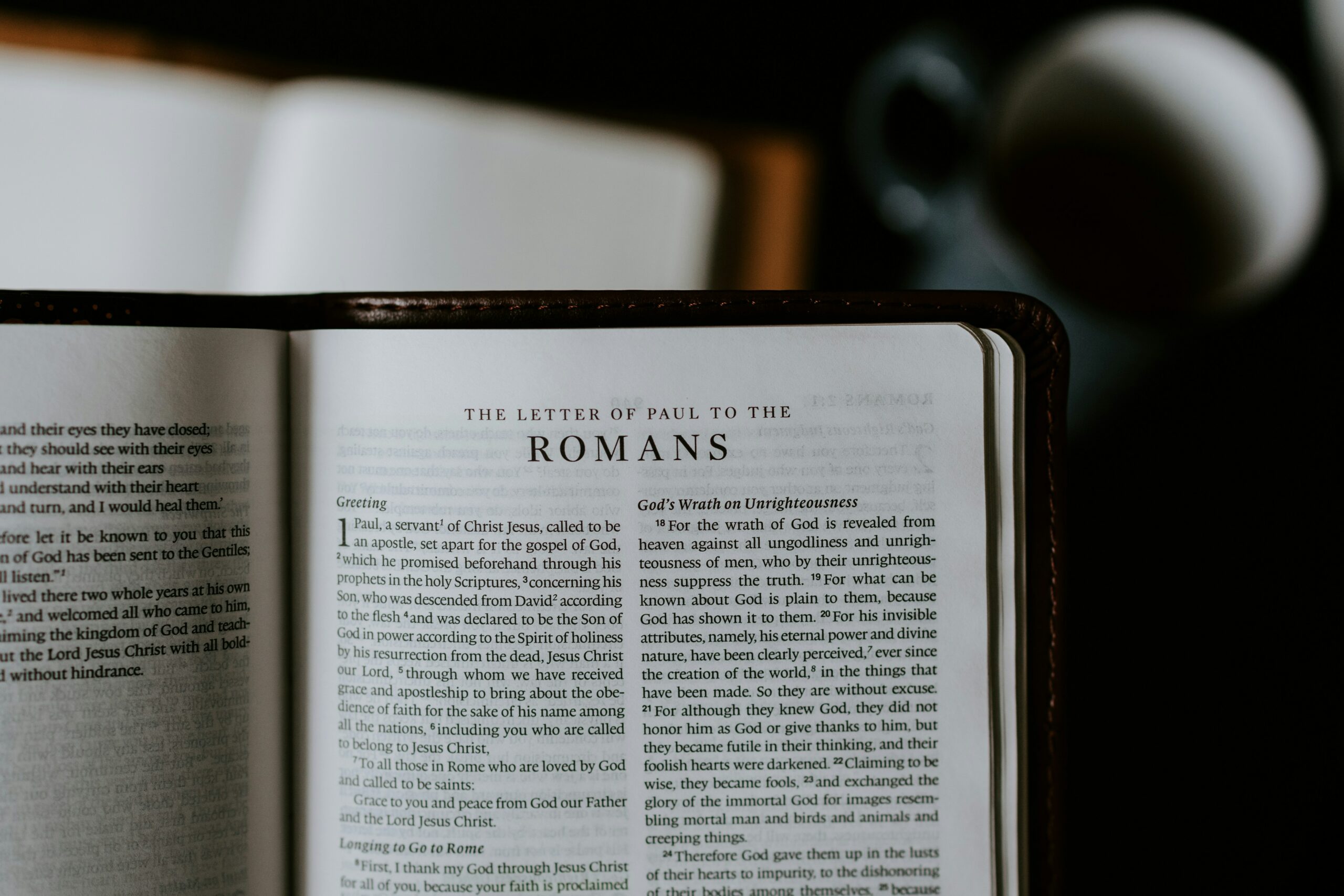
Established in Christ, Part 4
This sermon explores the theological transition from the law’s condemnation to the believer’s freedom through Christ, as presented in Romans 8. It argues that the law, while perfect in its standard, was powerless to save due to the weakness of the flesh, prompting God to send His Son to condemn sin and fulfill the law’s righteous requirements. The central message emphasizes that this fulfillment is not achieved by human effort or moral striving but is a legal reality for those who are in Christ. The text contrasts the mindset of the flesh, which is characterized by hostility toward God and results in spiritual death, with the life of the Spirit, which brings peace and life. The tone is instructional and comforting, urging believers to rest in the assurance that their standing before God is secured by divine grace rather than their own performance.
Transcript
And those are in your bulletins
and I might point out just from the very beginning it’s a two
sided document. So you should be on the side
that says sanctification by God and that gives you the great
overview of where we are in Romans chapter 8. It is positioned as
divine assistance and we’ve seen how abundant that divine assistance
is, it’s not just help, it’s not just assistance in the classic
sense of the word. It is a rescue. It is an all-out
rescue of those who are hopeless and helpless. And in that sense,
assistance as a word falls far short of what really is taking
place there. The first section there is the identified as the fact that the
Christian’s life is first and foremost established in Christ.
But all the members of the Godhead are seen as prominent here in
Romans chapter 8 the Holy Spirit certainly has his part in the
divine assistance as does God there in verses 28 through 30.
Well all of that rolls to hopefully the great confidence that believers
take away. from the knowledge that God is
in complete control and that God has rendered divine aid in
abundance to believers. We find ourselves though in the
midst of this early section. We opened with the recognition
that we are established in Christ but even those opening words
were somewhat obtuse to us especially after hearing all that Paul had
to say in chapters two and three and then the reiteration of the
effects of the law in chapter seven. And so when Paul says
in quite stark contrast there is therefore now no condemnation
for those who are in Christ Jesus. The logical question is how did
this happen. How how did we come to enjoy
such a special place no condemnation. Which is exactly what the law
produces. How did we come to own and enjoy this new position
in which we stand? And we began to look at God’s
mitigation of the law’s condemnation. How did God go about removing
that? How did God set us free? If you would go back again. And
for this morning’s purpose, we’ll read only to verse eight, which
we hope to achieve this Lord’s Day. Romans chapter 8, verse 1. There
is therefore now no condemnation for those who are in Christ Jesus.
For the law of the spirit of life in Christ Jesus has set
you free from the law of sin and of death. For what the law
could not do, weak as it was through the flesh, God did Sending
his own son in the likeness of sinful flesh. And as an offering
for sin he condemned sin in the flesh. In order that the requirement
of the law might be fulfilled in us who do not walk according
to the flesh but according to the spirit. For those who are
according to the flesh set their minds on the things of the flesh
but those who are according to the spirit the things of the
spirit. For the mind set on the flesh
is death, but the mind set on the spirit is life and peace.
Because the mind set on the flesh is hostile toward God, for it
does not subject itself to the law of God, for it is not even
able to do so. Those who are in the flesh cannot
please God. However, you are not in the flesh,
but in the spirit, if indeed the spirit of God dwells in you. We began our consideration with
the first of these three definitive statements that are made in the
outset of Romans chapter 8 verses 1 through 4 that ultimately provide
us, these three statements, ultimately provide us with God’s mind on
the place of the law, the place of the law in the life of the
Christian. And we saw, first of all, the
law’s release that there is therefore now no condemnation for those
who are in Christ Jesus. And then we launched into verse
two and we’re not going to we’re not going to review almost any
of it. We saw that the law that is spoken
of there in verse two is used in two different ways not only
the law in the classic sense but also this law of the spirit
to what was that referring. And we saw that ultimately it
was the authority, if you will, exercised by the spirit. The
second part of a contrast, really, that Paul sets up. That it is
the authority, the operating principle in the life of a believer.
Now, so Paul says, look, the Holy Spirit has moved upon you
and has begun Not only a life of salvation, but a life of sanctification. And remember, that is the key
focus in this entire chapter. It is indeed the Holy Spirit
that is in view in verse two, as we’ve seen. And it is the
work of the Holy Spirit establishing us in Christ that is particularly
in view. It is the work of regeneration,
even as we forecasted in at the end, rather, of chapter seven. So as we begin to close that
opening question we saw not only the laws release that we have
been set free from the effects of the law that is condemnation
and the obvious question is how we answer that last Lord’s Day.
Essentially the law has a superior. The law doesn’t operate independently. The law was a tool in God’s hands
and the law is subservient to God himself. And so when the
law reaches its limits of what it’s capable of doing pronouncing
guilt upon all bringing all under the condemnation of death itself
then God has the prerogative being God to step in with a new
program. And that’s essentially what Paul
communicates there in verse three, what the law could not do weak
as it was through the flesh, not because of the quality of
the law. It wasn’t due to the weakness of the law. It wasn’t
the quality of the seed, if you will, as we talked about last
Lord’s Day. It was the quality of the soil
into which the seed fell. It fell into the putrid soil
of the human heart. And no human heart could rise
to the to the level of perfection that the law demanded. So God. God stepped in. And quite literally, thanks to
God, as we saw, the story didn’t stop with the law condemning
all under sin. And throwing up its hands, as
it were, and saying, I’ve brought them under condemnation, but
I cannot save them. The story doesn’t end there.
It doesn’t end with the powerlessness of the law. It doesn’t end with
the inability of the law to save and sanctify. Rather that was
only the beginning and it was precisely by God’s design. The
law had to condemn us. The law had to find us guilty. Lest we wouldn’t even know that
we needed God or a savior. or justification or righteousness
or sanctification or the work of the Holy Spirit in our lives,
we wouldn’t have needed any of it. And it was precisely what
God designed and precisely when God’s law had pronounced us guilty,
God stepped in. Look at the passage again, what
the law could not do, weak as it was through the flesh, God
did. And we spent time looking at exactly how he did that. First
of all, he condemned sin in the flesh that is in Christ’s flesh,
which he talks about explicitly in verse three. God did sending
his own son in the likeness of sinful flesh. He condemned sin
in the flesh that is in Christ’s flesh. He put him to death on
the cross. And he did so that he could justly
condemn sin. As one said, he did judgment
upon sin itself. As one said, whereas sin once
condemned the believer, now Christ, his Savior, condemns sin, delivering
the believer from sin’s power and penalty. The law condemns
sin in the sense of exposing it for what it really is and
in the sense of declaring its penalty of death. But Jesus stepped
in and put death itself to death. We saw that it was by means of
Christ coming in flesh and dying on the cross that God exercised
his prerogative of condemning sin. He sent him as an offering
for sin and in so doing thereby liberated us. There is the quickest
overview I could possibly provide of those opening thoughts. But
we come to a third. And this one if we’ve been released
from the law That is an astounding truth and we are thankful for
it. If we discover that the law has a superior we’re not too
surprised to find out that it’s God himself. But the third statement
the third profound statement that gives us God’s perspective
on the law which is our undertaking here these last several weeks.
The third statement is is one difficult to fathom difficult
to fathom even for Christians. the midst of mitigating the laws
condemnation towards us not only have we seen the laws released
in the law superior but the third is the laws fulfillment. I mean
for months as we studied Romans chapter two and three we saw
the impossibility of fulfilling the law we saw that there is
no salvation by way of the law that no one could possibly live
up and live according to the law but why. Why, Paul begins
to answer, was it necessary to condemn sin in the flesh? And he answers that in verse
four, he condemned sin in the flesh in order that the requirement
of the law might be fulfilled in us. God couldn’t just walk away,
God couldn’t leave us in the condition we were, he could have
left us in the condition we were in, but there would have been
none to be saved. God did step in, God did Step in to mitigate
the effects of the law. And he did so by sending his
son for the very purpose that the requirement of the law, the
righteousness of God might be met. That was the very purpose that
was the object, if you will, of sending his son for the condemnation
of sin. God’s purpose, as one said, in
condemning sin was that his laws requirements might be fulfilled
in us. that as we come to faith and
place our faith in the Lord Jesus Christ, His righteousness becomes
ours. Essentially, what Paul begins
to state here is the final phase, if you will, or the final cause
of Christ’s sacrifice on the cross, the atonement itself.
It not only satisfied the law because Christ was perfect, perfectly
sinless. But when we come to faith in
him, that righteousness begins to grow and to flourish. It’s
interesting, this statement, the requirement of the law. It
literally refers to the righteousness of the law. the righteousness
of the law. It essentially points to the
standard of what the law stood for perfection. We have that
at least in mind when you hear a little. Pardon me Leviticus
1918. You shall not take vengeance
nor bear grudge against the sons of your people but you shall
love the neighbor as yourself. I am the Lord. God was giving
his standard which was far superior to the standard that People had
operated under for thousands of years. Deuteronomy 6, 5, You
shall love the Lord your God with all your heart, with all
your soul, with all your might. It’s God’s standard that comes
into view. We see it in the prophets as
well. He has told you, oh man, what is good and what does the
Lord require of you? To do justice, to love kindness,
to walk humbly with your God. It was God’s standard. God’s
standard, which was perfect. God’s standard of righteousness.
which was upheld and upheld by Christ. He came as a perfect,
sinless, unspotted lamb, a perfect, sinless Savior to come and to
offer himself up on our behalf. And so this claim of the law,
that’s what Paul says. It’s almost courtroom language
here. It’s that we were acquitted. That’s in a very real sense what
took place here, that in us, The requirement of the law, the
righteous standard of the law was met. It’s as if the judge
banged his gavel down and said when he looked upon us, not guilty. But it’s not that we’re not guilty
in and of ourselves, we’re not guilty because of our union in
Christ. It was a legal claim, the law
had laid it down and now God himself has seen fit to uphold
that claim and meet it, meet it perfectly by the provision
of our Lord. One said. In a rather lengthy quote, but
I think such an excellent summary of what Paul has said thus far
in verses one through four that I’ll cite it in full and we may
pause a number of times when he says Christian holiness. is
not a matter of painstaking conformity to the individual precepts of
an external law code. In other words, he says, don’t
double back cycle back through the law and think that you have
to now and must, in order to achieve your salvation, live
according to this external law code. That’s not holiness. It is rather a question of the
Holy Spirit producing his fruit in the life. Reproducing those
graces which were seen in the perfection of Christ, it is now
the Holy Spirit who is indwelling you and the Holy Spirit who is
taking you to a new standard. Goes on to say that the law prescribed
the life of holiness, but it was powerlessness powerless to
produce such a life because of the inadequacy of the human material
that it had to work upon. Now. Now that God’s own son sent
into the earth in the likeness of sinful flesh has given up
his life as a sin offering on the people’s behalf. The death
sentence has been passed on in past on indwelling sin. It found
no foothold in the life of Jesus. It was effectively overcome in
his death. And the fruits of that victory
are now good to all who are in him. We enjoy. The righteousness
of Christ, we enjoy before God. The righteousness of Christ that
has been fulfilled. Has the righteous standard of
the law and it’s been fulfilled in us. He closes with this statement,
all that the law required by way of conformity to the will
of God is now realized in the lives of those who are controlled
by the Holy Spirit. What great news. What a blessed
passage of God to encourage the hearts of God’s people. And that’s
the very purpose. So in Christ, the demands of
the law have been met and Paul makes it explicitly clear that
they have been fulfilled in a specific but limited sphere. He says it
right there in us. And the obvious question is in
who? Because if The condemnation has been taken away, which is
great news, incredible news. And if we have now found fulfillment
according to God’s righteous standard, it’s absolutely crucial
that we find out who this is. Who is this? Us. It is those who no longer by
God’s magnificent grace alone, who no longer walk according
to the flesh, but according to the Spirit. That’s what he says
at the end of verse four. By God’s divine work in their
lives, they have been saved. Their sins have been accounted
for. Their legal jeopardy has been fully accounted for. And
as such, they now live and operate in a completely different sphere. It is the realm of the Holy Spirit
who now indwells them. Look at the passage. What the
law could not do, verse three, God did. What the law could not
do, weak as it was through the flesh, God did, sending his own
son in the likeness of sinful flesh and as an offering for
sin. He condensed sin in the flesh
in order that the requirement of the law might be fulfilled
in us. Who’s us? Those who do not walk according
to the flesh, but according to the spirit. We walk a different way. We walk
in a different realm. We live and we breathe new life. These words, as one commentator
pointed out, are not to be understood as expressing a condition of
the law’s requirements being fulfilled by us. What he means
is this, and this is crucial. When he says that the requirement,
the righteous standard of the law might be fulfilled in us
who do not walk according to the flesh but according to the
spirit, what he’s saying there is that, look, You’re not going
to wipe out the requirement that was due simply by the way that
you conduct yourself as a Christian. That’s not what he’s saying at
all. He’s not saying if you would only live good enough, you will
wipe clean the slate and meet the standard. You’ll fulfill
the righteous demand of the law. That’s not what he’s saying. But rather. as indicating the
manner of the fulfillment of the law’s requirement. The law’s
requirement will be fulfilled by the determination of the direction
the set of our lives by the spirit. It’s the spirit who takes us
and places us into a new sphere. That is the moment of regeneration.
That is that moment of salvation. When God himself does his work
in our lives and he’s not saying That we can now achieve our own
salvation if we would only walk correctly. We enjoy freedom from the condemnation
of God, the condemnation brought on the law because the Holy Spirit
reached in, drew us out, placed us in the sphere of Christ, and
we no longer are under condemnation. We walk in a completely different
world. It’s a beautiful passage. And Paul isn’t finished with
the thought. In fact, he’s only just introduced it at the end
of verse four. He introduces this dichotomy,
this tension between two different souls. There’s two different
kinds of people in view. There are those who walk according
to the flesh and there are those who walk according to the spirit.
That is essentially what Paul sets up. And he will continue
to play this imagery all the way down through verse 11. Watch
what happens. He mentions it almost offhandedly. He’s not saying that we earn
our salvation according to the way that we walk. He’s just identifying
who is it? Who is it that enjoys this blessing
of God? Who is it that enjoys having
met the righteous standard of God? Well, it’s those who don’t
walk according to flesh, but according to the spirit. He’s
introduced it. Then in verse five, look, he
goes back to this image. For those who are according to
the flesh, set their minds on the things of the flesh. And
he wants to identify who it is that is in view. He wants to
fully color this image that he’s brought up. This dichotomy between
those in the flesh and those in the spirit. What are they
like? How do they live? What are the
consequences of how they live? He tells us about those in the
flesh and he answers that in 5B with regards to those in the
spirit. That those who are according
to the spirit, essentially, and you could supply this easily,
they set their minds on the things of the spirit. Paul returns to those who are
in the flesh in verse six, for the mind set on the flesh is
death. What is the consequence then
for those in the spirit, the mindset on the spirit is life
and peace. The blessings are profound. Paul returns to those who are
in the flesh in verse seven in a much more lengthy statement,
and he says that the mindset on the flesh is hostile toward
God, for it does not subject itself to the law of God, for
it is not even able to do so. And those who are in the flesh
cannot please God don’t. Be mistaken, he says. If someone
is truly in the flesh, they cannot possibly be pleasing to God if
they do not know Christ, if they have not placed their faith in
Christ, they may be the nicest people on the block. Maybe not
your block, hopefully not. But they do not know Christ,
and because they do not know Christ, they cannot please him,
not inherently. And then Paul turns In verses
9 through 11, we hope to take up next Lord’s Day, Paul turns
to assure the Roman Christians, Paul turns to assure them of
their standing in Christ. And he says in verse 9, however,
you are not in the flesh, but in the spirit. You are already
those having been placed in to the spirit sphere of Christ by
the Holy Spirit. If indeed, the spirit of Christ
dwells in you, and he wasn’t saying this To breed doubt among
them and to cause them to fret and to stir. But that point being made. He
takes it and goes back to those who are in the flesh in 9B and
he says, but if anyone does not have the spirit of Christ, he
does not belong to him, he’s not Christ’s. And Paul closes with these profound
words, words that we shared on Resurrection Sunday, if Christ
is in you. Though the body is dead because of sin, yet the
spirit is alive because of righteousness. But if the spirit of him who
raised Jesus from the dead dwells in you, he who raised Christ
Jesus from the dead will also give life to your mortal bodies
through his spirit who indwells you. We’ll take those words up
in weeks to come, but let’s go back to verse five. Let’s look
at those who are in the flesh. Paul has mentioned them. He certainly
has given us some clues as to who they are. And as I said a
moment ago and I want to reiterate this critical clarification.
Here’s how one describes these words in their positioning. Those
who are according to the flesh set their minds on the things
of the flesh. One said this. This verse. indicated by that
little preposition for explains how walking after the spirit
leads to the fulfillment of the claim of the law. Do you understand
the shocking nature of that statement? He says, if we would only live
good enough. If we would only live lives.
According to the spirit. Then we would fulfill the claim
of the law. It is absolutely shocking, and it goes against
everything that Paul has said in the book of Romans thus far.
Paul is merely explaining to whom this blessing falls. Who
are those who enjoy the blessing of the work of God in their lives?
The law could not save them, so God did. And as such, they
now walk according to the spirit. Paul is not setting up a litmus
test by which people can screen themselves to see if they’re
walking is spiritual enough to meet the standard of the law.
Paul is writing to the Roman Christians to encourage them
in what God had already done for them, not what they could
do for themselves. God did it all. And because of
that, they now walk or they operate in a and live in a different
realm, the realm of the Holy Spirit, no longer the realm of
the flesh. What does it mean? This phrase. According to the flesh, look
at verse five, those who are according to the flesh. The phrase
essentially refers to their core spiritual nature. It’s just where
they are. That’s who they are. They are
in the flesh. They are according to the flesh.
They are fleshly. It is, as one said, a person’s
fundamental essence, his bent, his disposition. He is of the
flesh. Those who operate in the flesh
and take the flesh as their standard and fleshly ideas. Paul spoke
about it in Galatians. We’ll come there in a moment.
It is a condition where everything that they do just operates out
of that sphere. It’s not that they don’t do any
kind of things. It’s not that they can’t do some
good on a human level, but their entire orientation point is fleshly. We’ll elucidate on that in a
moment. What are the things of the flesh? Maybe it would be
helpful if we stood back and looked at what are the things
of the flesh. It is all of those things that
correspond to the unregenerate natural condition of man. Paul spoke of them in Galatians. When he said in Galatians 517,
the flesh sets its desire against the spirit. The spirit against
the flesh, these are in opposition to each other so that you may
not do the things that you please. But if you are led by the spirit,
you are not under the law. Now, the deeds of the flesh are
evident, but they’re not limited to these. The deeds of the flesh
are evident immorality, impurity, sensuality, idolatry, sorcery,
enmities, strife, jealousy, outbursts of anger, disputes, dissensions,
factions. envying drunkenness carousing
and things like these of which I forewarn you and just as I
have forewarned you that those who practice such things will
not inherit the kingdom of God. Now I say that it includes those
but it’s not limited to those because it includes all kinds
of false ideologies false philosophies false ideas called religion. That ultimately appeal to our
own human ego. They salve our conscience that
our own religion by its design is meant to round off those rough
edges of what we know God expects. And in such rather as such. We end up having our consciences
dulled by these so-called religions. And many, many are led astray
by these things, things that do not save. As one said, the objects on which
their hearts are set and to which their lives are devoted, not
merely sensual things, but all things which do not belong to
the category of the things of the spirit. The objects of our
attention, desire and pursuit. To the unsaved or corrupt and
worldly, no wonder Paul said to the Philippians, their end
is destruction, their God is their appetite, their glory is
their shame. They set their minds on earthly
things. Which is essentially what he
says here. In what way do they set their minds? It’s an interesting
phrase. It refers to not just thought
patterns, habits of thought, but it’s kind of the orientation
point of the individual’s mind. And as such, it includes what
the person loves, how the person orients their thinking, their
worldview, you might say. One described it in these terms.
He says, to adopt a man’s interest as your own, to side with him,
to be of his party. That’s fascinating, isn’t it?
Well, then whose side is the fleshly man siding with? It goes on to say it makes its
aims, characteristics and interests their own. Have you ever known
people like that? They take up somebody else’s cause. They didn’t think
this last week, but suddenly, you know, they get this idea
in their head and they’ve taken up, they’ve sided with someone. So it is to be of someone else’s
mind, to be on someone’s side, to be on someone’s party, their
team. It means it goes far beyond signifying
to like someone or to care for someone. It indicates that you
have absorbed their thinking into yours. You have adopted
their positions. Their positions are now your
positions. And it is, as another said, to
make this object of attention desire our pursuit. It becomes
our all-encompassing goal. What is it? Those, as one said, who live
according to the flesh have their lives basically determined by
their sinful nature. They set their minds on, they
are most deeply interested in, they constantly talk about, they
engage in glory in, The things pertaining to the flesh. That’s
where they live. That’s their orientation point.
It’s their sinful nature. What Paul basically points to
is the entire condition of unredeemed, unsaved people. Who Peter says
indulge in the flesh and its corrupt desires. They just live
like they live. And that’s what makes them so
at odds with God. Is that when they hear that God
disapproves of the way that they live, they bristle. Paul goes on. Paul goes on to
verse six. And he points out that. There’s
something else about the fleshly. That there are consequences,
that these consequences are absolute, they’re not conditional. If you
are in the flesh, you will reap the consequences. The consequence
is simple. The mind set on the flesh is death. The mind set
on the flesh is death. Well, what is the mind set on
the flesh? We’ve touched upon that already, right? I mean,
it is a fleshly person. But one pastor, I think, really
encapsulated it when he said, no matter how self-sacrificing
you are, how moral, and the sincere and sincere your life may be. His religious efforts are selfish.
The thought patterns the basic inclination to orientation or
bent is a more deep seated significant than any actual disobedience
which is simply the outward manifestation of the inner fleshly compulsions
of an unregenerate person. every unredeemed person, whether
religious or atheistic, is hostile toward God. That’s the mindset
on the flesh. He wants his way. He certainly
doesn’t want God’s way. And as a result, death is in
the offing. Death is his benefit. But it’s interesting to note.
It’s not that he brings this death upon himself. It isn’t. It’s as if Paul is citing a policy
here that the two go hand in hand. And the question is the
question that Paul that we must understand from Paul’s words
is what is the relationship of death to a mind that are set
on these things these things of the flesh. It literally means that they
lie under that sentence. Those who live that way lie already
under the sentence of death. It’s not that they bring death
upon themselves. It’s not that the one leads to
the other. They both. Are wed together. As one said, Paul does not say
that the mind set on the flesh leads to death, but that it is
death. Paul’s emphasis is on the state of death into which
every believer already exists, unbeliever already exists, even
while his body and mind may be very much alive and active. He’s
in the sphere of death, he has a death sentence, he’s already
operating. That’s why Paul can say that
we were dead in our trespasses and sins. We were walking dead
man. The mindset on the flesh doesn’t lead to death, it is
death. It’s death itself. Paul’s not finished. Look at
verse 7. Paul says the mindset on the
flesh is hostile toward God. We learn something new about
those that are in the flesh. The mind set on the flesh is
hostile towards God. What Paul wants to do here is
point out how it is. How it is that these things are
so intertwined, this life of flesh and death itself. Why does
that happen? Why is that such a logical conclusion? It’s because the mind set on
the flesh is hostile with God. They picked a fight with God.
No, they didn’t pick a fight. They went to war with God and
it was a death match. They would put God to death if
they could. They hate God. They hate his
laws. They hate his ways and they are
hostile towards him. That is the way of the flesh.
That is the way of those who do not know God. Charles Hodge said it is in its
nature opposed to God who is the life of a soul, his favor
is life and therefore opposition to him is death. The fleshly
mind is enmity to God. We know that. I mean, we know
that from James chapter four. James chapter four spells it
out. Friendship with the world is enmity toward God. That’s
exactly what Paul is saying here that those who live their way,
those who live in the flesh. I’ve taken up Cause against God
himself. Fleshly man does not subject
himself to the law of God because he isn’t even able to do so.
He’s in bondage. He’s in abject bondage. To sin
itself into that sinful way, which makes for you. If you are
in Christ. If you have been taken out of
that sphere and placed into another such a magnanimous blessing.
That we should fall on our faces every day and thank God for the
salvation that we’ve come to own because it wasn’t because
of anything in us. It wasn’t because of anything
that we had accomplished. It wasn’t because of anything that
we had done or secured. One pastor said that fallen man’s
fierce hostility to God is the response of his egotism. And
we were all born into that. We were all born God-haters,
as Paul calls them in Romans 1.30. Fallen man’s fierce hostility
to God is the response to his egotism, to God’s claim, to his
allegiance. Determined to assert himself
to assert his independence to be the center of his own life
to be his own God. He cannot help but hate the real
God whose very existence gives the lie to all his self assertion. His hatred of God and his rebellion
against God’s claim upon him is expressed in God’s law are
inseparable from one another. You cannot love God’s law and
be at enmity with him. Likewise, you cannot. You cannot
be at war with God without also hating his law. As a rebel against
God, he hates God, and as one who hates God, he rebels against
him. That mind of our fallen nature,
which is enmity toward God, is also submissive to his law. Pardon
me, unsubmissive to his law, and indeed, by its very nature
is incapable of submitting to it. Do you get that? Do you get
how utterly in bondage you were to sin and sinfulness? And it’s
God. It’s God who took you out of
that realm and placed you into the realm of the Spirit. Placed
you into Christ. And it’s great news. It’s great
news. And we’ll take up next Lord’s
Day. what it is to be in the Spirit, what it is to walk in
the Spirit, what it is. The blessings of being. In and walking by the Spirit
of God, let’s examine our hearts. Oh, merciful King. We humbly
bow before you and thank you that if these things are true
as we believe them to be. Lord God, We were doomed. We were walking in death itself. And because of nothing in us,
you reached down. You brought us to life and you
showed to us our utter deplorable situation and sinfulness and
our desperate need of a Savior. You showed to us Christ and you
placed us in Him. You brought us to faith. Oh, Lord God, help us to hold
humbly to the salvation that we own. We don’t earn it by one
degree. Our God has accomplished it all.
It’s in Jesus name that we express our gratitude to you.
Messages: 204