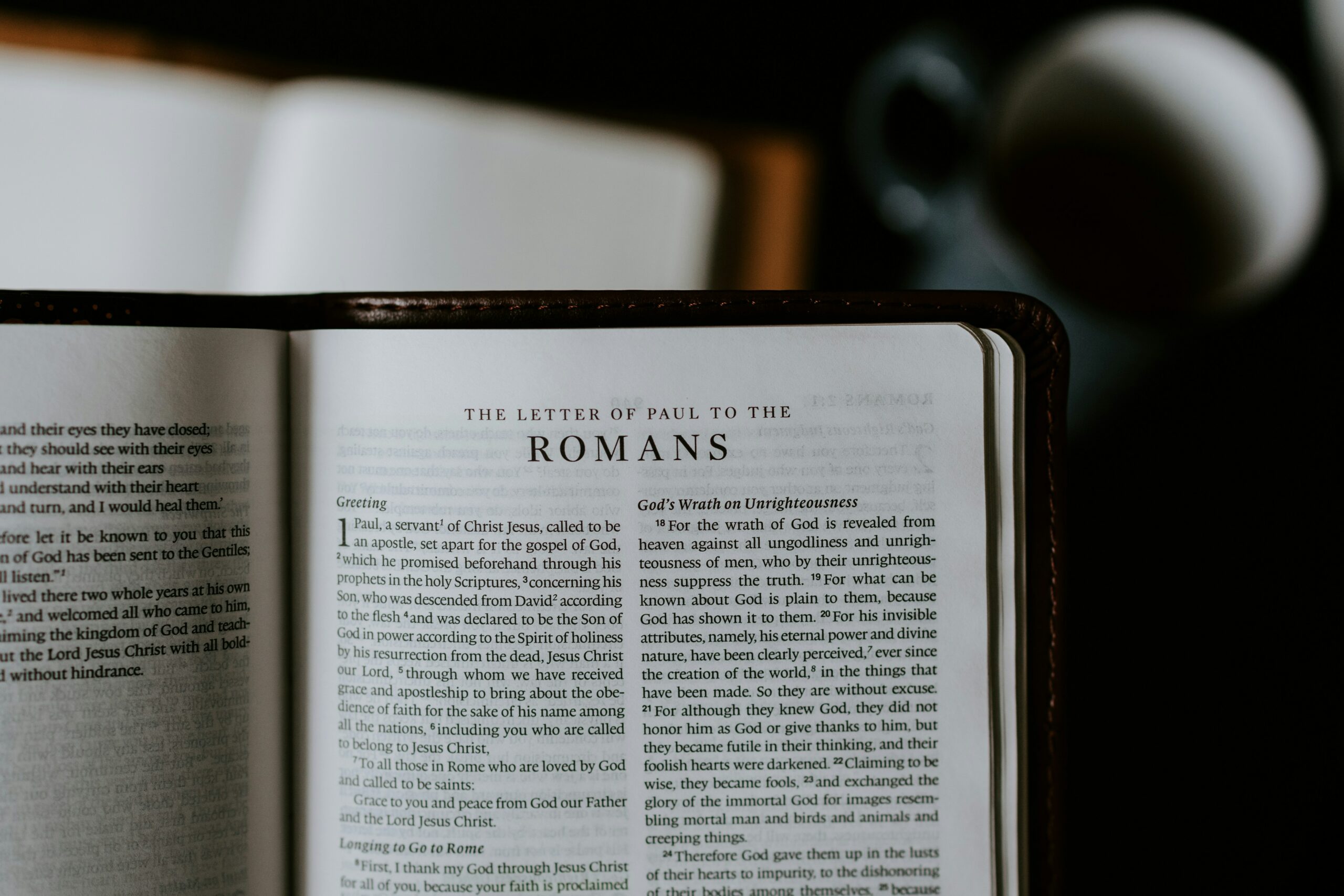
God’s Gift of Rightousness, Part 4
This sermon examines the core of Paul’s argument in Romans, focusing on how God’s righteousness is manifested apart from the law to address the tension between divine justice and human sin. The central message resolves the apparent conflict of how a just God can forgive sinners without compromising His character, answering the question of why Christ was sent as a propitiation. By analyzing the interplay of justification, redemption, and atonement, the exposition highlights that God remains just while simultaneously justifying those who have faith in Jesus. The preacher emphasizes that this solution satisfies the demand for justice through the sacrificial death of Christ, thereby vindicating God’s holiness and offering hope to a world often frustrated by perceived injustice. The tone is instructional and reassuring, presenting the cross as the ultimate demonstration that God is both supremely just and supremely gracious.
Transcript
Romans. We find ourselves once again
in Chapter three and even in the same passage, and I find
this meditating and enjoying even savoring this passage, we
come back to it again this week to wrap up the thoughts that
we have begun. We are pleased and happy to be
in this passage because it is a passage about salvation. Paul
has turned the corner and he has entered into this grand subject
of the salvation of souls, having already laid the groundwork of
the sinfulness of humanity, both Jews and Gentiles. As we saw
this short section, as one put it, is the heart and whole of
the book of Romans. This is the core, if you will.
As one said, it proclaims the fact of that that the one decisive
once for all redemptive act of God, the revelation both of righteousness,
which is from God and also the wrath of God against human sin. This is the hope. This is the
hope for sinners, if you would. Romans chapter three, beginning
in verse twenty one. Where Paul writes, but now. Apart from the law, the righteousness
of God has been manifested, being witnessed by the law and the
prophets, even the righteousness of God, through faith in Jesus
Christ for all who believe. For there is no distinction,
for all have sinned and fall short of the glory of God, being
justified as a gift by His grace. through the redemption, which
is in Christ Jesus, whom God displayed publicly as a propitiation
in his blood through faith. This was to demonstrate his righteousness
because in the forbearance of God, he passed over the sins
previously committed for the demonstration, I say, of his
righteousness at the present time, that he might be just and
the justifier of the one who has faith in Jesus. Now, let’s pause for a moment.
I began several weeks ago to give you the structure, and probably
one of the most striking and overlooked features of this is
that but now that stands at the head. There is a stark contrast
here. Paul has dealt with sin. Now
he wants to take us into the great subject of salvation. But
now is a strong contrast with all that proceeds what one called
a wonderful and marvelous contrast between man’s total depravity. Man’s total inability to please
God. And God’s own provision of a
way to himself, what a contrast, there is no greater. We went
on to see the simple sentence. If you want to frame the sentence
most simply, it is the righteousness of God has been manifested. But
to append that but now is not inappropriate, nor is it inappropriate
to append verse twenty to the righteousness of God repeated
there. But the simplest sentence is the righteousness of God has
been manifested, not as something new. God’s righteousness, God’s
righteous standard. have been shown for centuries,
thousands of years to the Jews. God showed himself. God revealed
his standard. But now for the first time, it
was being manifested, shown, revealed as that which we could
lay hold of, which we never could have before. We never could have
lived up to the standard. And so now this gift is given
to us as it were on a platter. It is precisely that which we
lack, this righteousness, because as sinners, we are anything but
righteous. We can’t achieve God’s righteous
standard on our own. That’s what the law proves. That’s
what it was given to prove. And as a result of the fall of
Adam and Eve, we are inherently sinful. We have a complete inability
from the moment we’re born to please God or even to work ourselves
up to that. But now God’s righteousness is
manifested the way to God, that the avenue to God has been opened
up to us. And now suddenly the sinners
find where the gospel opens up this righteousness to us. The
answer to this great need. The revelation bearing the news
that man most needs to hear how to secure, how to lay hold of
God’s righteousness, how to meet that divine standard that has
been promised by the prophets and now has come to full revelation
by means of the gospel. And so, Paul, what he does here,
having laid out the simple sentence, Paul just talks about these matchless
qualities that we spent the last several weeks. mulling over and
meditating these qualities of this righteousness. What is this
righteousness? And we saw first and foremost
that is apart from the law. It is able to impart what the
law could not. There was no one that could lay
hold of the righteousness which was through the law because they
couldn’t live a life good enough to do that. The second key feature
was that it was witnessed by the law and the prophets. This
wasn’t new. It was a key feature of the long
declared plan of redemption of God. This wasn’t a surprise.
This wasn’t a change of plans. This is exactly what God had
laid out. This is the plan of redemption. Thirdly, the third matchless
quality that we considered. was that it was exclusively,
this righteousness was, exclusively received by believing in the
Lord Jesus Christ. There is no other way. None. Look at verse 22. But now, apart
from the law, the righteousness of God has been manifested, being
witnessed by the law and the prophets, even the righteousness
of God through faith in Jesus Christ. That’s it. There is no
other. And then the fourth key feature
is that it’s freely available to all, which is just such an
astounding point that Paul makes. For all those who believe and
God throws open the doors, as it were, to sinners and bids
them come, come in faith, come to the only one that can save
their soul, the Lord Jesus, and come and place your faith in
him. And in him alone, he gives us
the means. Exactly as Paul had detailed
in Second Corinthians 521, he made him who knew no sin to be
sin on our behalf, that we might become the righteousness of God
in him. What great hope, what great promise.
Now, Paul proceeds from there, obviously. And we talked a little
bit more about the structure and what he’s going to do from
here forth is how does it work? How does this righteousness work?
I understand all these elements to this particular righteousness,
apart from the law, faith in Christ. I understand that, but
I want to know the intricacies of it. I want to know how it
works. And that’s what Paul is going to do. Paul’s going to answer the questions.
How does God take an unrighteous sinner? And impart righteousness
to him. And why would God do that? That’s where we’ve been. That’s
what we’ve begun to look at in these ensuing verses. Paul addresses
that following what I suggested to you, and I I’m even more convinced
that that’s the case now. In verse 22 and 23, the latter
half of 22 and 23, it’s a parenthetical thought. It’s not unimportant. Did you hear me? It’s not unimportant
to say that all have sinned and fall short of the glory of God.
But it’s a repeated point. Paul’s bringing up a refrain
from chapters one and chapter two of everything that he talked
about. Do you remember when I said to
you that all have sinned? All means all. That’s what Paul’s
doing. It’s a parenthetical thought.
The point that Paul wants to make there is found in verse
twenty four that we are justified as a gift by his grace. Verse twenty four resumes and
explains the four qualities that Paul has just laid out to us
that this saving righteousness of God is apart from the law,
according to faith in Christ, available to all. And how does
it work? Being justified as a gift by
His grace. We spent no little time on justification
last week. One pastor, just to sum it up
with one little verse, said it this way. We are righteous. With
the righteousness of God, not with our own, which is as a filthy
rag, but by that which he has provided and which consists in
the infant infinitely meritorious righteousness of his own dear
son. We have the righteousness of
Christ. Now, from there, with that little
foundation beneath us, Paul makes two additional statements. That
having been justified as a gift by his grace, Paul points out,
first of all, that it’s through the redemption which is in Christ
Jesus. And we spent no little time there
as well. That redemption, that idea of redemption, meaning to
purchase out of sin and out of slavery, that’s the image that
he wants to elicit. That we are in a slave like condition
to sin, to a harsh and cruel taskmaster, not merely Satan
himself, but to the to the element of sin, to the idea of sin, to
the effects of sin. We are enslaved to it and by
means of redemption, which is given through Christ, we are
liberated, freed from that. It’s a powerful thought. Redemption,
as one said, is a ransoming, an act of setting free by payment
of a ransom price. It is that ransom from sin from
which we are liberated. Now, Paul buffets that with this
little statement where we began to consider last week. Last Lord’s
Day, we looked at verse twenty five. And I suggested then, and
if you look again, everything in verse twenty five all the
way down through verse twenty six hangs on two little words. Two grand words, Jesus Christ,
everything here describes him. When Paul says that we are justified
as a gift through his grace, through the redemption, which
is in Christ Jesus. whom God displayed publicly as
a propitiation. He begins one long clause that
all points back to those two words, Jesus Christ. He wants to tell us about him.
He wants to tell us about God setting him forth publicly as
an atonement. And he tells us the purpose of
it, which is to reveal the righteousness of God and we Spent no little
time there as well. Never before. Had people been
granted access to that great benefit, the benefit of God’s
own righteousness, and now that righteousness was opened up to
them by way of this propitiation, strange word, unfamiliar word. Largely forgotten word. It is
the payment, it is the wrath removing sacrifice, as one described
it. Now, as we’ve said, the language
is rich here. It’s almost like Paul is intentionally
overdoing it. Anybody who knows me knows I
like my ice cream relatively plain. It can have one thing
in it, usually not nuts. Especially if it’s sweet, it’s
got to be one thing and one thing only. I don’t like ice cream
with a whole lot of sweet stuff and goo weaving through it and
caramel and chocolate. I don’t like all that. That’s
what Paul’s doing here. He is loading this thing up.
This is better than the most profound Sunday you’ve ever had.
Here’s what he does. He uses, first of all, the language
of the courtroom when he talks about justification. He uses
the language of the marketplace when he talks about redemption,
freedom from slavery. And he uses the language of the
temple with regards to its sacrifices when he talks about propitiation.
They’re all big words, and any one of them is enough to describe
the gospel. Any one of those concepts, you
could go to the heathen and give them the gospel in full if you
used only one. What Paul does here is lavish,
layer upon layer, suite upon suite, to where you have the
most profound passage, at least one of in all of Scripture. Justification,
the declarative act of God, redemption. The highlight of here is the
idea of our being in utter bondage to sin and then finally propitiation
to illustrate the idea of the liability that we have to God
and to his wrath and that that propitiation satisfies calms
down completely. Satiates that wrath, as I said,
everything else in verse twenty six modifies that one word. Propitiation. Propitiation modifies Christ
and everything else tells us about what this propitiation
is like. What Paul means to do here in closing is tell us about
the nature of this sacrificial offering, and we began last week.
What Paul gave us is five profound features of the atonement offered
by Christ to the father. We looked at. And we’ll touch
only briefly this morning by way of a very quick review. We
saw, first of all, with regards to the redeeming sacrifice of
Christ that secures our salvation, that it is in his blood, that’s
the first prepositional phrase that we consider it is in his
blood, in Christ’s blood, which answers the question, how is
this payment made? How is this propitiation made? I was encouraged by more than
one to dip back in and to review parts of the notes that I left
out last week, one of which was Romans nine. Pardon me. We’ll
get to Romans nine, Hebrews nine. Listen to Hebrews nine to describe
the sacrificial offering. And if you’re familiar with the
book of Hebrews, it is a back and forth the entire time, looking
back at the Old Testament economy and comparing that with Christ.
Now, listen to Hebrews nine. Now, when these things, these
sacrifices have been so prepared, the priests are continually entering
the outer temple, performing divine worship. But into the
second, only the high priest enters once a year. Not without
taking blood, which he offers for himself and for the sins
of the people committed in ignorance. He’s talking about a sacrificial
offering. He’s talking about going in and
making a blood sacrifice. For all. Verse 11, but when Christ
appeared as a high priest of the good things to come, he entered
through the greater and more perfect tabernacle, not made
with hands, that is to say, not of this creation and not through
the blood of goats and calves, but through his own blood, he
entered the holy place once for all having or obtained eternal
redemption. For if the blood of goats and
bulls and the ashes of a heifer sprinkling those who have been
defiled sanctify for the cleansing of the flesh. How much more with
the blood of Christ, who through the eternal counsel of the Spirit
offered himself Without blemish to God, to cleanse your conscience
from dead works, to serve the living God. It’s the gospel,
but it’s according to his blood, it’s according to the blood of
Christ, but secondly, it is through faith and faith is all over this
passage. This answers the question, why
did God pardon me? How do sinners receive this benefit? We know the blood has been shed.
We know that it’s paid for sin and sinners. How do we appropriate
it? How do we put it to work? It’s
through faith. We receive Christ through faith.
Thirdly, we saw that it was to demonstrate his righteousness.
And we’ll revisit this idea again this morning. But it answers
the question, this third statement to demonstrate his righteousness.
Why did God use the method of propitiation? payment for sin
as a remedy for sin. Why did God choose that method? And as I said, we’ll revisit
it in brief this morning. So I’ll leave that there for
now. The fourth element, if you’re looking at the passage, it begins
in verse twenty six for the demonstration, I say, of his righteousness,
Paul recharges his batteries and adds a simple statement.
At the present time, What Paul does here? Is say,
why did God pass over sins in the past and why is he passing
over sin now? How could God do that? Paul means
to answer that question and he does so in point number five
point number five. Answers the question, why did
God send Christ? Of all people, his own son. Why did God send Christ as a
propitiation for sin? That he might be just and the
justifier of the one who has faith in Jesus. Now, if I haven’t
lost you yet, you’re doing well. We’re through the review. But
I want to press on and I want to press on to point five, if
you would look again where Paul Begins there at the end of verse
twenty five and twenty six. Where Paul says. That his final point is for the
demonstration of his righteousness at the present time. That he might be just and the
justifier of the one who has faith in him. I want to park on those two verses
this morning, those two little lines. That’s all we’ll handle
this morning. That’s plenty. Years ago, I began
to sense a frustration in our country, in our society. The
OJ trial and several trials had come. There had been a series
of what were perceived as public travesties in the legal system.
It seemed that most people began to sense that our country was
in a demise of sorts. And about that time, I read a
passage that, at least for me, put it all in perspective. It’s
a point made, interestingly, in the book of Ecclesiastes,
which we just read weeks ago. The passage, or verse, was Ecclesiastes
8.11. Which says, because the sentence
against an evil deed is not executed quickly, therefore the hearts
of the sons of men among them are given fully to do evil. What
it basically discusses is what we were sensing in our society
that when justice is incomplete, when justice is not meted out,
When criminals get away with everything from murder to everything
else, the society begins to get frustrated. The society needs
justice. The society desires justice. It desires peace and law abiding
citizens. And so when justice is not served,
when a criminal gets off scot-free, When a judge makes what is sensed
by the masses to be a bad decision, it is frustrating. It is maddening
at times, and it’s frustrating because it is perceived as being
unjust because the judge or the jury or the system has just pronounced
a guilty man essentially righteous. I remember during the L.A. riots,
We lived there and I remember reading a sign that said, no
justice, no peace. Remember, no justice, no peace. And I remember thinking and shuddering
at the time, how could any human really cry out for justice? Do
we really want justice? I don’t think so. We’ve never
for a moment gotten what we deserve. Otherwise, we wouldn’t be here.
But that doesn’t take away the sense of frustration. From crime
that goes unpunished, from evil deeds that go unanswered. And remember, this was exactly
Hezekiah’s complaint to God. How long, O Lord, will I call
for help and you will not hear? Can you imagine talking to God
like that? I cry out to you violence, yet you do not save. Look at
our society. It’s rampant. Why do you make
me see iniquity and cause me to look on wickedness? Yes, destruction
and violence are before me. Strife exists and contention
arises. These were evil days. He’s not
exaggerating. It was bad and it’s bad in our
own day. Therefore, the law is ignored. And justice is never upheld for
the wicked surround the righteous. Therefore, justice comes out
perverted. It is a common complaint, isn’t
it? I mean, if Solomon and now Habakkuk are echoing essentially
the same exact complaint. But it wasn’t just Habakkuk that
questioned God’s justice system. Many Old Testament characters,
even Old Testament saints, questioned or doubted God’s justice, even
if only for a moment. Some of these people may not
have verbally challenged God, but in their actions, they cried
out, God, you’re unfair. Adam and Eve, let’s start there. Adam and Eve didn’t like God’s
justice system. They didn’t like the rules. They
didn’t like all this. And so they circumvented it to
their own destruction. And to the sinfulness of all
humanity, Adam and Eve questioned God’s justice system. What about
Cain? Maybe the second generation will
fare better. Cain didn’t like God’s justice
system either, did he? And he took matters into his
own hands. In fact, even Abraham. The great father of nations didn’t
like God’s justice system at times and took matters into his
own hands, even telling his wife to lie. Joseph’s brothers didn’t
like God’s justice system. They didn’t appreciate the sovereignty
of God. They didn’t like that at all.
They took matters into their own hands. What about Moses?
Moses didn’t like the justice system of God either. And when
the people seemed displeasing to Moses, Moses reached out,
struck his staff on a rock two times. And that was enough, that
was enough for God to levy punishment to Moses. King Saul, do we even
need to go into his exploits? King Saul didn’t appreciate God’s
justice system. King Saul liked to take matters
into his own hands because he didn’t think God was doing things
quick enough. Job. And you say, Job? For 37, 38 chapters, Job does
pretty well. Job does pretty well against
his friends. And all it is, and parents will know this one immediately,
all it is seemingly at the end is a sigh. A sigh of frustration
with God’s justice system. That’s what happens when parents
ask their children to do a simple task. Obey me in this thing. You don’t like the justice system,
and that’s what it came down to to Joe. Just a sigh. Just under his breath, David. You talk about a guy with a difficult
task, David, do me this favor, put your heart down here in a
little book that I’m going to call the Psalms. And over and
over and over and over again, we see David’s frustration with
the justice system of God. Psalm 73 being one of at least
the most favorite of mine, where it’s as if David walks through
the town muttering at all the rich people and all how easy
they have it. And he comes right up to the
edge of sinning. Jonah, Jonah, Jonah didn’t like
the justice system of God. Jonah didn’t like God’s sovereignty.
Jonah didn’t like God’s plan. Jonah didn’t like being in God’s
service, at least not on this particular mission. So I’ll take
up one of my own. Thank you. Habakkuk, who’s already
on record, is questioning God verbally. Ananias and Sapphira,
if you want to get into the New Testament, the pattern continues.
Peter himself. How many times did Peter contend
even with the Lord Jesus? And so it’s not surprising that
there would be frustration with God’s ways, frustration with
God’s way of doing things, frustration with God’s justice system. You
know what? One of the interesting features
of the Old Testament is over and over and over and over again,
God almost constantly has to defend his own justice. He has to defend his own righteousness. Listen to just a short stream,
Job 8.3. At the outset of the book of
Job, it just says this. Does God pervert justice? The
mere thought of it is absurd. Why even ask the question? It’s
rhetorical. Certainly. Job 3723. What happens by the end of the
book of Job? The Almighty, we cannot find him. He is exalted
in power and he will not do violence to justice and abundant righteousness. There’s the testimony. But why
does it even need to be given? Because we doubt it. Psalm 711,
I told you the Psalms are replete. With testimonies, both challenges
to and testimonies of God’s justice, God’s righteousness. Psalm 711,
God is a righteous judge. Why does that even need to be
said? Because there were some that don’t like the way God judges,
some that think he’s unfair. God is a righteous judge and
a God who has indignation every day. And the implication there
is that his indignation is righteous. It’s just it’s perfectly fair
for God to think the way he does about some people. Psalm 11,
seven. For the Lord is righteous, he
loves righteousness, the upright will behold his face. Psalm 36,
six, your righteousness is like the mountains of God. Your judgments
are like great deep, O Lord, you preserve man and beast. That comes on the heels of great
doubting. Psalm 50, verse six, the heavens
declare his righteousness for God himself is a judge. Isaiah
5 16, the Lord of hosts will be exalted in judgment and the
holy God will show himself wholly in righteousness. Why do all
these things need to be said? If everybody just held God and
esteemed him as being inherently righteous and just and fair,
and if we never questioned any of it, why do we need any of
this? Why do we need the book of Psalms? Zephaniah 3.5, the Lord is righteous
within her. He will do no injustice. Every morning He brings His justice
to light. He does not fail. But the unjust
knows no shame. And finally, Malachi 217, the
last book of the Old Testament, you have wearied the Lord with
your words, yet you say, how have we wearied him in that you
say everyone who does evil is good in the sight of the Lord
and he delights in them? Exactly our argument. God is
unfair because he’s not dealing with them, that’s what he says.
Listen to it, he says, you say, how have we wearied him in that
you say everyone who does evil is good in the sight of the Lord
and he delights in them or where is the God of justice? So it’s common, this frustration. This frustration with God, and
it’s precisely that strain that Paul is working to alleviate
here. For thousands of years, God had
patiently borne with the sins of mankind. And what had that
gotten him? Gratitude? Humble thanksgiving? No, it had gotten him the frustration
from those who were relatively better than others, incrementally
better, perhaps, The frustrations of countless many had grown. God’s law was clear. God’s judgment,
though, was to some too occasional, too seemingly capricious to equal
the high standard that was set forth by God’s law and God’s
threatening. God wasn’t fulfilling his word. God was dropping the ball on
how to deal with sin. As one pastor said, The great
problem with salvation was not the matter of getting sinful
men to a holy God, but of getting that holy God to accept sinful
men without violating his justice. That’s Paul’s point here. And
please. It wasn’t that it took God time
to figure out a method. It’s not that it took God time
to conceive of a new way. We just saw that God’s timing
was God’s timing. Paul tells us that he’s absolutely
sovereign in his timing, but from man’s viewpoint, not God’s,
it seemed like an impossible task to save sinful humanity
without, as it were, having to grade on a curve, right? Without
God having to lower his standards, without God having to grant some
kind of amnesty to sinners, how how could we do it? That was the problem. And Paul
opens up to us the solution to that problem as he winds down
this great section, he answers the question, why would God send
Jesus Christ, his own son? as a propitiation. Why not more
goats? Why not more bulls? Why not more
doves and pigeons and sheep? Why not some of us? Why Christ? Paul tells us that he might be
just and the justifier of the one who has faith in Jesus. Now, this play on words, and
that’s exactly what it is, just and justifier. It’s a play on
words. Both of these words are built
on the same root, Dika, Dikaion and Dikaionta. And you know that Paul has been
all over this word, in fact, 60 plus times in the book of
Romans 64, I think precisely. Sixty four times this word or
one of its one of the words that comes from this route are used
sixty four times in the Book of Romans. So Paul’s been all
over it, not just here in the Book of Romans, but powerfully
in this little section. Three, twenty one through twenty
six, and I just want you to look at it, just glance down for a
moment. Verse twenty one. Dikaiosune, the righteousness
of God. Verse 22, again, the righteousness
of God. Verse 24, don’t be misled. It’s
built on the same exact root. Dikaioumenoi, being justified,
that is made right. I’m going to skip the Greek because
I can’t read it without my spectacles for once being justified, that
is being made right. Verse twenty five spoken again
of God’s righteousness. And then finally here again in
verse twenty six, three additional times. First of God’s righteousness
again and the final two, which again are this play on words,
just. and justifier, right and making
right, if you wanted to use a different set of words. And the idea behind
this play on words is not even new with Paul. Listen to Isaiah
45, 21. Declare and set forth your case.
Indeed, let them consult together who has announced this from of
old, who has long since declared it. Is it not I, the Lord? And there is no other God besides
me, a righteous God and a savior. Not exactly a one to one parallel,
but the idea is there and we’ll show you in a moment. What Isaiah
does, of course, is take up the conundrum. If God is just. He must punish sin. How then
could he possibly be a savior? Zechariah highlighted the same
conundrum. Zechariah 9.9 Rejoice, O daughter
of Zion! Shout in triumph, O daughter
of Jerusalem! Behold, your king is coming to
you. He is just and endowed with salvation, humble and mounted
on a donkey, even on a colt, the foal of a donkey. You see,
it was understandable that God would be just. They expected
God to be just. That was their frustration that
they seemed it seemed like he wasn’t honoring his own word. It was understandable that God
would be just the punisher of sin, but he couldn’t be both
just and savior, could he? The bottom line is, God has not
allowed the guilty to go unpunished, though it sometimes may seem
like it. God has not ignored the sin of sinners. God has not
turned a blind eye to the unrighteous. As A.W. Tozer said nearly 80
years ago, God’s justice stands forever against the sinner in
utter severity. The vague and tenuous hope that
God is too kind to punish the ungodly has become a deadly opiate
for the conscience of millions. What they basically think is
God hasn’t moved yet, so I’m OK. It hushes their fears and allows
them to practice all pleasant forms of iniquity, while death
draws every day nearer and the command to repent goes unregarded. God hasn’t forgotten about sin,
God hasn’t chosen not to deal with sin. Just as a criminal’s
deeds must be punished to satisfy the society’s demands for justice,
so must every sinner’s penalty be met before God. In order for
God to be just, every sinner’s penalty must be met. That penalty must be paid. And
when God demands such satisfaction, he is absolutely just in doing
so. Thomas Watson said it this way,
if God be just, there will be a day of judgment. Now, things
are out of course, sin is rampant, saints are wrong, they’re often
cast in a righteous cause. They can meet no justice here.
Justice is turned into wormwood. But there is a day coming when
God will set things right. He will do every man justice.
He will crown the righteous and condemn the wicked. He has appointed
a day. God has met the satisfaction
of that penalty in his son, the Lord Jesus Christ. God paid the
sin of sinners. And it was enough and it satisfied
the wrath of God. Charles Hodge does an exceptional
job point by point, line by line, laying out how this work. Listen carefully. Christ was
set forth as a sacrifice for the manifestation of the righteousness
or the justice of God, that is, that he might be just, although
the justifier of the ungodly. When this word just is spoken
of the conduct of a judge and in reference to his treatment
of sin, it must mean the modification of general rectitude, which requires
that sin should be treated according to its true nature. In other
words, he says God can’t go great on a curve and still be considered
just. He has to deal with that sin
like it is. And he does. A judge is unjust
when he allows a criminal to be pronounced righteous and treated
accordingly. He acts justly when he pronounces
the offender guilty and secures the infliction of the penalty
which the law denounces. There is no such disregard to
the claims of justice in the justification of the sinner who
believes in Christ, he is justified neither on account of his own
acts or character, nor by dispensing with the demands of the law,
but on the ground of complete satisfaction rendered by the
obedience and the death of Christ. What he says in much more verbose
fashion than what Paul says in the end, having sent Christ God
proves himself as just, and in the same exact moment he justifies
sinners so that one does not wipe out the other. One does
not remove the other. As one said, this happened in
order to prove or to demonstrate that God had not been unfair.
that God had not been unjust when in his forbearance he treated
with indulgence for a time the sins committed in earlier days.
It is absolutely blasphemous to charge God with injustice
for setting the sinner free. Either those of the Old Testament
who placed their faith in a coming Messiah or those who are alive
At the coming of Christ, even down to our own day. In such
case, the sinner who places his faith in the Lord Jesus Christ
is no longer guilty. It’s not guilty. And he is not
absolved of his sin because of his own performance, according
to God’s law, nor any other attempt at satisfying God’s wrath on
his own. But only through the Savior’s
blood and through his faith in that Savior. As one commentator
said, the ultimate object of God’s display of Christ as a
sacrifice for sin, God displayed Christ as a sacrifice in order
to show his righteousness. As in all of God’s attributes. Injustice, God is perfect. God
always judges rightly, dispenses punishment in perfect measure
to those who fully deserve it. When we find ourselves having
sinned against God, we can plead our case before a judge who we
know will judge fairly. Paul answers the question, why
did God send Christ? As a propitiation. That he might
be just and the justifier of the one who has faith. In Jesus. Once again, for the third time.
In this short section, Paul drives home the point that salvation,
if there is any. Is through faith. It is only
through faith and only through faith in the Lord Jesus Christ. Close with a summary of one pastor.
He said it was only through the cross. that God could provide
a just redemption for sinful men, but of immeasurably more
importance was that the cross demonstrates forever that God
is both supremely just and supremely gracious. Christ died that the
world might see that neither God’s holiness nor his justice
have been abrogated. The cross was the ultimate vindication
of God’s justice. and His righteousness. Would
you join me in prayer? Our merciful God, Your mercy was so great, Your
plan of redemption was so perfect, that You sent Your own Son To
die a horrible death on the cross and to pay our penalty for sin. Oh, Lord God, we humble ourselves
in your presence, and perhaps we have never even pondered. The depth of that truth. That you have paid. The debt
of sinners and in so doing, you have satisfied the very wrath
of God. Lord God, for any of us who have
placed our faith in the Lord Jesus Christ and who enjoy salvation
purely because of that, we humble ourselves before you and express
our gratitude. And pray that you would grant
us the grace to live worthily. According to our calling. Father, for any who do not know. The Lord Jesus. For any who would
wag their finger at God and label him unjust, may they know him
for the first time as a fair God, a just God, a God who could
not grade on a curve without doing great damage, irreparable
damage to his own righteousness. And so because of that, he sent
his own son To be the payment for sinners. God, we rejoice
in that, and I pray that you would draw every sinner in the
room. To faith in the Lord Jesus. Because he is the only hope. Thank you and we praise you.
We pray these things in Jesus name. It didn’t take.
Messages: 204